In a comment yesterday, Diogenes said he wouldn't mind living on the Mont-Saint-Michel. On the internet I didn't find any houses for sale on the Mont, but here's one only about three miles from it. It's surprisingly reasonable in price (299,000 euros = about 320,000 U.S. dollars) and looks beautiful. Below is a description in French that I found on the seloger.com web site. To see three other houses for sale nearby, and many more in the region, follow this link. You can follow this link to display a slideshow of photos of the house described just below. There's a translation into English below.
Sur les hauteurs du bourg de Roz-Sur-Couesnon, avec une vue sur le Mont-Saint-Michel, cette propriété de 170 m2 dispose de tout le confort pour accueillir une famille avec ses vastes pièces de vie dont un séjour prinicpal (44 m2 environ) avec cheminée et cuisine aménagée et équipée, un salon de 38 m2 et ses quatre belles chambres (15,60 m2 / 17,30 m2 / 13,20 m2 / 12,70 m2) . La configuration des lieux peut aussi laisser imaginer un aménagement de gîte séparé, d'autant que les deux greniers pourraient vous offrir environ 70 m2 aménageables supplémentaires avec une pleine vue sur le Mont-Saint-Michel après création d'ouvertures.
Le jardin côté Est offre un beau dégagement sur la baie.
Détails complémentaires: Chauffage (fuel - chaudière 2012) par le sol au RDC, Volets roulants électriques, couverture ardoise, Garage en pierre. Préau. Maison reliée à la fibre.
Here's the translation (thanks to DeepL.com):
On the heights of the village of Roz-Sur-Couesnon, with a view of Mont-Saint-Michel, this 170 m2 property has all the comforts to welcome a family, with its spacious living areas including a main living room (approx. 44 m2) with fireplace and fitted and equipped kitchen, a 38 m2 lounge and four bedrooms (15.60 m2 / 17.30 m2 / 13.20 m2 / 12.70 m2). The layout of the property could also be used as a separate gîte, especially as the two attics could be converted into a further 70 m2 of living space with a full view of Mont-Saint-Michel.
The east-facing garden offers a beautiful view of the bay.
Additional details: Oil-fired underfloor heating (2012 boiler) on ground floor, electric roller shutters, slate roof, stone garage. Yard. House connected to fiber.
This house near the Mont is almost exactly the same size as our house in Saint-Aignan, but it's an example of a completely different architectural style.

Showing posts sorted by relevance for query mont saint-michel. Sort by date Show all posts
Showing posts sorted by relevance for query mont saint-michel. Sort by date Show all posts
25 November 2024


07 March 2007
Le Mont Saint-Michel: getting there
We had an easy drive most of the way up to the Mont Saint-Michel. We left the house at 8:00 a.m. under clear skies. I expected the trip to take us about four hours, but it ended up taking five hours. For the first couple of hours, we were averaging about 75 km (45 miles) per hour. In other words, after the first two hours on the road, we were about 150 km from home.
 Arriving at the Mont, we were greeted by signs like this one.
Some parking areas were under water at high tide.
When you are driving on small roads (routes départementales or even routes nationales) in France, you can't go much faster than that. The speed limit is 90 kph (about 55 mph), but there are many areas where the limit is 70 kph, and in the towns and villages the speed limit is 50 kph (30 mph). You always end up driving through a lot of villages and towns on the D and N roads. It's picturesque if you're in the mood, but it is slow.
Even out in the countryside, there are quite a few big trucks on the road. In fact, trucks are a real scourge in France now, I think. It's hard to find a straight stretch where you can see around them, much less actually pass them.
 Oops! This car backed up a little too far.
It had to be towed out of the muck by a truck.
And then there's the farm equipment. Several times over the course of a half-day drive, you will find yourself behind a tractor on a narrow, curvy road. So you just toodle along in a line of cars behind the slow-moving vehicle. It can be frustrating. You have to keep a positive attitude. We were lucky that we didn't have any significant rain along the way on this trip, because that too can slow you down significantly.
Finally, the worst thing that can happen is a detour. We had been on the road for 3½ hours and had just driven through the town of Vitré, on the edge of Brittany. There's a great-looking château there, by the way, but we didn't have time to stop. We'll have to go back.
 A collection box for the lifesaving service at the Mont
As we left Vitré, I said to Walt that I thought we'd be at the Mont by 12:30 or so. It would be perfect timing for the lunch we were planning to have there. Our planned route would take us along a little route départementale toward the west, farther into Britanny, and then turn straight north toward our destination. And then there it was: the dreaded yellow ROUTE BARRÉE — 5 KM sign.
The dilemma then was: what do we do? Keep going and hope for the best, or turn back and try to find an alternate route? Well, I'm a charge-ahead kind of guy when I'm at the wheel of a car, and I didn't want to turn back. There was bound to be a way through the construction or whatever else it was blocking the road. Often the route turns out not to be barrée at all because the work crew has gone off to have lunch in a local café.
In this case, the road was actually closed but there was a way through, of course. We ended up driving on unmarked, winding, narrow roads for 45 minutes or so.
These were roads that we couldn't find on our map. Just when we were about to give up hope, you came upon another yellow Déviation sign pointing the way. Then we realized they really were sending us way around our elbow to get us to our thumb, so we took matters in your own hands and struck off into uncharted territory on the faith that the little back road that went toward this or that village wouldn't turn into a gravel track a couple of miles out or end at a washed-out bridge.
 Walking up into the village at the Mont Saint-Michel
As I said, we did end up spending only 45 minutes lost out in the wilds of rural Brittany. We turned off the marked detour at Saint-Christophe-des-Bois and made it to Mecé without incident. The little Peugeot was just bouncing along on the rough pavement of the winding country lanes when, horror of horrors, just after the hamlet called La Sauqueretière a huge tractor, wider than the roadway itself, pulled out of a farmyard right in front of us.
Merde, I thought, now we are in for an interminably long crawl for who-knows-how-many kilometers. Kiss that Mont Saint-Michel lunch goodbye. And then a miracle: after less that one kilometer (felt like 10 minutes), the monster tractor turned off onto a dirt road and the way was clear in front of us.
 A jumble of rooftops over the streets of the Mont Saint-Michel
A few miles farther on, we ended up turning onto a stretch of autoroute (freeway, actually). We hadn't planned to take the autoroute, because it was less direct than the little roads, but it suddenly seemed like a good idea. It was bound to be faster. The speed limit on it was 130 kph (80 mph). And faster it was too: we were on the Mont by 1:00 p.m., sitting in a restaurant ordering our lunch.
 Arriving at the Mont, we were greeted by signs like this one.
Some parking areas were under water at high tide.
When you are driving on small roads (routes départementales or even routes nationales) in France, you can't go much faster than that. The speed limit is 90 kph (about 55 mph), but there are many areas where the limit is 70 kph, and in the towns and villages the speed limit is 50 kph (30 mph). You always end up driving through a lot of villages and towns on the D and N roads. It's picturesque if you're in the mood, but it is slow.
Even out in the countryside, there are quite a few big trucks on the road. In fact, trucks are a real scourge in France now, I think. It's hard to find a straight stretch where you can see around them, much less actually pass them.
 Oops! This car backed up a little too far.
It had to be towed out of the muck by a truck.
And then there's the farm equipment. Several times over the course of a half-day drive, you will find yourself behind a tractor on a narrow, curvy road. So you just toodle along in a line of cars behind the slow-moving vehicle. It can be frustrating. You have to keep a positive attitude. We were lucky that we didn't have any significant rain along the way on this trip, because that too can slow you down significantly.
Finally, the worst thing that can happen is a detour. We had been on the road for 3½ hours and had just driven through the town of Vitré, on the edge of Brittany. There's a great-looking château there, by the way, but we didn't have time to stop. We'll have to go back.
 A collection box for the lifesaving service at the Mont
As we left Vitré, I said to Walt that I thought we'd be at the Mont by 12:30 or so. It would be perfect timing for the lunch we were planning to have there. Our planned route would take us along a little route départementale toward the west, farther into Britanny, and then turn straight north toward our destination. And then there it was: the dreaded yellow ROUTE BARRÉE — 5 KM sign.
The dilemma then was: what do we do? Keep going and hope for the best, or turn back and try to find an alternate route? Well, I'm a charge-ahead kind of guy when I'm at the wheel of a car, and I didn't want to turn back. There was bound to be a way through the construction or whatever else it was blocking the road. Often the route turns out not to be barrée at all because the work crew has gone off to have lunch in a local café.
In this case, the road was actually closed but there was a way through, of course. We ended up driving on unmarked, winding, narrow roads for 45 minutes or so.
These were roads that we couldn't find on our map. Just when we were about to give up hope, you came upon another yellow Déviation sign pointing the way. Then we realized they really were sending us way around our elbow to get us to our thumb, so we took matters in your own hands and struck off into uncharted territory on the faith that the little back road that went toward this or that village wouldn't turn into a gravel track a couple of miles out or end at a washed-out bridge.
 Walking up into the village at the Mont Saint-Michel
As I said, we did end up spending only 45 minutes lost out in the wilds of rural Brittany. We turned off the marked detour at Saint-Christophe-des-Bois and made it to Mecé without incident. The little Peugeot was just bouncing along on the rough pavement of the winding country lanes when, horror of horrors, just after the hamlet called La Sauqueretière a huge tractor, wider than the roadway itself, pulled out of a farmyard right in front of us.
Merde, I thought, now we are in for an interminably long crawl for who-knows-how-many kilometers. Kiss that Mont Saint-Michel lunch goodbye. And then a miracle: after less that one kilometer (felt like 10 minutes), the monster tractor turned off onto a dirt road and the way was clear in front of us.
 A jumble of rooftops over the streets of the Mont Saint-Michel
A few miles farther on, we ended up turning onto a stretch of autoroute (freeway, actually). We hadn't planned to take the autoroute, because it was less direct than the little roads, but it suddenly seemed like a good idea. It was bound to be faster. The speed limit on it was 130 kph (80 mph). And faster it was too: we were on the Mont by 1:00 p.m., sitting in a restaurant ordering our lunch.
11 March 2007
Dinner, the tides, and the rain
 The tide finally started rising around the Mont
After sitting out in the light rain to finish our white wine apéritifs, we left the Vieille Auberge and walked out onto the ramparts one more time to see if the tide had come in enought to surround the Mont Saint-Michel completely. It had risen, but it wasn't yet as high as we had hoped to see it. But it was after 6:00 p.m., showery, and starting to get dark.
We decided to go back to the room and rest a little before going back out for dinner. We turned on the TV and put on Laurent Ruquier's nightly « On a tout essayé » program, which can be kind of silly but at least is in French and gives you an idea of the kinds of topics that are being discussed at Paris dinner parties that week and day. It's a way of staying in touch with French popular culture and the latest controversies, buzzwords, and catch phrases.
At 7:00 p.m., to our surprise, loudspeakers started blaring warnings in the street just below our hotel room window. The message was broadcast in French, English, German, and other languages. "If you have left your car in one of the lower parking lots, now is the time to move it up to the causeway. The lower parking lots will soon be flooded by the rising tide. You must go and move your car now!" Last call.
 Yellow roof lichens and bright green shutters
We got ourselves ready and left the room just before 8:00 to go find a restaurant for dinner. The Vieille Auberge's restaurant, where we had had lunch, wasn't open for dinner. Some of the choices were La Mère Poulard, which seemed pretty expensive; Chez Mado, a very spare, hip-looking place where there were one or two tables occupied by diners by 8:00; Le Saint-Pierre, which is a Logis de France and seemed like a possiblity; and Le Saint-Michel, which seemed to be the least expensive of the five restaurants we found open; and, finally, Le Mouton Blanc, where we ended up going.
It came down to oysters. At Le Saint-Pierre, you could have nine oysters for 12€. At Le Saint-Michel, you could get 12 oysters for the same price. Both Le Mouton Blanc and Chez Mado gave you six oysters for 8€. (In fact, it turned out that Chez Mado and Le Mouton Blanc had exactly the same menu).
I remember thinking that I would be willing to pay 16€ to eat 12 good oysters. Le Mouton Blanc appealed to us more than the Le Saint-Michel, which appeared to be a bar with just two or three tables set up for diners inside, at street level. Those tables sat empty.
I wonder if Le Saint-Michel doesn't have a dining room on an upper floor, but we didn't find out. One advantage that the other two restaurants had over this one was a choice of oysters. There were ones from Cancale in Brittany and from the Chausey Islands on their menu, but the Saint-Michel's menu just listed "oysters," if I remember correctly.
 Seen from the window of our hotel room
The dining room at Le Mouton Blanc, which we could see into through windows on the street, was more attractive. And here were eight or ten tables occupied by people who seemed to be enjoying their food. There was a big fireplace (but I don't remember there being a fire in it).
We went in and got a table. The waiter brought the menu and we looked it over again (after having looked at the copy on display outside the restaurant door). When I looked at the choices on the 26€ "prix fixe" menu, I had second thoughts about eating just a dozen oysters for dinner.
Both of us, however, decided to have oysters as our starter course. They served the oysters six to a plate, three from Cancale and three from the Chausey Islands. They were strangely presented, however. Instead of being served on the half-shell, as is customary, these were served whole, though partially opened, on the plate.
 Wooden roof shingles and climbing vines
Instead of opening the oyster by sliding the knife into the shell and cutting the oysters' attachment to the flat half of the shell and removing that half, the person opening the oysters at the Mouton Blanc had obviously just stuck the knife in and cut wherever the blade ended up. As a result, some of the oysters were more or less cleanly cut in half. To eat them, you had to pry the top shell off, and that wasn't easy in every case. There were little chips of shell inside, stuck to the oysters.
Luckily the oysters were delicious, so it was worth the trouble. But the presentation was a little rustic, not to say slap-dash. Several lemon and lime wedges decorated the plate, as well as a little bowl of mignonnette sauce (vinegar with chopped shallot and coarse black pepper in it). The plate was very crowded, then, and the top shells of the oysters had to be put somewhere. It would have been much better if they had brought the oysters to the table on a big platter, as is often done, and let us take them onto our plates one at a time, putting the empty shells back on the platter as we finished each oyster.
As a main course, I decided to have grilled gambas, or prawns. As we sat there, I watched a couple at a nearby table eating mussels and French fries, and the fries looked really appetizing. So I asked the waiter what came with the prawns, and told him I would like fries with mine. He said the prawns were normally served with rice. I asked him to bring us a platter of fries as an extra; we would share them.
 A wooden attic door and slate roof tiles
The rice might have been a clue to the way the prawns (and Walt's scallops) were to be served. It was all brought more of less Asian style — the prawns with some salad on a rectangular white plate, and a separate rectangular white plate holding a bowl of steamed rice and a bowl of sauce. The sauce was either diced eggplant or diced cooked ginger in a sweetish, vinegary liquid. It was delicious. But the fried potatoes, as good as they were, really didn't go with it at all.
The prawns were very hard to eat with a knife and fork. I guess I could have used my fingers, but I didn't. Each prawn (four of them) was served intact — head, legs, and shell. By the time I cut off the head, there really wasn't much left to eat. And I had nowhere to put the heads but on my plate. That got kind of messy. I carefully "peeled" each shrimp with my knife and fork, and what I did finally get to eat was good. But I should have had the scallops.
That's a lot of detail, but my point is that it was surprising if not disconcerting to be served Asian-style food in a restaurant called Le Mouton Blanc (The White Sheep) on the Mont Saint-Michel. To wash it all down, we ordered and enjoyed a bottle of Sauvignon Blanc from the Valençay wine region, which is just about 10 miles east of ... Saint-Aignan. The wine was very good, and I think it was 22€ for the bottle.
 Red window, red door
The Asian-style food made sense in at least one way: several of the tables in the restaurant were occupied by young Japanese tourists. Right next to us were three 20-something Japanese guys. One of them had the oysters, and the other two had plates of foie gras for their starter. Then two of them had another Mont Saint-Michel specialty, gigot d'agneau (roast leg of lamb). The third had rack of lamb. The lambs that graze on the salty grasses around the edges of the Baie du Mont Saint-Michel are famous for their flavorful flesh.
I don't even remember what we had for dessert. Sorbets, I think. Oh yes, green apple sorbet with calvados (apple brandy, a Normandy specialty). When the time came to get the check, the waiter absent-mindedly put it on our neighbors' table instead of ours. They looked surprised, and Walt looked at the three Japanese guys in mock surprise himself and said an enthusiastic « Merci ! » They all burst out laughing.
When we left the restaurant, it was misty but not actually raining. We walked out to the causeway to see if the parking lots were flooded. They were not, though the tide was right up to their edges. There's a raised wooden boardwalk you take from the end of the causeway over to the main gate at the Mont, and it was sitting high and dry.
We walked back up the main street and stopped in the bar/restaurant at the Saint-Pierre for a little digestif before turning in for the night. I had an armagnac and Walt had a calvados, I think. The Saint-Pierre's dining room was attractive and there were several tables of diners who seemed to be enjoying the food. There was a hot fire in a big stone fireplace. Next time we'll have to try eating there (if we ever go back to the Mont).
 Stone buttresses holding up the enormous Mont St-Michel church
The next morning, I woke up at 7:00. It wasn't actually raining when I looked out the window. While I got my shower, Walt looked out the window and through the gap between the two buildings out onto the mudflats. He said he could see the water rising. I looked and, sure enough, you could see it, and it rose pretty fast too. Where there had been mud, after three or four minutes there was water. Walt got his shower, we packed up, and by 8:00 we were out of the room. That was the earliest we could check out, they had told us. And it had started to rain cats and dogs (as was predicted).
We hauled our bag and camera bags up the stairs, out the door, and through narrow streetes over to the hotel registration desk (our room was in a separate annex) and checked out. The woman was bright and friendly, and she charged us the 50€ promotional rate I had hoped I had really signed up for (even though the sign on the back of the hotel room door said it normally went for 75€). I asked her if the room had recently been remodeled, and she said it had. I told her it had been very comfortable, which was the truth. The bathroom was obviously brand new.
We then hauled our bags down through the main street and back out to the causeway parking lot in a heavy, wind-driven rain. We didn't get thoroughly soaked but that was only because we scraped along the sides of the buildings along the street to avoid the worst of the downpour.
 Stone chimneys
When we arrived at the wooden walkway leading from the main gate up to the causeway parking lot where we had left the car, the lower end of the ramp was under water. Whether it was because of the combination of rain and tide, or whether a wind shift overnight had pushed more seawater up into the bay, I don't know, but the tide was considerably higher in the morning than it had been the night before.
The Mont really was surrounded by the tide, and only the high causeway was still above water. The problem was, it was raining so hard I couldn't really take any pictures. Walt snapped a couple and posted them on his blog.
09 March 2007
Walking ... er, climbing ... around on the Mont St-Michel
What did we do after lunch at the Mont Saint-Michel? I told Walt that my report would be: we walked around the ramparts leaning into the wind so that we wouldn't blow away. We climbed up and down the old narrow streets and staircases so many times that we nearly wore a path in the stone. We walked in the mud. Then we sat down at the Vieille Auberge to have a pre-dinner glass of wine and it started raining — so we sat there in the rain and enjoyed our apéritif.
In Normandy, you are supposed to experience the rain. You might as well enjoy it. The fine Normandy drizzle is good for your complexion, they say. So we sat out in the rain and enjoyed it.
 A postcard I bought shows the Mont surrounded by mud.
If all that doesn't sound like fun to you, you can skip the Mont Saint-Michel on your next trip to France. At least it wasn't crowded.
Most of the time, the Mont Saint-Michel sits out in the middle of a gigantic mudflat. Only once in a while does the tide flood in and really turn the place into an island. Or a peninsula, strictly speaking, since the man-made causeway that links the Mont to the mainland doesn't get flooded. There is a plan to demolish that causeway (la digue, in French, which means "dike") and replace it with a bridge, turning the Mont back into the island it used to be.
 Another postcard: the Mont is virtually an island at flood tide.
From up in the village and on the ramparts around the edge of the Mont, you are treated to wide views of the surrounding mud flats, with gulls and other water birds soaring over them. There are rivers of water flowing through the grayness of the mud.
 Views over rooftops out to the mudflats
Walking the circle that includes the higher streets of the village and the ramparts on top of the old walls wouldn't take very long except for the many stairs there are to climb. We must have walked around three or four times as we waited to see evidence that the tide really was going to rise and water was going to surround us. After the third or fourth time, I suggested that we take a walk out on the causeway to see the views from there. My legs were aching.
We had already had a causeway "incident" earlier. When we first arrived, we were told to park in one of the lower lots — a lot that was supposed to be flooded at high tide later in the day. "Walk up to your hotel," the parking attendant said, "check in, and get your key. With the key you will get a 'badge' that will open the gate to the parking lot reserved for hotel guests. Park your car there. That lot doesn't flood."
 Up an down stairs with views of the flats.
That's Walt on the lower right.
We followed those instructions. But we couldn't get the "badge" we were given at the hotel to open the gate to the hotel parking lot, which is up on the causeway. I sat there in the car in front of the gate, motor running, for what seemed like an eternity while Walt tried everything, waving the so-called badge in front of every part of the gate and surrounding posts that looked like it might be the badge reader. Nothing doing. Electronics! Phooey!
 Up the steps and then back down: sore calves
Finally, we drove back out to the parking attendant's booth and asked the person to explain once more how it was supposed to work. She did. We drove back up, and there was a man about my age there doing the same thing Walt had been doing — waving the badge around in front of every opening, slit, or box that looked like it might contain the badge-reader. Walt talked to the man and then tried again and voilà, the gate opened!
 Mont Saint-Michel rooftops
The man thanked us profusely. He said he had been there for five minutes trying to get it to work and feeling like a fool. We had done our good deed for the day, and we managed then to park our car out of reach of the impending waves. We were fed, we had the key to our room, and the car was safe. Now we could enjoy the afternoon.
In Normandy, you are supposed to experience the rain. You might as well enjoy it. The fine Normandy drizzle is good for your complexion, they say. So we sat out in the rain and enjoyed it.
 A postcard I bought shows the Mont surrounded by mud.
If all that doesn't sound like fun to you, you can skip the Mont Saint-Michel on your next trip to France. At least it wasn't crowded.
Most of the time, the Mont Saint-Michel sits out in the middle of a gigantic mudflat. Only once in a while does the tide flood in and really turn the place into an island. Or a peninsula, strictly speaking, since the man-made causeway that links the Mont to the mainland doesn't get flooded. There is a plan to demolish that causeway (la digue, in French, which means "dike") and replace it with a bridge, turning the Mont back into the island it used to be.
 Another postcard: the Mont is virtually an island at flood tide.
From up in the village and on the ramparts around the edge of the Mont, you are treated to wide views of the surrounding mud flats, with gulls and other water birds soaring over them. There are rivers of water flowing through the grayness of the mud.
 Views over rooftops out to the mudflats
Walking the circle that includes the higher streets of the village and the ramparts on top of the old walls wouldn't take very long except for the many stairs there are to climb. We must have walked around three or four times as we waited to see evidence that the tide really was going to rise and water was going to surround us. After the third or fourth time, I suggested that we take a walk out on the causeway to see the views from there. My legs were aching.
We had already had a causeway "incident" earlier. When we first arrived, we were told to park in one of the lower lots — a lot that was supposed to be flooded at high tide later in the day. "Walk up to your hotel," the parking attendant said, "check in, and get your key. With the key you will get a 'badge' that will open the gate to the parking lot reserved for hotel guests. Park your car there. That lot doesn't flood."
 Up an down stairs with views of the flats.
That's Walt on the lower right.
We followed those instructions. But we couldn't get the "badge" we were given at the hotel to open the gate to the hotel parking lot, which is up on the causeway. I sat there in the car in front of the gate, motor running, for what seemed like an eternity while Walt tried everything, waving the so-called badge in front of every part of the gate and surrounding posts that looked like it might be the badge reader. Nothing doing. Electronics! Phooey!
 Up the steps and then back down: sore calves
Finally, we drove back out to the parking attendant's booth and asked the person to explain once more how it was supposed to work. She did. We drove back up, and there was a man about my age there doing the same thing Walt had been doing — waving the badge around in front of every opening, slit, or box that looked like it might contain the badge-reader. Walt talked to the man and then tried again and voilà, the gate opened!
 Mont Saint-Michel rooftops
The man thanked us profusely. He said he had been there for five minutes trying to get it to work and feeling like a fool. We had done our good deed for the day, and we managed then to park our car out of reach of the impending waves. We were fed, we had the key to our room, and the car was safe. Now we could enjoy the afternoon.
29 September 2007
I keep ending up...
... at the Mont Saint-Michel. Don't get me wrong — I'm not complaining. It's just that for a place that is so far from Saint-Aignan, it's getting a lot of attention from this Saint-Aignanais. I've been to the Mont at least half dozen times since 2004.
 The Mont Saint-Michel seen across a cornfield on the edge of the bay.
I guess I'm struck by that number of recent visits because the first time I ever went to the MSM was in 1973 (when I was a very young boy). And the second time was 19 years later, in 1992, with Walt. The long time between visits wasn't because I didn't spend much time in France then — I lived in Paris for five years between 1974 and '82. I guess I was busy working.
It all started when I found out that a good friend of CHM's and mine had a house up in the village of Carteret, near Cherbourg on the Cotentin Peninsula. And guess what's just off the road that leads to Carteret. Yes. Le MSM. I drove up there to get CHM and a friend of his to bring them to Saint-Aignan in 2004, and we stopped to take a look at the Mont.
 The town of Avranches seen across the mudflats from the Mont
Then, a few months later my mother and her sister came to visit. We decided to drive up to Normandy to see the town of Carteret, which gave its name to the North Carolina county I was born in. And we stopped at the Mont. We also stopped at several of the D-Day beaches.
 There's a little church on the Mont dedicated to Joan of Arc.
Saint Michael's was one of the voices that young Joan heard, in
the early 1400s, telling her to go chase the English out of France.
In May 2005, Walt and I decided to go to Normandy to eat oysters and mussels. We put the dog in the car and took off. We went to Carteret, and on the way we saw the Mont.
The Mont really is a sight to see, but all those times, for one reason or another, we didn't actually walk up its narrow streets and climb all the stairs required if you want to walk around the ramparts. In 2006, that changed. Our friend Sue from California was staying with us, and we wanted her to see the MSM. We drove out there — it takes about four hours on a good day — in mid-June. We spent the night in a hotel in Domfront, an old hilltop town where we've stayed before, and then drove the last few miles out to the Mont the next morning.
 View of the church buildings on the Mont taken from the causeway
By the time we got there, the tour buses had already arrived and the narrow streets were elbow-to-elbow with tourists (including us). We walked (or climbed) up to the top and paid the price of admission to see the old abbey church and cloister at the peak of the Mont. Then Sue went shopping in all the boutiques lining the main street while Walt and I sat down at a table on the outdoor terrace of the Vieille Auberge and ate mussels and frites with some good Muscadet white wine.
 This is where we keep returning for meals on the Mont.
It's not gourmet fare, but it's good and the prices are reasonable.
That experience convinced Walt and me that we wanted to go to the MSM in the winter to experience the atmosphere without crowds of tourists. January and most of February 2007 came and went without our budging from Saint-Aignan, and then I said to Walt that I wanted the trip to the Mont as my birthday present in early March.
We went and it was great. It rained, just as it is supposed to. It poured, actually.The high tide came in and the Mont was completely surrounded by water, with the exception of the high part causeway that links it to the mainland and that was built in the late 1800s. The Mont itself has been there since time immemorial, of course, and churches and monsteries have been in existence on its peak for more than a thousand years.
Speaking of that causeway, the French government has a plan to supprimer it. Tear it down. Rip it out. They want to make the Mont into real island at high tide again. The causeway will be replaced by a bridge that tourists can walk across, and that little shuttle buses can cross to carry who can't or don't want to hoof it. Water will flow under it, and not be blocked by it.
 The dam being built across the mouth of the
Couesnon river at the Mont Saint-Michel
Sand has been building up around the Mont for more than a century, so only the very highest tides can surround it entirely nowadays. In order to wash away some of that build-up of sand, the authorities are putting up a dam across the river that flows into the bay at the foot of the Mont. When the highest tides come in and push water up into the river, they will close the dam. More water will build up from the river's natural flow. At the right time, they will open the floodgates and all that water will flood out and start pushing the sand back out to sea. After some unspecified length of time, they hope, the Mont will become a real island again.
 An old gate along the streets of the Mont
With Joanna and Janice, I drove back to the Mont again on 20 September. We stopped in our village just outside Saint-Aignan to buy some wine from Bruno and the Domaine de la Renaudie. J & J wanted to take back a couple of bottles each as gifts. They each got a bottle of rosé (Perle de Rosée, one of our favorites) and a bottle of 2006 Sauvignon Blanc AOC, the winery's specialty. Bruno was busy dumping a load of white wine grapes into the pressoir and we watched for a few minutes, and then he took the time to sell us the bottles we wanted. His wife Patricia was out supervising harvest operations in the vineyard.
Then we stopped in a big Centre E. Leclerc, a hypermarket (as they call it in French) or superstore if you prefer, re J & J loaded up on cookies, chocolate, tea towels, and other items to take back as gifts for their co-workers and friends. By the time we really started the trip toward the Mont, it was noon.
 Signs on the main street of the Mont
We stopped for a roadside picnic — I had made sandwiches early that morning — between Le Mans and Laval at an autoroute rest stop, and arrived at the MSM about 4:30 p.m. We just had time to take a walk around the lower ramparts and admire the views. The tide was low. We didn't go up into the abbey. We did a little souvenir shopping, and then we went — where else? — to the Vieille Auberge for a dinner crêpe, a glass of wine, and a cup of coffee. Joanna said that the crêpe (or galette, really) she had, filled with ham, egg, and cheese, was just about the best thing she had eaten in France.
As you probably know, the Catholic calendar used in France dedicates each day of the year to a saint. Today happens to be Saint Michael's feast day. Just a coincidence.
You can read my other topics about the Mont here, here, here, here, here, and here.
 The Mont Saint-Michel seen across a cornfield on the edge of the bay.
I guess I'm struck by that number of recent visits because the first time I ever went to the MSM was in 1973 (when I was a very young boy). And the second time was 19 years later, in 1992, with Walt. The long time between visits wasn't because I didn't spend much time in France then — I lived in Paris for five years between 1974 and '82. I guess I was busy working.
It all started when I found out that a good friend of CHM's and mine had a house up in the village of Carteret, near Cherbourg on the Cotentin Peninsula. And guess what's just off the road that leads to Carteret. Yes. Le MSM. I drove up there to get CHM and a friend of his to bring them to Saint-Aignan in 2004, and we stopped to take a look at the Mont.
 The town of Avranches seen across the mudflats from the Mont
Then, a few months later my mother and her sister came to visit. We decided to drive up to Normandy to see the town of Carteret, which gave its name to the North Carolina county I was born in. And we stopped at the Mont. We also stopped at several of the D-Day beaches.
 There's a little church on the Mont dedicated to Joan of Arc.
Saint Michael's was one of the voices that young Joan heard, in
the early 1400s, telling her to go chase the English out of France.
In May 2005, Walt and I decided to go to Normandy to eat oysters and mussels. We put the dog in the car and took off. We went to Carteret, and on the way we saw the Mont.
The Mont really is a sight to see, but all those times, for one reason or another, we didn't actually walk up its narrow streets and climb all the stairs required if you want to walk around the ramparts. In 2006, that changed. Our friend Sue from California was staying with us, and we wanted her to see the MSM. We drove out there — it takes about four hours on a good day — in mid-June. We spent the night in a hotel in Domfront, an old hilltop town where we've stayed before, and then drove the last few miles out to the Mont the next morning.
 View of the church buildings on the Mont taken from the causeway
By the time we got there, the tour buses had already arrived and the narrow streets were elbow-to-elbow with tourists (including us). We walked (or climbed) up to the top and paid the price of admission to see the old abbey church and cloister at the peak of the Mont. Then Sue went shopping in all the boutiques lining the main street while Walt and I sat down at a table on the outdoor terrace of the Vieille Auberge and ate mussels and frites with some good Muscadet white wine.
 This is where we keep returning for meals on the Mont.
It's not gourmet fare, but it's good and the prices are reasonable.
That experience convinced Walt and me that we wanted to go to the MSM in the winter to experience the atmosphere without crowds of tourists. January and most of February 2007 came and went without our budging from Saint-Aignan, and then I said to Walt that I wanted the trip to the Mont as my birthday present in early March.
We went and it was great. It rained, just as it is supposed to. It poured, actually.The high tide came in and the Mont was completely surrounded by water, with the exception of the high part causeway that links it to the mainland and that was built in the late 1800s. The Mont itself has been there since time immemorial, of course, and churches and monsteries have been in existence on its peak for more than a thousand years.
Speaking of that causeway, the French government has a plan to supprimer it. Tear it down. Rip it out. They want to make the Mont into real island at high tide again. The causeway will be replaced by a bridge that tourists can walk across, and that little shuttle buses can cross to carry who can't or don't want to hoof it. Water will flow under it, and not be blocked by it.
 The dam being built across the mouth of the
Couesnon river at the Mont Saint-Michel
Sand has been building up around the Mont for more than a century, so only the very highest tides can surround it entirely nowadays. In order to wash away some of that build-up of sand, the authorities are putting up a dam across the river that flows into the bay at the foot of the Mont. When the highest tides come in and push water up into the river, they will close the dam. More water will build up from the river's natural flow. At the right time, they will open the floodgates and all that water will flood out and start pushing the sand back out to sea. After some unspecified length of time, they hope, the Mont will become a real island again.
 An old gate along the streets of the Mont
With Joanna and Janice, I drove back to the Mont again on 20 September. We stopped in our village just outside Saint-Aignan to buy some wine from Bruno and the Domaine de la Renaudie. J & J wanted to take back a couple of bottles each as gifts. They each got a bottle of rosé (Perle de Rosée, one of our favorites) and a bottle of 2006 Sauvignon Blanc AOC, the winery's specialty. Bruno was busy dumping a load of white wine grapes into the pressoir and we watched for a few minutes, and then he took the time to sell us the bottles we wanted. His wife Patricia was out supervising harvest operations in the vineyard.
Then we stopped in a big Centre E. Leclerc, a hypermarket (as they call it in French) or superstore if you prefer, re J & J loaded up on cookies, chocolate, tea towels, and other items to take back as gifts for their co-workers and friends. By the time we really started the trip toward the Mont, it was noon.
 Signs on the main street of the Mont
We stopped for a roadside picnic — I had made sandwiches early that morning — between Le Mans and Laval at an autoroute rest stop, and arrived at the MSM about 4:30 p.m. We just had time to take a walk around the lower ramparts and admire the views. The tide was low. We didn't go up into the abbey. We did a little souvenir shopping, and then we went — where else? — to the Vieille Auberge for a dinner crêpe, a glass of wine, and a cup of coffee. Joanna said that the crêpe (or galette, really) she had, filled with ham, egg, and cheese, was just about the best thing she had eaten in France.
As you probably know, the Catholic calendar used in France dedicates each day of the year to a saint. Today happens to be Saint Michael's feast day. Just a coincidence.
You can read my other topics about the Mont here, here, here, here, here, and here.
08 March 2007
Accommodations on the Mont Saint-Michel
We arrived at Mont Saint-Michel just in time for lunch. Everyone had told us that there aren't any great restaurants on the Mont itself, so we didn't have high expectations. But we had to eat!
I guess the first thing I should say about our experience at Mont Saint-Michel this time is that it wasn't crowded. We were there last June and it was a mob scene. That's why we wanted to go back in winter — to enjoy the atmosphere without having to push our way through crowds. There were about a quarter as many cars and people at the Mont this time compared to last June. As you can see there were some tour buses but not that many. A lot of the people we saw were Japanese.
 This is an insignificant number of cars and buses
compared to summertime crowds
We had reserved a room at a place called La Vieille Auberge — The Old Inn — so we decided we might as well have lunch there too. We had eaten there last June and it was fine. We walked in, got a table, and told the people in charge that we would be staying the night. Lunch was a 21-euro menu.
I had moules à la marinière, or steamed mussels, as my starter course, and Walt had une assiette d'amandes farcies, or stuffed baked clams. Amandes means "almonds," and Walt said they were only OK. He had the same dish in Dieppe last summer and he said those were a lot better. My mussels were good.
 We had lunch and spent the night at La Vieille Auberge on the Mont.
As a main course, we both decided to have salmon with a sauce dieppoise, which is a cream sauce that has some mussels, small shrimp, and mushrooms in it. It was served with rice and broccoli. Aside from the fact that the salmon was overcooked, it was pretty good. We drank a bottle of Muscadet, a white wine from the area at the mouth of the Loire River, with the meal. For dessert, I had a slice of far breton (see Walt's blog topic on the word far) and Walt had a crème caramel.
 Uncrowded streets
After lunch we went to see our room, and were please to find that it had just been renovated. The bathroom was entirely new. It was small, but perfectly clean and functional. The bed was pretty comfortable. Later, after spending the afternoon climbing around the little streets and the ramparts of the Mont, we slept like babies.
 "View" (such as it was) from our hotel room —
we could see the tide come in, at least
Now we are not really big spenders when it comes to hotels or restaurants, especially in these times when the U.S. dollar is at record lows against the euro. The room we booked was a wintertime promotional offer, and we paid just 50 euros for the night's accommodation. Along with the brand new bathroom, we had telephone and TV in the room. It was quiet. For us, it was comfortable from every point of view, and because it was on the Mont itself we didn't have to drive anywhere between arrival and departure.
 Looking down to the street below from our hotel room window
Here's a sample of the menu at the best-known restaurant on the Mont Saint-Michel, which is La Mère Poulard. Its speciality is omelets, made by a secret method and different, evidently, from omelets you get anywhere else in France. We didn't try them because we wanted to eat seafood and fish on this trip.
 Special appetizers at La Mère Poulard restaurant this March
Here's a translation:
I guess the first thing I should say about our experience at Mont Saint-Michel this time is that it wasn't crowded. We were there last June and it was a mob scene. That's why we wanted to go back in winter — to enjoy the atmosphere without having to push our way through crowds. There were about a quarter as many cars and people at the Mont this time compared to last June. As you can see there were some tour buses but not that many. A lot of the people we saw were Japanese.
 This is an insignificant number of cars and buses
compared to summertime crowds
We had reserved a room at a place called La Vieille Auberge — The Old Inn — so we decided we might as well have lunch there too. We had eaten there last June and it was fine. We walked in, got a table, and told the people in charge that we would be staying the night. Lunch was a 21-euro menu.
I had moules à la marinière, or steamed mussels, as my starter course, and Walt had une assiette d'amandes farcies, or stuffed baked clams. Amandes means "almonds," and Walt said they were only OK. He had the same dish in Dieppe last summer and he said those were a lot better. My mussels were good.
 We had lunch and spent the night at La Vieille Auberge on the Mont.
As a main course, we both decided to have salmon with a sauce dieppoise, which is a cream sauce that has some mussels, small shrimp, and mushrooms in it. It was served with rice and broccoli. Aside from the fact that the salmon was overcooked, it was pretty good. We drank a bottle of Muscadet, a white wine from the area at the mouth of the Loire River, with the meal. For dessert, I had a slice of far breton (see Walt's blog topic on the word far) and Walt had a crème caramel.
 Uncrowded streets
After lunch we went to see our room, and were please to find that it had just been renovated. The bathroom was entirely new. It was small, but perfectly clean and functional. The bed was pretty comfortable. Later, after spending the afternoon climbing around the little streets and the ramparts of the Mont, we slept like babies.
 "View" (such as it was) from our hotel room —
we could see the tide come in, at least
Now we are not really big spenders when it comes to hotels or restaurants, especially in these times when the U.S. dollar is at record lows against the euro. The room we booked was a wintertime promotional offer, and we paid just 50 euros for the night's accommodation. Along with the brand new bathroom, we had telephone and TV in the room. It was quiet. For us, it was comfortable from every point of view, and because it was on the Mont itself we didn't have to drive anywhere between arrival and departure.
 Looking down to the street below from our hotel room window
Here's a sample of the menu at the best-known restaurant on the Mont Saint-Michel, which is La Mère Poulard. Its speciality is omelets, made by a secret method and different, evidently, from omelets you get anywhere else in France. We didn't try them because we wanted to eat seafood and fish on this trip.
 Special appetizers at La Mère Poulard restaurant this March
Here's a translation:
- a selection of nine oysters from our coastal waters: Brittany oysters from the beds at Cancale, and Normandy oysters from the open waters off the Chausey Islands.
- a traditional omelet with boletus mushrooms: the traditonal Mère Poulard omelet with boletus and other wild mushrooms.
- Bisque of lobster with razor clams: a soup of Brittany or Normandy lobster, tartar of razor clams, and a pot of fresh cream.
- Warm Normandy foie gras: duck foie gras from Normandy panned with ginger bread and apple liqueur.
- St-Jacques scallops with vegetable caviar: St-Jacques scallops marinated with cardamom seeds and a caviar of eggplant & tomatoes.
07 July 2006
Le Mont Saint-Michel
I can't believe it was as long ago as June 20 that we were at the Mont Saint-Michel. Since that day, we have made a quick trip to Paris to drop one friend off at the airport for her return to California and to see another old friend who's back in France after at two-year absence. Then we received two other sets of company, both couples with two children. We've been pretty busy, and time is flying. Here we are in July already.
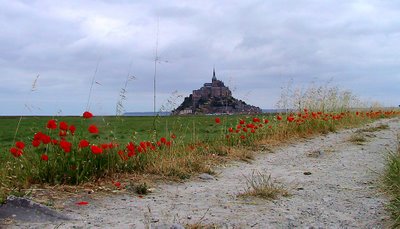 The Mont seen from a dirt road lined with red poppies
We took the little coastal road, the D75, once we got close to the Mont, because we wanted to get good views of the place before we arrived. At one point, to get an unobstructed view from the top of a levee, we stopped the car and walked a few hundred yards down a gravel road to reach what we thought would be the edge of the mudflats. We got the panorama, but we were surprised to find not mudflats but a pasture full of grazing sheep on the other side of the levee.
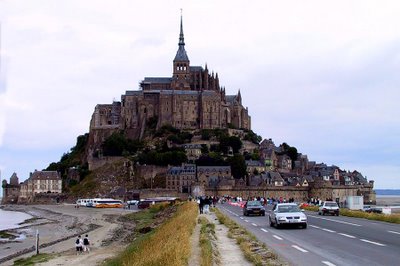 View of the Mont from the causeway connecting it to the mainland
The bay has silted up considerably over the past 150 years of so, and the Mont is now just barely an island. A government-sponsored project to return the bay to its original state is in the works. The causeway that prevents seawater from flowing around all sides of the Mont will be removed and replaced by a bridge. The hope is that the flowing water will wash all the accumulated sand back into the ocean.
 The mudflats north of the Mont at low tide
Of course, some wise guy said global warming should take care of the silting problem whether the government undertakes this project or not!
When you get to the Mont and enter into the old town through big stone archway, the first thing you see is the most famous restaurant on the island, La Mère Poulard. The local specialty is the omelet, a concoction of beaten eggs that resembles a soufflé more than it does the standard French omelet. We didn't have one. I think the plain omelet at La Mère Poulard listed at about 20 euros -- that's 25 dollars in U.S. money. Obviously, the restaurant is trading on its reputation. An omelet served with fricasseed lobster for 48 euros (nearly $65), or an omelet served with foie gras and mushrooms for 45 euros.
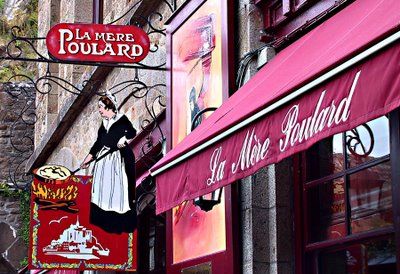 Famous for its omelets
The other thing you notice when you enter through the archway onto the Mont's narrow streets is the crowd. The place was mobbed at 10:30 on a Tuesday morning in June. I can't even imagine what it is like in July or August, or on a Saturday or Sunday during high season.
We walked around a little, but by 11:30 Walt and I decided it might be a good idea to sit down and have lunch before everybody else on the island decided to do the same thing. We had intended to have an omelet, but as I said the prices were just too high, especially considering that we can buy a carton of 10 eggs for 75 eurocents at the supermarket and easily make a good omelet at home.
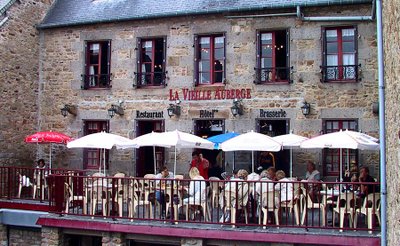 Outdoor dining at La Vieille Auberge on the Mont Saint-Michel
We looked at menus posted in front of some other restaurants and the offerings at a place called La Vieille Auberge (The Old Inn) appealed to us. It was early, so the place wasn't crowded. The restaurant had an outdoor seating area, and the weather was getting warm enough to make that attractive.
 I took this close-up of our waiter when he wasn't looking
Sue decided she wanted to go shopping instead of eating lunch, so it was just me and Walt. We each ordered an assiette de crudités (raw vegetables with vinaigrette dressing) and a serving of moules à la crème avec frites (steamed mussels in a cream sauce, served with fried potatoes). We had a bottle of the house white wine, which was, I think, a Sauvignon Blanc from Touraine (where Saint-Aignan is located). The mussels were plump and tender in their shells, the cream was rich and tasty, and there were just a few French-fried potatoes to fill out the meal. The bill for all that and coffee came to about fifty euros. And it was all delicious. We spent about an hour and a half at the table, enjoying the people-watching and the food.
Both before and after lunch, as we were strolling along the old walkways around the edges of the island, we saw many groups of people out walking on the mudflats. Some were couples or groups of three or four, but several were larger groups of young people. They were probably school groups with teachers and guides.
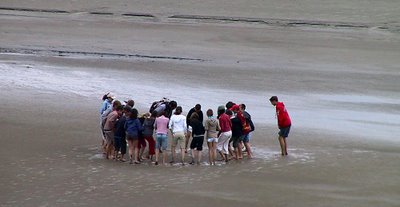 A group of young people who seem to be trying to stamp on the sand
until it starts to turn into quicksand
The flats surrounding the Mont are famous for their patches of quicksand, and it is always advisable to go out with with a knowledgeable guide.
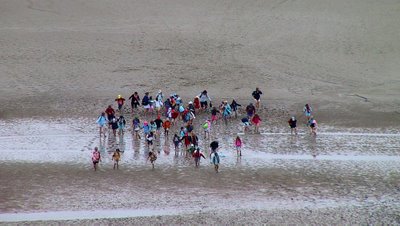 This group is crossing a low spot that will turn into a channel
of water when the tide comes in
High tide was at 1:30 p.m. the day we were there, and we were able to watch the waters rise over the course of the day.
 These people on the island's walkways are watching the tide come in
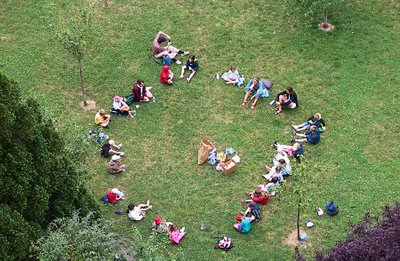 These people are having a picnic in a grassy field on the lower part of the island
We plan to go back soon, but during the winter when there are fewer busloads of people on the Mont. We'd like to stay in a hotel on the island itself, not on the mainland, and be able to wander the streets early in the morning and late in the evening, when no one is around.
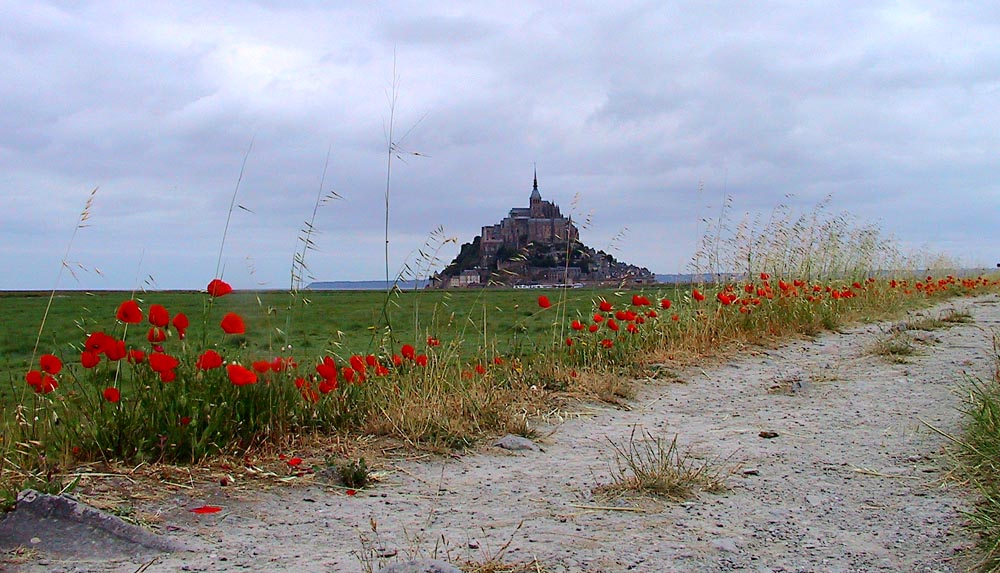 The Mont seen from a dirt road lined with red poppies
So the Mont Saint-Michel trip is fading into memory. We left Domfront by car that June 20 morning and drove the hour or so it took to get to the coast. There wasn't much traffic, and the weather was gray and cool. We even ran through one rain shower on the way to our destination, I remember. The countryside was very green.
 Sheep grazing in the salty meadows that now line the coast near the Mont
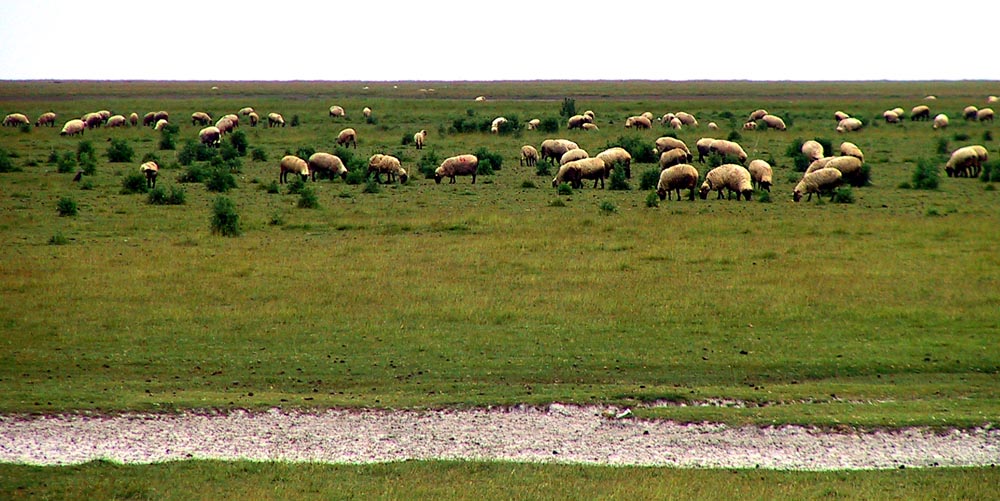 Sheep grazing in the salty meadows that now line the coast near the Mont
We took the little coastal road, the D75, once we got close to the Mont, because we wanted to get good views of the place before we arrived. At one point, to get an unobstructed view from the top of a levee, we stopped the car and walked a few hundred yards down a gravel road to reach what we thought would be the edge of the mudflats. We got the panorama, but we were surprised to find not mudflats but a pasture full of grazing sheep on the other side of the levee.
 View of the Mont from the causeway connecting it to the mainland
The bay has silted up considerably over the past 150 years of so, and the Mont is now just barely an island. A government-sponsored project to return the bay to its original state is in the works. The causeway that prevents seawater from flowing around all sides of the Mont will be removed and replaced by a bridge. The hope is that the flowing water will wash all the accumulated sand back into the ocean.
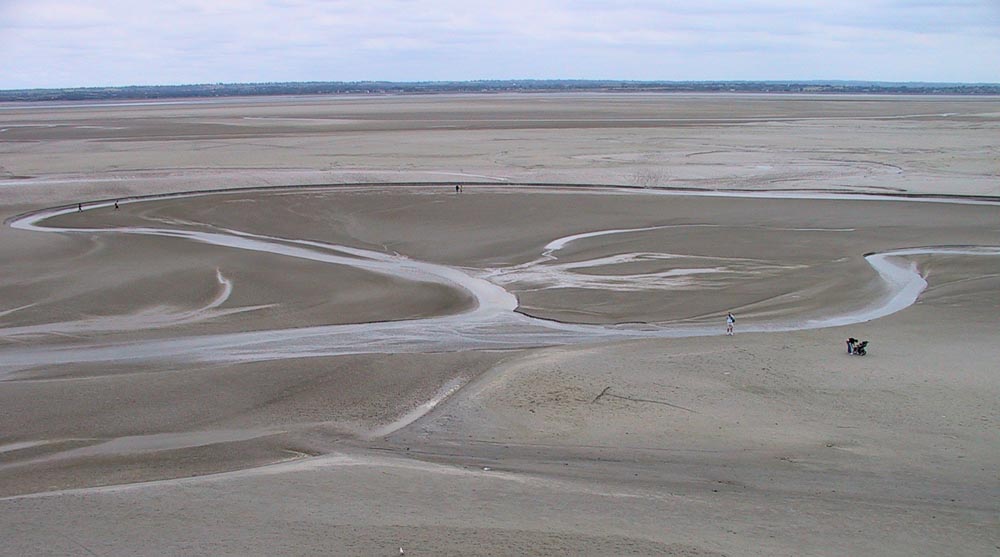 The mudflats north of the Mont at low tide
Of course, some wise guy said global warming should take care of the silting problem whether the government undertakes this project or not!
When you get to the Mont and enter into the old town through big stone archway, the first thing you see is the most famous restaurant on the island, La Mère Poulard. The local specialty is the omelet, a concoction of beaten eggs that resembles a soufflé more than it does the standard French omelet. We didn't have one. I think the plain omelet at La Mère Poulard listed at about 20 euros -- that's 25 dollars in U.S. money. Obviously, the restaurant is trading on its reputation. An omelet served with fricasseed lobster for 48 euros (nearly $65), or an omelet served with foie gras and mushrooms for 45 euros.
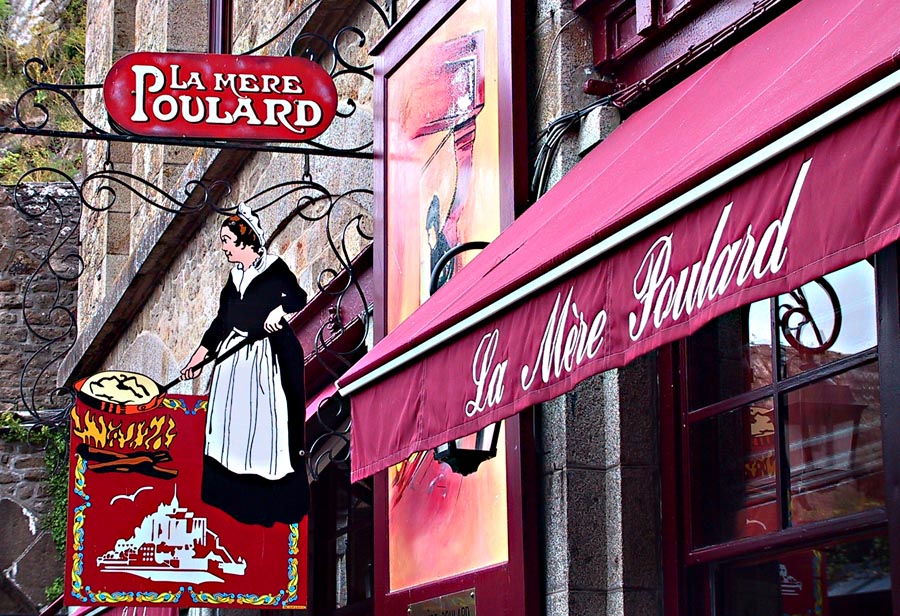 Famous for its omelets
The other thing you notice when you enter through the archway onto the Mont's narrow streets is the crowd. The place was mobbed at 10:30 on a Tuesday morning in June. I can't even imagine what it is like in July or August, or on a Saturday or Sunday during high season.
We walked around a little, but by 11:30 Walt and I decided it might be a good idea to sit down and have lunch before everybody else on the island decided to do the same thing. We had intended to have an omelet, but as I said the prices were just too high, especially considering that we can buy a carton of 10 eggs for 75 eurocents at the supermarket and easily make a good omelet at home.
 Outdoor dining at La Vieille Auberge on the Mont Saint-Michel
We looked at menus posted in front of some other restaurants and the offerings at a place called La Vieille Auberge (The Old Inn) appealed to us. It was early, so the place wasn't crowded. The restaurant had an outdoor seating area, and the weather was getting warm enough to make that attractive.
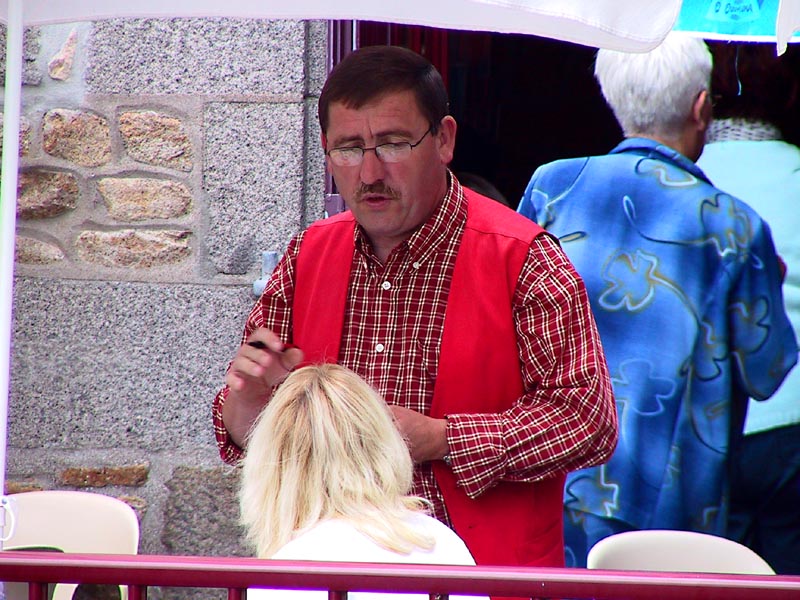 I took this close-up of our waiter when he wasn't looking
Sue decided she wanted to go shopping instead of eating lunch, so it was just me and Walt. We each ordered an assiette de crudités (raw vegetables with vinaigrette dressing) and a serving of moules à la crème avec frites (steamed mussels in a cream sauce, served with fried potatoes). We had a bottle of the house white wine, which was, I think, a Sauvignon Blanc from Touraine (where Saint-Aignan is located). The mussels were plump and tender in their shells, the cream was rich and tasty, and there were just a few French-fried potatoes to fill out the meal. The bill for all that and coffee came to about fifty euros. And it was all delicious. We spent about an hour and a half at the table, enjoying the people-watching and the food.
Both before and after lunch, as we were strolling along the old walkways around the edges of the island, we saw many groups of people out walking on the mudflats. Some were couples or groups of three or four, but several were larger groups of young people. They were probably school groups with teachers and guides.
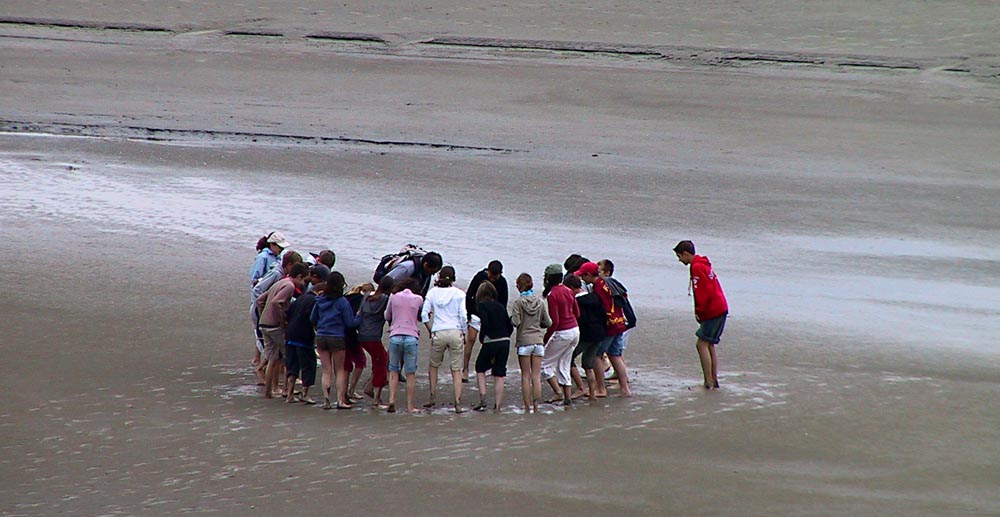 A group of young people who seem to be trying to stamp on the sand
until it starts to turn into quicksand
The flats surrounding the Mont are famous for their patches of quicksand, and it is always advisable to go out with with a knowledgeable guide.
 This group is crossing a low spot that will turn into a channel
of water when the tide comes in
High tide was at 1:30 p.m. the day we were there, and we were able to watch the waters rise over the course of the day.
 These people on the island's walkways are watching the tide come in
After lunch we took the self-guided tour of the old abbey on the top of the Mont. It was built starting in the 11th century, I believe, and is a monastery. Rooms were added on top of rooms over the centuries. It's all quite impressive. Walt has some pictures on his blog.
 These people are having a picnic in a grassy field on the lower part of the island
We plan to go back soon, but during the winter when there are fewer busloads of people on the Mont. We'd like to stay in a hotel on the island itself, not on the mainland, and be able to wander the streets early in the morning and late in the evening, when no one is around.
04 March 2007
Where are you headed?
 Au Mont Saint-Michel en juin 2006
Peter just returned to California after a two-week visit to the Dordogne, the Loir-et-Cher, and Paris. Claude from Paris is headed off to London. Friends who live in Normandy are spending a weekend in Paris with their son. Evelyn just got home from Florida and is starting to plan a trip to France for the summer.
 Le Mont Saint-Michel on the Normandy coast, September 2004
And Ken and Walt are heading off tomorrow for the Mont Saint-Michel for a night or two, with a stop-off in Nantes on the way back to Saint-Aignan. Photography (if the weather cooperates) and seafood are on the agenda. We hope there won't be throngs of people in the steep, narrow streets of the Mont at this season.
 June 2006
Where are you going this spring?
 Sheep grazing on the salt marshes at the Mont Saint-Michel
June 2006
23 April 2020
How and when to visit Rocamadour

Now that I've mentioned Rocamadour, I have to do a post or two about the place. I've been there twice, in pre-digital (I'm talking about photography) 1995 and again in the digital age, in 2006. This is my virtual vacation week, and maybe just sorting through and processing photos turns out to be one of the best ways to see Rocamadour. Avoid the crowds. These are some pictures I took as we arrived there on a very busy tourist day, April 30 (the eve of the big May 1 holiday in France).


So what we did was go back in 2007 in wintertime. It was a trip we took on my birthday in early March that year. We rented a room on the Mont and spent the night — just one, I believe. The weather cooperated, and we pretty much had the place to ourselves, especially after 6 p.m. when the few busloads of tourists had departed for the day. The streets emptied out, and we found a good place for dinner. There were just enough people in the restaurant that it didn't feel deserted and sad, and the food was good.

The next morning, we saw the tide come in and the Mont temporarily become an island. That was one of the moments I wanted to experience. So what if rain was pouring down — you expect that in Normandy. It's atmospheric. If you don't get soaked, or at least pretty damp, you haven't really been there. We then drove back to Saint-Aignan (4 or 5 hours on the road). It was fun.

Maybe it's not fair to compare Rocamadour to the Mont Saint-Michel. Sorry to give you text about one place and photos of the other.
P.S. I just found a web site that lists the 125 famous places France that draw the biggest crowds every year. Eurodisney, the Louvre, and the Eiffel Tower in Paris all top six million visitors annually, with Eurodisney far in the lead. At between one and 1.5 million a year, the Mont Saint-Michel is in the same league as the great cathedral in Reims (Champagne), the Arc de Triomphe in Paris, the American military cemetery at Colleville (near Bayeux and the D-Day beaches in Normandy), and — uh-oh! — the Beauval zoological park in Saint-Aignan, with its giant pandas. Rocamadour doesn't even make the list. So go there if you can. Rocamadour needs your business!
P.S. I just found a web site that lists the 125 famous places France that draw the biggest crowds every year. Eurodisney, the Louvre, and the Eiffel Tower in Paris all top six million visitors annually, with Eurodisney far in the lead. At between one and 1.5 million a year, the Mont Saint-Michel is in the same league as the great cathedral in Reims (Champagne), the Arc de Triomphe in Paris, the American military cemetery at Colleville (near Bayeux and the D-Day beaches in Normandy), and — uh-oh! — the Beauval zoological park in Saint-Aignan, with its giant pandas. Rocamadour doesn't even make the list. So go there if you can. Rocamadour needs your business!
Subscribe to:
Posts (Atom)