Showing posts with label wine. Show all posts

02 September 2007

Grapes and the vendanges

"Black" grapes, either Gamay, Cabernet Franc, or Côt

I wouldn't be surprised to see the grape harvest — les vendanges — start tomorrow. Bruno of the Domaine de la Renaudie told me a couple of weeks ago that harvesting wouldn't start before September 1, but he seemed to think the grapes were close to being ready. It's slightly early, but the weather is nice right now. If it starts raining again, that will be bad for the grapes.

A La Renaudière, 31 August 2007

Don't imagine big groups of workers out in the vineyard picking grapes by hand. Some Touraine grapes are harvested that way, but around Saint-Aignan most of the picking is done mechanically — by machines. The grapes are sort of sucked off the vines in a big vacuuming process.

I wondered if these weren't the Pineau d'Aunis grapes
that they sometimes use to make rosé here in Touraine,
but Walt looked that variety up and said the grapes are
much darker and that it used to be called Chenin Noir.

Bruno and Patricia have told me that harvesting by hand is just too expensive nowadays. Touraine wines, while good, don't command the big prices of the Bordeaux and Burgundy vintages. Grape-growing and wine-making are family businesses here, and mechanical harvesting makes it possible for the members of the family to do all or most of the work.

White wine grapes — either Sauvignon Blanc or Chenin Blanc

I'll be sorry when the grapes are gone, because they are so beautiful to look at and take pictures of. But they will be wine by next May, and that can be nice too!

A tiny spider on a grape leaf

In Friday's San Francisco Chronicle, there was an article about Loire Valley red wines, covering the territory from Saumur, west of Tours, all the way to Sancerre, which is about 150 miles upriver, including Touraine appelations like Bourgueil, Chinon, Amboise, and Cheverny.

22 August 2007

Limiting myself to six...

No, not six French fries or six glasses of wine. I'm talking about pictures. Ones taken with the new camera. The limit is not on taking just six, it means just posting just six. Today.

Yesterday we had a bright sunny afternoon. I took the dog out for a walk in the vineyard about 4:00 p.m.

You can click on the pictures to enlarge them on your screen.

A dog's-eye view of a walk in the vineyard

Even in bright sunlight, using the LCD screen on the back of the camera to frame pictures is okay. It had better be, since the camera has no other viewfinder. Only once or twice did I have a hard time seeing what I was taking a picture of because of bright sun on the screen or too many reflections.

Grapes in autumn colors

Callie was bound to notice the grapes sooner or later. I keep stopping to take pictures of the beautiful clusters hanging off the grape vines. I don't want her to eat any. First of all, the grapes belong to somebody else and will be used to make Touraine wines. And secondly, grapes and raisins can make dogs very sick, according to what I've read.

Did I forget to mention that today is Callie's six-month birthday? She was born February 22.

"What are these things he keeps pointing that silver box at?"

I want you to know what a strict limit six pictures is. I spent about 45 minutes out in the vineyard with the dog and in that amount of time I took... this is embarrassing... 120 pictures. About 25 of those are ones I would consider posting on the blog. There are a lot of near-duplicates in the full batch, where I took extra shots from a slightly different angle or with slightly different camera settings. So it's not a bad as it seems. But still...

More autumn colors: a grape leaf

Obviously, the pictures I take with this camera have good color and clarity. And it is so light to carry around compared to the other camera I used to use on my walks in the vineyard.

When I got back to the house, I looked out the kitchen window and saw that Maryvonne across the street had company. They were sitting outside, enjoying the afternoon sun. I snapped this telephoto picture through the window. I don't think they noticed me taking their picture.

Catching the last rays of afternoon sun

I'm more than happy with the TZ3's zoom, and the macro seems to work well too. The TZ3 is the new Panasonic Lumix digital camera I got last week. It has a 10x zoom.

Our vegetable garden isn't doing great. The weather has been too damp and cold for tomatoes and aubergines. It was raining again during the night, and I think the forecast for today is not good. But we planted a pumpkin patch out back, on top of what used to be the compost pile. We had moved the pile to a different location, and wanted to plant something to fill in that spot.

Pumpkins

I think we are going to have a ton of pumpkins this year. That might seem obvious, since each pumpkin will weigh about a ton when it's fully grown. I see lots of pumpkin soup and pumpkin pies in our future.

Okay, that's it for today.

19 July 2007

Buying and bottling wine

We buy wine in bulk here in the Loire Valley. One of the local winemakers — producteurs in French — told us where to go to buy a few 10-liter plastic jugs. A 10-liter jug holds just over 13 bottles of wine.

Bottling up some red Gamay wine from Saint-Aignan's vineyards

Wine is part of the local diet, and Walt and I do the best we can to fit in with the local population. We've adapted nicely, thank you very much.

When we first arrived, we bought wine in bottles the way we were used to buying it in the U.S., in the supermarket or in a winery. We knew some of the local wineries sold it in bulk, but we weren't sure how complicated the bottling process might be and what kind of equipment we would need.

We had bought bulk wine in Provence once, when we were on vacation. That time we didn't put it in bottles; we just drank it up pretty fast. We figured that even is some of it spoiled, it was a lot cheaper than buying bottles. And more fun.

The first year or so we were here, we saved a lot of wine bottles, assuming we would need them one day. That has worked out very well. We've never had to buy any bottles.

The corking device gets a workout.

When we went to the wine supply store recommended to us, we asked about corks and a corking apparatus. We were very competently counseled and ended up with a corker that works really well. It's a floor-standing model, and it cost only 25.00€. The plastic jugs were about 4.00€ apiece. We figured we would amortize those costs in short order, given the low prices charged locally for wines in bulk (en vrac) compared to wine in the bottle.

Bottling 10 liters of rosé, which I bought for 8.90€ at a winery
in Seigy, a village just east of Saint-Aignan. Yes, that was less than
10.00€ for 10 liters. Dry rosé is a good summertime wine.

Wine goes for anywhere from 1.00€ to 3.00€ per liter when you buy it in bulk. The people at the coops and wineries pump it into your containers out of big stainless-steel tanks, using what looks like a gas pump. At 2.00€ a liter, you are paying 20.00€ (about $27.00 U.S. currently) for 13 bottles of wine, or just over $2.00 a bottle.

Rosé in the bottles, waiting to be corked

The coop up in the wine village called Saint-Romain-sur-Cher, about 5 miles north of Saint-Aignan, sells AOC Gamay, Cabernet Franc, and Sauvignon Blanc wines in bulk for between 1.75 € and 2.25€ a liter. They also sell non-AOC Chardonnay and a non-AOC red blend (called vins de pays, local wines) for about 1.20€. These are light, fruity, drinkable wines that are called vins de soif — wines that quench your thirst.

The wine-and-bottle rack in our pantry

The wines you buy in bulk need to be bottled unless you can drink the whole 10-liter jug in about 48 hours' time. Otherwise, the wine oxidizes and turns into vinegar. A cork adds about 0.05€ to the price of each bottle.

Just by accident, I have found a winery that will sell me wine tax-free, which I'm sure is not exactly legal. I don't ask any questions. That reduces the price by at least 20%. I just have to be careful not to get stopped by the gendarmes or the douaniers (customs agents) on the drive back home from the producteur's place. Please don't tell anybody.

02 July 2007

July: plus ça change...

You'll never guess what the weather is like this morning. It's raining! We just saw a rainbow and then came a sudden downpour. It might have stopped raining for the moment. I see rays of sunlight, but you can't trust the treacherous clouds.

Roses in our garden — there aren't as many
now as there were a month ago.


It rained all day yesterday, off and on. We only got 5 mm, or about 0.2", of moisture, but it rained hard at times, while never for long. It rained lightly for much of the day. It was enough to keep us indoors.

The garden is very green. If you enlarge the picture
by clicking on it, you can see red apples on a tree in the
background, and red cherries on a tree on the right.


You are probably tired of reading about this rainy weather by now. So you can imagine how tired we are of experiencing it.

The rain makes it hard to take Callie out for regular walks, which makes her hyper and antsy. She plays by herself, we try to play with her, and several times a day we make a brief foray out into the garden so that she can pee etc.

Dark clouds gathering over the woods and vines

While our tomato and eggplant plants are growing, they are not producing anything yet. Other plants are doing better. Cherries are amazing this year. All the trees are loaded down with them. Most of them are sour cherries around here.

Wildflowers grow out in the vineyard. The ground looks dry,
but that's because it is very rocky.


We have our own cherry tree out back, behind the garden shed. In the four previous years, we have had practically no cherries from it. And the ones we did have were all pit and almost no flesh.

This year, it is loaded with small but fairly plump cherries. I picked enough to fill a big basket on Saturday because I thought they were good to eat. Walt didn't like them, though — he thought they were bitter. So I made jam out of them yesterday.

Red apples on a tree in our garden

We also have loads of apples on our own trees, and I think we are going to have loads of blackberries on all the land surrounding us. Blackberries here don't grow so vigorously as they did where I grew up in North Carolina or where a good friend lives up the the Sierra foothills of California. They don't seem to invade all the land or take over other plants.

Blackberry blossoms and thorns

But this year the blackberry brambles seem to be full of blossoms. If the weather turns warm, as predictions indicate that it will this week, all the blossoms will turn into berries.

Grapes in bunches in the Renaudie winery's vineyard

As for the vineyard, grapes are coming right along. In the Renaudie winery's vineyard out back, there are Cabernet Franc, Sauvignon Blanc, Chenin Blanc, Gamay, Malbec (called Côt here), and Pineau d'Aunis grapes.

These grapes look like they are starting to turn red.

I can't tell the difference between any of them except in the broad categories of white and red, as in the wines they produce. And I can't tell that until the grapes actually start to turn color. They are all green at the beginning.

Our house from out by the pond

Yesterday I cooked fresh spinach and fresh mushrooms. We thawed out a container of tomato sauce that we had made last fall. Walt sliced up some mozzarella and made dough for a pizza crust. Instead of pizzas, he made two calzones. That was a good way to spend a rainy Sunday.

21 June 2007

The last day of springtime

Now that the dog likes to go for long walks in the vineyard out back — or at least is willing to do so — the plan is for me to take her on one walk a day, and Walt on another. We want to keep her tired out!
Remember, you can click on any picture to see an enlargement.

The gravel road runs out into the vineyards that are part of
the Domaine de la Renaudie winery, run by the Denis family.


Seriously, the exercise will be good for all of us. Now if the weather will just improve a little so that we can enjoy the walks without having Callie stop for mud baths in big puddles along the way, we'll be in good shape.

The silver lining in the weather situation is that we are enjoying very dramatic skyscapes these days. The gravel road through the vineyard runs westward away from the house, and there isn't much to obstruct the view of the western sky. Our weather usually comes in from the west or southwest, off the Atlantic, the Pyrenees, and the Iberian peninsula, this time of year.

The big sky out over the rise, looking north

I just heard on the radio that the South of France — Provence, specifically — is having very hot weather and a pollution alert today. People are being asked not to do strenuous work outside or to jog or do other vigorous exercise. The air isn't good.

France is divided in half by air masses right now. The hot South is sitting under an upsurge of stagnant hot air coming off the Sahara. The north is plagued by unstable, humid air coming in off Spain and southerly regions of the Atlantic Ocean.

It's been showery with fairly frequent bolts of lightning and claps of thunder for a couple of weeks now. But breezes are keeping the air fresh-feeling most of the time.

The western sky looked stormy yesterday afternoon.

Yesterday it was warm and muggy. It didn't rain at all. But at 2:45 this morning, I was awakened by heavy rainfall. We have a plexiglass awning over our back door, which is just below the bedroom window, and heavy raindrops really set up a clatter when they fall on it. It poured rain for 10 or 15 minutes, it seemed to me, but then I was drifting back off to sleep by then.

I checked the rain gauge when I took Callie out at 6:15 this morning. We got just 2 mm, hardly a trace, of water from the early morning shower. To think that about 10 days ago we had a storm that dropped 35 mm of rain in less than 90 minutes. No wonder our roof sprang a temporary leak in that deluge.

Looking out over the rows of vines from
the edge of the surrounding woods


Yesterday afternoon when I took Callie out she stayed out of the puddles. Actually, I avoided walking close to any puddles by taking her around the periphery of the vineyard, along the edge of the woods, on the way out. She prefers that anyway; for some reason she doesn't like to walk away from the house on the gravel road.

The paved road a mile from the house is designated as
a route touristique through the Touraine vineyards.


When our path along the periphery took us back to the gravel road, about half a mile from home, Callie wanted to turn back. But I kept walking farther out, stopping frequently and calling her as I went. She would stop and sit and watch me for a while, but when I squatted down and called her she would come running to me, all squirmy if you know what I mean. We did another quarter of a mile in that mode.

The Domaine de la Renaudie vineyards

That's when we arrived at the paved road. A car went by just as we got there, and that scared Callie. So I put the leash on her, attaching it to her harness, not her collar. We walked east on the pavement for a couple of hundred yards with her on the leash. Another car came by (such traffic!) and Callie and I stepped a few feet off the road and just watched it go by. She needs to get used to cars.

Callie, 20 June 2007, looking fine in her harness

Then we walked along a line of trees and down a row of vines to get back to the gravel road for the return home. She likes that part of the walk the best. She was way out ahead of me on the leash. I was able to keep her out of the puddles; she wasn't even too interested in them, focused as she was on getting back to her home territory. This time she didn't need to be hosed down when she got home.

Today is the first day of summer. So far, it doesn't really feel like it. Predictions are for more cool, breezy weather next week.

17 June 2007

Talking with le père Denis

We had a pretty nice day in Saint-Aignan yesterday, though it wasn't particularly warm, and there were times when it got pretty windy. It didn't rain — that's what makes me say it was pretty nice. On the radio they're saying another front is moving in off the ocean this morning, so we can expect rain this afternoon. So what else is new?

Despite the rain and cool temperatures,
daisies are starting to bloom in the yard


I took Callie out for a walk in the late afternoon; I'm trying to make a habit out of doing that. We had walked out just a few hundred yards and were approaching the little cabane de vigneron — the vineyard workers' shed. These little stone buildings are used nowadays exclusively for tool and equipment storage, but in the past they were a place to spend the night instead of walking all the way back home and returning early the next day to continue working in the vines. I noticed a white car parked next to the cabane.

What to you suppose these gendarme bugs are up to?

Then off to the right, on a tractor trail that runs diagonally off the gravel road, I saw an older gentlemen dressed in blue work clothes and accompanied by two dogs. I waved bonjour his way and planned to walk on by with Callie, who was trotting along right next to me. Then I saw the man's two dogs running toward me at full speed. Uh-oh.

Callie saw them too and turned a ran at full speed herself, down a row of grape vines back toward our back gate. She was headed home. One of the man's two dogs was right behind her, but the other one stopped and stayed near me. I turned around and walked down a row toward the back gate too, figuring I would find Callie sitting there waiting to be let into the yard.

A fading rose in a neighbor's yard

When I got to the end of the long row and could see the back gate, there was no Callie in sight. Then I saw the man in blue waving at me, telling me that Callie had come back to him with his dog. So I walked back around the pond and up the gravel road to where I had started.

The man turned out to be Monsieur Denis, who owns all the vineyards out back. He is more or less retired now and his son Bruno operates the winery, along with his wife Patricia. They must be in their mid-40s. We know them and buy wine from them. This is not the first time I have seen the senior M. Denis out in the vineyard over these past four years.

Our friend Gisèle gave us a cutting off her begonia a couple
of years ago. This summer it is thriving on the front porch.
The drooping clusters of pink flowers are beautiful.

In fact, one day in January or February 2006 I was walking Collette out there and we stopped and said hello to M. Denis. He asked me what kind of dog Collette was, and I told him she was a Sheltie-mix SPCA dog that we had brought with us from California.

A few weeks later, Collette had a stroke and died. It was mid-March. Before long, I ran into M. Denis in the vineyard again, on one of the times when I tried to go for a walk by myself out there.

« Où est votre chienne ? » M. Denis asked. Where's your dog?

« Elle est morte au mois de mars, » I told him, « elle avait 14 ans. » She died in March at the age of 14. Oh, he said, I see. That was the extent of the conversation.

Walt transplanted some cala lilies earlier in the spring.
They enjoy the rainy, cool weather we've been having.


Yesterday M. Denis and I stood and talked a lot longer, while the dogs played. I told him Callie was not yet four months old, and he said one of his two dogs was just five months old itself. The other one is 11 years old. She's a basset hound or beagle, I would guess, and the younger one is the kind of spaniel, maybe a Brittany spaniel, that they use for hunting around here. M. Denis said it was the first time he had brought his puppy out into the vineyard to run around.

He said his work in the vineyard was finished for the season. He told me what it was he had done to the vines, but he used a technical term that went right by me. Then he said he couldn't very well get the the workers' way or do their work for them, so he was off for the summer. I got the distinct impression he wasn't too happy about the situation, but I could just hear his son telling him to take it easy and not try to do so much.

I asked him if the five-month-old puppy was a replacement for one of Bruno and Patricia's dogs, which I knew had been run over by a car last year. It was very traumatic for their children, Bruno had told me. No, M. Denis said, this puppy was his. But Bruno had taken another puppy from the same litter, so now his family had a new dog too. Both the Denis men are hunters.

Part of the Denis' vineyard

I told him that Callie is a border collie. « Ça chasse, ces chiens-là ? » he asked. Will she hunt? No, I told him, border collies are sheep dogs. I told him some friends had suggested we get a couple of sheep for the back yard so Callie would have an occupation, and he just laughed. He said he had had to put up an electric fence around his vegetable garden to keep the dogs from going in and breaking down all the plants — « ils allaient tout casser, » he said — but with sheep it would be even worse.

Grapes are starting to grow.

He said he'd noticed that his dogs were afraid of the wires the grape vines are strung along out in the vineyard, because they apparently thought those wires were electrified like the ones he had strung around his garden. He thought that was funny. « Chat échaudé, vous savez... » I told him, referring to the French version of the proverb that says "once burned, twice shy." He nodded and said that must be it.

After a few minutes he put his dogs in his little white van and headed for home, but not before Callie and the puppy jumped all over him and almost knocked him over. I was afraid I was going to have to pick him up off the ground, but there wasn't much I could do to keep the dogs off him and he didn't really seem to mind.

Callie after her afternoon mud bath

After he left, Callie headed straight for a big pool of standing water and did a repeat of her water-slapping act the day before. We walked on a ways, with me hoping she would dry out and rid herself of the sand and mud stuck in her fur. But I still had to wash her down when we got home, before I could let her back in the house.

27 February 2007

Dinner at L'Hôtel du Cheval Blanc in Bléré

Last Saturday night, Peter Hertzmann invited us to have dinner with him at a nice restaurant. He wanted to have a meal at the Lion d'Or (two Michelin stars out of three possible) in Romorantin, but when I called I was told the restaurant was closed for the season. Peter has eaten there before — the chef is a friend of a chef Peter has worked with in the past — and Walt and I had dinner there once as well, on a separate occasion.

We looked at the Guide Michelin web site for comparable restaurants in our area that might be possibilities. Walt and I have been to a couple, thanks to friends, including Le Rendez-Vous des Pêcheurs (one star) in Blois, Le Domaine des Hauts-de-Loire (one star) near Onzain, and L'Hôtel du Cheval Blanc (one star) in Bléré. The Michelin site also listed the restaurant run by Bernard Robin (two stars) in Bracieux near Chambord and Le Choiseul (one star) in Amboise.

L'Hôtel du Cheval Blanc in the town of Bléré, near Chenonceaux

Peter told us to choose the restaurant, and we picked the Cheval Blanc in Bléré, where we had had dinner one night the first summer we spent in Saint-Aignan, in 2003. We remembered that it was very good and that the prices there weren't outrageous. The prices listed on the Michelin site for some of the other starred restaurants were much higher, and we didn't want to abuse Peter's hospitality.

So what were the prices like? There were three menus (which are what we call "prix fixe menus" in good American English). For 60 euros, you could have five courses: a starter, fish, meat, cheese, and dessert. For 49 euros, you got four courses by leaving off the starter and "just" having fish, meat, cheese, and dessert. The fish and meat dishes are of course served with vegetables and sauces.

Finally, for 43 euros, you also got four courses: a starter, a choice of meat or fish as a main course, cheese, and dessert. Walt and I went with the 43-euro menu, and I for one am glad I did because it turned out to be more food than I could comfortably eat. Peter ordered à la carte because he didn't want dessert.

Remember that the euro is worth about $1.30 right now, so those three menus would cost $78, $64, and $56 American.

Here's what we ended up eating. While we were waiting for our starters, the server brought us each a plate of what are called amuse-bouches — we'd use the good American English term "hors d'oeuvres" for the same thing. On the plate were:
  • a tiny dish containing a spoonful or two of a sort of broccoli custard. I thought it tasted too strongly of overcooked broccoli, if you know what I mean.
  • a small glass of warm pumpkin purée or soup mixed with a coulis de tomates (a light tomato sauce) and which posed a dilemma — eat it with a spoon or just drink it out of the glass? We ended doing a combination of both. It was tasty and warm.
  • a tiny, very hot dish containing a few mussels (removed from the shell) in a garlic-parsley butter. It was a little salty and greasy for my taste, but I'm being picky when I say that.
  • another small dish containing some slices of slow-cooked chicken gizzards (gésiers confits) topped with some sliced, slow-cooked onions (oignons confits). It was delicious.
Except for the pumpkin-tomato soup, this amounted to about three tablespoons of food. The pumpkin-tomato soup wasn't much more than half a cup. Remember, though, it is not the appetizer but just a little something to tickle your tastebuds while you are waiting for the meal to begin.

As a starter or appetizer, Peter and I both had what they called un gratin d'huîtres, or oysters au gratin. It was a kind of very creamy soup with about half a dozen raw oysters floating in it. It was more like an oyster bisque than a gratin. There was a well-cooked julienne of leeks floating in the soup, which resembled a crème anglaise (a fairly liquid egg custard) but was savory (or salty) and not sweet. The dish had been set under a very hot broiler (called a salamander) for a couple of minutes so it was slightly golden on top.

Walt had a starter of langoustines, or prawns ("Dublin Bay prawns," to be specific), removed from their shells, cooked, and dressed with a light cream sauce, if I remember correctly. Since I was concentrating on my own appetizer plate, only Walt can give us more details about what he ate.

As a main course, I had a fillet of sandre, which is a European freshwater fish sometimes called "zander" or "pikeperch" in English, served in a creamy sauce. On the plate there was also a little ramekin containing a few sliced scallops cooked under the broiler. There must have been some vegetables, but the only one I remember was a little spoonful of cooked spinach.

As his main course, Walt had what the menu called médaillons de bar, which weren't medallions at all but which looked delicious. Bar is sea bass. The fish looked grilled, and there were vegetables on the plate. Peter had veal sweetbreads — ris de veau — but I couldn't see his plate very well from across the big round table so I can't describe it further. Peter did say it was the best meal he had had during his 10-day stay in France. He was in the Dordogne before coming to see us here in the Loire Valley.

To wash all this down, we ordered a bottle of Quincy wine. Quincy is a small grape-growing area about 25 miles east of Saint-Aignan, near the bigger town of Vierzon. Only white wines made from the Sauvignon Blanc grape are produced in Quincy, and ours was a 2005. When the time came to order a second bottle (twist my arm!), we chose a Reuilly. Reuilly is another small wine region and is adjacent to Quincy. The wines are also Sauvignon Blanc, and ours was a 2004. Both the wines, meant to be drunk young (the wines, not the drinkers) were delicious. The Reuilly was fruitier, and the Quincy was slightly more acidic.

There were two choices when it came to the cheese course. You could select samples of three or four cheeses off the restaurant's copious cheese cart, or you could order a salade de chèvre chaud — a mixed lettuce salad in vinaigrette served with two little rounds of bread with slices of goat cheese on them, slightly melted and browned under the broiler. I had the salad but I couldn't eat all of the cheese toasts. Peter had the same salad, and Walt had three pieces of cheese off the cart.

And dessert was still to come! I really wasn't hungry any more, but dessert was part of the menu I had ordered. There must have been a dozen desserts to choose from. I ended up ordering grilled pineapple slices with a scoop of mango sorbet served with two little macaroon cookies. I ate some pineapple and tasted the sorbet, but I didn't touch the macaroons. Walt had an assiette de sorbets, a selection of three fruit-flavored sorbet concoctions, which he said was very good. Peter skipped dessert.

I should mention that the desserts at the Cheval Blanc are served under what the chef calls a "gold dome". It's not gold but a few "threads" of hard, golden caramel shaped into a dome by dribbling the caramel over the outside of a bowl. You'd have to see it to imagine what it looks like, and I didn't take pictures. It's more of a gimmick than anything else.

We had coffee. We drove home. It had been pouring rain when we arrived, and it was still raining when we left. The drive takes about half an hour.

On the way home, Peter said he could see why the restaurant had only one Michelin star and not two, even though the food was very good. The service was a little rough. Our server was a young woman who had to take care of six tables simultaneously — at least 20 people in all. She was stretched to the limit, although she did have some help from the kitchen when it came to bringing dishes out to the tables.

All the customers in our dining room (which was one of two) appeared to be French, with the exception of us and a British couple at a table across the room. The British gentleman spoke French but I could hear his accent.

The restaurant's glassware was fairly crude by Michelin standards, Peter pointed out, and the flatware wasn't perfectly matched. One table knife, in particular, had been damaged; it looked as if somebody had tried to open a can with it. Before the main course came, the server laid out new silver, and by mistake she put the fish knives and fork at Peter's place and the silver that went with his food at mine. We had to point it out to her. She also dropped something on the floor at one point.

All those "defects" and errors would keep the Michelin inspectors from giving a restaurant a second star, even if the food was out of this world. And it was very good.

24 January 2007

Wine by the hour

I'm watching a show on TV called "La Route des Vins" and it's about Paris back in the days before World War II.

One old guy was just telling about his father's business selling wine, other farm products, and farm supplies and equipment. He said his father sold "wine by the hour" -- il vendait le vin à l'heure. People would bring their sandwich or their picnic food and then pay a set fee for the right to drink as much as they wanted for, say, an hour, or two.

Then they would curl up under a table or in a corner and take a nice nap.

Those days are long past, I guess.

05 January 2007

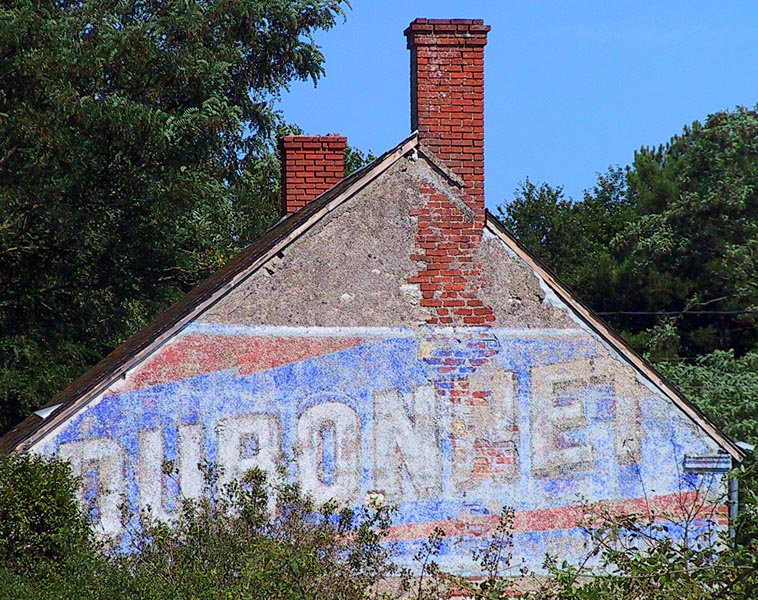
Du Bo... Du Bon... Dubonnet

In a comment on an earlier post of mine featuring ghost signs, Claude reminded me of the signs you used to see in the subway tunnels of the Paris métro — DU BO... DU BON... DUBONNET. I remember those well from the 1970s. Look at this picture, and this one.

Here's one I found on the web. This is not wall advertising, however (que je sache).

There are at least two Dubonnet signs around Saint-Aignan. This one is on the road to Selles-sur-Cher, on the N76, not far from the Suze sign I posted earlier. The sign is nearly hidden by bushes that are growing out of control near the old house.

As seen in July 2004 on the N76 between Saint-Aignan and Selles-sur-Cher
The article in the Loir & Cher Info publication that inspired me to post these pictures of old signs says that wall advertising was banned outside of built-up areas starting in 1936! So these signs must all be about 75 years old.

« Puis, en 1943, la surface de l'affiche est limitée à 16 m2 avec un message bref, sans illustration, au nom de la marque, » the article says. Well, the Dubonnet signs seem to respect at least some of those rules. Here's a close-up of the one pictured above.

Dubonnet, like Suze, is an apéritif wine, also called un vin cuit or
"cooked" wine. We would call it a fortified wine.

So what is Dubonnet? The tag lines on the ads say it is a Vin tonique au quinquina, or Vin de liqueur au quinquina. The French quinquina is related to the word quinine in English, and one dictionary says a vin au quinquina is a quinine tonic wine in English. Quinine or quinquina is a extract derived from the bark of the cinchona tree. I guess that's the derivation of the name of that other famous apéritif wine, Cinzano.

A tonic has medicinal qualities. It also stimulates the appetite. That's the point of drinking an apéritif before lunch or dinner. Such wines, including Dubonnet, Martini & Rossi, St-Raphaël, Campari, Suze, and Cinzano, are syrupy and bitter-sweet.

Here's another Dubonnet wall sign. This one is in the town of Selles-sur-Cher, about 10 miles upriver from Saint-Aignan. There's a big outdoor market in Selles on Thursday mornings.

Photo prise à Selles-sur-Cher en juin 2006

30 December 2006

Suze

This post is for Mimi. And Jerry. Mimi will know why. I don't know if they read my blog these days, but I hope they do.

Happy New Year!

It's the last day of 2006. Let's hope for nothing but the best in 2007.

Ghost ad for the apéritif wine called Suze

On the main highway that leads east from the Saint-Aignan area over to Romorantin and Vierzon, there's this old wall ad for Suze. Suze is a before-dinner drink, an appetite stimulant supposedly, that is made from the gentian plant. Before-dinner drinks are called apéritifs.

About gentian, the American Heritage Dictionary says:
gen·tian n. 1. Any of numerous plants of the genus Gentiana, characteristically having showy, variously colored flowers. 2. The dried rhizome and roots of a yellow-flowered European gentian, G. lutea, sometimes used as a tonic.

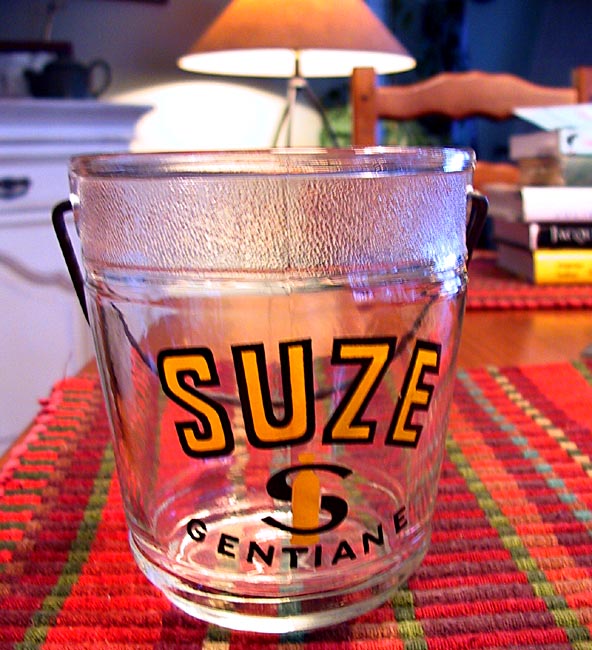
A Suze ice bucket that I bought in Laon in 1994

According to the official Suze web site, Suze-style gentiane drinks were made as early as 1795, but it was in 1889, the centennial of the French Revolution, when the name Suze was created. That same year, the Eiffel Tower opened to the public.

A close-up shot of the wall sign on the N76 highway near Saint-Aignan

* * * * *

Correction and addendum to yesterday's post about the house across from us at La Renaudière. It is not being sold. The son and daughter of Mme Simonnet are having it appraised for other reasons. I imagine they will inherit it 50/50 and they want to know the value in case one of them wants to buy the other's stake in the place.

17 November 2006

Les vins nouveaux sont arrivés !

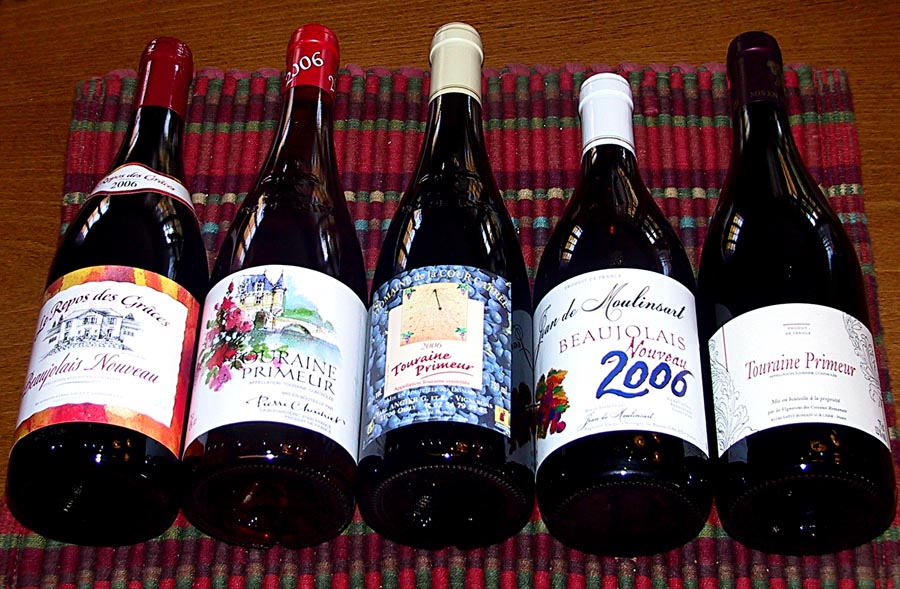
The third Thursday in November is the day the Beaujolais Nouveau (or Primeur) wines are released. You can probably already find Beaujolais Nouveau in most wine stores and even many supermarkets in the U.S. today.

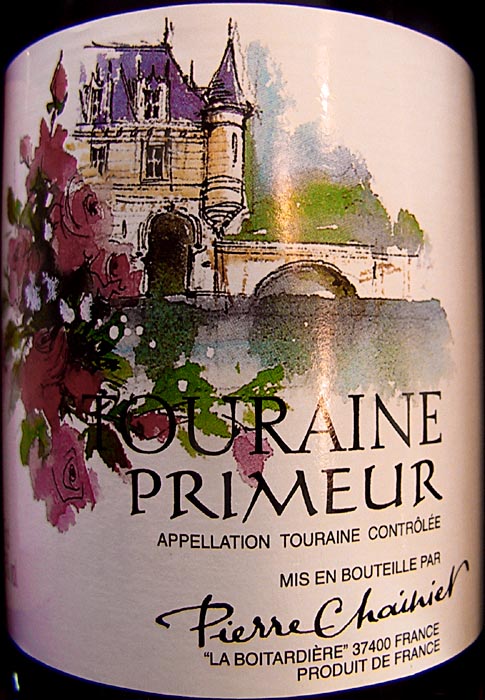
Click the picture to enlarge it so you can read the labels.

Here in France, other wines and regions have been getting into the act as well. The best known "new" wine after Beaujolais is probably Touraine Nouveau. Touraine is our region, and the primary red wine grape grown here is Gamay, just as it is in Beaujolais. So it makes sense.

Gamay from the Beaujolais region

Today at the big SuperU market in Contres, the new wines had a place of honor in the front of the store. And there we saw not only Beaujolais Nouveau and Touraine Primeur, but Côtes du Rhone Primeur and — surprisingly, because it's a white wine — Muscadet Nouveau.

Gamay from the Touraine region

We bought a selection of these young wines to try over the coming weekend. It doesn't take much to convince us to buy a new wine!