Showing posts sorted by date for query haricots verts. Sort by relevance Show all posts

06 October 2025

Pork and beans

This might not be what you think of when you hear the name "pork and beans." As I said yesterday, I made pulled pork over the weekend. On Saturday, I cooked a very lean 2.5 lb. pork shoulder roast for 8 hours in the slow cooker, with a lot of spices and about half a cup of vinegar. When the meat was tender, I took it out of the cooker and let it cool overnight. I warmed it up just slightly yesterday morning and pulled or shredded it. In French, this is called un rôti de porc effiloché. You could do the same thing with turkey legs, discarding the bones, cartilege, and skin. Just below, you can see what the pulled pork looked like.


I had found some haricots plats (Romano green beans) at the supermarket for the first time in a while. They are a variety of haricots verts (green or string beans) and I like them a lot. You could substitute other green beans or even a different green vegetable.

After trimming the beans and blanching (par-boiling) them, I melted some duck fat (you could use butter, vegetable oil, or some other fat) in a frying pan and heated up the beans and some pulled pork in it.

To round out the meal, instead of cooking pasta or potatoes, for example, we decided to make a pan of corn pone to have with the pork and beans. That's a style of corn bread. It all went together very well, I think.

25 March 2025

Quick and easy lunch (or dinner)

Yesterday or the day before an e-mail from the Food section of the New York Times landed in my Gmail account. It was about beans, and what a good and easy product they are to use — especially out of a can. It gave a lot of ideas for dressing up the idiomatic "pot of beans" to make them more appetizing.


I took inspiration from that article and opened up a can of white beans (often called cannelini in the U.S. or lingots in France). I decided to flavor them with dried herbs — oregano, chives, etc. — that I soaked in warm water for a few minutes before adding them and the soaking water to the beans. I also put in some diced shallot, garlic, and bell peppers that I sweated in olive oil, and a couple of bay leaves. We enjoyed them with some smoked chicken that I bought at the supermarket.


Beans that are sold in cans are already cooked. You don't have to soak or cook them at all, unless you want to add some aromatic ingredients the way I did. The flavor and texture of beans (except haricots verts) don't seem to be altered by the canning process, so they taste the same as dried beans that you soak and cook yourself. Actually, the ingredients listed on the label of the canned beans I buy are just eau (water), haricots blancs secs trempés (dried white beans, soaked), sel (salt), and arôme naturel d'ail (natural garlic flavoring). (I wonder what that last ingredient is all about.)

24 November 2023

Le gigot de novembre 2023


The gigot ready for the oven... I mixed thyme, chives, black pepper, salt, allspice powder, and hot smoked paprika into some olive oil, let it sit for an hour or so, and then brushed the mixture onto the top side of the gigot. I also put some garlic and shallots in the bottom of the roasting pan and poured in some dry white wine and water.


Here's how it came out of the oven. I roasted it in a hot oven (400ºF) for half an hour, and then turned the oven down to 350ºF for another 40 minutes. Finally, I turned the oven off and let the gigot rest inside with the door slightly open. And my fingers crossed.


Here's what it looked like when we started carving it. It came out rare or at least medium rare. Today we'll eat slices of lamb and boiled potatoes with home-made mayonnaise, followed by a green salad with vinaigrette dressing.


Yesterday's was a very simple meal, actually. We cut thin slices of lamb and enjoyed them with haricots flageolets and haricot verts flavored with some of the lamb drippings, along with some good bread and wine. Notice that these were slices from close to the outside of the leg so they're not as rare as the lamb we'll have today.

21 November 2022

Wok de poulet et pois gourmands

That would be a stir-fry of chicken and snow peas. Plus other vegetables: onion, carrot, mushrooms, sweet peppers, etc. We made it as a Thai stir-fry by seasoning it with Thai fish sauce and Thai chili paste with holy basil leaves.


We've been very happy recently to find fresh snow peas in our two Saint-Aignan supermarkets. We are also still getting very nice haricots verts. Today's menu: osso bucco à la milanaise.

11 November 2022

Haricots verts en provenance du Maroc

I'm finding really nice haricots verts in one of our local supermarkets these day. The beans come from Morocco and are not expensive (about two dollars a pound). They must be having a good fall season down there. Northern Morocco is more than a thousand miles south of Paris, and 900 miles south of Saint-Aignan.


I like to cook vegetables like green beans, broccoli, cauliflower, and potatoes in a steamer pot before incorporating them into a stew or a casserole (un gratin).


In this case, I steamed a batch of green beans. I had a half dozen small potatoes in the fridge that I had steamed a couple of days earlier. I browned the potatoes in a frying pan and I made a curry sauce using a jar of Ayam brand curry paste and a 20cl container of coconut milk. Then I added the steamed beans and potatoes to the sauce.

Walt cooked a couple of chicken leg-and-thigh pieces (cuisses de poulet) low and slow on the barbecue grill. The curry sauce was good with the chicken and the vegetables.

07 July 2022

Couscous for guests and for us

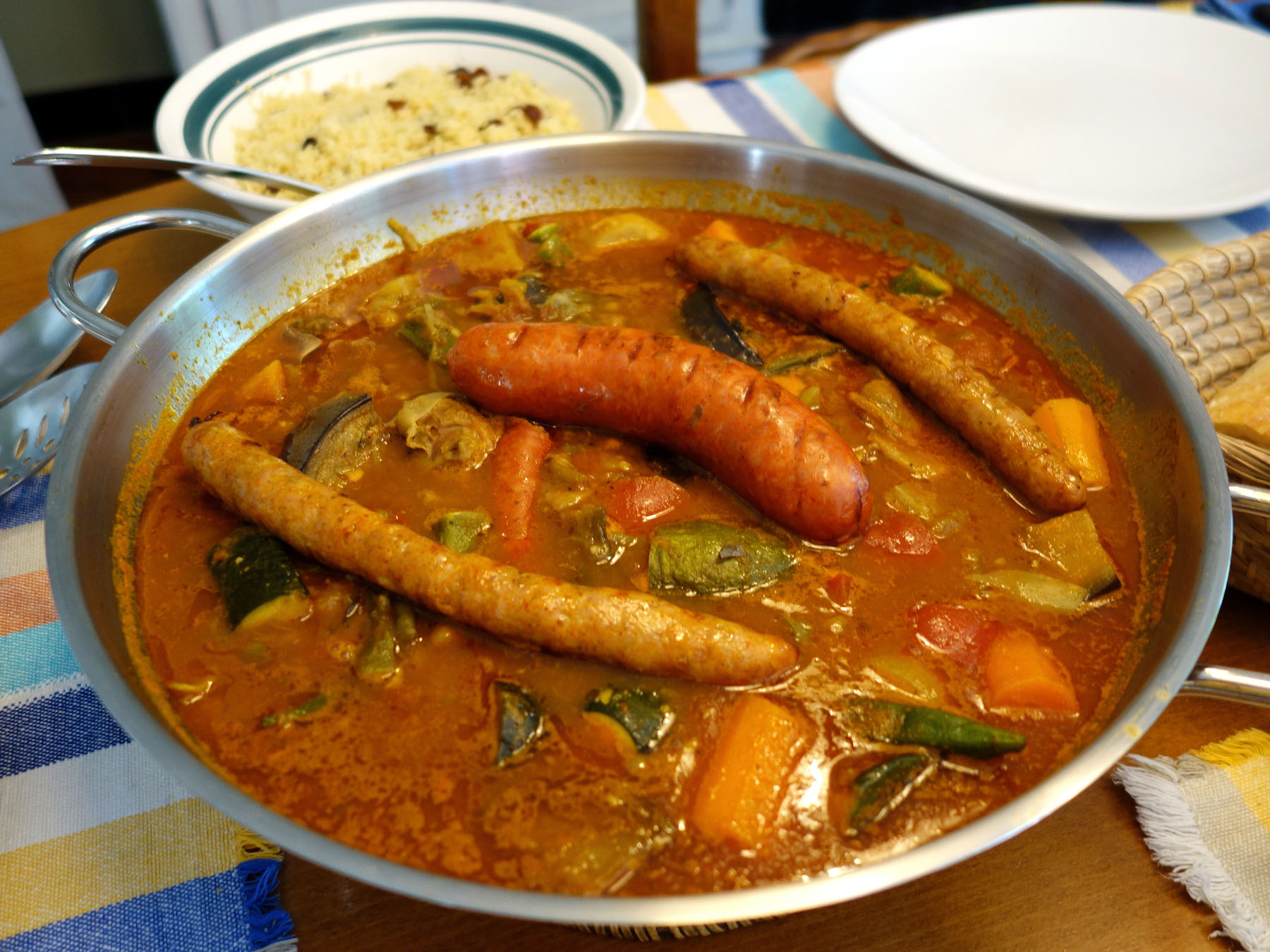
Tomatoes. Carrots. Turnips. Zucchini. Eggplant. Bell peppers. Haricots verts. Chickpeas. Onion. Okra. Lamb. Chicken. Grilled sausages. That's couscous, flavored with North African spices, a kind of curry powder. And served with couscous "grain" cooked with raisins. I made couscous and we had two meals of it (Thurs. and Sat.) while Jill and Peter were here.

Then Walt and I had couscous again on Tuesday. When Walt went to the butcher's shop to buy some more
merguez (lamb + beef) sausages, there weren't any to be had. So he bought veal sausages spiced
with Basque country piment d'Espelette as well as a Spanish chorizo. Unconventional, but delicious.

02 January 2022

New Year's black-eyes, duck, and sausages

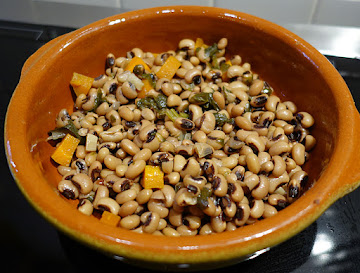
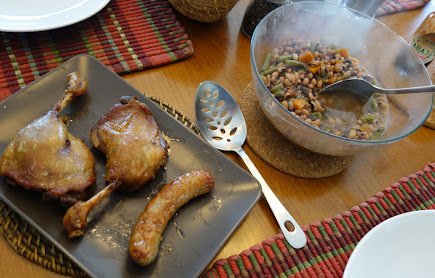
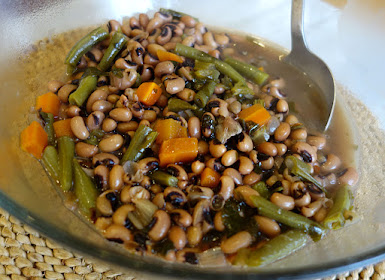
Yesterday I cooked my January 1 black-eyed peas in the slow-cooker for 10 hours. Also in the pot were a carrot,
a long stalk of celery with leaves attached, two big bay leaves, a large shallot, a garlic clove,
three dark-green leek tops, a generous amount of black pepper,
and a tablespoon of crushed hot red pepper.

   
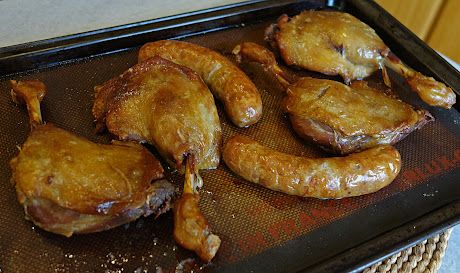
I bought the duck confit (cuisses de canard confites) at the supermarket in sous-vide packaging (vacuum-packed).
Four duck legs cost 10 €. The saucisses de Toulouse were raw, so first I poached them in water.
Then I put the duck legs and sausages on a baking sheet and browned them in a hot oven.

When the beans were cooked, I took out the carrot, shallot, and celery, chopped those up, the put them back in the pot
with the beans. I also put in a handful of cooked green beans cut into 1-inch pieces. For lunch, we each ate
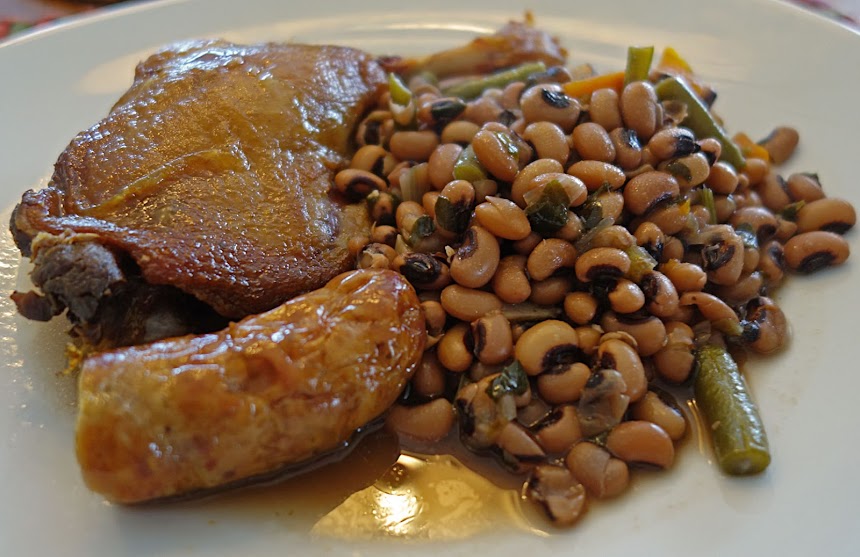
one duck leg-and-thigh piece, half a Toulouse sausage, and a good portion of the black-eyes as described.
We had a nice red Chinon wine (Cabernet Franc) with that.
Some duck fat went into the beans.

    Personally, I really enjoy black-eyed peas. I've eaten them since I was a child. Let me say, though, that I love all beans.
Black, red kidney, white, baby limas, butter, Soissons (giant limas), French flageolets, yellow wax, purple wax,
green beans, haricots verts, lingots blancs, haricots tarbais, cranberry, chickpeas (garbanzos), navy,
crowder peas, field peas, cowpeas, lentils, pink, pinto... which ones have I forgotten?
I'm glad I don't have to choose to eat just one variety of bean to like.
And I eat black-eyed peas year-round, not just on New Year's Day.
I guess I qualify as a lucky guy.

02 August 2021

Moules... et frites...

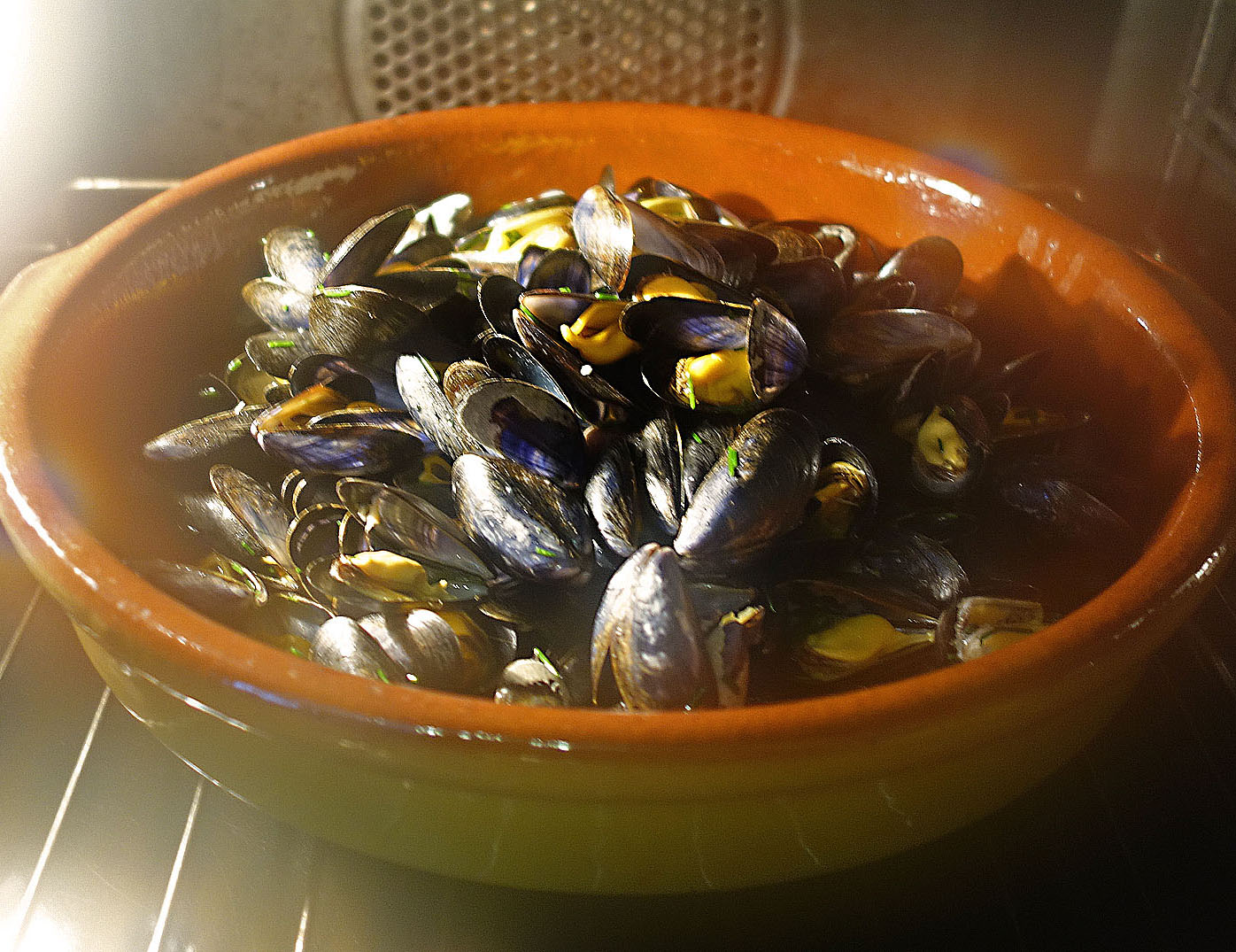
Yesterday's lunch: mussels (moules), French fries (frites), and green beans (haricots verts). Walt had bought a kilogram (2.2 lbs.) of mussels from the fishmonger at the Saturday morning open-air market in Saint-Aignan. I dumped them into a container of fresh, cold water, and then threw out the ones that floated. They were dead and unfit for consumption. Then I put the ones that didn't float in the sink and cleaned them one by one by pulling their "beards" off and scraping off any barnacles I found on the shells. I also threw out any that had broken shells.

1      2

3      4

5      6

We seasoned the mussels with fresh chives and black pepper and then cooked them in about a third of a bottle of dry white wine and three tablespoons of cream (crème fraîche). The cream is optional. There was no need to add salt; the moules are salty enough. They cooked in a pot with a tight-fitting lid for maybe 10 minutes. As soon as the shells open, they're done. Then I put them in a dish in a warm oven to wait while I boiled the creamy cooking liquid down to concentrate it a little. And while Walt cooked some French fries. We had already cooked the green beans. Both the frites and the beans, as well as the moules, were delicious with the creamy sauce. Don't forget the bread.

17 July 2020

Beans and bread


American friends of ours, K & J — they live just five miles upriver, on the other side of St-Aignan from where we live — have a fantastic vegetable garden. It's not only well laid out and tended to, but it's very productive. They have a lot of green beans right now, and they brought us a few pounds of haricots verts this week. I cooked them in a steamer pot and froze more than half of them. I made the ones we ate fresh into haricots verts à l'italienne (recipe), one of my favorite green bean recipes. It's green beans cooked in tomato sauce flavored with onion, garlic, herbs, and olive oil.

There's a good recipe for beans prepared and served this way in The Classic Italian Cookbook (p. 362) by Marcella Hazan.
I normally use this French recipe and it's good with any type of green beans.


I also made another loaf of sandwich bread yesterday. The dough had been in the freezer for a few weeks. It rose beautifully, doubling in volume and becoming foamy and light. I baked it in the Pullman pan I bought a while back. It's a metal loaf pan with a slide-on lid and a non-stick (anti-adhésif) coating on the inside.


Today we'll make croque-monsieur sandwiches (link) with a few slices of this bread. Those are toasted ham and cheese sandwiches that you eat with a knife and fork, and they are staple of French café food.

11 July 2020

Imagine turkey legs slow-cooked in red wine broth...

One standard item in supermarkets and on the outdoor markets all year long in France is the turkey leg. And when I say "leg" I mean the thigh + the drunstick. These are inexpensive and delicious. I'm not sure how widely available they are in the U.S. as a fresh product. I think you can get frozen turkey breasts, smoked turkey wings, and things like that, but are the legs and thighs widely available? Maybe you can ask the supermarket butcher for the legs.


I like to cook them in the slow cooker on low for as long as 12 hours. The one pictured above and below was one of three that I put into our six-liter mijoteuse ("simmerer") and cooked overnight. I season the turkey lightly with bay leaves, an onion, paprika, black pepper, a pinch of cloves, and of course some white wine.


These would be good cooked in red wine too, I find myself thinking all of a sudden. Whatever you do, don't add too much liquid to the pot. Use half water and half wine. The turkey will make its own broth as it cooks slowly at low temperature. The leg & thigh section here was the one on top in the pot, so it wasn't completely covered by the broth even after the cooking was finished. The skin looks lacquered, and the meat isn't boiled but steamed.


When the turkey legs are well-cooked, take them out of the broth, let them cool until you can comfortably handle them, and pull the meat off the bones with your fingers. Dispose of the cartilage, veins, and lumps of fat, as well the tiny, thin bones you'll find in the drumstick meat. Surtout, save the broth. Imagine what a good dinde au vin rouge — a version of the classic French coq au vin — you could make quickly with the rich red-wine broth, these nuggets of tender turkey meat, smoked pork-belly lardons, and sautéed mushrooms. Serve with pasta, steamed or mashed potatoes, or a green vegetable like petits pois or haricots verts.

02 December 2019

Pulled duck and Scott's BBQ sauce

Our Thanksgiving weekend cooking spree has come to an end. ("Spree" is a funny word — it means "a period or outburst of extreme activity" according to one dictionary.) Anyway, la fête à la cuisine lasted five days. Pumpkin pie, roast leg of lamb, slow-cooked duck legs, broccoli and potatoes with home-made mayonnaise, corn muffins, lamb curry, and "pulled duck" barbecue were some of the results. It's what we do when lousy winter weather settles over the region.(According to Accuweather, be got nearly 160 millimeters of rain in November (about six inches, three times the average).
Here's what pulled duck (on the pulled pork model) looks like. Pulled meats are a North Carolina specialty, and in a way they are like French rillettes (potted pork) but with less grease and more spice. You eat pulled pork, turkey, or duck hot, on your plate or on a petit pain (a bun, as in "hamburger bun") as a sandwich. In France, rillettes are spread cold on French bread — a slice of baguette or pain de campagne, toasted or not.

The sauce you add as the seasoning for pulled meats, at least in eastern North Carolina, is a vinegar & hot pepper concoction. Don't get the idea that the meat ends up tasting pickled — you don't put that much on. Other concoctions based on vinegar are mayonnaise, mustard, ketchup, and of course vinaigrette. Those sauces don't taste "pickled" any more than pulled meat à la carolinienne does. The pulled meats do taste spicy, however, and they are not served dry but slightly moistened and tender.


To make our pulled duck barbecue, I put chunks of slow-cooked duck in a frying pan and sprinkled on some Scott's BBQ sauce. I mashed the lumps of meat with a wooden spatula so that they would end up shredded into strands — falling apart — and brown slightly. That way, the sauce and spicy heat spread all through the meat. The ingredients in Scott's BBQ sauce are "vinegar, water, salt, peppers, and spices" — it's a patented mixture invented by a man named Adam Scott between 1917 and 1920 in Goldsboro, North Carolina, as a seasoning for pit-cooked pork.

The late Mr. Scott's BBQ restaurant closed down some years ago, but the sauce is still made by his descendants and sold on-line in in many North Carolina supermarkets. I bring it back from my trips to N.C. That said, it's not hard to reproduce. Notice that it contains both vinegar and water. You don't want it to be too acidic. And you don't put sugar in it, as you do to make most other American BBQ sauces. (In western North Carolina, people make a BBQ sauce with ketchup, or sometimes tomato paste, in it. It's sweet and not to the eastern half of the state's taste. In South Carolina, they put sweet mustard in their barbecue sauce.)


We ate our pulled pork with some of the beans we had cooked and seasoned to have with our roast leg of lamb. I added two things to the beans — some duck fat and some peppers (sweet yellow and hot red). The beans were French flageolets and some of our garden-grown haricots verts, and they were also good with some of Adam Scott's BBQ sauce sprinkled on them. This is not fancy food, but it is full of flavor.

25 May 2018

Le jardin potager de 2018

The vegetable garden — le jardin potager in French — is mostly in now. We have had a long spell of fine weather, with just enough rain to keep the ground damp but not make it muddy. In recent years, May has been a very wet month, but not in 2018. We've only recorded about one inch (28 mm) of rainfall this month, so far.


I was able to run the rototiller (le motoculteur) over the garden plot three times this spring. That's pretty good, considering that the winter and early spring were so gloomy and rainy. Walt set plants out earlier this week. They are still very small — 25 tomato plants of four or five different varieties — along with flat beans (haricots plats), snow peas (pois gourmands), zucchini (courgettes), chard (blettes), and winter squash (potimarrons). Those curly-cue steel rods you see are tomato stakes.


Here's one of the tomato plants. They look healthy but have a lot of growing to do. In many years, we don't even get the garden planted before June 1, so we are slightly ahead of the game. I have some Tuscan kale seedlings that still need to be planted outside, and Walt plans to sow green beans (haricots verts) in stages over the next few weeks so that they will keep bearing all summer.


Meanwhile, it's time to harvest some grapevine leaves (feuilles de vigne). We have a few vines (pieds de vigne) in our yard, but they almost never produce many grapes — the plants don't get enough sun. We do however get a lot of nice leaves in the spring and we can blanch, stuff, and roll them to make dolmas (stuffed grape leaves). In the photo above, you can see the  grape leaves in the background on the right. Those are sage flowers in the foreground, and the hedge in the back is hazelnut bushes.

03 February 2018

Samedi

The Renaudière vineyard outside Saint-Aignan-sur-Cher in the Loire Valley, late January 2018

The vines in winter

P.S. — If all has gone well, I'm in North Carolina right now.

Jet lag: I'm up and in the kitchen at 2:30 a.m. cooking a batch of Italian-style green beans with ham, onion, tomatoes, and haricots verts that I found in my mother's refrigerator. She's sleeping peacefully. I hope my sister is sleeping peacefully at her house too, after spending a week of 18- to 24-hour days keeping watch over our mother.


01 August 2017

Today's chore...

...and yesterday's. Walt went out yesterday morning and picked these haricots verts that he has grown in the 2017 vegetable garden. Today they'll have to be processed for cooking and/or freezing. Some chores are not unpleasant to tackle, however, and make you feel productive. This is about 1.2 kilos of beans, or slightly more than 2½ lbs.


Yesterday afternoon was not a time for doing chores. We went across the river for lunch with friends C. and M., who live about a mile from us as the crow flies. Our mutual friends Sue and Leon are visiting from Australia and staying there. We spent the afternoon, until about 7:30 p.m., having a fine "lunch" and some fine wine together. A good time was had by all, I think, and the weather was perfect. C. & M. are very generous and hospitable hosts.

09 July 2017

The garden this morning

In American English, when we say "garden" we normally mean a vegetable garden — un jardin potager in French. If it's something else, we call it, for example, a "flower garden." In other varieties of English, "garden" means what we call a "yard" in the U.S. — the front yard, back yard, or side yard. Here are some photos of our garden that I took a few minutes ago.

Summer squash plants

Rows of haricots verts (green beans)

The whole garden — it's mostly tomatoes

Forecasts are calling for strong thunderstorms this afternoon. I hope the forecasts are wrong.

25 November 2016

Gigot - flageolets

In France, more often than not, you will be served little pale-green flageolet beans with lamb. I don't know where that tradition came from. A gigot is a leg of lamb, and the Larousse Gastronomique food and cooking encyclopedia says: Le gigot rôti, piqué d'ail et accompagné de flageolets, est le plat traditionnel des fêtes familiales et des repas fins. The Grand Robert dictionary says that the flageolet bean is « très estimé » — "highly prized."


What are flageolet beans anyway? The LG says they are small, green or white beans that are grown in Brittany and in the north of France. They are harvested slightly immature, in August and September, and you can find them dried, canned, or frozen in the supermarkets. I remember reading somewhere that flageolets, also called chevriers, are closely related to the French haricot vert green bean, or maybe even the same plant.


The LG also says that in the Touraine region, where we live, dishes prepared « à la tourangelle » are large cuts of mutton or lamb that are roasted, served with their natural juices, and accompanied by « une garniture de haricots verts et de flageolets liés à la béchamel claire ou au velouté. » You often see flageolet beans and green beans cooked and served together.


By the way, a flageolet is also a little flute. I think the name for the beans is an allusion to the fact that they make you toot after you eat them. We had our flageolets and some Tuscan kale as the garniture (vegetables) that we ate alongside our rolled-and-tied, boneless leg of lamb yesterday.