Showing posts sorted by date for query Collonges. Sort by relevance Show all posts

20 May 2026

Dans la rue à Collonges-la-Rouge


Collonges-la-Rouge, built of red sandstone, was founded in the 8th century, and some think that it might have been a Roman colony before that time. Here's a link to the English-language Wikipedia page about the village, if you want to read more about it.

09 February 2021

La Dordogne, suite et fin...


I certainly have posted a lot of photos from that five day trip to the Dordogne and the Lot départements that we enjoyed in 2006. When we came to live here, we had visions of traveling a lot all around France and into other nearby countries. We managed to go to Madrid for a few days in 2004, but other than that we haven't traveled to or toured around in any country other than France, the the U.S., and Canada.

The fact is, however, that Walt and I have traveled a lot in France, without realizing we were doing so. For several reasons, including having a dog to take care of, and a cat since 2006, we aren't free to pack up the car and just drive away for a week or two. Life is more complicated than that. As for summer travel, one of the reasons we looked forward to living here was having a big vegetable garden. Gardens need to be weeded and watered from April through September. And harvested. We tied ourselves down by growing fresh food and keeping animaux de compagnie.


These are my last photos of our trip to the Dordogne, for the time being. They're some more that I took in Sarlat. Looking back on that trip, I realize how much of Fance we really have seen. I started this series of "pandemic posts" by thinking about the gîtes ruraux we have rented over the years. That project grew into all the posts on this blog about the places where the gîtes were located, what we saw, and what we did there. I could move beyond the gîte theme, and I might decide to do that. I guess it depends on how long we remain confinés. We had to cancel two road trips in 2020 (to the Baie de Somme up north, and the Limousin down south) because of Covid-19.


Take Paris, for example. We've only stayed in a rented apartment there once in the nearly 18 years we've lived in Saint-Aignan. We've been to Paris so many times over the years, though, staying often in hotels. And I'm lucky to have a good friend, who you know as CHM, who has generously put me up in his Paris apartment many, many times over the years. He and I have also done a lot of traveling around France, including several trips up to Picardy, into Normandy, Champagne, and Burgundy, and all around the Touraine and the Berry. Maybe I should drop the gîte theme and also write about and show pictures of other trips I've been lucky enough to enjoy.


As you know, la Picardie, la Normandie, le Berry, etc. — not to mention la Touraine, where we live, and the Périgord and the Quercy — are old provinces of France (here's a map), with their own cultural identities, traditions, histories, and even languages or at least dialects. They were replaced by départements during the French Revolution in the late 18th century. I have a lot of photos and a lot of memories. I'm constantly amazed by the technical quality of photos I've taken with a series of digital cameras over the past 20 years. And it would probably be a good idea for me to write down some more of my memories, as I continue getting older in spite of all my best efforts to stay young. The memory declines, you know... Writing about these travels nourishes my love of France, and soothes my soul.
Besides, writing these posts requires research on several levels, and I learn a lot as I go. This is a blog, not an encyclopedia, but still, I want the information to be accurate, on target, and interesting. I've been getting used to the new Blogger interface and authoring tools for nearly six months now, as you might be able to tell. Not having to spend time and mental energy struggling with the software leaves me more time to process photos and write more or less coherent text. So I'll keep on, and maybe even get better at it over time.


By the way, you might have noticed that over the course of this series about the Dordogne and Quercy provinces, there are two towns that are major attractions in the region and that I've left out — Rocamadour and Collonges-la-Rouge. That's because I posted a lot of photos from those two places less than a year ago (April 22-28, 2020), at the beginning of the pandemic.
You can see them by clicking this link and scrolling down to the third post and the half dozen that follow.

01 February 2021

Le gîte à Vézac

By car, the gîte we rented in Vézac was 15 minutes from Sarlat or the château de Montfort, five from La Roque Gageac, and less than 10 from Beynac or Castelnaud. We had rented it for 120 euros for three nights (two bedrooms, three people), Fri-Sat-Sun. That would have made it a four-day trip, because Sarlat is only about four hours south of Saint-Aignan, and we did a lot of sight-seeing along the way on the two "drive days." For example, we spent a couple of hours in le beau village called Collonges-la-Rouge on Tuesday, May 2.


That Monday was May 1, a big holiday when a lot of people would be traveling by car, expecially back toward the Paris area. I asked the owner of the gîte if he had customers coming in on Monday, and he said no. So I wondered if he could let us rent the gîte for a fourth night. He said yes, for 40 euros. We thought that was a good deal, and we had plenty left to do on that extra day in the area. Above, you can see what the gîte looked like. The owner lived in the house with the slate roof, and we stayed in the stone building with the clay-tile roof.


Above you can see what the kitchen was like. We didn't do any heavy-duty cooking, but we took pre-cooked foods with us in a cooler, and we could re-heat things as needed. There was a big supermarket just up the road toward Sarlat. We didn't spend a lot of money or time in restaurants. We had a lot to see and we didn't want to spend daylight hours indoors, or do a lot of night driving.


Luckily, Walt took some photos inside the gîte. I didn't, so only the first photo in this post is mine. Walt has let me borrow his pictures — he had a new digital camera at that point — his first. We used the wood-burning stove in the photo above to take the night-time chill off the place. The owner supplied us with some wood to burn in it, free of charge.


The gîte had obviously been renovated very recently. The place seemed new and was very clean. It was sparsely furnished, but the beds were comfortable, the water was hot, and everything worked. It was in a great location, as I've said.


We had a television, so we could keep up with the news and keep up with daily weather reports. There were a lot of decorative touches around the gîte that were interesting, like this French version of a cookie jar.


I can't believe that I've been doing these "pandemic posts" for nearly a year now. I guess this is all fairly backward-looking, though I hope that it is forward-looking as well. Maybe someday soon we'll be able to travel again and see other parts of France, or even some of these same places one more time. Meanwhile, we are enjoying our stay in what Walt always says is the nicest, most comfortable gîte we've ever stayed in: our own house in Saint-Aignan.

28 January 2021

Bretenoux, un village dans le Quercy

Before it flows through the department named for it, the Dordogne river, from its source in the Auvergne region, crosses the historical province called le Quercy. Le Quercy and le Périgord are two old provinces that are now better known by their modern département names — respectively, the Lot and the Dordogne. The old regions and the newer départements are seldom coterminous, meaning the boundaries were re-defined when the newer administrative entities were created. La Touraine, for example, is basically the Indre-et-Loire département, but it also includes the town of Montrichard and several villages along the Cher river, including the one we live in, that are in the Loir-et-Cher département.


Le Quercy, when it was a province, was more or less centered on the town of Cahors. Then, during the Napoleonic era, the bottom of the province was lopped off to form a new département, the Tarn-et-Garonne. Well-known places in the Lot portion of old Quercy, in addition to Cahors, are Rocamadour, Figeac, Padirac, Gourdon, Souillac, and St-Cyr-Lapopie. The place where I took the photos in this post, Bretenoux, is not so famous, but it's pretty. I read something about this area sometimes being called le pay bas du sud-ouest — the netherlands of the French southwest.


Bretenoux seemed slightly sleepy and forgotten. It has a famous château, Castelnau — I posted a photo of it a few days ago. A year or so ago, I posted photos of a pretty Quercy village called Autoire. Bretenous is just a few miles south of the beau village called Collonges-la-Rouge.


It was the kind of place where it seemed appropriate to see old cars like the one below. A lot of old houses here and in other Quercynois villages and towns have watchtowers (échauguettes) and turrets as distinctive architectural features. Bretenoux is a village of the type that are called bastides — planned towns from hundreds of years ago (13th century) that were built in a grid pattern with straight streets and big town squares.


Another nearby castle is called le château de Montal (below). It's built in the Renaissance style, and dates back to the time when the château de Chambord was being built farther north, during the reign of king François 1er.


Old "ghost signs" like the one below seem to add to the ambience, along with the arcades along the streets. In medieval times, these were villes nouvelles. Now they are ancient villages.


25 June 2020

Salers houses and buildings

Salers is one of the 150 or so little towns that are members of the Plus Beaux Villages de France association. In fact, the organization was founded in Salers, after the idea of creating it was conceived by the mayor of Collonges-la-Rouge, less than 50 miles to the west. (However, it takes between 90 minutes and two hours to drive those 50 miles on twisty little roads, according to Google Maps.)

Salers, pop. 350 or so, is five or six hours south of Paris by car, and four hours south of  Saint-Aignan. Two hundred years ago, its population was about 1,600. It feels like a town but now has the population of a village. About half the housing units in the town are occupied only seasonally.


Above is a short slideshow of photos I took when Walt and I spent a few days in the Salers area in September 2009. You can see our friend Evelyn in the first photo, and Walt and our now-deceased border collie named Callie in the second photo. Compare this slideshow to one about Collonges-la-Rouge that I posted a couple of months ago. Maybe Salers should be named Salers-la-Noire. The local building stone is gray and black volcanic rock.

By the way, the final S of Salers is silent as pronounced locally, so Salers rhymes with the French word salaire (salary). You do sometimes hear people from other places say [sa-'lehrce]. The town is famous for producing a cheese called Salers, which is the high-end Cantal cheese made only in summer when the cows are grazing out in the pastures on fresh grasses and wildflowers. The town is also famous for the meat of the Salers breed of bovines — more about those later.

28 April 2020

Collonges-la-Rouge : une église, bien sûr


I'll wrap up my three-part series of photos showing the beau village of Collonges-la-Rouge with a few shots of the town's church. I'm also wrapping up my virtual "confinement" vacation. It's time to get back to work.


People down there in Collonges have been using that red sandstone as a building material for a long, long time — the church was built (starting) in the 11th and 12th centuries. Like most ancient buildings in France, it has been modified — fortified, restored, expanded — over the course of the centuries, for defensive reasons or just because the town was prospering and tinkering with the church was a good way for people to spend some money and demonstrate the strength of their faith.


Anyway, what work do I need to do? Well, the vegetable garden needs to be prepared for planting. The conventional wisdom here in the northern part of France is that the last danger of frost falls on about May 15. Religion is involved, of course. The three Catholic saints who are honored on May 11, 12, and 13 are called Les Saints de Glace — the "ice saints". (Every day of the calendar year is dedicated to a saint.)


Those three days in mid-May often bring a spell of cold weather to France and other European countries (Austria, Belgium, Germany, Italy, etc.). Snow has been known to fall during the ice saints' days. Right now the weather is fairly warm, but just to be cautious we don't set seedlings out in the garden plot before May 15. In some years, when the weather in May turns rainy and cool, we don't plant the garden until June 1.


By the way, the church in Collonges is dedicated to St. Peter. Here he is in stained glass.


We had a very wet and mild winter this year, so a lot of tenacious weeds have taken root in the part of the garden plot that we didn't cover with a tarp, for several reasons. We had a winter crop of kale growing there, and we also gathered up yard trimmings and debris and made what we call "a burn pile" — all that stuff has been burned now. So I need to get the rototiller out and start turning the soil over and uprooting the weeds. It's going to be a lot of work.


Speaking of vegetables, yesterday I drove up to Super U, a supermarché just three miles from our house, to pick up a load of groceries that I had ordered on-line last week. And I actually got some broccoli! A week or 10 days ago, the last time I went to collect kitchen provisions, there was no broccoli to be had. Yesterday there was, and I'm happy. Lunch today will be a broccoli and chicken stirfry.


The one thing the supermarket didn't have in stock yesterday was yeast. We have very little yeast left after baking bread twice recently. I think I might have to make a sourdough starter using the little bit of yeast that we do have. That will stretch it so that we can make bread again next week.

27 April 2020

The streets of Collonges-la-Rouge

Collonges-la-Rouge is a member — the founding member, in fact — of the Plus Beaux Villages de France association. According several web sites I've read, back in the 1970s the Reader's Digest company put together a publication called just that — Les Plus Beaux Villages de France — listing the 100 most beautiful villages in France. The mayor of Collonges became aware of it and contacted the mayors of all the villages listed, asking them if they'd be interested in creating an association of such villages to promote and preserve them. More than 60 mayors responded and the association was founded in 1982. More than 150 villages are members today.

This slideshow of my walk through Collonges features 10 photos and runs for less than 2 minutes.


It was the same mayor of the town then known simply as Collonges who added the suffix -la-Rouge to the name to distinguish it from other villages and towns in France and Switzerland that were also named Collonges. The name derives from the Latin colonia (colony). A Roman colonized the area nearly 2000 years ago and soon people were referring to the town that grew up here by that name. I took these photos on May 2, 2006, and I'm publishing them now as part of my "virtual vacation" series because we are not allowed to travel during this great coronavirus confinement of 2020.

26 April 2020

Collonges-la-Rouge


Collonges-la-Rouge, with its permanent population of about 500, is a village located just 20 miles north of Rocamadour, 10 miles south of the bigger town of Brive-la-Gaillarde, and approximately a three-hour drive south of Saint-Aignan. Most of the buildings in the town are built out of local red sandstone.


The town of Collonges dates back more than a thousand years. For a time, in the 1300s and 1400s, it was a prosperous wine village — its wines were appreciated by the popes, who at the time had their residence in Avignon. Collonges was especially prosperous during the early and mid-1500s, the time we call now the French Renaissance. It became the "residential capital" of its region.


The town made it through the French wars of religion in the late 1500s relatively intact. Catholics and Protestants shared use of the church. Collonges remained prosperous through the 1600s and was acquired by the French monarchy in 1738. Then came the French Revolution of 1789. The town suffered, and its population declined. Its buildings were used as a stone quarry in the early 1800s. This scenario was too often repeated in France.


After a brief resurgence as a wine village in the 1800s, the imported-from-America phylloxera scourge struck and decimated the vineyards. The vines were pulled out and were replaced by walnut groves as well as farms and pastures. In the early 1900s, local people and the town government mounted a campaign to save Collonges and its remaining buildings. Many were classified as historical monuments.


More recently, Collonges was rediscovered by well-to-do families who have restored many houses and buildings to use them as vacation homes or rentals — about half the town's 300 houses now serve asrésidences secondaires. (Thanks to Wikipédia.fr for this information, which I have summarized.)

I've known about Collonges-la-Rouge since the 1970s. Back then, I was on the staff of an organization called the American Association of Teachers of French (AATF) that was headquartered on the campus of the University of Illinois in Champaign-Urbana. We had a stock of tourism posters that had been donated to us by the French government, and we gave them out free to French teachers all over the U.S. who used them to decorate their classrooms. One of them pictured the town of Collonges-la-Rouge. Walt and I still have it. We had it mounted on a board decades ago and it hangs on a wall in our entryway here in Saint-Aignan. My first actual visit to Collonges was in 1995. We returned in May 2006, and that's when I took these photos.

25 April 2020

Rocamadour, suite et fin

I have 10 photos of Rocamadour left, so I'm posting them as a slideshow. I took these on April 30, 2006, when we spent a few days in the Sarlat/Cahors area (Périgord et Quercy provinces) in SW France, about four hours south of Saint-Aignan. The slide show runs for slightly less than two minutes.


We had lunch in Rocamadour the day we were there. The village was very crowded with tourists like us, especially since April 30 is the eve of the big May 1 ("labor day") holiday in France. April 30 fell on a Sunday in 2006. Two days later we stopped in Collonges-la-Rouge on our way back to Saint-Aignan. Collonges is another major attraction in this part of France, and you'll see why when I post some photos of the town tomorrow....

15 July 2018

A rare treat: des épis de maïs

On Friday I drove over to Romorantin, a big town (pop. 18,000) about 40 km (25 miles) from our house. It's a 40-minute drive on little roads, passing through villages like Billy and Gy-en-Sologne. I was shopping for a huge clay pot that I want to plant a grapevine in, and for groceries in stores like Picard (frozen foods) and LIDL (discount groceries) that we don't have here in Saint-Aignan.


I found the pot I wanted in a garden center (Delbard), and I found some nice things at the LIDL store. One was a rare treat: fresh corn on the cob. It was corn imported from Germany. We seldom find corn on the cob around here. My impression is that a lot of feed corn is grown in France and around Saint-Aignan, but very little sweet corn.


I also got some good saucisses de Toulouse pork sausages. So for lunch yesterday we had poached, grilled sausages, corn on the cob wrapped in aluminum foil and cooked on the grill, and a batch of Italian flat beans from our vegetable garden. Everything was delicious and it was a fine Bastille Day meal.


I cooked the flat beans in butter and chicken broth with some sliced shallot. The beans had been picked an hour or two before we ate them. They're about my favorite kind of green beans these days.


A couple of days ago I mentioned and showed a picture of some wine (or water) pitchers that I saw over in La Borne in June. They made me realize we haven't used our own wine pitchers in a while. I did a quick count and found at least 10 of them of various sizes in our kitchen and dining room. I took a photo of these five. The biggest pitcher came from a shop in Collonges-la-Rouge — we were there in 2006. The glass pitchers are standard items in France, and we have two sets of them.

31 May 2018

Good-bye May, hello June (and Sue)

Our friend Sue from California is scheduled to arrive today for a two-week stay. She's flying in from Slovenia, where her tour of the Balkan states ended. She's flying to Paris CDG airport this morning, and then taking the high-speed TGV train down to Tours — if all goes well. I'll drive over to Tours and pick up up at noontime. We've been friends since 1975 — we met in Paris that year — but we haven't seen each other in 12 years now. Sue, Walt, and I became really good friends during the years when he and I also lived in California (1986-2003).

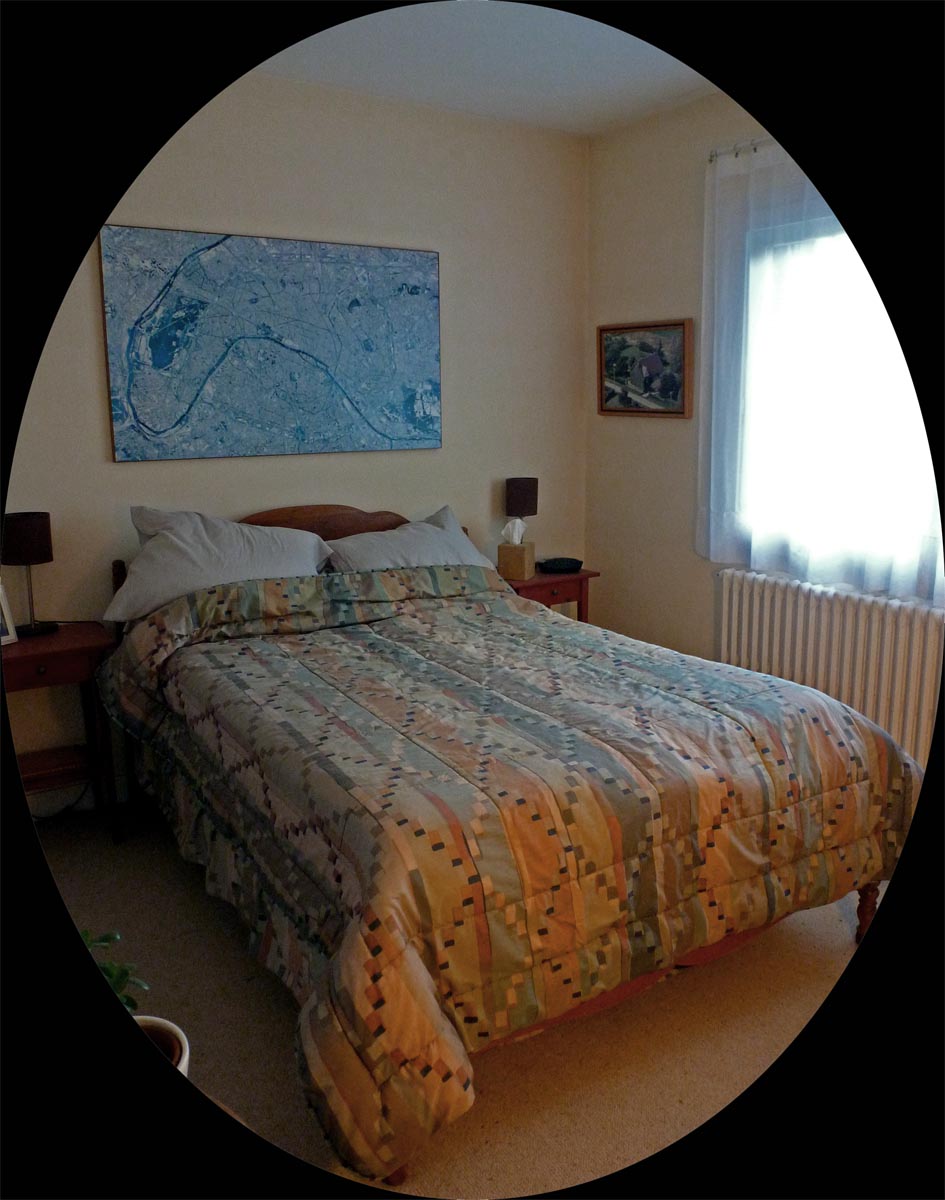
This is the room Sue will stay in at our house. It's a fairly small bedroom, and it was the first room we refurbished when we moved here in 2003. The house had stood unoccupied for years when we bought it, and humidity and age had taken their toll. In this bedroom, ugly old wallpaper was hanging in strips from the walls, unstuck by moisture. The floor was austere, cheap-looking asphalt tile. We pulled all the wallpaper down, sanded the walls lightly, and painted the walls and ceiling. We contracted with a company to come put down carpet over the old tile. The paint job and carpet are still in pretty good shape, but it's definitely time to redo the room.

We slept in this room from 2003 until 2010, before we had the attic space finished off and moved our bedroom upstairs. This 1960s-era house is like many French houses and could even be compared to a large Paris apartment. The rooms are small, except for the living room and the bathroom. The two bedrooms are tiny, and in the whole house there was only one closet when we moved in. The people who had it built came here from Paris and this was to be their retirement home, but they never really lived in it. She died in 1976, and he moved into an apartment in Saint-Aignan, keeping the house as a place to come and spend some summertime weeks "in the country" — two miles from town.

The bed you see here is one that my mother found at a garage sale back in the mid-1980s. Walt and I were living in Washington DC. We drove down to my mother's in North Carolina, saw the bed, and decided to sand and refinish the headboard and footboard. We did the work in my mother's garage, and when we finished she offered the bed to Walt as a gift. We've had it ever since. We brought it to France in 2003. Sorry it's kind of hidden by the comforter on it, but here's what the room looked like in 2010.


The room has a good view of the back yard and vineyard. It faces west, so you don't have the sun shining in your eyes when you wake up in the morning, but the afternoon sun can make the room bright and cheery.

In past years, we've done a lot of touring around with Sue — Yosemite, northern California, Utah, the Loire Valley, Paris, the Dordogne, Provence, the Mont Saint-Michel, etc. And we are going to be fairly busy for the next two weeks, though the years have slowed us down slightly. On the schedule now are the gardens at the Château de Villandry, an hour west of Saint-Aignan. Walt wants to take Sue to Versailles; she's been there before, back in the 1970s with me, but maybe not since. It's two or three hours north of here. The city of Bourges, its cathedral, and the nearby Cistercian abbey of Noirlac are another possible destination. It's only about 90 minutes east of Saint-Aignan. There's a picture of Sue and Walt in this post about our Dordogne trip in 2006 and the beautiful town of Collonges-la-Rouge.

17 May 2006

Collonges-la-Rouge

France is just full of amazing places. Rocamadour, for example. Not to mention Honfleur and the Mont-Saint-Michel in Normandy; the perched villages of Provence; and the châteaux in the Loire Valley. Paris! Plus hundreds of others. Well, here's another place to add to the list.

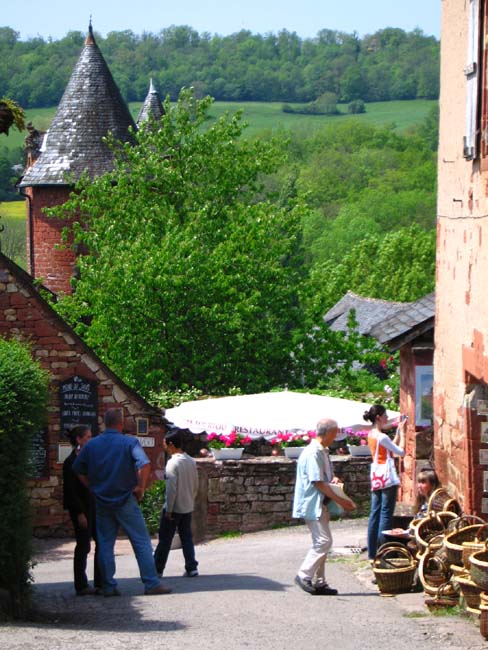
On the final day of our trip to the Dordogne, we left Sarlat early and made our way to another incredibly picturesque village, Collonges-la-Rouge. The whole place is built out of a locally quarried red stone, and many of the houses sport little round turrets.

The stone Collonges is famous for

Red stone houses with round turrets in Collonges-la-Rouge
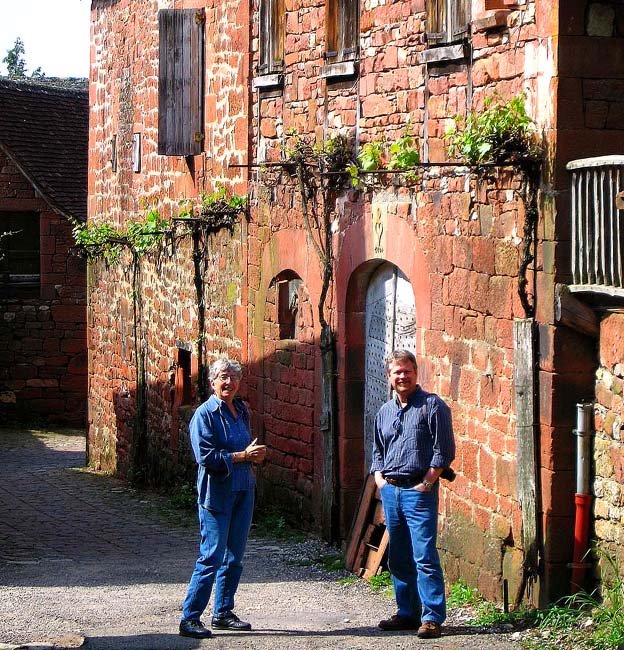
Walt and I had been to Collonges in 1995, and we wanted Sue to see it. The reason that Walt and I went there in '95 was that I had a travel poster picuring Collonges, and we wanted to see it for real. I got the poster back in the 1970s when I worked for the American association of French teachers in Illinois. The French tourist office gave us posters to distribute to teachers, and I kept a few for myself (I was teaching French in the U.S. back then).

Sue and Walt in Collonges-la-Rouge

Anyway, Collonges is located 25 or 30 miles northeast of Sarlat, near the city called Brive-la-Gaillarde. Not too far away are other interesting villages: Turenne, built around a ruined château up on top of a steep, pointed hill; Martel, a fortified medieval town dating from the 7th century; and Bretenoux, a squared-off bastide town built in the late 1200s.

Typical houses in Collonges, along little country lanes

An inviting front door

May 2 was a hot day, and we had driven an hour or more on little winding roads, sometimes in thick forest, to get there. At times we thought we were lost but we kept going and we found the way. It took longer that we thought it would, but then everything in France takes longer than you think it will.

Self-portrait

The three of us wandered the streets of the village for an hour or more, taking pictures, looking in shops, and enjoying the nice weather. Our plan had been to drive on to Brive-la-Gaillarde, a much bigger town, and look for a place to eat lunch. But at about noon we walked by a little restaurant that had 5 or 6 tables out on a patio that was at least partially shaded by walls, umbrellas, and plants. The menu looked good, and there were some free tables, so we decided to sit down. Then we wouldn't have to stop in Brive; we could just drive on through and head on north.

Street activity in front of the outdoor restaurant where we ate lunch

The countryside around Collonges is as green as the town is red

Walt and I had a bavette (flank steak) with stewed shallots and some French fries and salad. Sue had a galette (buckwheat pancake) stuffed with ham, egg, and cheese. We had some Bergerac wine and a cup of coffee to finish the meal. Perfect.

The streets of Collonges

More of the typical red stone

The Michelin guide says Collonges grew up in the 8th century around a church and priory. In the 16th century (imagine, 800 years later) it became popular with officials of the neighboring County of Touraine, which was in political and economic ascendency, as a vacation spot. They had the fancy houses, towers, and turrets built for their stays in the country.

The Romanesque church in Collanges

The church in these pictures was built in the 12th and 13th centuries, according to Michelin. I enjoyed spending some time inside the building, which was cool and dark compared to the warm sunny weather outside.

A window in the church at Collonges

Vaulted ceilings in the church at Collonges