Showing posts sorted by relevance for query gibelotte. Sort by date Show all posts

31 March 2013

The Easter rabbit

At this time in my life, everything seems to have happened, or started, very long ago. I started learning French 50 years ago this year, when I was fourteen and a freshman in high school. Fifty years! I came to France for the first time more than 40 years ago, and 40 years ago on this date I was living and working in Rouen, in Normandy. Then I lived in Paris for a couple of years, in mid-'70s, plus three more years from '79 to '82.

Thirty years ago Walt and I started living together in Washington DC. We had met a couple of years earlier in Paris. That same year, I started working with my friend CHM. Then Walt and I moved to California more than 25 years ago. And, finally, we moved to France ten years ago. See what I mean. Everything happened... started... so long ago...

 Our Easter rabbit in its marinade of white wine, herbs, and vegetables

That's the way it is with the Easter rabbit. I won't call it a bunny. We started cooking a rabbit for Easter back around 1984, when we were living and working in DC, because seeing the Easter Bunny everywhere on TV and in stores that spring made us think about eating rabbit the way we had enjoyed eating rabbit in Paris. I think we've had rabbit on Easter every year since then.

So today we are cooking a rabbit, as usual. I'm cooking it in almost the most basic, simple way: « en gibelotte », it's called. That means stewed in white wine with lardons, carrots, onions, herbs, and mushrooms. It's a kind of fricassée, like Coq au vin is a fricassée, but the gibelotte is made with white wine instead of red wine — at least in my version. (The Larousse Gastronomque says a gibelotte is a « fricassée de lapin au vin blanc ou rouge » — but to me the red wine version is more often called a « civet ».)


The recipe I'm basing my Lapin en gibelotte on is Monique Maine's, in Cuisine pour toute l'année (1969). She calls it « Lapin au vouvray ». That's appropriate, since we live near Vouvray, which is on the Loire River less than an hour from here by car, and the first time that we came tp stay fpr twp weeks in the Loire Valley was 12 years ago in Vouvray, in a gîte rural we'd rented for a vacation. That turned out to be a pivotal moment, because we ended up living here not long after the good experience we enjoyed here.

I'll translate and post the recipe tomorrow. The first step is to marinate the rabbit for 6 hours or more in white wine (preferably vouvray, but any dry white wine will do) with the aromatic vegetables. Then you take the rabbit pieces out of the marinade liquid, dry them off with a (paper) towel, and sautée them in butter or olive oil before stewing them in the marinade. You can cook chicken the same way.

The rabbit cut up — two front legs, two hind legs, and the "saddle" (or « râble » in French)

I cut the rabbit up yesterday — Walt went to the Saturday market in Saint-Aignan and bought one from our favorite vendor — and put it in to marinate. I'll be doing the cooking part after I come back from my walk with the dog this morning.

19 April 2007

Rabbit with lardons and white wine

When Easter rolls around and the Anglo-Saxon world starts talking about bunnies, it always reminds me that I haven't cooked a rabbit in a while. The annual springtime rabbit has been a dinnertime treat chez nous for about 20 years now.

In France, Italy, and other countries, by the way, the Easter Bunny doesn't bring eggs and chocolate. The bells do. Bells? Oui, bells, as in church bells. Bells (les cloches) bringing chocolate eggs? It all sounds very strange. Of course, in our culture, why do rabbits bring eggs? Are the chickens too busy?

Rabbit pieces, smoked pork chunks, herbs, and
aromatic vegetables marinating in white wine

The Easter Bells are for real, though. One day this week I was walking through the Intermarché parking lot here in Saint-Aignan and overheard some people, a group comprising three generation at least, standing and talking near the cart rack. An older woman said to a young boy: "So did the bells come by — Les cloches sont-elles passées ? — on Easter morning at your grandmother's house? Did they bring a lot of chocolate?" Evidently, the bells fly in from Rome.

Lardons cut from a slab of smoked pork belly
which has been trimmed of its rind


Back to bunnies. When you buy a farm-raised rabbit at the Saint-Aignan market, you get the whole thing, skinned. You have to clean it and cut it up yourself — or at least I did. I didn't ask the poultry vendor to do it for me, but maybe I could have. Cutting it up includes cutting off the head, which they sell you by tradition to show you that it really is a rabbit (you can tell by the teeth — they are not the teeth of a cat, for example). I discarded the head, though I suppose you could boil it in a pot (optionally, with some chicken pieces) to make stock.

As Walt remarked that day, the market rabbit's head is there but the ears are missing. I don't know why that is. The feet are missing too — I guess people who raise or butcher rabbits have a good supply of lucky rabbits' feet around their houses. On the rabbit I bought last Saturday at the Saint-Aignan market, I should point out, not much else was missing. There was the liver and there were the kidneys; those parts are good to eat. There also were the lungs, which I discarded. I never found the heart or any other vital organs, however.

Cut the rabbit into at least seven pieces: the two shoulders (aka front legs), the two back legs, and the thorax cut into three more or less equal pieces. The two pieces of the back behind the rib cage, called the saddle or râble, are the meatiest pieces on the rabbit.

Now rabbit is a little gamier than chicken. The Larousse Gastronomique cookbook says the meat is very digestible, but rabbit needs some flavoring ingredients to make it really good. One classic method of cooking rabbit is to baste it with Dijon mustard and roast it in the oven. Another is to cook it in ... what else? ... wine. White or red — your choice.

Frying lardons in a little butter or oil
after their marinade

Rabbit cooked in red wine is called a civetcive means chive or green onion. It's a rabbit cooked with onions in red wine. The chicken equivalent of a civet is coq au vin — rooster or chicken cooked in red wine with onions, mushrooms, and lardons cut from smoked or salt-cured pork belly.

Rabbit pieces and lardons browning in the pan
after being marinated in white wine and aromatics

Rabbit cooked in white wine is called lapin en gibelotte. The chicken equivalent is a fricassée. I'm not sure that there are lardons in most fricassées, but they are essential in a gibelotte. Rabbit, smoked lardons, onions, garlic, carrots, herbs, and white wine — that's the way I like to cook rabbit. I learned the recipe and method nearly 30 years ago from a woman in Paris who was in her 80s at the time. It's a French country classic.

I don't know why we don't have lardons as a readily available ingredient in large parts of the U.S. You can cut your own, of course, if you can get smoked or cured meat, including what is called slab bacon. I never had much luck finding slab bacon in San Francisco, however, though I did once find it in a supermarket up in Fort Bragg, in far northern California, when we were there on a weekend camping trip. I was ecstatic, and I took plenty back home with me to San Francisco that Sunday. After that, I started finding smoked slab bacon in at least one San Francisco supermarket. It was imported from Germany.

In the U.S. South, cooking meats, fish, greens, green beans, or dried beans with cured pork — streak o' lean, pork belly, side meat, fatback, etc. — is a long tradition. When I was growing up, for example, my mother would cook a big baked flounder by laying some bacon strips over the fish and surrounding it with aromatic vegetables like chopped onion, sliced carrots, and celery stalks, along with potatoes or even sweet potatoes. Collard greens, green beans, and pinto beans were all cooked with a chunk of salt pork or smoked fatback.

The use of pork belly or bacon as a flavoring ingredient is one of the things that make me say that old-style Southern cooking and French country-style cooking are strikingly similar in many ways. (Cooking vegetables until they are thoroughly done, considered a horror in California cuisine, is another.)

Rabbit pieces, lardons, and herbs
after their cold white wine bath


One feature of French cooking that I'm not sure you find much in Southern cooking (maybe I'm wrong...) is the marinade. In the case of the rabbit, it's good to slice up some onions, garlic, and carrots, wash some fresh herbs (thyme, parsley, sage, bay leaves, or whatever you like), and put all that in a big dish with the rabbit, the chunks of smoked pork, and some black peppercorns. Pour white wine over it all to cover, and then put it in the refrigerator overnight or for at least three or four hours. Another thing I like to add to a marinade of this kind is a half-dozen whole allspice berries (piment de la Jamaïque in French).
Don't let the order of the pictures in this post confuse you. The steps to follow in cooking a rabbit (or chicken) this way are:
  1. Marinate the rabbit and lardons for 8 hours or longer in white wine.
  2. Take the rabbit and lardons out of the marinade and brown them in a pot in butter or oil. Save the marinating liquid.
  3. Pour the liquid over the browned meats and simmer for a couple of hours.

When you're ready to cook, take the rabbit pieces and pork lardons out of the marinade and let them dry a little, or dry them off a little with a paper towel. Now they are ready to sauté. The flavors of the herbs and aromatic vegetables, the white wine, and smokiness of the pork will have already flavored the rabbit.

Herbs, chopped onion and garlic, and
pieces of pork rind ready to go into the pot


You can discard the herbs, onions, and garlic at this point, but when the time came it seemed like a shame to me to just throw all that out. So I put it all in a wire basket that I would be able to put in the pot with the rabbit when I simmered it in the white wine. And don't throw out the white wine you used as the marinade — that's what you cook the rabbit in. It has picked up a lot of flavor too.

Cook it all at the simmer

Another thing you shouldn't throw out is the rind of the smoked pork belly, if you have any. Save it, put it in the marinade if you want to, and at the end cut it up into small pieces and put it in the wire basket (or cheesecloth pouch, or right into the pot) and cook it with the herbs, onions, and everything else in the pot. The pork rind gives the sauce good richness in the form of gelatin.

The cooked rabbit: that's the liver (delicious)
that you see there. The color of the sauce in this picture
is not great but believe me, it was good.


I decided to save the carrots and cook them directly in the wine with the rabbit and pork. Some cooks would throw them out, on the theory that they had already given their flavor up to the marinade. But I wanted to cook and eat them.

Walt made some fresh noodles and we cooked some
nice haricots verts to go with the stewed rabbit.


Once you have the rabbit, pork, carrots, and the aromatics (whether loose or in a ball or pouch) in the pot in which you've browned the meat, pour on the wine that the rabbit marinated in. If it isn't enough to cover everything, add more wine, or add water. Or chicken or vegetable broth. C'est vous qui voyez — it's your call. What I'm describing is more a method than a recipe.
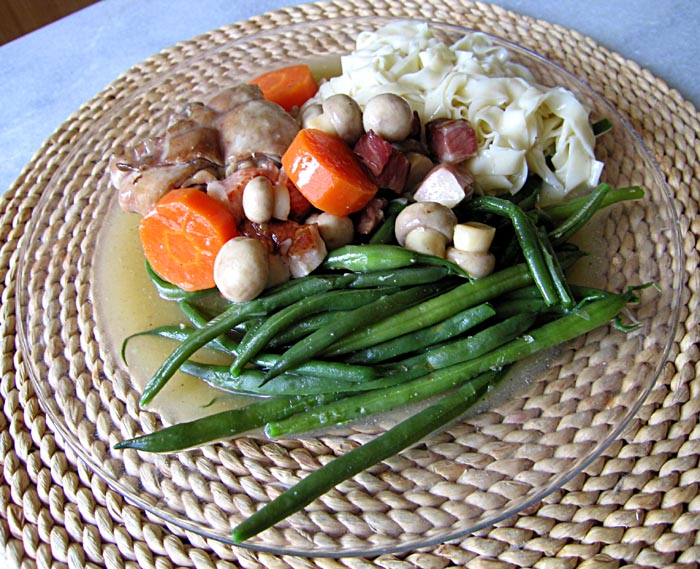
Sunday dinner of rabbit, noodles, and green beans

Whether or not you thicken the sauce is up to you as well. I thickened it slightly with a little potato starch mixed into cold water to make a slurry. You pour that slowly into the simmering sauce until you get the consistency you want. You could do the same thing by making a flour and butter roux and stirring that in slowly. The sauce shouldn't be too thick, though.

Bon appétit !


28 March 2016

Cooking rabbit in springtime

If you don't live in France, you probably don't cook or eat rabbit very often — if at all. It's a standard item in France, the way duck is. Over here, people don't just eat chicken and turkey, but also guinea fowl and pheasant and quail. And rabbit.

We cooked our lapin de Pâques yesterday. Walt and I have been cooking rabbit at Easter for more than 30 years now. It all started two or three years after we met back in 1981 in Paris. In 1982 we went back to live in the U.S., in Washington DC.

Here you can see the two "saddle" or filet sections on the left, and the liver and thigh sections toward the top.

Then in 1984 or 1985, Easter rolled around and there were pictures and stories about Easter bunnies all around us. That reminded us that we had really enjoyed having rabbit for dinner in restaurants when we lived in Paris. I went on a search and actually found rabbit in a market (maybe Eastern Market?) or supermarket in the DC area. I don't remember where exactly.

So we started our own "tradition" of cooking rabbit every year for our Easter dinner. Yesterday was no exception. On Saturday I went to the open-air market in Saint-Aignan and bought a nice locally raised rabbit, all prepared for cooking. All I had to do was cut it up. Basically, you get two big fat back leg-thigh sections, two pieces of "breast" (the saddle or filets), and two smaller front legs when you finish carving. Rabbit meat is very lean and not gamey. We are talking about rabbits that are raised for food, not wild animals. I did a couple of detailed posts about lapin en gibelotte a few years ago.

Cooked with the rabbit are onions, shallots, garlic, mushrooms, smoked bacon, and white wine, with bay leaves, salt, and pepper.

One of the simplest and most delicious ways to cook rabbit is to make what is called a gibelotte (a kind of fricassée). You brown some onions, garlic, and mushrooms in a pan along with some lardons fumés (chunks of smoked bacon or ham). Take all that out of the pan, set it aside, and brown the rabbit pieces in the same pan.

Then put the onions and all back in the pan and add in some wine and some chicken or rabbit broth — just enough to not quite cover the rabbit pieces. You want them braised and browned, not boiled. Put the pan on to simmer either on top of the stove or in the oven for an hour or so. Serve with rice, millet, quinoa, or boiled potatoes and either a salad or a vegetable like haricots verts, broccoli, kale, or collard greens.

30 March 2024

Lapin en gibelotte pour Pâques

For tomorrow's Easter dinner, I'll be cooking rabbit. It's a standard item here in the supermarkets and on the open-air markets. This year, I just bought a couple of rabbit thighs. The hind legs of the rabbit are very meaty and very lean. I'll cook it in a way that's called en gibelotte, which means in a stew made with a white wine sauce,mushrooms, onions, and smoked pork bacon (lardons fumés). I'll be adding some turnips, leeks, carrots and chicken gizzards (gésiers) to the stew, because I like them. I'll take pictures.

If you want to see various versions of rabbit stew on my blog, click this link and then scroll down to see some old blog posts.

We'll also be enjoying some fromage de chèvre as the cheese course with our rabbit lunch. I bought an A.O.C. Sainte-Maure de Touraine log of goat cheese. As you can see I did my shopping at Super U. More tomorrow...

13 April 2009

Moroccan rabbit with lemon and almonds

We always cook rabbit on Easter. We started cooking rabbit on Easter just because Easter made us think of the Easter Bunny, and I said: "Hey, why not cook a rabbit. It's something we don't eat very often, and it can be really good." That was probably in 1983 or 1984.

For years, we would make a Lapin en gibelotte for Easter dinner. That's a classic French stew of rabbit, onions, carrots, potatoes, and herbs with a thickened, creamy sauce. We probably also made Lapin à la moutarde a few times — rabbit cooked in a sauce made with Dijon mustard is another French classic.

Tajine de lapin au citron et aux amandes — Morroccan-style rabbit

In 2008, we saw a cooking show on French cuisine TV where the chef made a Thai curry with rabbit. So we made that. It involved boning the rabbit and cutting the meat into small pieces. It was really good, but it was a lot of trouble. Walt blogged about it, with pictures. The recipe is there too.

The rabbit came cut up into 6 pieces with the liver in
a little plastic cup inside the supermarket package.


This past winter, we saw a Swiss cooking show on French CuisineTV on which the cook, Annick Jeanmairet, prepared a Tajine de lapin au citron et aux amandes. That's a rabbit cooked with lemon and almonds, not to mention onions, garlic, and typical Moroccan spices: cumin, coriander, turmeric, saffron, cayenne pepper, ginger, cinnamon, nutmeg, and so on. It looked really good so we got the recipe off the CuisineTV web site and saved it for our Easter dinner.

When you buy a rabbit, you get two each of these pieces:
front leg, saddle (the back), kidney, and back leg.
You also get the liver, which is good like chicken liver.


One good thing about recipes for rabbit dishes is that you can always substitute chicken if you can't find or don't like the idea of eating rabbit. You should try rabbit, though, if you haven't. Domesticated rabbits don't have a gamy taste at all, and the meat is even leaner than chicken.

Here's a step-by-step description of putting the Moroccan rabbit dish together.

You can cook potatoes — no need to peel them — in the pot with the rabbit. Or you can omit them and serve the rabbit with rice, pasta, or couscous.
Peel and slice up two medium onions (or a medium onion and a large shallot). Peel and de-germ four cloves of garlic. Using a vegetable peeler, remove the zest of two lemons.
Cut each zested lemon into four wedges. Squeeze out the juice and seeds . Then cut each of the eight wedges in half again. You'll put the zest strips and the wedges, pulp and all, in the dish to cook with the rabbit.
Here's the lemon zest. It's in strips, but I think it could just as well be grated if you want. After they cook, the strips are tender and tasty.
Put olive oil in a heavy-bottomed pot and cook the onions & garlic in it on low heat. You'll brown the rabbit with them and spices before adding liquid.
Add 2 tsp. of curry powder to the pot. Let the spices cook for 2 minutes, and then put the rabbit pieces in. Stir them around and turn them so that they get covered with spice.
The saddle (râble) pieces have long flaps of meat on each side. Pin them down using wooden skewers to make them cook neatly.
Pull the fat off the rabbit kidneys, and trim up the liver to remove any veins or fat. Cut the liver into 2 or 3 pieces if you want. Add all and then 2 cups of water. Cook on low heat for 45 minutes.
Five minutes before before serving, add peeled almonds and fresh herbs to the post. Parsley and cilantro are good, but I bet fresh oregano and basil would be good too.

So you cook the rabbit pieces in a big pot with the onions, garlic, spices, and potatoes. I say use curry powder or make up you own spice blend. The original recipe called for just cumin and saffron. The Moroccan ras-el-hanout spice blend I used contains cumin, turmeric, ginger, nutmeg, coriander, and cardamom.

The cooking liquid is water. Let the rabbit pieces brown a little in the pot before adding liquid. Add salt and pepper liberally. When the potatoes are done, the rabbit pieces will be done too. Like chicken, rabbit doesn't really take long to cook.

The potatoes and rabbit pieces are cooked.
Add peeled almonds and some herbs for the last five minutes.

The rabbit we bought at SuperU seemed especially good and meaty. It weighed about 3 lbs. I'm sure this would be very good with chicken or even turkey. I think chicken thighs and drumsticks might be the best.

On the plate — a little messy, but delicious

Annick Jeanmairet's recipe (in French) says you can substitute black olives for the almonds in this tajine. I think green olives would be just as good. In fact, here's what I'm going to do next week: I bought some turkey wings at SuperU on Saturday — they sell them as a substitute for veal and call them blanquette de dinde — turkey for stew. It's actually just the first wing section with a big piece of turkey breast meat attached. I'm going to cook the turkey Moroccan style with lemon and olives.

10 September 2014

Kitchen news, retro-style

Yesterday I ordered a piece of kitchen equipment of a kind that I have never before owned and never before used. Decades ago these devices became popular in America. Back then, I viewed them as a ridiculous fad of little utility or interest. Times and tastes do change. In fact, whole countries and cultures change noticeably over just a few decades. I've seen it happen.

A new kitchen appliance

The thing I'm talking about is called a cuiseur or mijoteuse électrique in French. When I tell you that my favorite kind of French cooking is preparing what are called plats mijotés, you'll wonder why it took me four decades to decide to acquire a mijoteuse. Some of the most famous plats mijotés are coq au vin, blanquette de veau, and bœuf bourguignon — not to mention la poule au pot and le pot-au-feu.

So if you know what the verb mijoter means, you've figured out what appliance I'm talking about. The next time I decide to make a daube de bœuf, lapin en gibelotte, or choucroute garnie, it will be just the the kitchen appliance to have at the ready.

Here's an American slow-cooker that resembles the one I've ordered.

Mijoter means « faire cuire ou bouillir lentement, à petit feu » and, more figuratively, « préparer un plat avec soin, avec amour ». It means "to simmer", in other words. The device is a "simmerer" or, as it's known nowadays, a slow-cooker. A crock pot. I'm jumping feet-first into the '70s!

The one I've ordered from amazon.fr has a removable oval-shaped stoneware cooking dish that you can put on the table to serve the meal from. And then you can run it through the dishwasher. It holds 6.5 liters if filled to the brim, for about 5 liters of usable volume.

 The removable stoneware cooking vessel

With that shape and size, it can accommodate a small poulet, canard, or pintade, not to mention a small rôti de bœuf, de veau, or de porc that you want to braise slowly for several hours. I can see some good NC-style pulled pork or a batch of chili con carne coming out of it... not to mention all my favorite French plats mijotés listed above.

25 June 2007

The way it was supposed to be

Except for the occasional emergency, this is what life was supposed to become. It's the way I imagined it, the way I wanted it. We would retire from the work life and commuting hell in the big city (San Francisco, in our case) and go live the quiet life in the country. It was a choice. A plan.

Why France? Well, I lived here before, back in the 1970s and early 1980s. I "grew up" in France and lived through either my second childhood or my first retirement — I look at it both ways — in those years, before I went to Washington and then California to work for 20 years, to have a career.

I couldn't really imagine where in the American countryside two guys like us would settle and feel comfortable. I knew France would be fine for us. We would learn a lot, especially when it came to the language and the history. We might travel a little.

So what do you do with your time after you retire? That's the big question that faces you. You work on your house — cleaning, repainting, calling in contractors to do specialized tasks, and working out a list of priorities based on the amount of money you can or want to spend.

You garden. That's a seasonal task in the Loire Valley, there being five months out of the year when you can't really do much outside because of the rainy, cold weather.

But year-round, you shop and cook. Luckily, I love to plan meals, prepare fresh food, and cook. You try to stick to a healthy diet and not eat junk food. You go to outdoor markets and supermarkets and you compare not only prices but quality. You try to buy the best produce at the lowest price. You avoid prepared foods because you don't want to spend a fortune and you want to know exactly what there is in the food you eat.

You can spend a good part of the afternoon pitting the tiny
red plums you gathered for free in your neighbors' yard


You also look for specials on meats. You buy what you can when the price is low and put it into the freezer for later. You spend a lot of time learning how to prepare meats, and you spend a lot of time trimming, de-boning, cutting up, grinding, and cooking meats. You fall back on the French classics — boeuf bourguignon, boeuf aux carottes, coq au vin, lapin en gibelotte, blanquette de veau. You can't go wrong with the classics.

In the garden, you try to grow as much good food as you can. Tomatoes of course, eggplant/aubergines, cayenne and bell peppers, squash/courgettes, collard and mustard greens, okra, haricots verts/green beans, cucumbers, and pumpkins. Herbs. You take advantage of untended cherry trees out back and the generosity of friends and neighbors who have a surplus of plums and quinces. You pick apples in the yard and blackberries out on the edge of the road.

You make clafoutis, and if you can you make French-style tarts with apples, plums, pears, cherries, and blackberries. And you make jellies and jams and preserves. Even if you don't really eat that much jelly and jam, you make it anyway. You end up with a lifetime supply in the pantry. You try to give it away. You just hate to see the fruit go to waste.

You go and actually count the number of jars of jam and jelly you have in the pantry. There are about 30 of them, and some are quart jars. You think you ought to start selling the stuff at an outdoor market.

And then you make more preserves because
that's what you do with surplus fruit


And you blog. You write a blog. You read blogs. You leave comments and you spend a lot of time reading and writing e-mail messages. You read a lot of newspapers on the Internet, and you try to resist ranting too much about the current state of the world.

You only start the car and actually go somewhere a couple of times a week, especially since you get fresh bread delivered to your front door five days a week. That's the one thing you would have to go out for, or spend a lot of time making.

You get lots of visitors, especially from the U.S. You make some friends among the local people. But you don't seek out a busy social life, preferring to spend your time doing all the things you need to do to keep your life on track, as listed above. You never really have enough time, do you?

Voilà. A new life. Just as busy, but less stressful. That was the point, wasn't it?

18 April 2022

Lapin aux carottes et aux champignons

For our Easter Sunday dinner, I decided to make a stewed rabbit with carrots and button mushrooms. As far as I can tell, it's about the same thing as an old recipe for lapin en gibelotte, which I've made in past years. The other ingredients are onion, celery, herbs, and white wine. I didn't put in any lardons (bacon) this time, but I might add some today before we have the lapin aux carottes again.

Why are we having it again today? It's because Walt didn't eat any yesterday. Or anything. He was not feeling well at all.
I won't go into details; if he wants to tell about it, he will do so on his blog.


These photos are fairly self-explanatory. It's how you make a standard stew with meat and vegetables. In France
you can buy a whole rabbit or you can buy rabbit parts. This recipe would be good made with chicken or turkey.


I thickened the stewing liquid with a flour roux, and I put in my favorite spices, including black pepper and allspice.
The recipe I found on the internet had ingredients and instructions, but no quantities except for the amount of flour
for the roux and the number of onions. My translation (or adaptation, really) of it is below.


Rabbit with carrots and mushrooms

a rabbit cut into serving pieces
carrots
fresh button mushrooms
celery (optional)
smoked pork lardons (optional)
chopped onion to taste
thyme, oregano, or both
bay leaves
flour
salt
pepper
allspice (optional)
white wine
chicken or rabbit broth (or water)
potatoes (optional)

In a non-stick pan, sauté the rabbit pieces in olive oil until they start to take on a golden brown color.

Take the rabbit pieces out of the pan and set them aside. (I browned them in two batches — I was cooking a big rabbit, 1.7 kilos =3¾ lbs.) — in a non-stick frying pan and put them in a big wok in which I was going to cook the stew.)

Cook the (optional) lardons in the same pan. Put them in the wok with the rabbit pieces, along with the carrots, onions, celery, and mushrooms. Set the wok on a moderately hot burner and stir everything around to lightly brown the vegetables. Cover the wok as necessary and turn the heat down so that the vegetables and meat will start to cook through without burning.

Take the cover off the wok or pot. When the liquid in the wok has basically evaporated, sprinkle a tablespoon or two of flour over the stew ingredients. Stir. Season with salt, pepper, and (optional) allspice. Gradually pour in a mixture of white wine and broth, stirring everything to let the flour thicken the liquid. You should end up with just enough liquid to barely cover the meat and vegetables. (I had made rabbit broth using the trimmings and the head (!) of the rabbit after I cut it up. I had also marinated the rabbit pieces overnight in white wine and herbs, which also went into the stew.
)
 
Stir everything around gently. If the gravy is too thin, cook the stew uncovered to let it reduce. Adjust the amount of liquid to get the consistency you want. At this point, I put in four smallish potatoes, whole, to cook in the gravy. Let the stew simmer for 30 to 60 minutes, until the meat and vegetables are done to your taste. I like the rabbit well cooked, almost falling off the bone.


This kind of stew is almost better re-heated the next day, people always say. I'll let you know tomorrow if it was.

30 March 2021

The Tuesday market in Valençay

The weekly open-air market in Valençay is set up on Tuesday mornings.
There are a lot of vendors there selling local goat cheeses, of course.

And there are also many others selling fresh local produce and meats.

Valençay has a small but spacious market hall on the main town square so that even in bad weather
the market is a pleasant place to shop. I wish Saint-Aignan had a market hall like this.

Bavette is a lean cut of beefsteak that is cooked rare to medium-rare so that it's tender.
Many sources say it would be called flank steak in U.S. terms but I think it's more like skirt or hanger steak.
However, skirt and hanger are used to describe different cuts of beef in the U.S. compared to the U.K.,
so it's hard to figure out what's what.

Tomates ! They remind me that yesterday was like a fine summer day here in the Loire Valley region.
Walt has planted tomato seeds in little pots and we'll set the seedlings out in the garden plot in May.

Celery root, a.k.a. céleri-rave in French and celeriac in English, is good peeled and grated, raw, as a cole-slaw type salad,
or cut into chunks and cooked like carrots or turnips. You can also roast the whole celery root in the oven.

These are whole rabbits that have been skinned and prepared for cooking. The brown stuff is the liver,
which is like chicken liver and is delicious. I've seen such rabbits cooked whole in a pan in the oven,
but most often you see them cut up into serving pieces and cooked in a braise or a stew.
We'll be cooking rabbit (lapin en gibelotte — three old posts) this coming weekend...

18 April 2014

Not the first time

So at least three of you have said you've been caught up in the same kind of bomb scare that I was caught up in Sunday morning at Roissy/CDG airport. It must happen a lot.


It happened to me once before. Years ago. Walt and I were checking in for a flight over in Terminal 2. The woman examining our passports and registering our luggage was just finishing up when an announcement was made over the intercom. I couldn't quite hear what it was all about.


But the Air France clerk suddenly tossed us our boarding passes and yelled: "We have to run! Follow me!" And we literally went running out of the terminal. We fully expected to hear and feel an explosion behind us. We didn't. It was pretty exciting, all the same.


Yesterday was a beautiful day here in Saint-Aignan. I went out and walked around the vineyard with the dog in the morning. The rest of the day, I was sort of in a daze. My body wanted to sleep, but I did my best to stay awake. I dozed off in front of the TV several times in the afternoon. It was probably a mistake to try to watch the latest recorded episodes of The Good Wife at that particular time.


Today is gray and rain threatens. I slept for the second night in a row. I'm optimistic about my jet-lag ending quickly, but I also know that just when you think it's over it hits you again. By Monday, I should be in good shape. I will probably have a groggy Easter weekend.


We will be cooking a rabbit. That's what we do on Easter. It's a 30+-year-old tradition in this household. This time, I think we might grill the rabbit — if it doesn't rain on Sunday — and baste it with a mustard sauce as it cooks. In the past, we've made rabbit French-style (en gibelotte), Thai-style (in a coconut-milk curry), and other ways. Grilling it will be a first.


Meanwhile, here are some pictures of purple flowers of various kinds that I've taken recently around the yard and vineyard.