Showing posts sorted by relevance for query haricots verts. Sort by date Show all posts

19 August 2010

Green bean salad — haricots verts en salade

French cooking isn't necessarily fancy or complicated. Much of the food we eat here in France is very simple — especially the salads. Often French salads are just one ingredient, dressed with vinaigrette. Here are some standard ingredients:
  • grated raw carrots
  • steamed red beets, diced
  • sliced tomatoes
  • chopped raw cabbage
  • sliced raw mushrooms
  • peeled raw cucumbers, seeded and sliced
  • cooked green beans
The closest you get to complicated, with multiple ingredients on one plate, is when you have an assiette de crudités — that's a plate with several of these simple salads served side by side, not all mixed together.

I made a standard French salade a couple of days ago — it was haricots verts en salade — a salad of cooked green beans. Then I started reading about it. I have a set of cookbooks that I draw on for ideas and methods.

Haricots verts en salade, with a vinaigrette dressing
and a finely chopped shallot


First, I looked at La Véritable Cuisine de Famille, by Tante Marie (ca. 1920). She says, in very few words, to put some cooked, drained green beans into a salad bowl and season them the way you would season an "ordinary salad." Obviously you need to know how to season an ordinary salad, French-style, if you want to make these.

What is a salade ordinaire, anyway? In France, it's just some lettuce leaves in a vinaigrette dressing. It's not something you see in French restaurants much any more, but it's often one of the courses, right before the cheese (or even with it), that make up meals prepared and served at home.

So how do you make a vinaigrette? Tante Marie says hers is composed of some chopped parsley, a chopped shallot, a tablespoon of vinegar, a tablespoon of oil, and some salt and pepper. Nowadays, however, French vinaigrette dressings nearly always have some amount of Dijon mustard in them.

In Je Sais Cuisiner, by Ginette Mathiot (first published in 1932, I've read — my copy is ©1970 — and recently translated into English as I Know How to Cook), the recipe for making haricots verts en salade is just as cryptic. It says to cook some green beans, drain them, and season them with vinaigrette.

Look up vinaigrette in Mathiot's book and you'll find the same recipe you find in Tante Marie's, with one exception. Mathiot specifies one tablespoon of vinegar but three tablespoons of oil. Those are the proportions most people use nowadays. Use less oil, and the vinaigrette is too vinegary.

Maybe Les Recettes d'une Grand'mère (et ses conseils), by Renée de Grossouvre (1988) will be more help. She says to cook some green beans, drain them, and let them cool until they are just lukewarm. Then make this dressing:
In a bowl, mix up a good vinaigrette dressing with a small amount of [Dijon] mustard... dissolved in a tablespoon of vinegar, some salt, some pepper, and with three tablespoons of fine olive oil. (« Dans un bol, battez une bonne sauce vinaigrette avec une pointe de moutarde... délayée dans une cuillère à soupe de vinaigre, du sel, du poivre, et ajoutez-y trois cuillères à soupe d'huile d'olive fine. »)
That's the standard vinaigrette today. Whisk the dressing until it is well blended (emulsified) and then pour it over the beans. Toss the the beans in it. Add some chopped fresh herbs (parsley or chervil) and a chopped or thinly sliced French shallot if you want. You can use a very small onion if you don't have a shallot. That's it.

Did I mention that you also need to know how to cook the beans? You do that in a large quantity of water that has been brought to a rolling boil. Don't cover the pot or the beans will lose their bright green color. Let them boil, the French books say, for 15 to 20 minutes. (You might want to cut that time in half.) To be fair, Madame de Grossouvre says the cooking time is a function of the quality of the beans — the fresher they are, the less cooking they need.

It's gardening season. The beans are very good right now. Cook them just enough and season them with the simplest vinaigrette dressing. Enjoy them for the flavor of the beans, not the extra ingredients you might put into a more complicated dressing. Mustard, vinegar, and oil are all you need. Herbs, onion, shallot, or even garlic are optional. No sugar!

By the way, I looked in the Joy of Cooking and I didn't find anything resembling these French recipes for making a green bean salad.

23 August 2012

Stir-fried green beans with shrimp

It's always surprising how some plants in the vegetable garden produce like mad in certain years and give you almost nothing other years. This year, so far, green beans are the stars of the garden. We planted both haricots verts and haricots cocos plats back in June.

At this point, we've starting blanching and freezing the cocos plats (Italian or Romano flat beans) after eating an awful lot of them over the past few weeks. And now we are getting ready to start blanching and freezing haricots verts for wintertime enjoyment, because we're getting more than we can eat even if we have some every day.

 Stir-fry the green beans and pieces of sweet red pepper for just two or three minutes.

One of the best dishes we've had with our green beans was a stir-fry with shrimp, lardons (chunks of bacon, ham, or pancetta), sweet red peppers, and Chinese noodles. I don't really have a precise recipe for it because it was mostly improvised. I can say though that the first step is to peel and de-vein the shrimp (I had about two dozen) and marinate them in a mixture of diced ginger and garlic with some hot red pepper flakes, soy sauce, chopped herbs (basil is good), and white wine (sweet or dry). Leave them in the marinade for a hour or two and then prepare the beans and the sweet red pepper for cooking.

Here are the beans and the shrimp after stir-fying, waiting to be combined with noodles and sauce.

Stir-fry the beans and sweet peppers in canola or some other neutral oil on high heat for just three or four minutes. Take them out of the pan and set them aside. Then stir-fry the lardons for a minute or two in the same pan. When the pork is nearly cooked, toss in the shrimp (don't put in the liquid marinade at this point) and stir-fry them for two or three minutes, just until they stiffen and turn pink. Set them aside with the beans and peppers.

We've had an abundance of haricots verts this month.

Meanwhile cook up about half a pound of Asian noodles, spaghetti, linguine, or other pasta in boiling water until just done. Drain them and toss them in a little bit of vegetable oil to keep them from sticking together.

In the wok where you cooked the beans and then the shrimp, sauté a small onion, diced or sliced. When it's cooked and starting to color, add a two or three tablespoons of soy sauce, a tablespoon of sugar, a quarter cup of white wine (sherry, mirin, or other), and the same quantity of Chinese oyster sauce. Optionally, add some hot red pepper flakes or Asian chili-garlic sauce. Add in the shrimp marinade too. Stir all that together with the onions in the wok and let it cook down and thicken slightly to make a sauce.

Stir-fried green beans and shrimp with lardons, sweet red peppers, onions, and Asian sauces.

Add the cooked noodles or pasta to the wok and toss them in the sauce. Then add the beans and shrimp and toss everything together. Be careful not to let either the beans or shrimp overcook. They just need to heat through again for a minute or two. We thought this was a great success and really delicious.

30 November 2013

With that lamb...

In France, with gigot d'agneau you serve beans. Usually they are the little pale green flageolet beans, which are the beans inside haricots verts when you let the haricots verts grow big. That's what we had with our gigot, along with some haricots verts mixed in for appearance. I didn't take pictures of those, but you can see them in the background on the last photo I posted yesterday.


As a first course, Walt made a salad that he's been making once or twice a year for a while now. It's a radis noir, a black or Spanish radish, peeled and sliced super thin on a kitchen mandolin. And it's the cheese called Mimolette, also sliced thin and arranged on top of the radish slices. The herb is tarragon (estragon) this time; sometimes it's chervil (cerfeuil). The dressing is just a little white wine vinegar and EVOO. I couldn't resist that abbreviation, which I think is funny. I guess you can figure out what it means.


We had a light cheese course after the lamb. We had a Tomme de Domessin — Domessin is a village in the Savoie region, in the Alps. And we had a Maroilles, which is a cheese from the north of France that people find especially stinky. I like it. The Maroilles (pronounced [mahr-WAHL]) is the orangey soft cheese on the right in the photo above.


For dessert, we had Walt's version of U.S. pumpkin pie. He makes it with his own buttery crust, of course, and a filling of pureed or at least mashed pumpkin or squash pulp, flavored slightly with the typical anglo-saxon spices (cinnamon, nutmeg, ginger, cloves, cardamom) but in very small quantities so that the spices aren't overpowering. He also reduces the amount of sugar. This year, we had a bumper crop of winter squashes in the garden, so he used the flesh of half a spaghetti squash and that of half a butternut squash. It makes a nice tart (we call it a pie in America, but it doesn't have a top crust like apple pies and others do).


19 August 2015

Haricots verts de deux façons

The vegetable garden is producing a lot of haricots verts — green beans — these days. We don't have as many rows of beans this year as we have had in the past, so we won't be putting a lot of beans in the freezer. We're just enjoying eating them fresh. One of my favorite ways to cook them is haricots verts à l'italienne, with onions and tomatoes (also fresh from the garden).


I made these yesterday and we ate nearly all of them. A translation of the recipe, which comes from a popular French home cooking book published nearly 50 years ago, is here on this blog in a 2014 post.


Meanwhile, Walt has found this really good way of cooking green beans either with beef or pork, and they'd be good with chicken or shrimp too. The meat gets marinated briefly in soy sauce, fish sauce, and chili sauce or cayenne pepper. Then it's stir-fried in a wok. After it's cooked, take it out of the pan and set it aside. Put the beans into the same pan and add just a little water to keep the sauce from burning and to steam the beans slightly.


Put the meat back in the wok when the beans are cooked to your taste and let everything heat through again. Serve with rice and more soy sauce, plus some sesame oil and/or toasted sesame seeds. We've enjoyed both the pork and beef versions of this recipe, and if we get enough beans to make it, I'd like to do it with strips of chicken or turkey breast next time.

20 August 2016

The “getting creative with green beans” series

Walt picked three more pounds of green beans — haricots verts — yesterday. He's been bringing in several pounds a week since the end of July, so we are eating a lot of beans and freezing a lot more. See other recent green beans posts here.

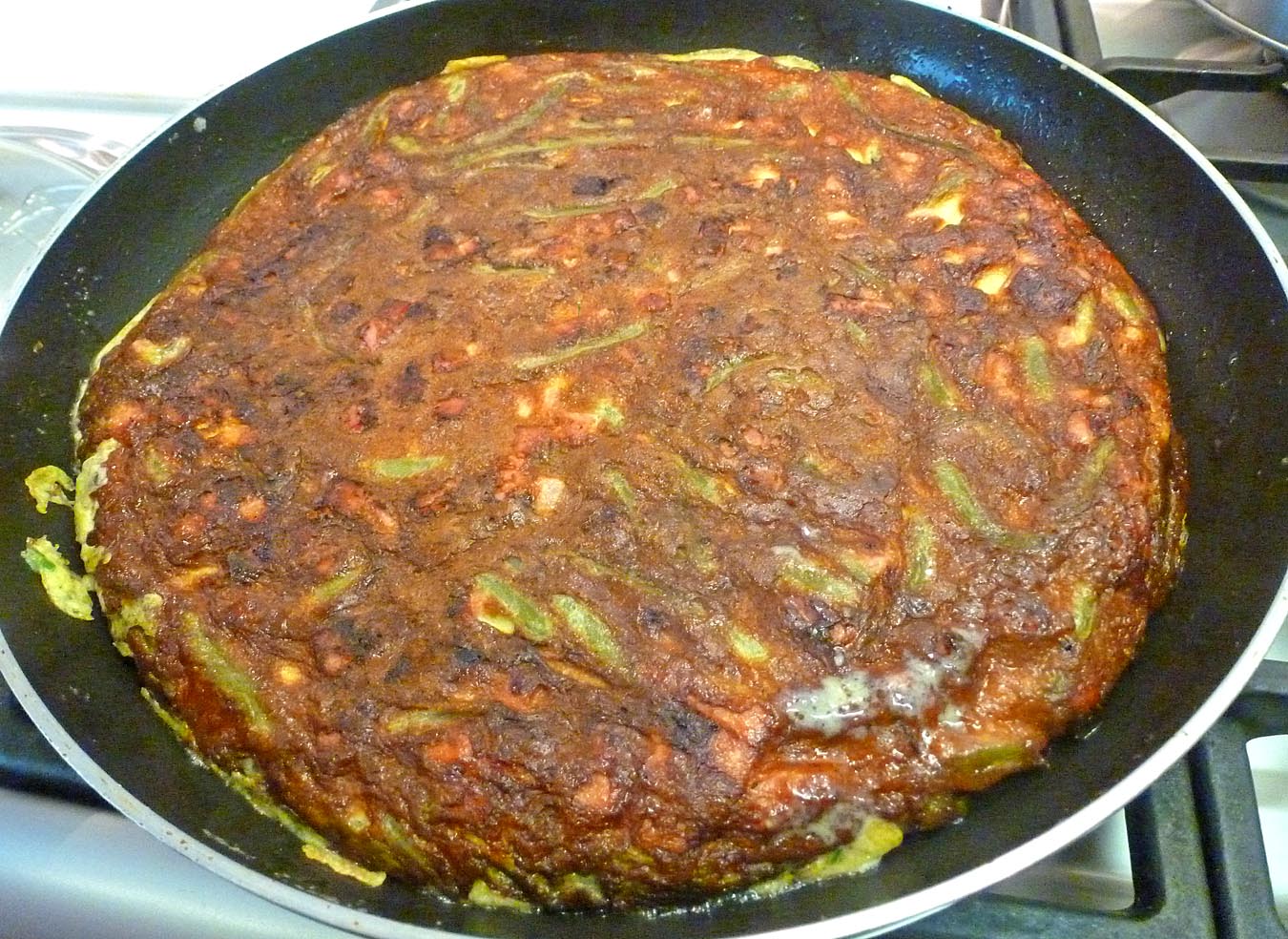
The idea I found in my googling around the web this time was to make what the recipe called « une omelette aux haricots verts ». It's not really an omelet in my book, but a frittata. That's an Italian-style egg concoction that could be called « une omelette plate » — a flat, not folded omelet — or a Spanish-style tortilla made with green beans rather than potatoes. You can serve and eat the frittata hot, warm, or cold, as you prefer.


Usually, making a frittata is easier than making a French-style omelette. The flat omelet doesn't need to be cooked baveuse, or "runny," like a folded omelette. It's less delicate but just as delicious, because it's full of good vegetables and, optionally, meat. The trick in the case of this green-bean frittata is to get it cooked all the way through. It's so big that flipping it over is a challenge.

What you do is cook about a pound (I used 500 grams) of green beans so that they are as crunchy or tender as you like them. I cooked them in a steamer for 15 or 20 minutes, making them tender but not mushy. Then you beat together six eggs in a big bowl with salt, pepper, herbs (chives in this case), and a good handful of grated cheese (Swiss, Cheddar, or Parmesan). I added some diced ham. Put the cooked green beans in the bowl with the eggs and mix everything together delicately. Pour the mixture into a hot non-stick skillet with some oil or butter and let it cook on low heat until the bottom is firm and the frittata will slide around in the pan when you shake it.

Then you have two options. You can set the pan under the broiler in the oven to cook the top, or you can turn it over and finish cooking it on top of the stove. To do so, slide it out of the pan onto a big plate, the cooked bottom side still facing down. Turn the skillet over to cover the top of frittata, and using mitts or potholders to keep from burning your hands, turn the whole thing upside down so that the frittata is cooked-side up in the pan. Put it back on the heat for a few minutes to finish the cooking. As you can see, one side is browned, and the other side is just barely cooked.

11 November 2022

Haricots verts en provenance du Maroc

I'm finding really nice haricots verts in one of our local supermarkets these day. The beans come from Morocco and are not expensive (about two dollars a pound). They must be having a good fall season down there. Northern Morocco is more than a thousand miles south of Paris, and 900 miles south of Saint-Aignan.


I like to cook vegetables like green beans, broccoli, cauliflower, and potatoes in a steamer pot before incorporating them into a stew or a casserole (un gratin).


In this case, I steamed a batch of green beans. I had a half dozen small potatoes in the fridge that I had steamed a couple of days earlier. I browned the potatoes in a frying pan and I made a curry sauce using a jar of Ayam brand curry paste and a 20cl container of coconut milk. Then I added the steamed beans and potatoes to the sauce.

Walt cooked a couple of chicken leg-and-thigh pieces (cuisses de poulet) low and slow on the barbecue grill. The curry sauce was good with the chicken and the vegetables.

17 July 2020

Beans and bread


American friends of ours, K & J — they live just five miles upriver, on the other side of St-Aignan from where we live — have a fantastic vegetable garden. It's not only well laid out and tended to, but it's very productive. They have a lot of green beans right now, and they brought us a few pounds of haricots verts this week. I cooked them in a steamer pot and froze more than half of them. I made the ones we ate fresh into haricots verts à l'italienne (recipe), one of my favorite green bean recipes. It's green beans cooked in tomato sauce flavored with onion, garlic, herbs, and olive oil.

There's a good recipe for beans prepared and served this way in The Classic Italian Cookbook (p. 362) by Marcella Hazan.
I normally use this French recipe and it's good with any type of green beans.


I also made another loaf of sandwich bread yesterday. The dough had been in the freezer for a few weeks. It rose beautifully, doubling in volume and becoming foamy and light. I baked it in the Pullman pan I bought a while back. It's a metal loaf pan with a slide-on lid and a non-stick (anti-adhésif) coating on the inside.


Today we'll make croque-monsieur sandwiches (link) with a few slices of this bread. Those are toasted ham and cheese sandwiches that you eat with a knife and fork, and they are staple of French café food.

27 May 2009

Green beans cooked with tomatoes

One of the best ways to cook green beans is with tomatoes, onions, and, optionally, carrots — IMHO. Okay, yes, just slightly steaming beans and serving them plain with butter or olive oil is also pretty good, especially if you have fresh haricots verts.

But when you want something a little different, cut up a big onion and about a pound of fresh tomatoes. Cook the onions in olive oil or butter. When they just start to soften, add the tomatoes to the pot. After two or three minutes of cooking on medium, add about 1½ lbs. of green beans. If you want to add a couple of peeled and sliced carrots, add them at the beginning with the onions. I put carrots in many things.

Green beans from the freezer starting to cook
with fresh onions, carrots, and tomatoes.


You can use fresh or frozen green beans. Fresh are always better, but it's not yet the season here in the Loire Valley. We had beans from last year's garden that had been blanched and packaged for the freezer. This is a good way to prepare frozen beans when you don't have fresh ones.

Here's the result. Of course the beans lose that bright
green color, but the tomato pieces hold together.


Add a couple of cloves of garlic, plenty of pepper, some salt, a couple of bay leaves, and a sprig of thyme to the pot with the beans and tomatoes. Also add ½ cup of water. In my French cookbooks, it says to let the beans & tomatoes cook for an hour on medium heat. You might like it cooked for considerably less time than that.

Monique Maine calls these « Haricots verts à l'italienne ». I don't know if they are really Italian, but I've been cooking them in France since the 1970s.

I'm heading over to Intermarché this morning to buy a couple of rabbits. I'm talking about rabbits that have been cleaned and skinned, and are ready to be cooked. They are on special at 5.39€/kg, or about $3.50/lb. with a U.S. dollar that's worth 71 eurocents right now.

07 August 2016

Steam-blanching and stir-frying haricots verts

Yesterday I processed and cooked the second big batch of green beans — nearly 3 lbs. — from this year's vegetable garden. All these beans came from the first row of haricots verts that Walt planted. He planted two more rows of them at two-week intervals in July, so we'll have beans coming in for quite a while yet.

After the beans were cleaned and the stem ends pinched off, I though about blanching them in preparation for putting them into the freezer. Even though our weather isn't really hot right now — but it's beautifully sunny — I didn't relish the idea of heating up a big pot of water on the stove. Usually, you blanch (or parboil) vegetables in a big quantity of boiling water before freezing them.


I thought it might be a good idea to try steaming the beans instead of boiling them. So I looked it up, and sure enough, there were several web sites that described a process called "steam-blanching" — so that's what I did. I divided the beans into two batches and, one after the other, put them in the steamer basket over a small amount of boiling water. Each batch stayed in the steamer for about 5 minutes. Then I let them cool on a rack in the sink before putting them into plastic bags.


That gave us 2 good packages of beans to freeze, and we still had nearly a pound left to cook and eat at lunchtime. We also happen to have a great crop of basil, both sweet and Thai varieties, growing in pots in our greenhouse tent, and a dozen or so individually frozen skinless, boneless chicken breast filets in the freezer... sounded like Thai basil chicken with green beans might be a good plan.


The most promising recipe I found called for ¾ lb. (360 grams) of chicken breast cut into strips and ½ lb. (240 grams) of fresh green beans. It also called for about ¼ lb. of mushrooms and the same amount of baby corn ears. Since we had so many beans, I eliminated the other two vegetables and used about a pound of cut-up green beans — raw, fresh beans, not blanched — with the chicken to make the dish.


Walt made a cooking sauce for the chicken and beans by combining 3 tablespoons of oyster sauce with 2 tablespoons of Asian fish sauce and stirring in 2 teaspoons of sugar. We stir-fried the beans in two batches, five minutes per batch, in a hot wok with just a tablespoon or so of oil. We set the stir-fried beans aside and then stir-fried the chicken strips with some shallots and garlic.


When the chicken was mostly cooked, we put the stir-fried, crisp-tender beans back in the pan, poured in the cooking sauce with some Thai sriracha hot pepper sauce (a tablespoon at least, and more as as you please) and let all that simmer together, stirring it around, for 3 or 4 minutes. Toward the end of that time, Walt mixed in about a cupful of cleaned and torn basil leaves and just let them wilt. It was ready to be served with some noodles we had already cooked according to package instructions (rice would also be good).

02 January 2022

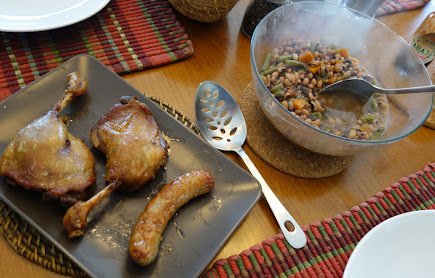
New Year's black-eyes, duck, and sausages

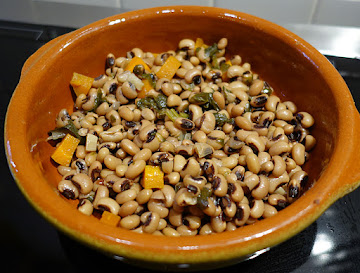
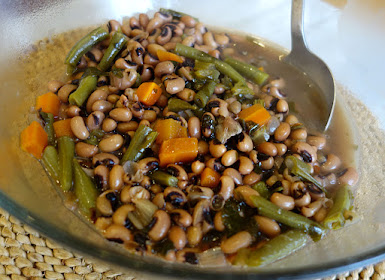
Yesterday I cooked my January 1 black-eyed peas in the slow-cooker for 10 hours. Also in the pot were a carrot,
a long stalk of celery with leaves attached, two big bay leaves, a large shallot, a garlic clove,
three dark-green leek tops, a generous amount of black pepper,
and a tablespoon of crushed hot red pepper.

   
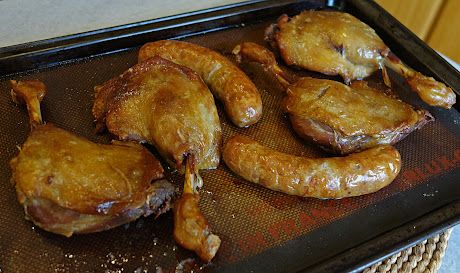
I bought the duck confit (cuisses de canard confites) at the supermarket in sous-vide packaging (vacuum-packed).
Four duck legs cost 10 €. The saucisses de Toulouse were raw, so first I poached them in water.
Then I put the duck legs and sausages on a baking sheet and browned them in a hot oven.

When the beans were cooked, I took out the carrot, shallot, and celery, chopped those up, the put them back in the pot
with the beans. I also put in a handful of cooked green beans cut into 1-inch pieces. For lunch, we each ate
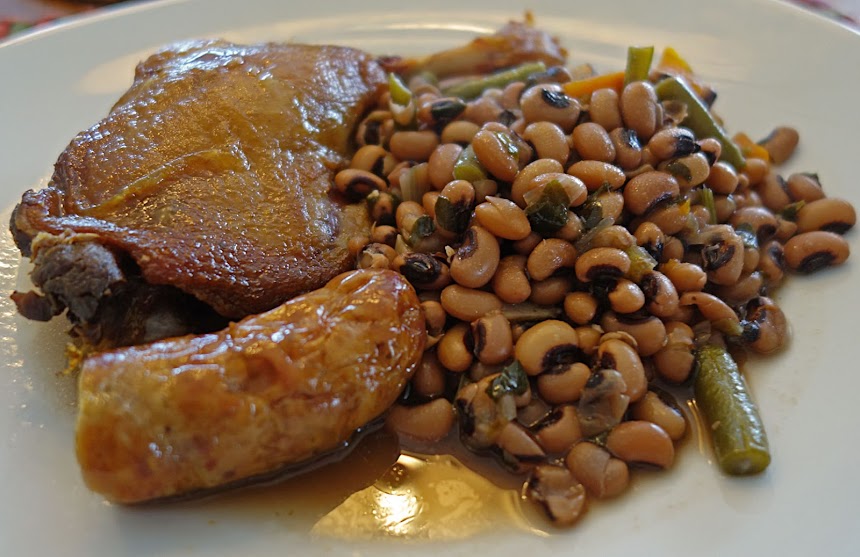
one duck leg-and-thigh piece, half a Toulouse sausage, and a good portion of the black-eyes as described.
We had a nice red Chinon wine (Cabernet Franc) with that.
Some duck fat went into the beans.

    Personally, I really enjoy black-eyed peas. I've eaten them since I was a child. Let me say, though, that I love all beans.
Black, red kidney, white, baby limas, butter, Soissons (giant limas), French flageolets, yellow wax, purple wax,
green beans, haricots verts, lingots blancs, haricots tarbais, cranberry, chickpeas (garbanzos), navy,
crowder peas, field peas, cowpeas, lentils, pink, pinto... which ones have I forgotten?
I'm glad I don't have to choose to eat just one variety of bean to like.
And I eat black-eyed peas year-round, not just on New Year's Day.
I guess I qualify as a lucky guy.

27 November 2009

Bay Bolete? Porcini? Cep?

I hope that your Thanksgiving Day was a good one, and that your Thanksgiving dinner was delicious if you had a special one.

Ours was very nice. S. the Englishwoman, now a good friend, and U. the German woman, a new friend, arrived about 12:30. We had some sparkling dry Vouvray wine, to which we added some home-made black currant (cassis from our garden) liqueur, as our pre-dinner drinks. I made prunes wrapped in bacon, cooked in a hot oven for a few minutes, and Walt made smoked salmon roll-ups filled with céleri rémoulade, for our apéritifs. Life is good.

Haricots panachés — flageolets and haricots verts —
are especially good with lamb.


The lamb might have been considered a catastrophe by some French chefs. It didn't come out as rare as I thought it would. That said, it was delicious — pink on the inside, crusty on the outside, with a good pan sauce made from the leg of lamb's cooking juices, some bay leaves, thyme, rosemary, garlic, and shallot, with white wine.

The quality of the cooking was what it was, but the quality of the lamb was beyond reproach. S. said it was the best lamb she had eaten in many years, and I'm sure she was being sincere and not trying to flatter anybody but the butcher. The young butcher in Saint-Aignan really seems to know what he is doing.

Bay Bolete? Or Porcini?

U. brought us a gift, since it was her first time at our house. She went out into the forest south of Saint-Aignan, which she says is owned by the people who live in the château, and she picked mushrooms. They are beautiful, as you can see from the photos. U. also brought a nice bottle of Bordeaux red wine.

They look good enough to eat!

For the first time in my life, I'll take mushrooms to the pharmacy to have them more precisely identified. U. eats them, she says, so I feel 99% sure they are safe — not toxic. The one thing that surprises me is that they have yellow spongy materiel under the caps, not gills. But I see pictures in books and on the web of good edible mushroom that have the same.

See the greenish-yellow spongy stuff?

I believe, from reading my Larousse guide to champignons, and looking at this Wikepedia article in French, that these are champignons of the variety called bolet bai. That's the Bay Bolete in English. Wiki says they are good eaten young, but these don't look so young to me. I'd better find out more before doing anything with them, and they say the pharmacist can tell you.

Whiter caps and browner caps

Here's why it's so hard to know: these mushrooms look exactly like the one in this photo I also found on Wikipedia, and it's supposedly a Boletus edulis var. grandedulis, which would make it a Cèpe de Bordeaux, one of the best mushrooms you can eat.

Tomorrow: roast goose cooked by some French people we've met over the past month. They live over in Montrichard, and we are going for lunch. I bet it's going to be good.

06 October 2025

Pork and beans

This might not be what you think of when you hear the name "pork and beans." As I said yesterday, I made pulled pork over the weekend. On Saturday, I cooked a very lean 2.5 lb. pork shoulder roast for 8 hours in the slow cooker, with a lot of spices and about half a cup of vinegar. When the meat was tender, I took it out of the cooker and let it cool overnight. I warmed it up just slightly yesterday morning and pulled or shredded it. In French, this is called un rôti de porc effiloché. You could do the same thing with turkey legs, discarding the bones, cartilege, and skin. Just below, you can see what the pulled pork looked like.


I had found some haricots plats (Romano green beans) at the supermarket for the first time in a while. They are a variety of haricots verts (green or string beans) and I like them a lot. You could substitute other green beans or even a different green vegetable.

After trimming the beans and blanching (par-boiling) them, I melted some duck fat (you could use butter, vegetable oil, or some other fat) in a frying pan and heated up the beans and some pulled pork in it.

To round out the meal, instead of cooking pasta or potatoes, for example, we decided to make a pan of corn pone to have with the pork and beans. That's a style of corn bread. It all went together very well, I think.

02 August 2012

Chores and payoffs

We've just had two nice days for garden work, despite predictions of rain from the weather services. Tant mieux. We've tried to take advantage of good conditions to get outside and get things done.

Still tilling up garden plots for planting in August

It's a little strange to be tilling up garden plots in August. Usually all that work is done in April or May. This year, though — almost out of necessity — we'll try to have a fall crop of carrots, white radishes, greens, and chard. If mother nature cooperates, we'll be harvesting in November or even December.

The tomato plot seems to be healthy despite damp conditions.

But not all the summer crops are failing, by any means. Neighbors and friends around the area have been telling us that their tomato plants either aren't bearing fruit or that the tomatoes themselves are diseased because of dampness. Ours are doing fine, and we even have a couple of big tomates out there that are starting to turn red — not to mention dozens of green ones that look healthy.

Thank goodness for the rototiller. Getting it repaired
and serviced in June was a good thing to do.


Yesterday afternoon some friends came over for apéritifs and we took them on a garden tour (at their requiest) before they left to drive home. Walt pointed out an aubergine (eggplant) that I hadn't yet seen, and we noticed quite a few poivrons — long sweet peppers and bell peppers — on the plants nearby.

A first harvest of cocos plats and a few haricots verts

And beans! The long flat Romano beans Walt planted are really bearing fruit right now. They're called haricots cocos plats on the markets and at the supermarkets around Saint-Aignan, and they can be really delicious (and expensive). We picked a pound and a half of them, 700 grams, a couple of days ago, and we're having them for lunch today. That's just the beginning of the payoff from garden work, we hope.

08 July 2014

Haricots verts à l'italienne

There have been major problems with the TGV in the "chunnel" since yesterday morning. An electrical problem immobilized a train in the tunnel yesterday morning. Nearly 400 people had to be evacuated through an emergency side-tunnel. Trains from Paris to London were delayed or had to be canceled.

Walt just saw a post our friend Peter left on Facebook. He and Jill left Saint-Aignan yesterday morning at 7:15, and they finally arrived in London 12 hours later — four or five hours late. But at least they made it. Meanwhile, Walt and I were resting at home after a very busy weekend. I went to three restaurants in three days, and we prepared dinners at home on Thursday (grilled chicken breasts and salade macédoine) and Saturday (raclette).


Yesterday, I needed to cook some green beans I had bought for the weekend but hadn't used. They were the wide, flat beans called haricots cocos plats in France — I think they are known as Romano beans in America. I decided to cook them Italian-style, with tomatoes and onions, since I also had a few fresh tomatoes in the kitchen.


Here's the recipe I like. It's from the book Cuisine pour toute l'année (1969) by a woman named Monique Maine. The book has been my favorite French cookbook for nearly 35 years. I'm translating:

Green Beans Italian Style

750 g (1¾ to 2 lbs.) fresh green beans
500 g (1 lb.) fresh tomatoes
4 small onions
1 clove of garlic
thyme
salt and pepper
30 g (2 Tbsp.) butter
1 Tbsp. oil

Wash and trim the green beans. Cut them into pieces if you want. Wash and trim the tomatoes
and cut them into halves or quarters. Peel and slice the onions. In a big pot, melt the butter
 with the oil and cook the tomatoes and onions for a minute or two on medium-high heat.
Add the beans to the pot with the garlic clove, salt and pepper, and some thyme.
Pour on a half cup of water. Cover the pot and let the beans cook
for about an hour on medium heat.

You can reduce the cooking time if you like the beans crunchier. I used only olive oil (3 Tbsp.) instead of part butter and I used our dried, garden-grown oregano instead of thyme this time. I also added some mushrooms we happened to have in the fridge. We'll be having half the beans for lunch today, with escalopes de dinde. The rest of the beans go into the freezer for later.


The weather here is lousy right now. It feels downright chilly this morning, and the weather woman on Télématin just said that the high temperatures today will be much lower than seasonal averages. It's raining in different places around the country, but not in Saint-Aignan for the moment. The plate of hot green beans with tomatoes and onions will be good comfort food.