Showing posts with label markets. Show all posts

24 July 2007

Un temps exécrable

Exécrable. That's a nice word, isn't it? Well, "nice" might be a strange way to describe a word that is synonymous with mauvais, dégoûtant, and déplorable. That's the modern sense in French, according to the authoritative French dictionary, Le Grand Robert.

An older, now-literary meaning of exécrable brings up these synonyms in Le Grand Robert: abominable, détestable, horrible, maudit, odieux, repoussant, and répugnant. I'm not very literary, but I'm sure I could find ways to apply all these terms to the weather we've been having since early May.

Notice the chaise longue beckoning. I guess we need to
buy a tent to put over it, since it rains every day now.


Will we always remember this summer as the one with the weather that Callie brought us? This was the summer we were going to spend on our new chaises longues out in the garden, where Callie could do less mischief than in the house. Ha! We bought those chaises in April, the last month when our weather was decent. Good purchase, eh?

At least we're not in western England, where towns including Tewkesbury and Gloucester are experiencing the worst flooding anybody there can remember. Our friend Janet's daughter and son-in-law live in Tewkesbury. Actually, the daughter, Corinne, is here in Saint-Aignan right now. The other day she said her house is on high ground and not in much danger of flooding. I'll have to call her today to see if she was right. Her husband is back there; I imagine him piling sandbags up around their residence.

Yesterday about 6:00 p.m., looking west over our garden.
Corinne from Tewkesbury doesn't have to feel like she missing out
on rainy weather back in England while she's here in Saint-Aignan.


We've now had 51 mm, just about 2 inches, of rain in July. That's more than we had in December, or January, or February, or April, or May. But it's less than half of what we had in June. So we're doing pretty well. Summer is bound to start any day now.

We had hard downpours all day yesterday, and collected 15 fresh millimeters of water, over half an inch, in the rain gauge.

************

On a more positive note, Sunday afternoon was beautiful. About 7:30 p.m., a hot-air balloon floated right over our house. In past summers, we had balloon sightings several times a week. This year, the weather has not permitted...

Notice the French tricolor flag hanging off
the left side of the montgolfière.
22 July 2007

************

Saturday morning I was able to go to the outdoor market in Saint-Aignan, dodging raindrops as I moved from one stand to the next. I didn't need much. Walt was making pizzas for lunch, so I went to see the mushroom lady and got a pound of nice brown champignons. I looked at some produce stands, inspecting the melons and haricots verts and just shopping. Nothing really appealed.

Suddenly, I noticed that there was only one person — one! — in line at the cheese stand. I couldn't believe it. Normally, the line stretches around the block (American image) and the wait is long.

The cheese stand's wrapping paper. Chabris is about
15 miles east of Saint-Aignan on the banks of the Cher.


I ran over and bought some cheese. One thing we can get from the Saturday morning cheese vendor is parmeggiano — the supermarkets here don't carry it except in its grated form in little plastic bags. I also snagged a demi-sec goat cheese (known locally as un bleu) and a heart-shaped Neufchâtel, a salty cow's-milk cheese from northern Normandy.

The little poem at the bottom of the fromagerie wrapping paper says:

"For the joy of your palate, not to mention your guests',
The counsel of the cheese specialist is surely not to be disdained."

11 June 2007

Artichokes

Do you ever cook and eat fresh artichokes? If you are in California, probably. Elsewhere, maybe not. Most of the artichokes grown and sold in the U.S. come from the northern California coast, I believe. In France, a lot of them come from Brittany, which has a similar coastline as far as geography and climate go.

But even here in Touraine, our neighbor François, who lives down at the end of our road where it joins up with the highway, has six or eight huge artichoke plants in his garden. His plants are about four feet tall and are covered with big artichokes — there must be at least two dozen of them. I'll have to go take a picture.

Our artichoke plants are just starting to grow now.

We planted artichokes ourselves a month or so ago. They are starting to grow. I hope they have put down a lot of roots by now. Somebody told us not to expect them to produce any artichokes the first year, so we won't. We have five plants, and maybe we'll get a good crop in 2008, if the plants survive the winter.

Yesterday morning I went shopping at the SuperU supermarket in Saint-Aignan. I noticed these big globe artichokes in the produce department, and I bought two for our lunch today. Each one is about six inches (15 cm) in diameter.

Artichokes from SuperU in Saint-Aignan

A year ago we were in Paris in the springtime. One day we took a walk around Les Halles. On the rue Montmartre, near the church called Saint-Eustache and not far from the famous restaurant called Au Pied de Cochon, there was a street market set up to sell produce, meats, and other food products.

I noticed that one vendor had beautiful globe artichokes on his stand. They looked pretty much like the ones I bought at SuperU this morning. We were staying in an apartment near Arts et Métiers and eating most of our evening meals there. The artichokes looked like something good to fix for dinner, steamed or boiled and eaten warm or cold with vinaigrette or mayonnaise.

So I approached the vendor's stand and said I'd have two artichokes, s'il vous plaît. The man picked out two nice ones, weighed them, and dropped them into a plastic bag. That'll be 29 euros, he said.

Twenty-nine euros!
I was flabbergasted. That's nearly $40.00 U.S., for two artichokes. How ridiculous can you get? I told the man that they were far too expensive, and said I'd changed my mind.

He acted like he was offended. "I'm glad most of my customers aren't like you," he said in French. I told him I was sure he was glad of that. He was ripping people off big-time if he was selling any artichokes at all at that price.

The lesson: in a French market, don't be afraid to say you've changed your mind if you are surprised at the high price of some item you thought you wanted to buy. And buyer beware. You won't be able to bargain — that's not really the custom in France — but you can always just say no.

How much did I pay for the two artichokes I bought at SuperU this morning? Well, they were 90 eurocents apiece — that's about $1.20 each, or $2.40 for the both of them. Compare that to nearly $40 for two artichokes at the market in Paris.

25 April 2007

Paris: Izraël & le Marais

After our sushi lunch in the Japanese restaurant at Sèvre-Lecourbe last Friday, we drove over to our hotel, an Ibis at the Porte de Gentilly, to check in. We've stayed there many times since 2003, and when you are with car in Paris it's very handy and inexpensive. Not charming, I guess, but clean and comfortable. The rates: 55 euros a night on weekends — with the moribund dollar, that's $75.00. Not bad. And the parking is free, on the street.

We didn't linger at the hotel because we had told our friends Chris and Tony we'd come to their apartment in the Marais at 3:00. We drove up there and around the block a couple of times looking for a parking place. The Marais is a very densely built-up neighborhood and street parking is scarce. I was about to give up and head for an underground garage when I noticed what looked like a half-space right on the Place des Vosges.

Well-stocked shelves at Izraël, l'Epicerie du Monde, in the Marais.

The Peugeot 206 is pretty small, but this was going to be tight. I backed in and nudged backward and forward five or six times. It fit! We had about three inches between our bumpers and the bumpers of the cars in front and in back of us. We paid the meter — two hours maximum — and headed out on foot. We were only steps or so from our friends' rental apartment at the corner of the rue de Turenne and the rue des Francs-Bourgeois.

Our plan was to walk over to the shop called Izraël, which specializes in exotic products and ingredients, to look for some spices we and Chris & Tony wanted to buy. Izraël, l'Epicerie du Monde, is at 30, rue François-Miron, very close to the intersection of the rue de Rivoli and the rue Vieille-du-Temple. As you can see, everything there was beautiful and appetizing. They carry products you'd have a hard time finding elsewhere in Paris. Check out this blog for more pictures and information; it's in French.

We have walked by there a thousand times over the years and I had never noticed the Izraël shop before. Right next door to it is a wine shop, and I know I've bought wine there several times in the past — including some California wine for French friends one year.

It just goes to show you that you can walk right by a place many many times before you ever focus on it. That's the beauty of Paris — there is so much there (I almost said "there there," if you know what I mean) that you can never know it all. There's always a new discovery around the next corner. I've had friends who lived nearby and spent time in this neighborhood since the late 1970s!

Walt and I were looking for a smoked paprika from Spain to use in our cooking. We wanted hot smoked paprika (fort), but Izraël only had the mild (doux) version. Fine; we can add some hot unsmoked paprika to it, or some ground cayenne pepper. We bought a good supply of the smoky stuff.

Chris & Tony were looking for a ground hot pepper powder they had gotten as a gift from a friend who brought it back from the Ivory Coast in Africa. They didn't have a name for it. They said it had a deep, rich flavor that you don't get with ground cayenne or other hot pepper powders they've been able to find in California.

The staff at Izraël recommended the North African spice blend called harissa — in powder form, not the paste you normally eat with couscous. They bought some and will try it when they get back home.

We had walked from the Place des Vosges over to Izraël's shop, and we walked on to the Bazar de l'Hôtel de Ville after that. It's not far. Walt had a specific item he was looking for, and he found it. After that success, we walked back through the rue des Rosiers, the heart of the old Jewish neighborhood that is the Marais. We noticed that Jo Goldenberg's restaurant there, a real landmark, has closed down. The storefront was empty.

Another Marais landmark, L'As du Fallafel — people queue up

Our two hours were up and we had to go move the car. We walked back up to Chris & Tony's apartment — a nice studio just one floor above street level but with double-glazed windows that closed out street noise very effectively — to drop some things off. Then we walked over to the car and went for a drive around the city.

Façade of a building on the rue des Rosiers in the Marais

We drove over to the 13th arrondissement to buy some things in a big Asian supermarket, and then drove up the Champs-Elysées and around the Arc de Triomphe on our way out to La Défense.

14 April 2007

What we got at the market today

We went to the outdoor market in Saint-Aignan this morning and here's what we bought.

Click the picture to see it in full size

Strawberries: these are locally grown (in the Sologne) and are called gariguettes. They are not the same strawberry variety as the ones you get in California, which are, according to what I've read, the same ones they grow in Spain and export to France and the rest of Europe. The gariguette strawberries are sweeter and juicier — as a general rule, anyway. Strawberry season is just beginning here.

Fraises, pain, et asperges

Asparagus: these are also local and in season. They are asperges blanches, white asparagus. We buy them from a man who sets up a table right next to Mme Doudouille's stand. I think the man who sells the asparagus also grows them, and his prices are good (€6 a kilo right now — that would be $3.50 a pound or so with a euro at $1.35, if you can believe that). The ones he had for sale today were just beautiful.

Jambon de Savoie en tranches

Ham: the slices of ham come from Mme Doudouille (yes, she is still here — it's a long story). They are slices of jambon de Savoie, ham from the Savoy region in the Alps — what is called jambon cru, raw ham, in France. Walt is going to use them with the asparagus...

Navets nouveaux — spring turnips

Turnips: these are baby turnips that one of the farmers brings to town to sell. I don't yet know what I am going to do with them, but they looked good.

Bread: the baguette was delivered, before we went to the market, by Roselyne the bread lady. It's made every morning by the baker in our village.

Le rôti de chez le volailler

Roast:
the little rolled roast is a rôti de pintade farci that we bought from the poultry vendor, or volailler, whose stall is right across from Mme Doudouille's charcuterie stall. That's a stuffed guinea-fowl roast. The woman behind the counter said it was stuffed with ground poultry (could be chicken, turkey, or guinea fowl, I guess) and herbs and spices. Volaille means fowl, and the volailler (vuh-ly-AY) is the person who sells poultry.

I'm cooking the roast right now. Here's what it looked like a few minutes after going into the oven.

Rôti de pintade farci — stuffed, rolled guinea-fowl roast

And here's a scan of the paper that the roast was wrapped in. These poultry people are the ones who agreed to pluck a pheasant for me a couple of years ago when our neighbor gave us one he had shot. I like to buy from them because they were so nice about that, and did it for free.

Volailles = fowl, poultry
Lapins 1er choix = "grade A" rabbits
Fromages de chèvre = goat cheeses
Markets: Fri. Montrichard, Sat. St-Aignan

These are also the people from whom I bought a rabbit last weekend. I'm still working on a posting about how I cooked that rabbit.


25 February 2007

Beans for lunch, crosnes for dinner

Yesterday, Saturday, was a full day. We started it in the morning, between rain showers, with a trip to the farmers' market in Saint-Aignan. We had three meals in the planning: Saturday lunch, and then lunch and dinner on Sunday. I've always said that life in France is essentially planning your next good meal. Whatever else you do is just filler.

Peter Hertzmann is visiting for the weekend. He's the cook, and the food is excellent. Have a look at his web site, which is called A La Carte.

Crosnes. They look a little like worms, don't you think?

At the market we found an heirloom vegetable that Walt and I have been wanting to try. These little corkscrew-shaped roots are called crosnes in France, and Japanese or Chinese artichokes in English. The French name apparently comes from the name of the town in France where they were first cultivated, Crosne, which is near Orly, just south of Paris.

The woman who was selling them said we should trim off the little rootlets and then wash the crosnes well to remove any sand. Then rub them in a towel with some coarse salt to remove some of the skin, which on these looks to be pretty thin anyway. To cook the crosnes, you poach them in simmering water or broth for 10 or 12 minutes. Then you sauté them lightly with a little butter and parsley, adding some cream if you want. Un peu de crème ne gâche jamais le plat, the woman at the market said. She said to serve them with grilled meat — pork chops or veal cutlets, for example.

Big flat green beans that Peter will cook with tomatoes and onions

What else did we buy at the market? Some mushrooms from the mushroom lady, some chicken breasts and eggs from one of the poultry vendors, some sausages from Mme Doudouille, and some Brussels sprouts from one of the vegetable stands.

Yesterday Peter cooked a mushroom and cheese omelet for lunch. Today we'll have chicken breasts and green beans (from the supermarket) for lunch, and then sausages with crosnes and Brussels sprouts for supper. (Some of you are interested in this level of detail about food, I believe.)

A bakery in the town of Levroux

After lunch yesterday, Peter and I drove over to Valençay to see the château there. It's about 25 km from Saint-Aignan. Peter was especially interested in seeing the kitchens there, which were once managed by the famous chef named Carême. Unfortunately, the château de Valençay was closed for the winter. It re-opens on March 25.

We then took a drive south to the town of Levroux, where we walked around and took some pictures of the early Gothic church there. More of that in future posts. We drove on through the country, and even though the fields are very green, the weather was dreary.

L'eglise Saint-Sylvain à Levroux, près de Châteauroux

Last night we had dinner in the restaurant at the Hôtel du Cheval Blanc in the town of Bléré, near Chenonceaux. It's a Michelin one-star restaurant and was not disappointing. We ate fish and drank local white wine. More about that later too.

22 January 2007

Nice graphics from the shops

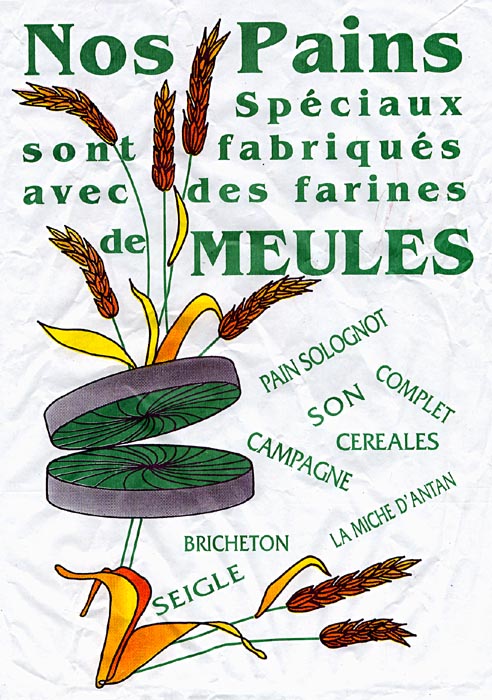
One of the nice things about shopping with the small merchants — boulangers, pâtissiers, charcutiers, and bouchers — in a place like Saint-Aignan is the beautiful packaging they use when they wrap up your purchases. Here's an example from a boulangerie in town.


I went there a couple of days ago to buy a galette des rois, the traditonal cake for the month of January in France. (See Walt's blog topic on La Fête des Rois.) The bag the cake came in had this graphic on it. It shows the ingredients you need — butter, sugar, eggs, almonds, etc. — and shows you what the finished galette looks like.

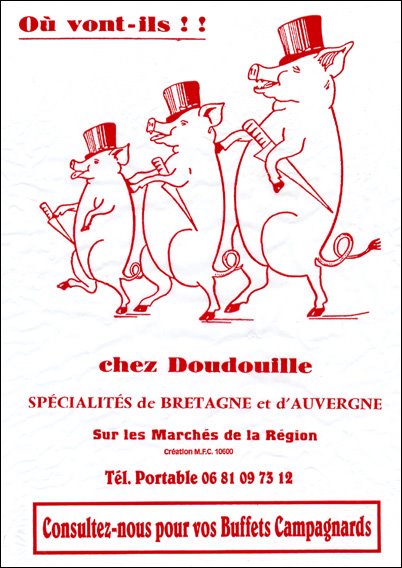
Here are packing examples from two charcutiers who sell their products at the Saturday market in Saint-Aignan, Doudouille and Hentry. I've posted these before.


And here's another example of graphics on packages from a boulangerie just across the rivers in Noyers-sur-Char.


Of course the wrapping paper is just paper. It's what's inside that really counts.

15 November 2006

More from the Intermarché ads

The Intermarché advertising flyer features duck this week, but there are of course other products on sale. Still, I just counted and there are 18 duck items shown in the brochure, including whole ducks, trimmed ducks, duck legs and breasts, terrines and pâtés, and tubs of fat. It's the theme.

There are almost no vegetables featured in the ads. I think that's because vegetables are just a given here, and because they are sold at market price, which isn't set in time for the publication of the ads.

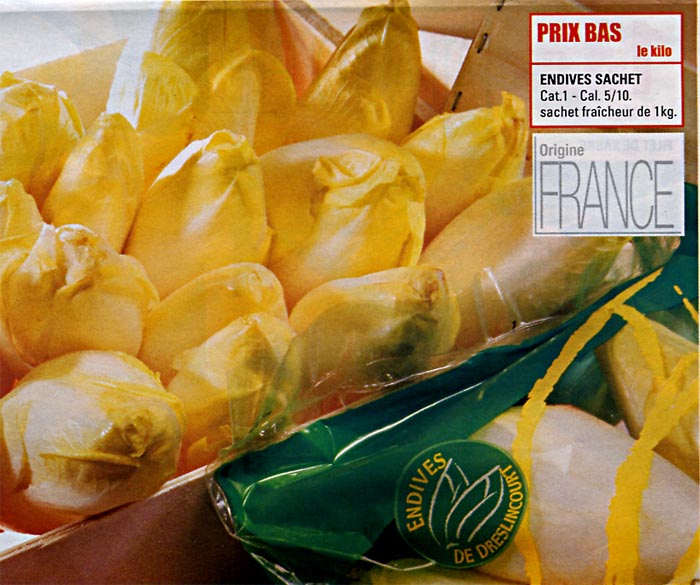
Endives for a low price (prix bas)

People buy vegetables, that's for sure, and there is always a good selection at Intermarché and the other supermarkets, not to mention in the outdoor markets. One vegetable that comes onto the market in the fall here is what we call Belgian endive in the U.S. Here it isn't a high-priced luxury product — it's standard fare. You can buy endives for about two euros a kilo, or a dollar a pound. These are grown in France.

This ad reminds me that I need to go buy some. There's nothing much better than gratin d'endives au jambon on a chilly winter day. It's endives braised, then wrapped in a slice of ham, and cooked in the oven in a cheese sauce. And here's another idea, using fish.

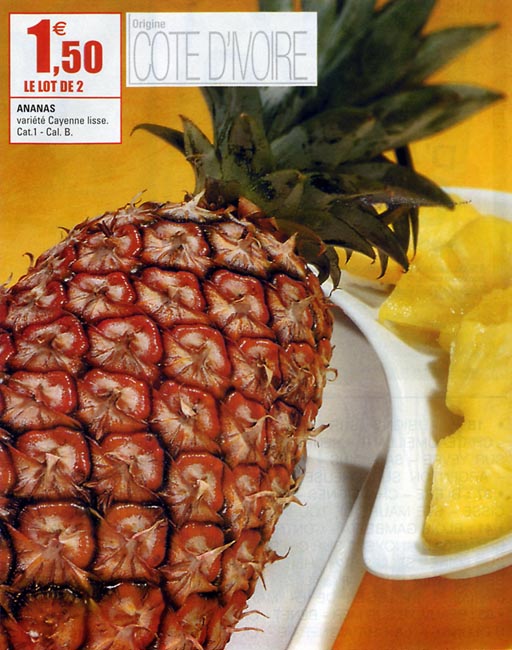
Pinapples for €0.75 each if you buy two

The situation with fruit is the same as with vegetables, but there is one ad for pineapples at Intermarché this week. They come from the Ivory Coast in Africa.

Do you want cheese with that? Here are a couple of cheeses that are on special this week.

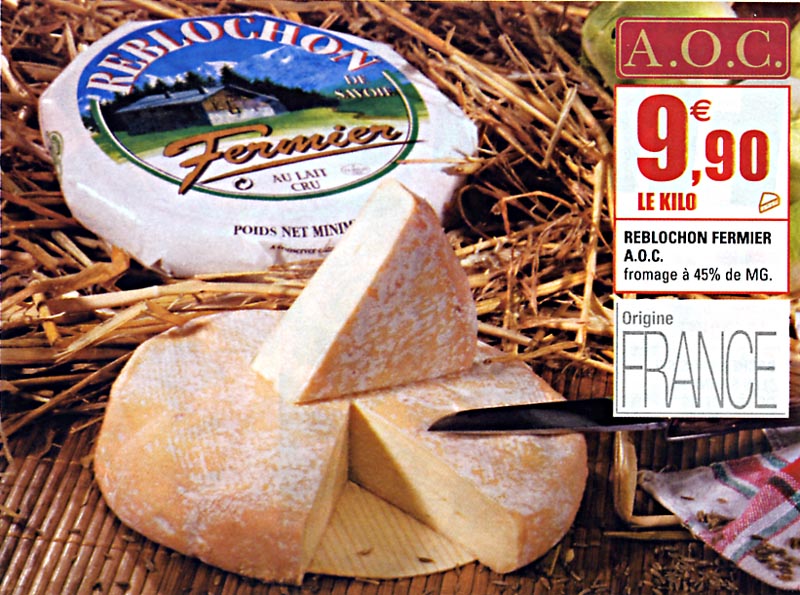
Farm-style Reblochon cheese for $5.85 a pound

Reblochon is a cow's-milk cheese produced in the Alpine region called La Savoie, on the border with Italy. Notice that this one is made from unpasteurized milk (lait cru, or raw milk). Using raw milk gives the cheese it a better, more natural taste, just like in the olden days.

Did you know this? When the label says that a cheese is 45% butterfat (matière grasse or MG), what it means is that if you completely dry the cheese out, so that there is no water left at all, then what you have left will be 45% butterfat and 55% milk solids. The amount of butterfat in the cheese when you eat it is actually much smaller than that — maybe 20%. Even so, don't overdo it. A little bit goes and long way, and it tastes so good.

Do American cheeses carry a label telling you how much butterfat they contain? I can't remember.

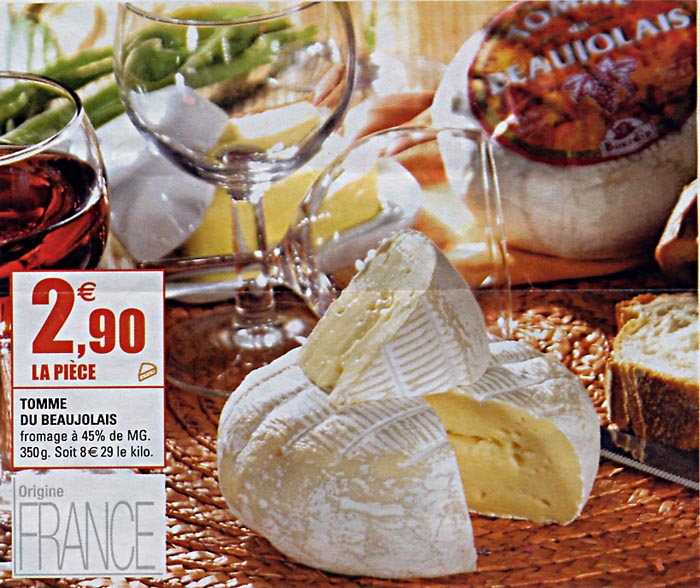
Tomme du Beaujolais at $4.89 a pound

I've never heard of Tomme du Beaujolais before, and it's not listed in my Larousse des Fromages, a cheese reference. It's also described as being "45% MG" so it contains the same amount of butterfat. It's produced in France and is made from pasteurized milk (since the label doesn't specify that it was made with raw milk). This is what is called an industrial cheese, because the label doesn't say it's fermier, or farm-style. It was made in a "factory" or big industrial dairy.

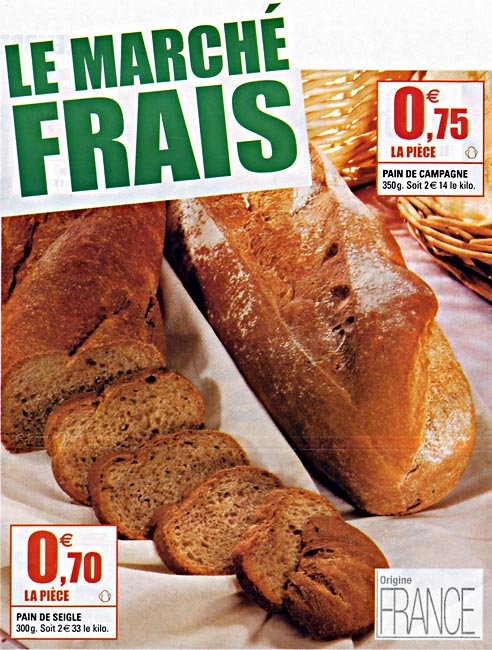
Rye bread for 90 U.S. cents a loaf, or $1.38 a pound,
or country-style bread for just a few cents less per lb.
even though the loaf costs more (it's bigger)

Here's some bread you can have with the cheese, country-style (campagne) or rye (seigle). I'd be more likely to buy rye bread to eat with raw oysters, with some sweet butter to spread on the bread. The pain de campagne — country-style bread — is a little coarser and probably healthier than the standard baguette made with white flour. The pain de campagne would be especially good with cheese.

It's time for lunch!

13 November 2006

La danse des canards

It's duck season. I'm glad I'm finally awake (I slept "on both ears" last night, as we say in French, for about 10 hours). Today the supermarket ads came in the mail. Intermarché sent a Marché frais — fresh products — flyer, and it's full of good seasonal food. A lot of it is duck.

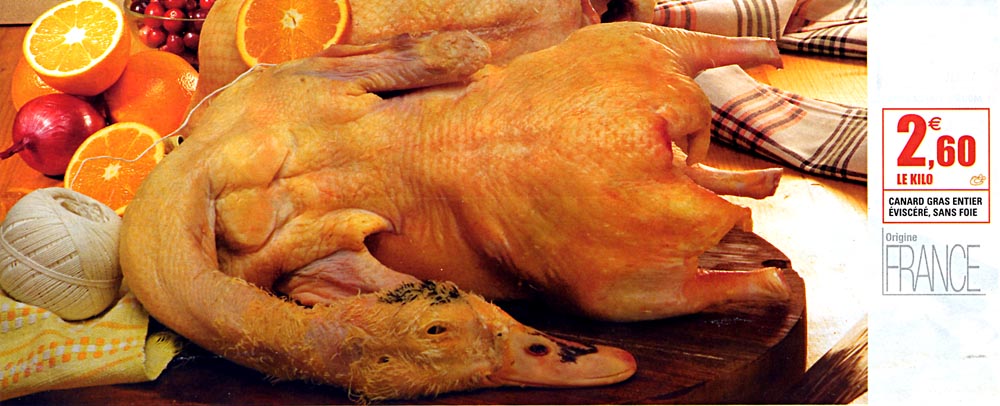
A whole fattened duck — canard gras — for a good price

The whole duck, eviscerated and without the liver, costs €2.60 per kilo — that's about $1.50 per pound. Of course, there's a lot of waste. The head for example. What can you do with that, besides maybe make stock?

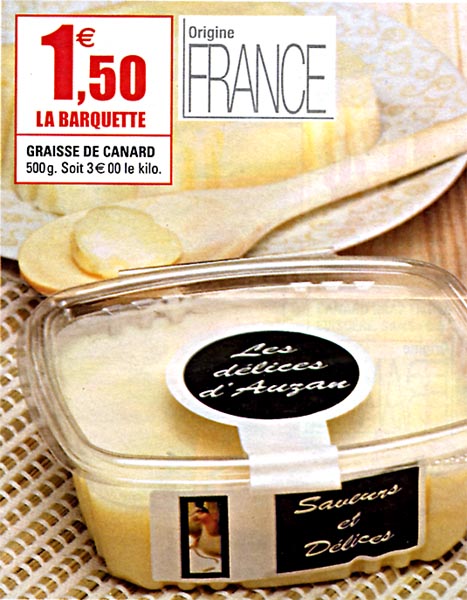
Duck fat — graisse de canard — in plastic tubs

A whole duck produces an amazing amount of fat when you cook it. The fat is very good for frying or sautéing potatoes, for example, or flavoring beans, greens, or other vegetables. If you don't have enough, you can buy some for just €3.00 per kilo, or about $1.75 per pound. A pound of duck fat goes a long way, unless you are very extravagant. It's cheaper than butter and, evidently, a lot better for you.

Goose fat and peppercorns at good prices too

If you don't relish the thought of eating duck fat, what about some goose grease? It'll cost you about 50% more, at $2.69 a pound. But you can make up for the high price by buying a few pounds of black peppercorns at just $2.99 a kilo, or $1.75 a pound. Do you realize how many peppercorns it takes to make a pound? A kilo of peppercorns lasts us at least a couple of years. What do peppercorns cost in those little jars they sell at Safeway or Food Lion in the U.S.?

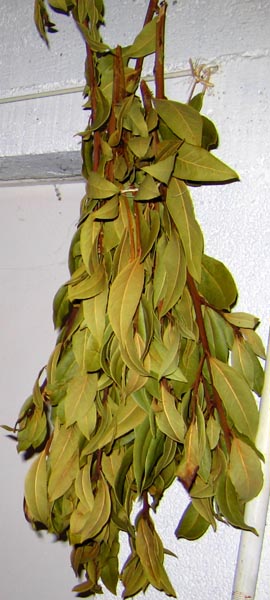
That reminds me of bay leaves. We have a bush in the back yard that produces thousands of the good, fragrant, aromatic European bay leaves every year. In the U.S., those little tiny vials containing 10 or 12 leaves that they sell in the spice aisle at the supermarket cost five or six dollars. Maybe we should go into business, since they are free here. And they are so good. I use them in all the sauces, stews, and soups that I make.

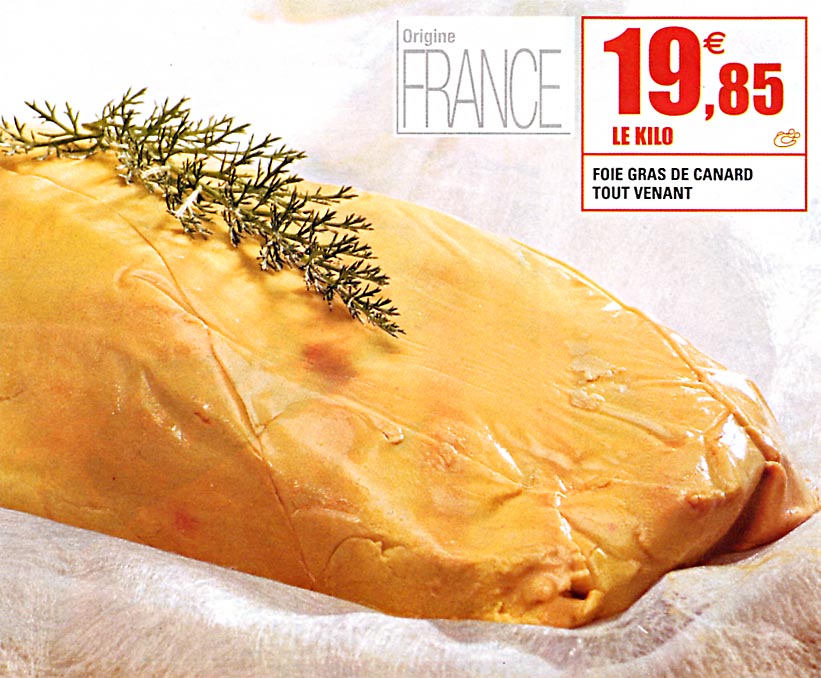
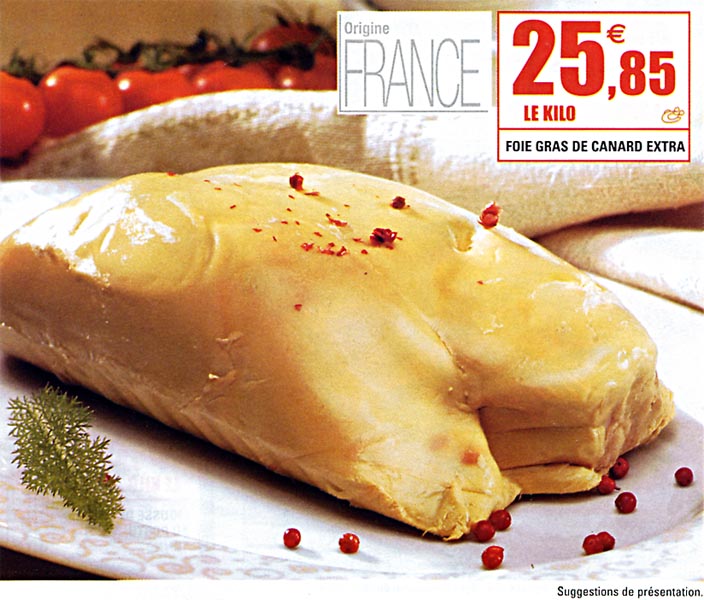
Finally, if you want duck foie gras — the enlarged liver of a fattened duck — there are two grades, ordinary (tout venant) and extra.

Ordinary duck foie gras, the liver of a fattened duck

Extra-fine duck foie gras

The little note at the bottom of the last picture says Suggestions de présentation. In other words, what you buy in the store might not look exactly like the picture shown. It certainly won't be decorated with those little red berries.

18 September 2006

Favorite haunts: Amboise and Vouvray

Yesterday I picked up Gabby and Margaret at their hotel in Saint-Aignan at 9:00 a.m. for our trip to the big outdoor market in Amboise. Unfortunately, it was raining. It wasn't a real rain — it was more of a mist or drizzle, and according to the weather forecasts it wasn't supposed to last. But there's nothing more discouraging than rain when your plan is to spend a couple of hours wandering through an outdoor market.
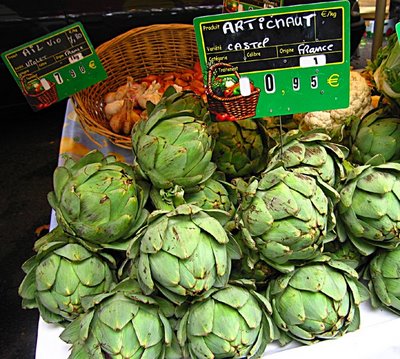
Artichokes at the market in Amboise

Because it was damp out, I figured we didn't need to be in any hurry to arrive at the market, which is about a 35-minute drive by the most direct route. Why not take a more scenic route and wait for the skies to clear? We drove through the wine villages of Mareuil-sur-Cher and Pouillé on the south side of the Cher river, and then we drove on over the one-lane bridge across the river into the village of Thésée-la-Romaine.

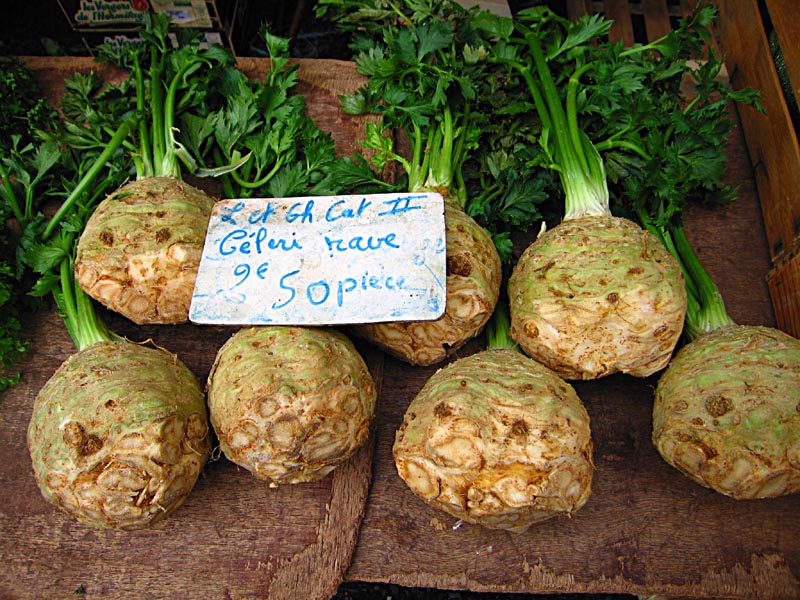
Have you ever eaten celery root?

At Thésée there are 1st-century, therefore Roman, ruins of an old ceramics manufactory. We stopped to see those. We drove on a few miles to the village of Monthou-sur-Cher, where the château du Gué-Péan (the paying ford, as in a place to ford a stream or river) is located. It's on a dead-end road about three miles off the main road, and on a misty gray day it appears to materialize out of nowhere in the middle of a green valley surrounded by forest.
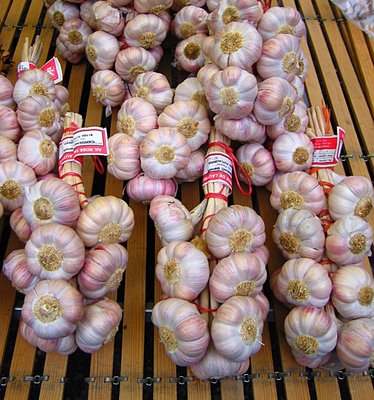
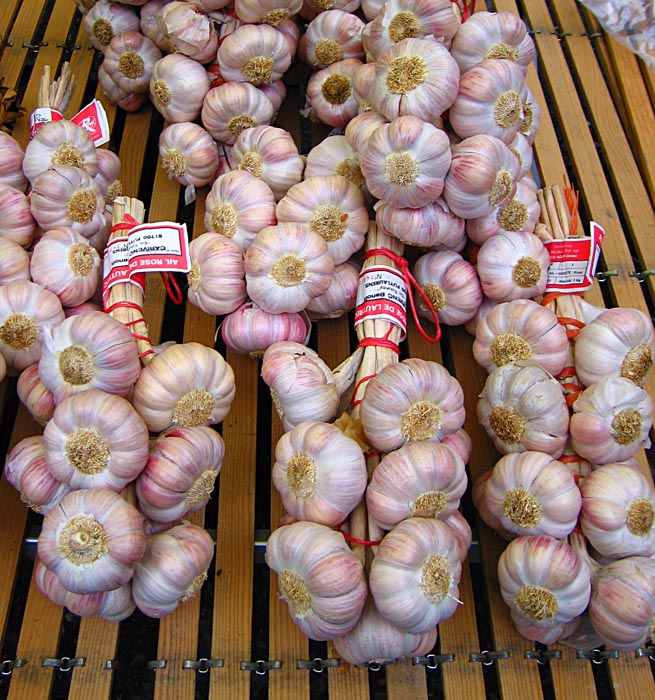
Needs more garlic, maybe?

After that, we drove on over to the town of Pontlevoy, where there is a big old abbey church. Instead of taking the road I know so well to go on to Amboise, I decided to take a detour through the town. I knew I could make a left turn a little ways in and get back on the road to Amboise.
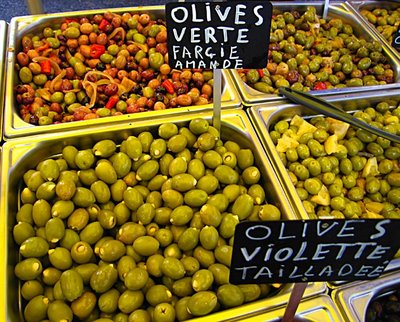
Olives are good at apéritif time

In the rain — it was falling harder now, and truly was rain, as the steady swipes of the windshield wipers proved — I of course missed the turn. We were on the road to Blois. Visibility was limited, and the clouds were so thick that even at 9:30 a.m. it seemed like late evening.

OK, I'll turn here, I said to G. and M., and this will get us back to the road we want to be on. I turned left, passed a couple of houses and then a farm, and found myself on a one-lane track going across flat fields that had recently been harvested. I was confident this little track would join up with the main road just mile or two on.

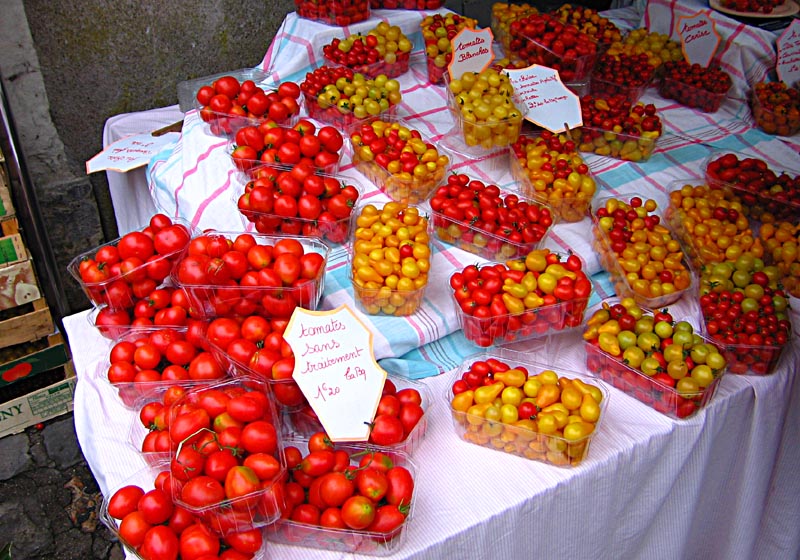
Cherry tomatoes

The road curved and curved, but I continued as the rain continued to fall. It wasn't getting any lighter. I came to a fork in the road, and as Yogi Berra advised, I took it. That is, I veered off the left, because that seemed to take us westward rather than northward.

A kilometer farther on, we noticed a big house on the right-hand side of the narrow lane, and then suddenly the pavement ran out and we were on a gravel path. It was wet, of course, with significant puddles. It didn't seem like a good idea to try it.

Gabby got out the map, and we stopped and studied it for a minute. None of the signs we had seen pointed toward any town or village on the map. So there was no choice but to backtrack. I did, and at least I was able to remember where we had come from. At a certain point, rising out of the mist I saw a grain elevator that I recogized as the one on the Amboise road leading out of Pontlevoy. I turned right, and very soon we came to a bigger road. I turned right and there was immediately a fork in the road, but this time with signage. Amboise left, Chaumont right.

We headed toward Amboise and the rain became just mist again. Vallières-les-Grandes and Souvigny-de-Touraine were right where they ought to have been (thank goodness), and at Souvigny I turned right onto a road that leads down into the Loire river valley. We coasted down the hill through some woods. The rain stopped and the sky lightened. And then there was the river, wide, flat, and low, right in front of us. We turned left on the river road and were in Amboise in 5 minutes' time. It was about 10:30.
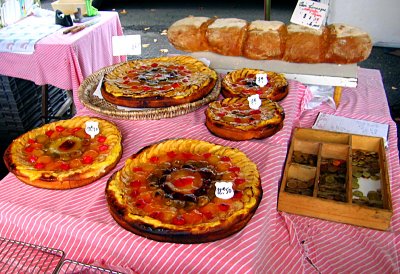
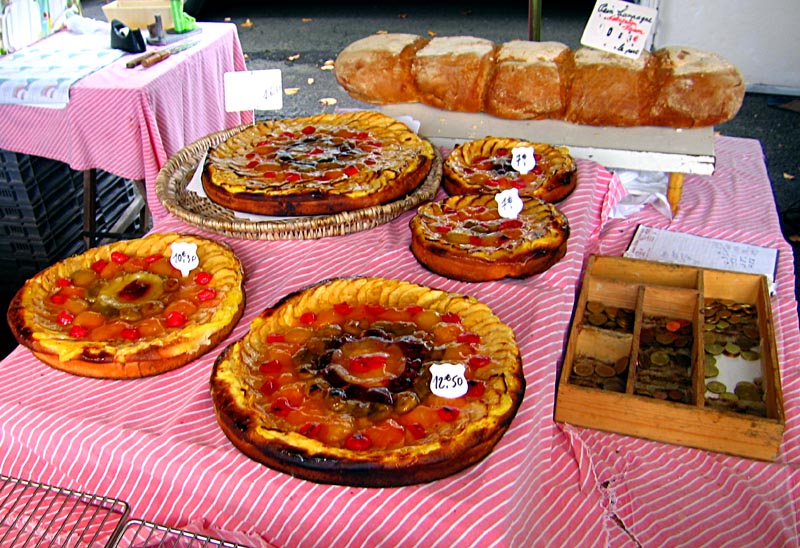
Tartes
{Parenthesis} It really is starting to feel like fall, or even winter, now. In summer it stays light until 11:00 p.m., and I'm hardly ever out in the dark. This past week, I've been out driving around in the dark (and I include yesterday morning in that) a couple of times. On Thursday night I was following my English friends home on a familiar road in Saint-Aignan when out of the dark, caught in the headlights, a group of gendarmes appeared waving flashlights and telling us to pull over. I thought it was a routine traffic check, but it turned out we were going the wrong was on a one-way road. With all the road work and detours around Saint-Aignan right now, some roads that weren't before have now been made one-way. You have to be really careful, especially at night when the signs are harder to see. I hate that sinking feeling you get when the cops pull you over — don't you? Luckily, after the gendarmes asked some question and checked our licenses, registration cards, and insurance papers, we got off with just a warning. {Close parenthesis}

At Amboise, we quickly found parking in the big crowded lot under the shade of rows of platanes (plane trees, so typical of France). We walked into the market where all the flowers and potted plants are being sold, and it was a festival of colors. The mist had stopped, the sky was getting bright, and the sun, even, was beginning to peek through.
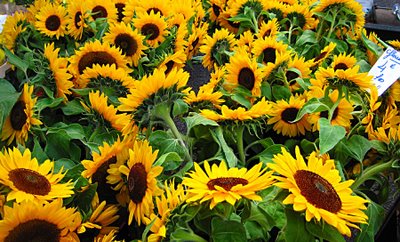
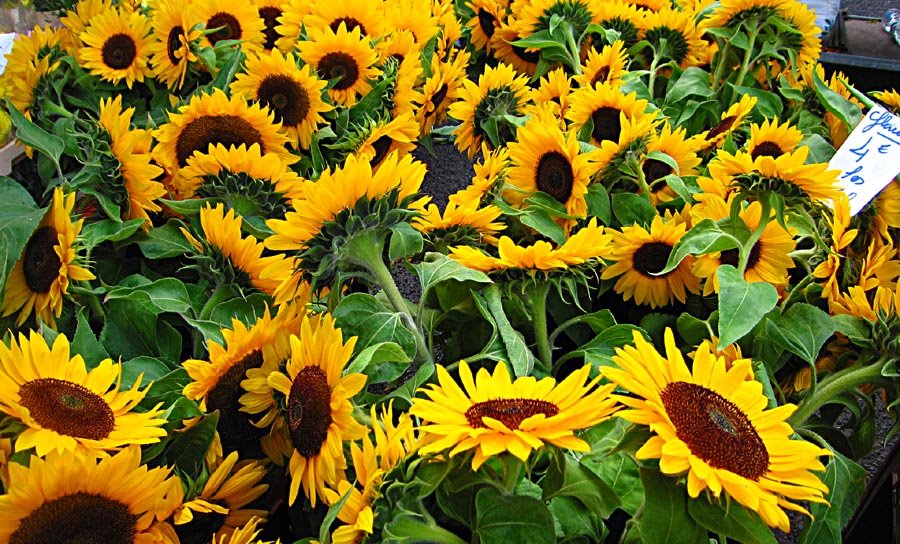
First there was rain, then there were sunflowers.

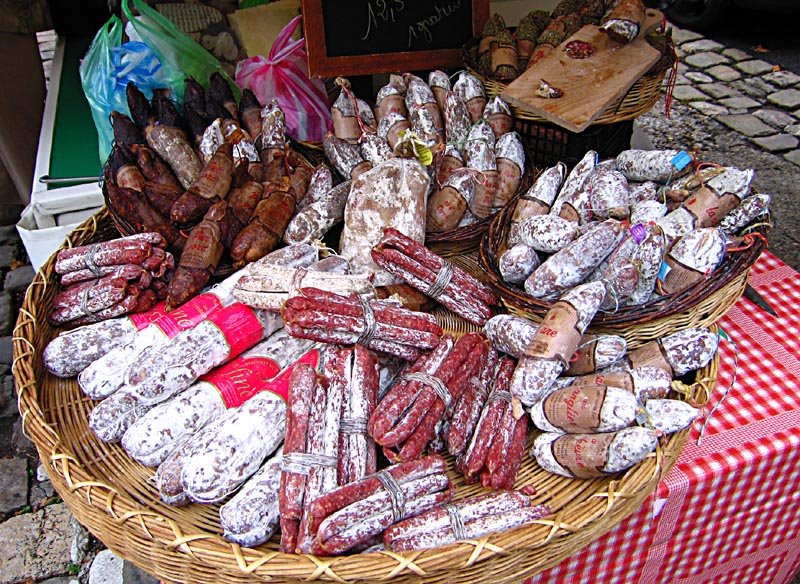
And then we wandered through the food stalls. That was what Gabby and Margaret wanted to see. After the gray gloominess of the morning's weather, the colors, sounds, and smells of the market were fantastic. We wandered from stand to stand, looking for free samples! The saucisson vendors were a good bet. They were all slicing off pieces of sausages and salamis and handing them to passersby in an effort to get people to buy some.
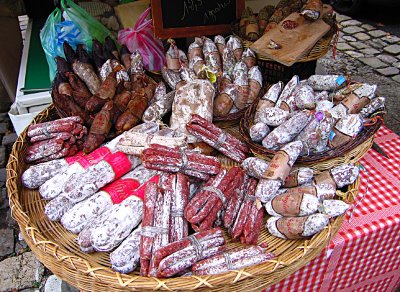
Saucissons et saucisses

Here was a plate of goat cheese slices set out for the tasting. And here some grapes or some olives. At one stall, Gabby picked up a bite-size pastry stuffed with sausage meat that she found in a little dish on a baker's counter. "It's good with the stuffing," she said. "Try one." I did, and it was good.

Margaret walked up and Gabby told her to grab one too. When M. reached out, the woman selling baked good saw her and said: "Hey, those aren't for tasting! They're 40 cents apiece." Uh-oh!
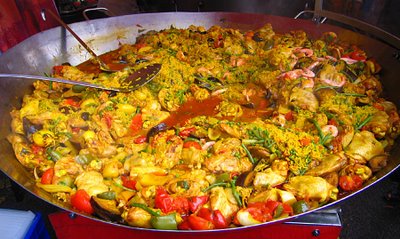
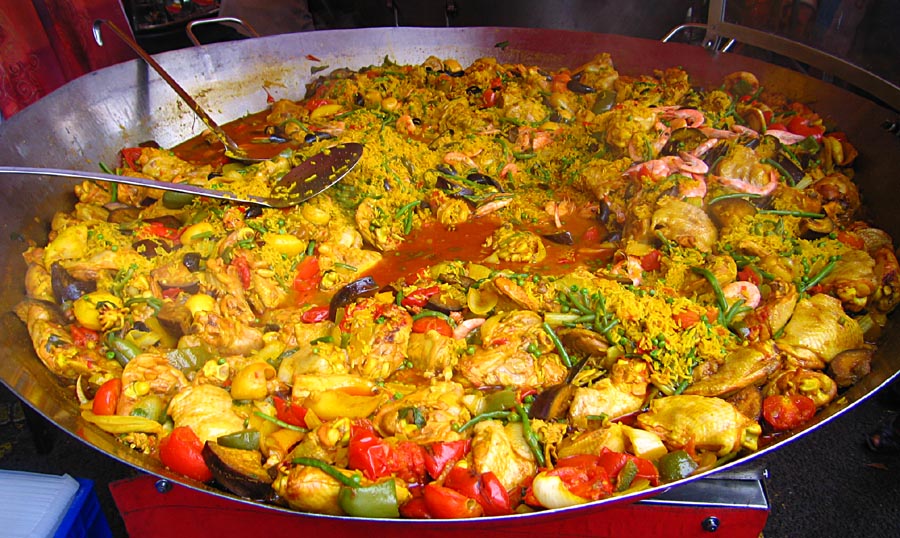
A lot of the local people must have paëlla for their Sunday dinner.


We bought some grapes, a little melon, a few peaches, and some olives. We mostly just looked at all the fish, meat, and vegetable displays, figuring out what things were called. Gabby's French is good, and she likes learning new words. The market wasn't nearly as crowded as I've seen it in the past. I supposed the morning's drizzly weather had kept some people away, though it was sunny and nice by the time we finished our perusal. It was all very pleasant.

After Amboise, we headed over to Vouvray, stopping to taste some wine in Montlouis along the way. At Vouvray, I headed, as usual, straight to the Aubert wine cave in the area called La Vallée Coquette. It's rustic, agricultural, and always open. The wine is excellent. We tasted some dry vouvrays, a 1998 and a 2004. G. and M. bought a bottle of each, and I bought three bottles of sparkling vouvray for Walt. It's what he likes.

Margaret and Gabby at Chenonceau, 17 Sept. 2006