Showing posts sorted by relevance for query steak au poivre. Sort by date Show all posts

22 December 2012

Steak au poivre, sauce au cognac

Steak au poivre has been Walt's birthday dinner since 1981. I wasn't there for the very first one. He was  traveling around the south of France with some friends in December that year. In Antibes, on the Mediterranean coast, he had a steak au poivre in a restaurant on his birthday and thought it was really delicious. Memorable.

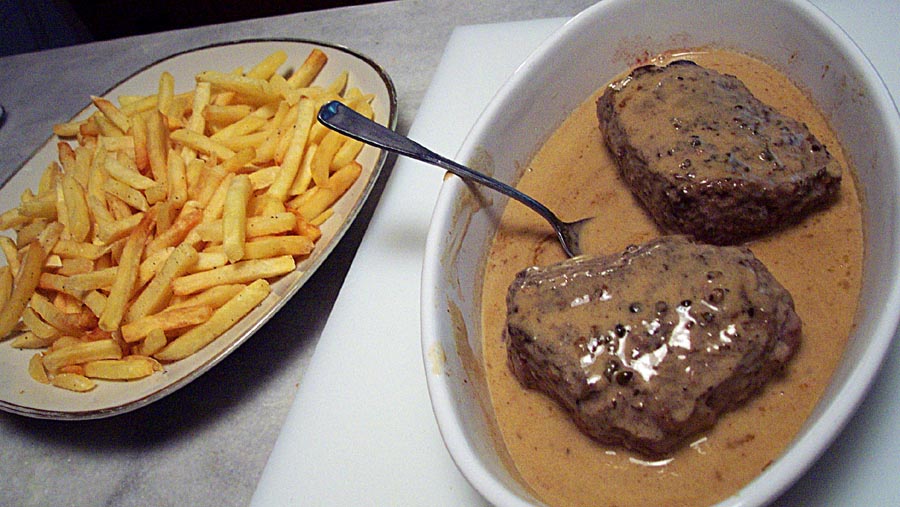
Steak au poivre garni de pommes frites

A year later we were both living in Washington DC when his birthday rolled around again. I told him I'd cook dinner. He told me about the steak au poivre in Antibes. I told him that I knew how to cook that — no problem. That was what we had for his 1982 birthday dinner. And we've made steak au poivre on December 21 every year since then.

A dry rub of crushed black pepper
In most years we've made the pepper steak with a cream sauce, which was my recipe in the 1970s. Then in the '90s we watched a Jacques Pépin (a well-known French cook and TV host who has lived in America for decades) and Julia Child (the American woman who introduced French cooking methods to America in the 1960s) cooking show in which Pépin makes his version of steak au poivre not with a cream sauce but with a sauce finished with butter. That's what we made this year (last year we made the cream sauce style — both are good).

We got a big, fairly thick piece of boneless entrecôte from the drive-up butcher this week — that's the cut known in different parts of the U.S. as rib-eye, New York strip, Delmonico, or club steak. To make French pepper steak, the first thing you do is crush some peppercorns using a mortar and pestle to make what is called a mignonnette de poivre. Then you rub the coarsely ground pepper all over the steak and let it sit for a couple of hours.

Sear the peppered steak on both sides in a heavy pan over high heat

When you're ready, you just sear the steak in butter over high heat in a thick-bottomed frying pan. Then take it out and cover it with foil and a kitchen towel, or put it in a warming oven, and let it rest for 10 or 15 minutes while you make the sauce.


Dice up a shallot and toss it into the pan that the steak cooked in. Let it fry for a minute or two, and then pour a good glug of cognac (or whiskey) into the pan. You can flame it, but it's not absolutely necessary. You can also use white wine instead of cognac to make the sauce (but it won't be as good, IMHO). Let the alcohol or wine reduce a little over high heat, and then add a quarter cup of dark beef stock. Let that too reduce a little and then put in either cream or some butter cut into small pieces to melt and give the sauce a nice gloss.

Put the steak back in the pan for a minute or two and spoon some of the sauce over it. It's ready.

22 December 2020

Le traditionnel steak au poivre

Yesterday was Walt's birthday. We made his traditional birthday dinner: steak au poivre et pommes frites, with a big green salad dressed with vinaigrette. The first time Walt had steak au poivre, he's told me, was in a restaurant on his birthday in 1981 when he happened to be in Antibes, or maybe Nice, in the south of France sur la Côte d'Azur. Memories blur. The second time he had that dinner for his birthday was with me, in Arlington, Virginia, on his birthday in 1982. We cooked it at his apartment. And we've cooked it for his birthday every year since then. That would be 38 times.


This kind of steak au poivre is made with crushed black pepper (poivre noir concassé) and a cream sauce with Cognac or Calvados (apple brandy from Normandy) and veal or beef broth in it, along with small amounts of Dijon mustard and Worcestershire sauce. The first step is to coat the steak in crushed pepper, let it "marinate" for an hour or two, and then sear it in a hot frying pan.


Transfer the seared steak to a warming oven and make the sauce in the same pan, de-glazing it with Cognac or Calva, adding a good amount of cream plus the other ingredients. Put the steak back in the pan with the sauce and let it all warm through, but don't let it boil or cook too long. You want the steak rare or maybe medium rare. This year we cooked a thick slice of faux-filet from Limousin cattle (raised a couple of hours south of Saint-Aignan) that we got in a local butcher's shop. Faux-filet is sirloin, I believe. And it's good — especially with the sauce. Here's a page in French about steak names in France and in the U.S.

23 December 2009

French pepper steak — Steak au poivre

This is the recipe for Walt's birthday Steak au poivre, French pepper steak. I've been making it for about 30 years. I don't usually use a precise recipe, but I described how I make it, with pictures, in this 2006 blog post.

The steaks "marinating" in coarse black pepper and the
bottle of marc de Touraine — a local brandy —made by a
neighbor, which we used to make the pepper-cream sauce.


Here's a recipe for Steak au poivre in French that I got off the Internet. It describes what I do and has the advantage of giving precise amounts for the ingredients. Use it as a guide. This is my adaptation/translation, with American measurements:
French Steak au poivre

4 steaks, ¾" to 1" thick, 6 to 8 oz. each
2 Tbsp. coarsely ground pepper
2 fl. oz. cognac
3 fl. oz. dry white wine
6 fl. oz. reduced veal or chicken stock
4 fl. oz. heavy cream
1 tsp. Dijon mustard
1 Tbsp. butter
2 Tbsp. vegetable oil
salt and freshly ground pepper


Pour a tablespoon of vegetable oil onto a plate and add a pinch of salt. On another plate, put the coarsely ground pepper.

Dip each steak in the oil and then in the pepper so that the pepper sticks to the meat. Let the steaks rest for an hour or even two if you have time.

Set a heavy skillet over high heat and put in a tablespoon of butter and a tablespoon of vegetable oil. When the butter is lightly browned, put the pepper-coated steaks in the pan and sear them for two to four minutes on each side so that they will be done the way you like them (rare, medium, etc.). Take the steaks out of the pan, put them on a plate, and cover them with foil to rest (in a warm oven or other warm place).

While the steaks are resting, pour the fat out of the skillet and put it back on high heat. Pour in the cognac and stir it around to deglaze the pan. Add the white wine and boil it until it is reduced by half. Add the cream and let that reduce by half as well, and then add the concentrated veal or chicken stock.

As soon as the sauce boils again, take the pan off the heat and stir in the Dijon mustard. Taste for seasoning and add salt and pepper as needed.

Add to the sauce any juices released by the steaks, stir well, and then pour the sauce over the steaks — or put them back in the pan, on low heat, to cook a little more, turning them to coat them completley in the sauce.
Serve these steaks with French-fried or sauteed potatoes, French bread, red wine, and a green salad dressed with vinaigrette. The sauce is delicous with French fries.

Sear the steaks in a heavy, very hot pan.

I've made this pepper steak recipe using cognac, armagnac, calvados, or other brandies at different times. Bourbon whiskey would also be good. You make the sauce with white wine alone, no brandy, but the flavor will be different.

The steak is good with either coarse black or white pepper (called mignonnette in French), and it's also good with coarsely chopped green peppercorns. Use as little or as much pepper as you see fit.

A sauce made with cream, pepper, wine, and brandy.

Julia Child makes her pepper sauce with a little sauteed shallot in it. That would be good too. In a recipe in one of her books, she puts in brandy but no white wine, and in another she puts in white wine but no brandy. Jacques Pépin makes a pepper steak sauce with butter instead of cream, but otherwise it's basically the same thing.

Strictly speaking, the veal or chicken stock is optional, as is the mustard, but both add good flavor. A dark, concentrated stock will give the sauce a darker color too. To me, the most important ingredients are the steaks, pepper, salt, white wine, and cream. The brandy or whiskey can also really enhance the flavor.

22 December 2011

Steak au poivre for a birthday

Somehow I've managed to catch a very bad cold. That's un gros rhume in French. Je tousse (I'm coughing), j'ai le nez qui coule (my nose is running), et j'ai mal à la gorge (I have a sore throat). I have no energy and I'm sleeping 15 hours a day. Except for the miserable cold symptoms, maybe that's a good way to get through the winter.

It was a huge steak (565 grams) and we have leftovers for today.

Yesterday was Walt's birthday and we made our “traditional” birthday dinner of steak au poivre (pan-seared steak served rare in a black pepper & cream sauce) with pommes de terre frites and salade verte. It's a dinner Walt had in a restaurant in Antibes, near Nice on the Côte d'Azur (the "French Riviera"), when he turned twenty-something in 1981.

The sauce is also good with the French fried potatoes.

We spent his birthday together in 1982 and I cooked steak au poivre for him — he didn't really think I knew how to make it, but it was a dish I had learned to cook during my time in Paris in the 1970s and early '80s. Unless my arithmetic is off, this is the 30th year in a row that we've enjoyed the birthday steak au poivre together — and the ninth time in France.

Don't forget the French bread (delivered by the village baker)...

The dinner yesterday was excellent, featuring a big, thick slice of what is called rumsteak in France. I think that's a transliteration of the term "rump steak" but I'm not sure it's the same cut of beef. Whatever it is, it's very lean and pretty tender. The sauce made with crushed black peppercorns, cognac (or the Normandy apple brandy called calvados this time) and crème fraîche goes really well with it, compensating for the meat's lack of fat.

...or the red wine, a 2010 Saint-Nicolas de Bourgueil
from the Loire Valley.

Maybe this cold will go away before Christmas Day, but I'm not counting on it.

15 February 2015

Hamburger steak au poivre

When I lived in Paris all those years ago, in a small 5th floor walk-up just off the rue Montorgueil, square in the center of Paris, I used to cook for a group of Parisian friends on weekends. One of the things we all enjoyed eating was French steak au poivre — steak with a black pepper and cream sauce — with sauteed potatoes and a green salad.

Because my budget wasn't really regal, I often made the steaks with ground beef. It was more tender than real steak selling at the same price, and the butcher would grind the meat when you ordered it, so you could see what cuts of beef he was using. It was always very lean.

Walt and I decided to make that the other day. We had some very thinly sliced, lean pieces of what they call rumsteak (rump steak) in France. They were too thin for making steak au poivre, which calls for thick cuts of beef cooked medium rare or even very rare. We decided to run two of the steaks through the meat grinder attachment on our stand mixer and shape the meat into thick patties.

First you coat the raw steaks with a good amount of cracked black pepper and let them rest for an hour or more to absorb the flavor. Then you sear them on high heat in a frying pan, and you take them out and let them rest while you make the sauce. Deglaze the pan with a little bit of cognac or white wine, put in a spoonful of Dijon mustard, and then add a few tablespoons of cream and stir it all together. Taste for salt. You can make as much or as little sauce as you want.

Walt made potato chips to go with our hamburger steaks. He cooked them in two batches in the deep fryer, and we put them in a warming oven while we seared the steaks and  made the sauce au poivre. We were surprised to see that the chips continued browning in the oven. They were browner than we expected but they were very good.

22 December 2006

Walt's birthday steak au poivre

If you read Walt's "Another American in France" blog, you know yesterday was his birthday. This was the 25th birthday of his that we have celebrated together. C'est incroyable, non ?

In the fall of 1982, we were living in Washington DC. Well, Arlington, Virginia, actually. We didn't live together then. We had met in Paris in 1981 and become friends. Walt was working for BlueCross/BlueShield in Washington as a phone rep, and I was still looking for a job as a translator.

When Walt's birthday rolled around in December, he told me that he had had the most amazing dinner on his birthday the year before in France. He was in Nice, and in a restaurant he ordered a steak au poivre avec frites. It was the best thing he had ever eaten, he said.

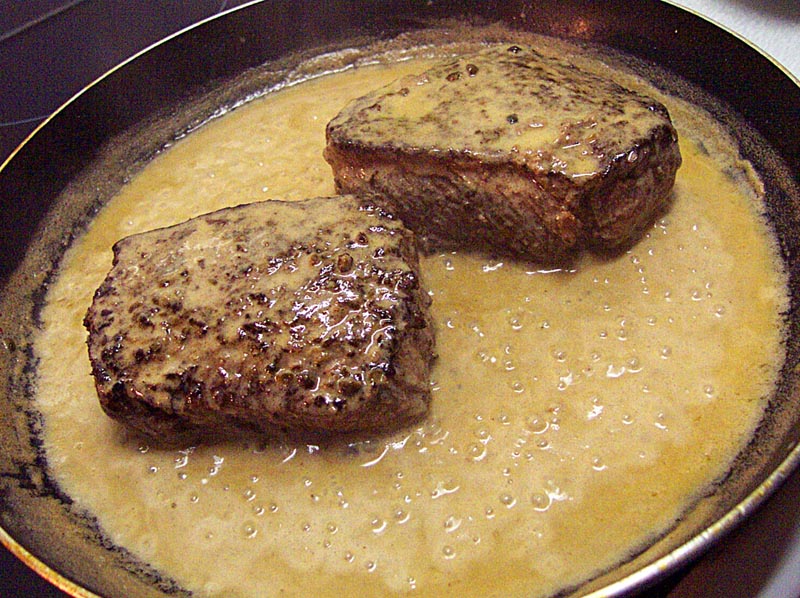
Big thick steaks warming up in the bubbly cream sauce

"I can make that," I told him, "if you want to have it for your birthday dinner again this year."

I don't think he believed me. But it was a meal I had been preparing for the past three years, during the time I lived in Paris and cooked a lot of dinners for a group of French friends. Everybody loved it. Sometimes I made it with bifteck haché — ground beef — because it was always good and was less expensive. And I always served it with sautéed potatoes, since making french fries in my small apartment in Paris was not an option.

Obviously, my version of steak au poivre has legs. Twenty-five years later, we still enjoy it, but only once a year. Maybe this year I'll make it more often.

We have a deep fryer (thanks, Cheryl) so now we can make
"proper" frites to go with the steak au poivre.


How do you make it? Rub coarsely ground black pepper or chopped green peppercorns on thick steaks and let them "marinate" in the pepper for 30 minutes to an hour. Then sear the steaks in a hot skillet. Take them out of the pan and deglaze with cognac or armagnac (¼ to ½ cup, I'd say). Let that boil down for two or three minutes, scraping up the pepper and meat juices, and then put in enough cream (French crème fraîche is best of course) to make a nice sauce. Add some salt at various points in the process.

When the cream sauce has cooked down for two or three minutes, put the steaks back in and turn them over to coat them in sauce. Let them heat back up and cook a little to get them the way you like them: rare or medium or whatever.

Serve with french fries or sautéed potatoes and a green salad.

P.S. I bet this would be good made with big thick tuna steaks. Now there's an idea...

22 December 2010

Birthday no. 29

Not 29 years old, Walt — far from it. Yesterday was the 29th time we've made his traditional birthday dinner together. The first time, December 21 in 1982, was before we started living together. We had just come back from spending a year in Paris, where we met.

I've told the story before, here. And I've given a recipe for steak au poivre before too, here.

We drank Touraine sparkling wine and made the sauce
with Armagnac, black pepper, and cream.


Yesterday was new-tires day. Since we only have one car, and since there is little if any convenient public transit to get us home from the garage, we took the car in at 9 a.m. and waited three hours for it to be serviced. Oil change, new tires, and all that. It was rainy but not too cold.

The garage is across the river in Noyers-sur-Cher. It's in what passes for a shopping center here: a zone d'activités commerciales (or ZAC). It is not a mall. Besides the garage, two contrôle technique centers, and a Citroën dealership, however, there's a supermarket (Intermarché), a hardware/DIY store (Bricomarché), a café/self-service restaurant, and a store called Facile that sells housewares, hardware, curtains, and other sundries.

Having three hours to spend over there was the perfect opportunity to do something we don't do very often: shop. We fortified ourselves by walking the few hundred meters (say two long blocks) from the tire place to the café and sitting down to drink a big cup of black coffee — un double express — and eat a croissant. We don't go to cafés much any more, and it was almost like being on vacation or in Paris. While we sat and sipped, we browsed through the Intermarché Christmas flyer to see what the store specials were. We needed to buy a couple of steaks and some other things.

Deux pavés de rumsteak

Then we went and browsed around the Bricomarché store until 10:00, when Facile opened. We looked at closet door hardware (thinking more powerful magnets might be in order for the closet doors in the loft). We looked for what Simon calls "goo" — mousse expansive — but didn't find any. We looked at dog toys for Callie. We looked at lamps and saw two we liked. In short, we killed a half an hour.

We went to Facile and wandered around for about 45 minutes, but finally didn't buy anything except a couple of inexpensive dog toys. We looked at light bulbs (Europe is changing over to fluorescent from incandescent bulbs now and we need to buy some). We looked at curtains. We looked a candles. We spent time examining all the items on sale in the kitchenware department. It was fun.

These days, I'm enjoying making frites using fresh potatoes
of the Charlotte variety, which are widely available here.


Then we went grocery shopping at Intermarché. There wasn't much of a line at the butcher counter. We told the man we wanted a couple of steaks cut from the piece called the rumsteak. The butcher there had told us years ago that rumsteack is the best cut for steak au poivre — it's tender and lean, and can be cut thick so you can cook it rare.

The butcher grabbed his knife and cut off two steaks, but they were too thin. I asked Walt if they looked okay to him and I could tell he didn't think so. The butcher looked at us and waited. Finally, I said: "Today's my friend's birthday, so he's choosing. We need thicker steaks." He looked at us and said: "Do you two speak the same language?" Yes, I said, we're Americans. But we live here.

« Vous êtes en famille, n'est-ce pas? », he said as he cut the thicker steaks. Yes, I said. I think he was asking whether we live together. I told him we'd been living here for more than seven years now. He finished cutting the steaks and I apologized for not taking the first two he had cut. No problem, he said with a smile. It was all very pleasant, with no tension or discomfort. The steaks cost just less than 10 euros.

The sauce could have been a nicer color,
but everything was delicious.


We then went back to Bricomarché and bought the two lamps we liked. We hadn't found any nicer lamps at Facile, and we've been looking for lamps for the guest bedroom a while now. We walked back over to the garage with all our purchases and got the car back, with its new tires and fresh oil.

It was a nice morning, and we had a great birthday dinner of steak au poivre, frites, and salade verte. With a bottle of local Touraine bubbly and then some good local Gamay red wine. Here's a link to Walt's post today, in which he explains how we prepared and cooked the steaks.

22 May 2013

Basse-côte de bœuf au poivre

A cut of beef that I've started seeing in the supermarkets around Saint-Aignan and that I particularly like is called basse-côte. I think it might be part of what we call the chuck — as in chuck roast or chuck steak. It's really hard to compare cuts of meat in France and in the U.S. because butchering styles are so different in the two countries.

Week before last both Intermarché in Contres and a smaller market in Saint-Aignan called Coccinelle had advertised specials on basse côte de bœuf. At Intermarché it was going for a little less than seven euros per kilogram — that would be about four U.S. dollars per pound. At Coccinelle it was more like ten euros a kilo, or close to six dollars a pound. I don't really know how that compares to U.S. prices.

Basse-côte ("bottom rib") of beef coated with cracked pepper, pan-roasting in butter

I bought a package of six basse-côte steaks at Intermarché and froze them separately so we'd have them over the next month or two. Walt has grilled a couple of the steaks and they're very tasty and tender. We decided to have another one a couple of days ago, in the middle of our four-day rainy spell. Grilling was not really an option, but pan-fried steak au poivre with a cognac cream sauce was, and was it ever good! There's nothing like good, comforting food when the weather is lousy.

The basse-côte steak "marinating" in crushed black peppercorns

I used a mortar and pestle to crush some black peppercorns, which I pressed onto the surface of the meat. I left it to "marinate" for about an hour before panning the steak quickly in a hot skillet with a little butter. Then I put the steak in a warm oven to rest and wait while I made the sauce. The first step was to deglaze the frying pan with cognac, white wine, beef broth, or just water. Cognac gives the sauce a nice flavor, and concentrated beef broth gives it good flavor as well as a nice brown color.

As it cooked, the meat separated into its natural sections because the connective tissue more or less melted. It was cooked medium-rare.

Let the cognac, wine, and/or broth boil away so that the pan is nearly dry and then pour or spoon in a good quantity of cream (crème fraîche is what I used) — a cup or a little less, say, for a small steak. Adding a spoonful of Dijon mustard gives good flavor. A few drops of Worcestershire sauce wouldn't be wasted. And then let the cream reduce and thicken for a few minutes over high heat.

Take the steak out of the oven and put it in the sauce, turning it immediately to coat both sides with peppery cream. Serve it right away, before it has time to cook further. I like it rare or medium rare, so that it stays tender.

30 December 2016

Two more café classics

The Larousse Gastronomique defines the term « café » — the establishment, not the beverage — this way:
Débit de boissons (café, mais aussi bière, vin, apéritifs et jus de fruits), où sont également proposés quelques plats rapides (croque-monsieur, sandwichs, salades garnies, assiette anglaise).
“Drinking establishment serving coffee (but also beer, wine, coctails, and fruit juices) where a small number of quick-to-prepare foods (croque-monsieur, sandwiches, composed salads, cold cuts) are also on offer.”

To get more elaborate food, you have to go to a brasserie or a bistrot. However, many Paris cafés also serve lunch nowadays, including dishes like the one above. It's called « gratin dauphinois » and it's thinly sliced potatoes oven-cooked in the oven in milk with garlic and nutmeg. I posted a recipe with photos back in 2007. This time, I forgot to take a photo of the finished gratin before we started spooning it out of the dish and eating it.


I made a gratin dauphinois — scalloped potatoes — earlier this week to have with the leftovers of our Christmas capon. I put cheese on top, but that's optional. Walt sliced the potatoes on the mandoline, so they were uniformly thin and perfect. That's powdered nutmeg and black pepper that I sprinkled on before pouring in the hot milk and putting in in the dish in the oven.


Another brasserie classic — a brasserie is a German/Alsatian-style café-restaurant where food and drink are served all through the day, not just at standard French mealtimes — is the steak au poivre (above), or beefsteak seared quickly in a hot frying pan and then dressed with a cognac cream sauce with a lot of crushed black pepper in it. We make steak au poivre at least once a year, for Walt's birthday (December 21), and sometimes another time or two in spring or summer. This year, our steak was filet de bœuf, beef tenderloin, so it was especially tender.

Today, I'm making another classic. It's gratin de chou-fleur — cauliflower au gratin — comfort food for a cold winter day.

22 December 2023

Birthday dinner no. 41

Walt and I started making and eating French steak au poivre as his birthday dinner in 1982. That makes this one number 41. This year, we bought a thick steak called a faux-filet from the local butcher. Instead of Cognac, we made a sauce with Calvados (apple brandy) from Normandy, along with crème fraîche, veal stock, and Dijon mustard. And a good amount of crushed black peppercorns, of course.


Surprisingly, the sauce, despite all that pepper, is pretty mild. It's also very tasty. The raw steak gets coated with crushed pepper and "marinates" for an hour or two before being seared in a hot frying pan. The meat absorbs the peppery flavor, and the brandy and cream tone it all down. Here's a link to a 2020 post about French steak au poivre, including a recipe. BTW, we didn't eat all of this. We have leftovers for today or tomorrow.

23 December 2005

Hectic week

It's been a hectic week. Our friends arrived last Sunday. On Monday I went with them to the notaire's office in a little town 15 miles south of here for the "signing ceremony" (les signatures in French) to close the deal on their house. I've been helping them by consulting on legal vocabulary and serving as an intermediary between my friends, on one side, and the seller, real-estate agent, and notaire on the other side. We toasted the closing and the new house with a good bottle of Vouvray bubbly that evening.

On Tuesday we moved a carload of things, including a dining room table and chairs that Walt and I had in storage in our garage, over to the new house. We loaned our friends things like a tea kettle and teapot, kitchen and bath towels, a comforter and pillows for their bed, a radio, and a broom! As a housewarming gift we gave them a set of dishes (porcelaine blanche), a set of flatware, and six drinking glasses. The woman who sold them the house left behind a few pieces of furniture, including a couple of beds and day beds, the cooktop and oven in the kitchen, a telephone, and a microwave oven. The heat and lights were left on.

So our friends of course wanted to sleep in their own house and experience what it will be like to live in it, way out there in the country where the closest neighbors are 3 miles distant, when they move over permanently in a few years. They enjoyed closing the shutters in the evening and opening them in the morning. They marveled at the silence. They couldn't marvel at the stars, because the weather has been cold and foggy since Monday. They dreamed and schemed and imagined what color schemes would work in what rooms and what kind of furniture and appliances they would want to buy.

We've only been out to eat once during the whole week, and yours truly has been doing most of the cooking. That keeps me busy, but our friends are easy when it comes to food. They are not big eaters, and they seem to like everything. He has had a cold, so we've been eating a lot of soup, and she is careful about her diet but loves salads and all kinds of vegetables. Walt and I like everything.

Another exceptional event this week was Walt's birthday on Wednesday. He and I have a traditional birthday dinner -- this was the 24th time that we've celebrated his birthday together -- and we didn't break the tradtion this year. The menu is French, of course -- steak au poivre and frites and salade. It's simple but good. The origins of the tradition are a story for another day.

So Tuesday night we went to one of the two butcher shops in Saint-Aignan and bought a big piece of rumsteak for four. We bought frozen frites (much easier and just as good) at the supermarket. This year, we have a new electric fryer thanks to one of our very best and oldest friends (don't take that the wrong way, C.) in the U.S., who ordered it from darty.fr and had it shipped to us as a birthday/Christmas present. The steak au poivre is served in a cream sauce that you make after using cognac to deglaze the pan that the steak cooked in. We bought a bottle of armagnac, a brandy similar to cognac that is made in far southwestern France, for the occasion. And I bought a big scarole (escarole) at the market to have as salad.

The steak was perfect (medium rare), the sauce was creamy and peppery and tasty because of the armagnac, and the salad was crisp, crunchy, and refreshing with a good mustardy vinaigrette. We had excellent bread from the boulangerie that cooks its breads in wood-fired ovens and that is located out in the vineyards a mile from our house. It was pretty much a perfect birthday dinner.

We have spent many hours this week meeting with an insurance agent, including have her come inspect the new house. She is the agent who has arranged car and homeowner's insurance for me and Walt, and I like her a lot. Her office is in Saint-Aignan, and she is an agent for Axa, one of the bigger insurance companies. We have always found her pleasant, competent, and easy to talk to.

Just yesterday, after presenting our friends with a proposal to insure their house (replacement value, liability, and full coverage except for earthquakes, which are exceedingly rare here) at a very reasonable price (you wouldn't believe it -- €275 per year!), the insurance agent said she wanted to talk not about business but about "personal" matters. She pulled out an envelope and spread out on her desk a few years' worth of Christmas cards and family "newsletters" that she wanted to show us. It turns out that her sister-in-law has lived in the U.S. for many years and has children and grandchildren who are American. And they live in San Mateo, CA, just a few miles from where Walt and I lived in San Francisco and from where our friends live. Le monde est petit, as they say.

We have also been out doing a lot of shopping with our friends, buying little household items and groceries, looking at appliances, and just helping them get the lay of the land when it comes to the practical side of living near Saint-Aignan. And now it is going to be Christmas. We plan to make a fondue savoyarde (that's a cheese fondue) on Christmas eve, and we will probably cook and enjoy eating it out at the new house. We'll go see the cheese ladies at the Saint-Aignan market tomorrow morning to buy the gruyère, emmenthal, and comté cheese we use in the fondue.

Then on Sunday I'm going to poach and then roast a duck with turnips, potatoes, and carrots, as I described in an earlier topic. That will be our Christmas dinner.

08 January 2020

Fortification


Now that I'm eating again, after my recent bout of food poisoning, I feel like I need foods that are fortifying. Steak, I thought. We had steak with a pepper-cream sauce just before Christmas (steak au poivre for Walt's birthday dinner), and I wanted something different. But first the steak. This one weighed 700 grams (1½ lbs.) and we of course did not eat it all in one sitting.


This is a cut of beef called basse-côte. When we first came to live here more than 16 years ago, I never saw this kind of steak in the supermarkets. I didn't even know it existed, so I never ordered it from the local butcher shops. It's what we call in the U.S. a chuck steak, I believe. It's not too expensive, and it's pretty tender. This one was sold as a basse-côte à griller — a steak to grill or pan-sear. Sometimes I see steaks called basse-côte à mijoter — meat for stewing that needs long, slow cooking.


The Larousse Gastronomique says that the basses côtes are neck muscles from the first five dorsal ribs of the steer. Boned out, the basses côtes make for delicious stews (pot-au-feu, for example), braises, and beef burgundy. Cut into steaks, they are good grilled and are called entrecôtes parisiennes, which are not too lean and are very much appreciated by gourmets.* I guess we are gourmets, by that standard!

The sauce I ended up making to serve with the steak and some pommes frites was a mixture of mushrooms, lardons fumés (smoked bacon), shallot, garlic, thyme, bay leaf, black pepper, beef broth (from a recent pot-au-feu), and red wine. We had half a small jar of dried cèpes (boletus mushrooms), which I simmered in the beef broth by for 15 minutes or so. That gave good flavor to the broth. Then I sauteed the lardons with shallots, garlic, herbs, added the mushrooms, the beef broth, and some red wine and let all that cook slowly and reduce slightly for half an hour. Then I thickened it by stirring in a slurry of potato starch and water.

The steak I just seared in a pan with a lid on it, slightly askew. I didn't want to eat it too rare, because my system is still delicate after last week's illness. It only took 5 or 6 minutes on each side to cook the meat to medium, especially since it was mostly covered (to avoid making a big mess on the stove). When it was browned, I set the pan in a slow oven to continue the cooking for a few minutes while I heated the sauce back up and Walt made a batch of French fries. To finish the meal we had a salad of lettuce and betteraves (red beets) dressed with vinaigrette. And bread and red wine too, of course.

* BASSES CÔTES Muscles du garrot entourant les cinq premières vertèbres dorsales du bœuf... Désossées, les basses côtes permettent des préparations savoureuses de pot-au-feu, de bœuf braisé ou de bourguignon. Tranchées, elles fournissent des grillades, ou « entrecôtes parisiennes », grasses, très appréciées des gourmets.

22 December 2007

What's cooking?

Yesterday we made our steak au poivre, a tradition for Walt's birthday. That's the only time we make steak au poivre during the year, and this year Walt decided to use poivre vert — green peppercorns — instead of crushed black peppercorns. A little bird told me Walt is going to do a post about it on his blog (I caught a glimpse of his screen as he was uploading photos).

Recently, we had a zucchini quiche.
Grate and sauté a couple of courgettes (green and yellow in this case),
and cook some chopped onion and smoked pork lardons too.


Today I'm making pumpkin soup, using a pumpkin we grew in our back yard patch last summer. In fact, Walt used part of the pumpkin flesh yesterday to make a really good pumpkin pie for our desserts over the next couple of days.

Get the cream, milk, and grated cheese ready.
Use skim milk and cream combined, or use whole milk.

The pumpkin soup I have in mind is one that I had in a restaurant somewhere out in the French countryside way back, I believe, in the 1970s or early 1980s. Or maybe it was in the late 1980s, on a trip Walt and I took back then. I can't remember where I was or who I was with, but I remember a soup with big thin slices of onion and pumpkin flesh in it. The base was, I believe, chicken stock and milk. I'm going to add some garlic. Most of the pumpkin or butternut squash soup recipes and soups you see these days call for pureeing the pumpkin, but that's not what I want.

Pre-bake the pie shell and scatter the lardons on the bottom.
Don't forget the nutmeg for the filling, along with some black pepper.
Lardons = U.S. bacon, by the way.


So that's what I'm going to do today. I saved out some pumpkin flesh and then we roasted the rest of the pumpkin, scaped out the cooked pulp, and froze it in plastic containers to use later. I'm going to make chicken stock this morning and sauté some onion and garlic slices in butter. Then I'll pour on the stock, add a bay leaf and maybe some other herbs, stir in some whole milk, and let that cook until the onions are limp and tender. At that point I'll put in the pumpkin slices and maybe one thin-sliced baking potato. As soon as the pumpkin and potato slices are cooked, we'll eat it.

I hope it's as good as the soup I have remembered all these years.

Make the filling and pour it into the pie shell.
Mix together the milk, cream, eggs, cheese, courgettes, and onions.

For Christmas, we are going to make a cheese fondue, which is something we do every Christmas Eve. Then on Tuesday we'll have a roasted poularde, which is a specially fattened immature hen that has not started laying. It's the hen equivalent of a capon, which is a young rooster that is castrated and fattened. The poularde weighs in at just under two kilograms, or more than four pounds. That should be enough for the two of us, with some good leftovers.

The finished quiche.
Nice for lunch with a green salad.

With the poularde we'll have a cornbread stuffing, some collard greens, and mashed potatoes. I grew the collards in my back yard garden and have them in the freezer. We have to get a pan of cornbread made tomorrow or Monday. I just happen to have brought back a couple of bags of cornmeal from my trip to North Carolina in November.

Oh, and for New Year's Eve, it'll be oysters and champagne (or Vouvray). And for New Year's Day a sort of cassoulet made with lamb, duck, Toulouse sausages, and (for good luck in 2008) black-eyed peas.

Happy Holidays and happy eating to all...

22 December 2025

Seared beefsteak in a creamy, peppery sauce

Yes, yesterday was Walt's birthday. We made the same birthday dinner we've been making on Dec. 21 every year since 1982. We haven't missed a birthday since then. It's called Steak au poivre in French. Here are a couple of photos. To see a historical review of Steak au poivreposts on this blog, click this link.

23 December 2014

Le déjeuner d'anniversaire en cinq photos


750 grammes de rumsteak
« façon tournedos »
choisi chez le boucher
à Saint-Aignan


Deux pavés de rumsteak
débarrassés de
leur barde de lard


Les steaks recouverts
de poivre noir concassé
en guise de marinade


Un steak nappé de
sa sauce au poivre noir,
avec pommes frites
en accompagnement


L'armagnac qui a servi
à faire la sauce au poivre, et
une belle tarte aux pommes
pour le dessert