Showing posts with label cooking: pork/lamb/beef. Show all posts

01 December 2009

Zucchini moussaka

The classic moussaka is a kind of casserole or gratin of eggplant slices, ground or chopped lamb in a tomato sauce, and a sauce béchamel with cheese melted in it. You can make the same thing using zucchini slices if you don't have eggplant — ou simplement pour varier les plaisirs (just to do something different).

We had zucchini slices in the freezer that we grew in the vegetable garden. In fact, it was yellow summer squash. It was cut into disks that had been blanched in boiling salted water for a couple of minutes before going into the freezer.

MoussakaZucchini moussaka

And we had the rest of the leg of lamb that we cooked on Thanksgiving Day. I cut it off the bone and cut the meat into ½-inch cubes. You could just as easily use ground lamb in this kind of recipe.

The first thing to do is to chop an onion (or two if they are small), a couple of cloves of garlic, and 6 or 8 mushrooms (cep stems are good — see yesterday's post). Sauté those in a skillet in oil or butter, and then add about 1½ lbs. of lamb. Season it with good pinches of dried thyme, allspice, nutmeg, cinnamon, black pepper, and of course salt.

The lamb mixture over a layer of zucchini slices...

...and another layer of zucchini slices over that

When the lamb is browned, add about ½ cup of tomato paste or very thick tomato sauce. Add water or white wine to moisten the mixture, without making it too soupy. If you have pan juices left over from roasting the leg of lamb, add some of those too (but not too much lamb fat).

Meanwhile, put a layer of zucchini slices in the bottom of a big baking dish. The slices can be blanched, sautéed, or just raw, however you want them. Spread the meat mixture over that, and put another layer of zucchini slices over the top. Salt and pepper the top layer.

A thick cheese sauce is the top layer.
It will set up because there's an egg in it.


Separately, in a saucepan melt two tablespoons of butter. Sprinkle in two tablespoons of flour and let it cook in the butter for a minute or two. Then gradually add milk or cream until you have a smooth, thick béchamel sauce. Grate in some nutmeg (or add a pinch). And don't forget salt and pepper.

Into the sauce put about ¾ cup of grated cheese — Swiss, parmesan, or feta, for example. When it has melted into the sauce, take the pan off the heat. Let it cool for a few minutes, while you break one egg into a bowl and beat it. Then add a spoonful of the cheese sauce to the egg and whisk it in well. Now pour the egg mixture to the cheese sauce, stirring it energetically so that the egg will be incorporated but won't scramble.

Pour this thick cheese sauce over the top of the casserole and spread it around to cover all the zucchini slices. Put some more grated cheese on top if you want. Bake the casserole in a 350ºF/180ºC oven for at least 45 minutes, until it's golden brown on top. Let it cool slightly before you cut it or spoon it out onto plates.

Don't leave out the cinnamon, nutmeg, and allspice when you cook the meat. Those are the good flavors you want in moussaka. You can make it with beef, but lamb is better.

21 August 2007

Albundigas and Mexican tortillas

Ever since I got my new camera, it's been raining. Yesterday I poured 11 mm out of the rain gauge, and this morning 20 more millimeters had accumulated in there. So that's 31 mm since Saturday — about 1¼ inches. That's a lot for mid-August.

It's soup weather, with temperatures in the 60s. In winter we'd pay good money for weather this "nice" — it's much colder in January, but looking out the window you wouldn't be able to see much difference. This is August, pour l'amour de Dieu ! Oh yeah, there are leaves on the trees, which there aren't in January, but it's that same leaden gray sky.

Sopa de albóndigas
on a chilly August day in the Loire Valley

So when nature gives you soup weather, what do you do? You make soup. After all, the temperature in the house is just 19ºC (that's 66ºF) and no, we don't have air conditioning. It's actually nice to have a pot of soup bubbling on the stove.

A few days ago, I was looking up something up in the Larousse Gastronomique (I do that all the time) — oh yeah, I was looking up andouillette. I opened the book and the first word that jumped out at me was albundigas. What? It's a word I know better with the spelling albóndigas, as in sopa de albóndigas, Mexican meatball soup. I went to the store the next morning and bought meat to make the meatballs.

Consulting the Larousse Gastronomique

It's strange what you find in the Larousse Gastronomique. It would never have occurred to me to look for albóndigas soup in the classic French cookbook, which was first published in 1938, I believe, and updated in 1967 (that's the edition I have).

The recipe looks pretty good. It says to use 250 grams (about half a pound) of beef, veal, or pork fillet. Sauté some onions and garlic, sprinkle on some flour as a thickener, and then grind the meat and mix it with the cooked onions and garlic. When you grind the meat, also run three green peppers (it says piments verts), some cilantro or marjoram, some thyme, and some breadcrumbs through the meat grinder and mix all that in too. Add an egg and a little broth to moisten the stuffing and put it in a pastry bag.

Squeeze out little dumplings of the meat stuffing, cutting them off with a knife and dropping them into boiling consommé to cook. The Larousse calls them quenelles and says to poach them in the consommé until they are done. Then, at the last minute, peel, seed, and chop three fresh tomatoes, cook them lightly in a pan with butter, and add them to the soup with the meat quenelles. That sounds like a mild but refined French version of albóndigas soup (unless those piments verts are really hot peppers).

Brawley, California — 17 February 2001

I know sopa de albóndigas from the time I spent down in the desert in Southern California, south of Palm Springs, visiting friends. There is a restaurant in the town of Brawley, in the Imperial Valley south of the Salton Sea, called Brownie's Diner. It's only a few dozen miles from the Mexican border, and a lot of the people who live and work in Brawley, El Centro, and the other Imperial Valley towns are Mexicans who work in the fields and local businesses.

Brownie's Diner in Brawley, California — 17 February 2002.
No, I don't know the people in the picture, and we were
not riding motorcycles that day. But a lot of people were.

I remember the albóndigas soup at Brownie's as a light broth with some tomato in it but full of chunks of carrots, onions, and celery along with the delicious meatballs. I can't remember if the meatballs were made with rice or not — that seems to be the classic style — or if they included mint leaves among the herbs that flavored them — that seems to be classic too. Here's a recipe for sopa de albóndigas that is supposed to be the real thing.

Making masa harina tortillas with the tortilla press

So I made albóndigas soup yesterday and Walt made corn tortillas. We have a tortilla press, thanks to our friends Chris and Tony, who hauled it to Paris from San Francisco last April. You know these are good friends when they are willing to carry something so heavy in their bags all the way across a continent and an ocean. Merci, merci, merci. Or should I say grácias, grácias, grácias?

Authentic corn tortillas

For the albóndigas I used about 600 grams of lean beef stew meat and 200 grams of pork lardons — plain (nature), not salted or smoked — which is chunks of pork side meat. I flavored the meatballs with fresh oregano and parsley, some chili powder, a good pinch of cumin, and of course onions and garlic. I didn't put rice in them, but breadcrumbs, and a couple of eggs.

Albóndigas, or Mexican-style meatballs

Making the broth for the soup was an exercise in cleaning out the freezer. I had a pint of plain chicken stock, a pint of water I had cooked swiss chard in, a pint some something labeled "spinach broth," and a pint of liquid I squeezed out of roasted zucchini pulp. I added a can of chopped tomatoes and their juice, and some chili powder, cumin, and hot paprika. That made a big pot of broth to poach the meatballs in.

Broth, tomatoes, vegetables, and meatballs

Walt says what I made resembled couscous broth more than the sopa de albóndigas he remembers. I did put in more tomato than was called for in the recipes, but I had a whole big can and wanted to use all of it. I also put in a squirt of the North African hot red-pepper paste called harissa. The vegetables are carrots, onions, zucchini, green beans, and swiss chard.

Because it resembles couscous broth, today we're going to eat some more of it but with couscous grain instead of tortillas. And we took a couple of North African merguez (lamb) sausages out of the freezer to grill and serve with it.

17 August 2007

Cochon de lait — suckling pig

A few days ago I wrote about the first time I arrived in France, in December 1969. I was a college student. We flew from New York City to Paris and stayed in the Hôtel Monge in the 5th arrondissement. And the director of our study program, a native Belgian who was a French professor in the U.S., took us as a group to a restaurant where we were presented with a suckling pig, a cochon de lait, as our dinner.

I remember that eating the meat of that suckling pig reminded me of eating pork and pork barbecue in eastern North Carolina, though the cochon de lait was not cooked with a very spicy sauce. The meat was very tender and tasty. I knew at that instant that I was going to love French food and cooking.

Last week, one of our Saint-Aignan supermarkets included a full page in its weekly advertising booklet advertising cochon de lait for sale at special prices. The first three items on the special sale are a small ham (jambonnette,) a shoulder (épaule), and a crown roast (couronne) of suckling pig.

The ham and shoulder will each serve eight people, and the crown roast will serve six. Each comes with a "free" bottle of Bordeaux wine as part of the price, which is approximately 20 euros a kilogram. That would be about $12.00 U.S. a pound.

A little more surprising from an American point of view is the whole piglet (un porcelet — a pig is either a cochon or a porc) that you can get for the same price. It comes with four bottles of Bordeaux. The piglet weighs in at about six kilograms and will serve from 18 to 20 people. You are told to cook it in the oven for 1½ hours at something over 400ºF.

If you are not having dinner for 20, you can get a demi-porcelet — a half-piglet — for the same price per kilogram. It comes, of course, with two bottles of red Bordeaux wine.

My mother says she thinks the pork in France is especially good, and she has credentials — she has lived her whole life in the Carolinas, where people raise a lot of hogs and eat a lot of pork. I believe I read, though, that the French consume more pork per capita than people in any other country. With all the ham, sausages, pâtés, rillettes, and other charcuterie products people eat here, that wouldn't surprise me.

The Larousse Gastronomique food encyclopedia says a porcelet or cochon de lait is a two-month-old pig. The de lait part of the cochon de lait name indicates that the animal has only been fed its mother's milk (it's a suckling pig, and lait means milk). The encyclopedia says the cochon de lait is often served stuffed (with forcemeat), and is usually spit roasted, but can also be braised or poached.


15 August 2007

Steak-frites

The meal most often served in French cafés and restaurants is steak and French fries — steak-frites, as they say. For decades it's been the French version of our American burger and fries, but with the advent of McDonald's and other fast-food chains, I wonder if the burger isn't now catching up. (Hamburgers catch up... ketchup... ha ha ha.)

French steaks are very lean pieces of meat. Some Americans are put off by them, because they are so different from the "marbled" corn-fed beef we are used to eating in the States. Steaks in France do have a different flavor compared to U.S. beef, and I assume that too is because the cattle graze on grass. The steaks you get in French restaurants or cafés are often a lot smaller than American steaks, too.

A French-style steak-frites, served with sauce béarnaise.
The lean French beef is good served with rich buttery sauces.

The word for beef in French is bœuf, which is also the word for the animal we call an ox. In English, we have one word for the name of the animal and a different word for the name of the meat we eat (sheep/mutton, pig/pork, and so on). In French, the language uses the same term for both, so you eat pig, sheep, or ox directly, not indirectly, if you see what I mean.

The different cuts of beef that are grilled as steaks (variously spelled steak, steack, biftek, or bifteck) are bavette (flank steak), entrecôte (ribeye), rumsteck (rumpsteak, according to the dictionary, or round steak, I think), faux-filet (sirloin), and tournedos or filet de bœuf. If you want a thicker steak, you order a pavé de bœuf — literally, a "paving stone" of beef. I think it's often pavé de rumsteak.

All the French cuts of meat are slightly different from the U.S. cuts because the meat itself is different and so are the butchering techniques and conventions. For example, there's a cut called onglet, which the Robert-Collins dictionary doesn't translate but just calls "prime cut of beef" (in italics in the dictionary). I think it might be called hanger steak in America — or is it skirt steak? Or are they the same thing? By the way, filet mignon is a term that in the U.S. applies to beef, but in France means pork, specifically pork tenderloin.

Because the French steaks are so lean, they tend to get very tough if they are cooked much past medium-rare, and in France well-done steaks are considered inedible by many. In response to the question « Quelle cuisson pour le steak ? » (How do you like it done?), the correct answers are bleue (very rare — almost raw, really — just flipped over in the pan and slightly browned on each side) or saignante (which more or less means "bloody" or very rare).

According to the dictionary, saignant as a degree of doneness means « viande rôtie ou grillée, peu cuite et dans laquelle il reste du sang » — meat roasted or grilled but only lightly cooked and in which there remains some blood. Bleu as applied to meat means « Très saignant, à peine grillé » — very rare, barely grilled.

Another acceptable answer to the degree-of-doneness question about steaks is à point, which means "just right" but usually comes out as about medium rare in American terms. In theory it means "medium" but as anywhere, the actual degree of doneness you'll get if you order your steak à point will vary from place to place and time to time. Cooking beef is not exactly a science. Judged by American standards, the French tend to undercook their steaks.

On an Internet travel forum I participate in, an American woman on her first trip to France wrote in and said that after eating at one Paris café, she had realized it was a terrible restaurant because the steak was hardly cooked at all. "It was like eating beef sushi," she said. "I'm used to raw fish, but I like my beef just slightly pink, not raw." I told her that that was how steak is served in France — nearly raw — unless you specify that it be cooked more thoroughly, and that the café is question is not a bad restaurantat all, IMHO. I've eaten there three or four times and enjoyed it. It's all a matter of conventions and expectations.

This was yesterday's lunch. Béarnaise is a hollandaise sauce
that is made using a reduction of vinegar, white wine, shallots,
and tarragon as its base. And lots of butter and egg yolks, bien sûr.


I haven't had a hamburger in a French restaurant in many years, but I remember from time gone by that the hamburger would be made very thick out of very lean meat and served extremely rare. If you were expecting an American-style hamburger, it was surprising or even off-putting to be served such a rare patty of almost purple ground beef.

So if you really like your steak cooked well-done — well, then don't order steak in France. That's what a typical French person would tell you. Cooked well-done, it won't be good, or even edible. It's too tough, and it'll be dry. In French, well-done is bien cuit — well cooked — but you don't even need to know that expression!

23 July 2007

Notre couscous au Vent de Sable

Last Monday, a week ago already, I was in Paris at CHM's. When I woke up it was pouring rain. We decided to stay in and work some more on CHM's DSL connection and wireless network. By about 10:30, we finally got it up and running.

Le Vent de Sable couscous restaurant at 31, rue
Mademoiselle in the 15th arrondissement, Paris.


After a quick errand — a trip by car over to the Old England store on the Avenue des Capucines, near Opéra — to buy some Fortnum and Mason tea that CHM can't find elsewhere in Paris — we headed for a lunch of couscous at the Vent de Sable restaurant on the rue Mademoiselle in the 15th arrondissement.

Walt and I had eaten couscous with CHM at the Vent de Sable last summer, and I posted about it here, with complete contact information for the restaurant. W. and I also had dinner there with our California friends Chris and Tony in April. So this was our third visit. (Do I sound like Michael Bauer?).

On the first and second visits I had the couscous méchoui, which is couscous; vegetables in broth with hot sauce, raisins, and chickpeas; and a big piece of spit-roasted lamb. It was very good.

This time I decided to have couscous with kebabs of lamb and beef. That came with a merguez sausage. The lamb and beef were fairly rare or medium rare and the combination with the couscous, broth, vegetables, and harissa hot sauce was good.

CHM decided to have chicken with his couscous and he said it wasn't as good as he had hoped it would be. The chicken was a little dry. It was a breast section that had been cooked separately from the broth and vegetables.

The pictures I took of the food at the Vent de Sable didn't come out, but I'm including some shots of the restaurant's décor, which is fairly elaborate.

Here's the recipe I usually use when I make couscous at home. It's from Monique Maine's book called Cuisine pour Toute l'Année. As usual, click on the image to see an enlargement.


Here's my translation of the recipe. You'll notice that it is not very logically organized, so you have to study it carefully before you begin. By the way, you can use chickpeas out of a can and they will be perfectly good.

Couscous

For 6 to 8 people:
2¼ lbs. couscous
1 chicken
2 onions
1 celery stalk
2 fresh tomatoes
1 carrot
3 zucchinis
1 turnip
5 small artichokes
1 green bell pepper
10 oz. chickpeas
6 slices of lamb from the leg
1 herb bouquet
12 merguez sausages
1 can of harissa hot sauce
3 oz. butter
oil, salt, & pepper

Work the couscous with your fingertips as you gradually humidify it with one cup of water. When the couscous grains start to separate, pour the couscous into the top of a couscoussier and steam it for 30 minutes uncovered. Pour the couscous into a big bowl and add a cup of oil and a cup of salted water. Work it again with your fingers. Put it back in the steamer and cook it for another 45 minutes while adding 3 oz. of butter cut into small cubes. Mix well. Cook a chicken in bouillon with all the vegetables (except the artichokes and chickpeas), the herb bouquet, salt, and pepper, for 50 to 60 minutes. After the first 30 minutes, add the artichokes, cut in half and choke removed. Soak the chickpeas for 12 hours, and then cook them for 3 hours in salted water. Cut the lamb slices into cubes and put them on skewers; salt, pepper, and oil them; grill them quickly. Cook the merguez sausages on high heat in a pan without adding any oil or fat. As they cook, spoon off the fat they release. They should be golden brown. Warm up the harissa pepper paste and add to it a tablespoon of olive oil. Serve the bouillon and vegetables in a tureen, the cut-up chicken, the kebabs and the merguez sausages on the same plate. The couscous in a bowl, the chickpeas in another, and the harissa separately.

Couscous is eaten in shallow soup bowls, each diner takes a little of everything, spoons on some bouillon and carefully adds just a little hot sauce.

23 May 2007

Rillettes — potted meat

Another traditional Loire Valley food product is called rillettes, or potted meat. The English term "potted" is kind of unfortunate, don't you think? We Anglo-Americans have a way of making good food sound unappetizing without meaning to, I guess. I think it's because we are so squeamish about food in general.

The French word rillettes sounds a lot better. Pronounce it [ree-YET]. If you want an American equivalent, think Deviled Ham. But that product is so full of spices and chemicals that you'd never even know it is made with meat! Again, it's "deviled" — that can't be good, can it? It's evil.

I got these rillettes from a vendor at the market in Saint-Aignan.
His shop is in Angé, a village about 5 miles west on the Cher river.


Rillettes are usually made from pork here in the Loire, but you can also buy or make rillettes of duck, goose, rabbit, or chicken. I bought some rillettes de porc to serve to our friends from California last weekend, because I was trying to serve mostly local foods.

According to the web site of a major producer of this kind of potted pork, rillettes were first made in the Touraine. But the best known rillettes today are made in Le Mans, the city famous for car races that is an hour or two north of Tours in the area called the Sarthe.

On the back of the container, some pigs are having a pro-rillettes
demonstration.
"Up with rillettes", their sign says. "Oh, to be
made into
rillettes by traditional and artisanal methods," says the pig.

In fact, there is a local rivalry, and some people enjoy the debate over the relative merits of rillettes du Mans and rillettes de Tours. Our neighbor Bernard says he and his hunting buddies have such a debate every year, since they hunt in the forests and fields between the two cities and the hunters come together from the two areas. They bring rillettes for their mid-day picnic (and bread and wine too, I'm sure).

Bernard says that the Tours-style rillettes are meatier, less fatty, and not cooked quite as long. He prefers that texture, in which the chunks of meat are left more nearly intact.

The best way to understand what rillettes are like, if you've never had them, is to realize that American-style tuna salad is called, in French, rillettes de thon. The tuna in tuna salad, like the pork or other meat in rillettes, is cooked until it starts to fall apart. It's shredded.

Here are the ingredients in the locally made rillettes:
lean and fat of pork; seasonings.


Then it's put up in fat — mayonnaise in the case of tuna (mayonnaise is an emulsion of vegetable oil and eggs or egg yolks), and pork, duck, or goose fat in the case of potted meat. Rillettes, like tuna salad, are easy to eat because they are spreadable, and they're good eaten on bread or toast or in sandwiches.

In the old days, before modern refrigeration, rillettes were made in the fall when hogs were slaughtered on the farm. Smoking the meat was one way of preserving the meat so that it would last over the winter. Making sausages, which could also be smoked, was another method of preserving the meat. Another was to pack it in salt. And another, in France, was making rillettes, which were packed in crocks and covered with a layer of fat that protected the meat from air and mold.

I bought these duck rillettes at the supermarket.
They aren't local, but they are good. They're 70% duck.


Making rillettes requires long, slow cooking the pork or other meat in fat and liquid. Six hours or more of cooking is not too much. Here's a well-known chef's recipe that I found on the web and a link to the French site:

Jacques Thorel's recipe for rillettes
  • 4½ lbs. of pork breast
  • 4½ lbs. of lean raw ham
  • 1¼ lbs. of lard
  • 2 cups of water
  • 1 cup of white wine
  • 1 Tbs. salt
  • 1 Tbs. black pepper
  1. Cut all the pork into 1-inch cubes.
  2. In a thick-bottomed pot, bring the water to a boil. Add the lard and the cubed pork.
  3. Cover the pot and put in in a water bath in a 220ºF oven for six hours. Stir the pot frequently with a wooden spatula.
  4. When the meat starts to fall apart, it's done. Pour on the white wine and let the meat cook for another hour.
  5. Take the pot out of the oven and stir and shred the meat.
  6. Put the meat into ramekins or jars while it is still hot. Store in the refrigerator.
Here's what rillettes look like in the container.

If you are in the U.S., you need to find fresh pork that has a sufficient quantity of fat to make good rillettes. I remember when I needed pork fat to make sausages in San Francisco. I had a hard time finding any. Finally, at Tower Market, I talked to one of the butchers. He brought out a big pan of fat that had been trimmed off the meat they were selling. I said that was exactly what I needed. He gave it to me free and wouldn't let me pay him when I tried. For him, it was something to discard. Ah là là !

The "industrially made" rillettes have a longer list of ingredients:
duck (70%) including lean meat, fat, and connective tissue*;
pork, including lean meat, fat, and connective tissue*;
sea salt, salt, pepper, and E250 (a preservative).


How do you eat rillettes? Cold, spread on bread or toast. Or in a sandwich. The traditional accompaniment is the little sour gherkins called cornichons in French. Any sour or even dill pickle, or pickled onions, would also be good.
_____________________________________________

* I assume that "connective tissue," aka "conjunctive tissue" (conjonctif de canard, conjonctif de porc) is listed as an ingredient because of European regulations. The local rillettes surely contain it too, even if it is not listed. Again, it's not very appetizing, but here's a definition I found on the web: the tissue found in nearly all parts of most animals. It yields gelatin on boiling, and consists of variously arranged fibers which are imbedded protoplasmic cells, or corpuscles; - called also cellular tissue and connective tissue. Adipose or fatty tissue is one of its many forms, and cartilage and bone are sometimes included by the phrase.


21 January 2007

How to make a Daube de bœuf

The daube turned out just right. It marinated for just under 24 hours, and then it cooked for about 5 hours in a 300ºF/160ºC oven.

The first step was to cut up a couple of carrots, a couple of onions, three or four shallots, and three garlic cloves for the marinade. I bought the meat already cut up and it didn't even need trimming. If I were making this in the U.S., I would use a chuck roast, I think.

The ingredients for the marinade are ready.

Oh, and the recipe I was more or less following called for a barquette de lardons fumés — that would be 7 or 8 oz. (200 g) of smoked bacon. If you can get slab bacon, that would be better than sliced, but the bacon is also optional in a daube.

Supermarkets sell packages of either plain (nature) or smoked lardons

I usually like to buy a slab of what we would call "bacon" in the U.S. — smoked streaky bacon, called poitrine fumée or lard fumé in France — and cut it into lardons myself. But this time I took the solution de facilité and bought a package of pre-cut lardons at the supermarket.

Beef, bacon, onions, shallots, carrots

The recipe I was using called for using a lot of parsley in the marinade, but I didn't remember to buy any parsley. So I used dried thyme, bay leaves, hot red paprika, black peppercorns, and whole allspice berries in mine.

Ready for the wine....

...which was a whole bottle of red.

I used a bottle of our local Cabernet Franc red wine for the marinade. Any full-bodied, dry red wine would do the job.

In hindsight, I was sorry that I had put the whole peppercorns and allspice berries in the marinade, because 24 hours later I found myself painstakingly removing them all by hand. If I hadn't put them in, I would have saved myself a lot of work. I guess I could have cooked the whole berries in the dish, but we would have ended up picking them out at the table...

I ended up separating the carrots from the lardons and onions etc., but I don't think that was really necessary either. Next time I'll use ground pepper and allspice and skip this step altogether.

Remove the beef chunks and pour the marinade through a strainer.

Sauté the pieces of beef in some oil or butter to brown them.

After you brown the beef, cook the onions, bacon, and carrots lightly in the same pan, just to soften them. You can also deglaze the pan with a little of the wine that everything marinated in. Then combine everything in a big baking dish with the calf's or pig's foot and pour all the liquid over it.

The only thing left to do is pour the wine over it all.
Then it's ready for the oven, at about 300ºF.


Again, I think the foot is optional, but using it does give the recipe an air of authenticity. I turned out to have a pig's foot in the freezer, so I used that. Before I put it in the dish, I put it in a big pot of cold water and brought it to the boil so that the pig's foot was blanched. One recipe for daube that I read said to do that, so I did.

Add some salt if you want to, but carefully because the bacon is salty and the pig's or veal's foot will also be salty. There was no salt in the marinade except what came out of the bacon. I'd say let the dish cook without added salt for a couple of hours, and then taste the sauce and add salt as necessary to taste.

The daube de bœuf after two hours in the oven

Cover the dish and let the daube cook for at least three hours and as many as five. If it looks like it's drying out, add a little water as needed.

When I tasted mine in mid-cooking, I thought the sauce was a little salty and a little spicy (from the paprika). I wondered what I could do to tone it down without watering it down to much. I ended up adding a couple of tablespoons of ... honey ... to the sauce. You couldn't taste the honey in the final dish, but the sauce turned out to be excellent.

The daube ready to serve after five hours in a slow oven

While I was making the daube, Walt was making a vegetable terrine which he has reported on in his blog. This last photo shows how it all looked just before we took it to the table. The daube sauce was excellent with the vegetables.

Vegetable terrine (carrot, cauliflower, and spinach) with daube de bœuf

19 January 2007

Cold there, breezy here

Friends in California have been telling me about the terrible cold weather they've been having, and I've seen reports on French TV as well. I think this has been the worst freeze in California since 1990, and I remember that one. So many beautiful plants were killed in San Francisco when temperatures dropped into the 20s that year. Now it has happened again.

Yesterday I drove up to Saint-Romain-sur-Cher to buy some wine and then on to Contres to get some groceries at the big SuperU store there. The man at the wine co-op in Saint-Romain, who knows me slightly but always forgets that I am American, not British, said: "Well, we are having perfectly British weather today, aren't we?"

After I reminded him I'm from California, not England, he told me all about the cold wave that has damaged the citrus crop there so badly. And he knew about the ice storm (even though in French there is no well-known term for that phonomenon — we don't have ice storms here) in the middle of the country. Nowadays the French news reports on U.S. events extensively, even the weather. Thirty years ago, that wasn't the case at all. I remember feeling very cut off from the U.S. when I lived in Paris back then.

Outside, yesterday was gusty in Saint-Aignan and Saint-Romain, but not cold (55º or so), and a fine rain was falling. Well, "falling" isn't exactly the right word — "blowing by," I guess, would describe it better. We were just on the edge of the big windstorm that blew across England and far northern France and into Belgium, Holland, and Germany yesterday. Gusts over 100 mph have been reported up there. I haven't seen the news yet this morning but I imagine there has been some damage.

Our winds seem to have died down now. Just as I was waking up, however, at about 5:30, I was aware of the sound of the wind swooshing through the big evergreen trees out back. So the storm here is not completely over. We have had gusts as strong as 40 mph, I would estimate. Right this minute, the temperature outside is 12ºC (54ºF). That's very warm for 7:00 a.m. on a January day.

I think I'll turn on France24 and see what the TV news is saying about yesterday's weather events. Do you get the new French 24-hours-a-day news channel on your cable or satellite systems in the U.S.? It broadcasts in French on one channel and in English on another, at least here.

The reason for the shopping expedition in Contres yesterday was to pick up the ingredients for two dishes we plan to start preparing today for the weekend. One is a vegetable terrine using three vegetables: carrots, cauliflower, and spinach. Walt noticed the recipe in a French cookbook we've had for years and plans to cook it today for tomorrow's lunch.

Meanwhile, I'm going to make a Daube de Bœuf using a recipe I noticed the other day in an e-mail newsletter I get from French Cuisine TV. How do you make a Daube? You take a kilo (2.2 lbs.) of stewing beef cut into big chunks and you marinate it for 24 hours in red wine with sliced onions, shallots, carrots, and garlic, along with herbs including parsley, thyme, and bay leaves. And oh yeah, you throw in a calf's foot (un pied de veau) as well.

After 24 hours, you take the meat out of the marinade, wipe it off to dry it, and then sauté it in a big pan. Add the carrots, onions, etc. from the marinade, and the foot (or not, if you can't get one). Then strain the marinade into the pan, put on a cover, and let it cook in the oven at low temperature for three or four hours until the meat is tender and the sauce is reduced. Serve with rice, noodles, or boiled potatoes. Or, in this case, vegetable terrine.

France24 says damage from yesterday's storm was especially bad in England. Dozens of deaths in England and Germany are attributed to the violent weather. I guess we were lucky in Saint-Aignan this time. I remember we had nearly a week of very stormy weather in January 2004, during our first winter here. I wrote about it on my web site at the time. And there was a huge storm in December 1999 that devastated much of France. This year's weather has been very moderate in comparison.

22 December 2006

Walt's birthday steak au poivre

If you read Walt's "Another American in France" blog, you know yesterday was his birthday. This was the 25th birthday of his that we have celebrated together. C'est incroyable, non ?

In the fall of 1982, we were living in Washington DC. Well, Arlington, Virginia, actually. We didn't live together then. We had met in Paris in 1981 and become friends. Walt was working for BlueCross/BlueShield in Washington as a phone rep, and I was still looking for a job as a translator.

When Walt's birthday rolled around in December, he told me that he had had the most amazing dinner on his birthday the year before in France. He was in Nice, and in a restaurant he ordered a steak au poivre avec frites. It was the best thing he had ever eaten, he said.

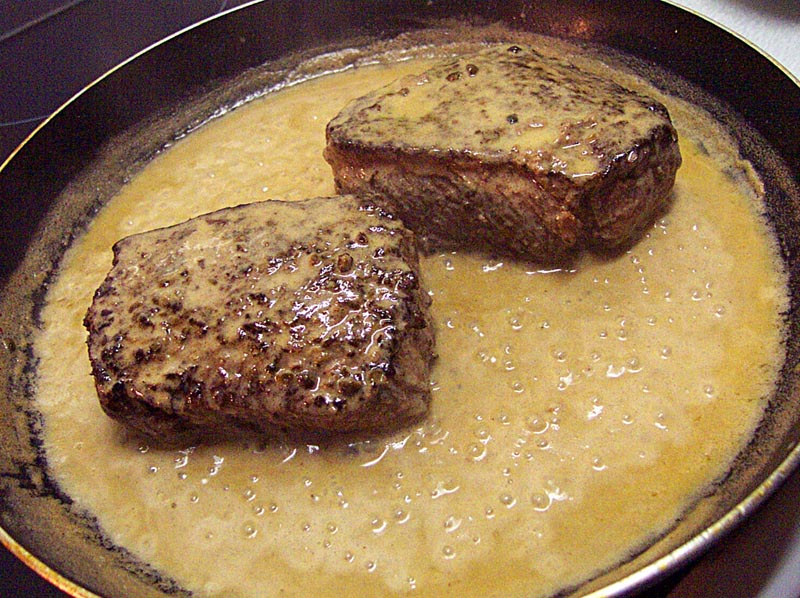
Big thick steaks warming up in the bubbly cream sauce

"I can make that," I told him, "if you want to have it for your birthday dinner again this year."

I don't think he believed me. But it was a meal I had been preparing for the past three years, during the time I lived in Paris and cooked a lot of dinners for a group of French friends. Everybody loved it. Sometimes I made it with bifteck haché — ground beef — because it was always good and was less expensive. And I always served it with sautéed potatoes, since making french fries in my small apartment in Paris was not an option.

Obviously, my version of steak au poivre has legs. Twenty-five years later, we still enjoy it, but only once a year. Maybe this year I'll make it more often.

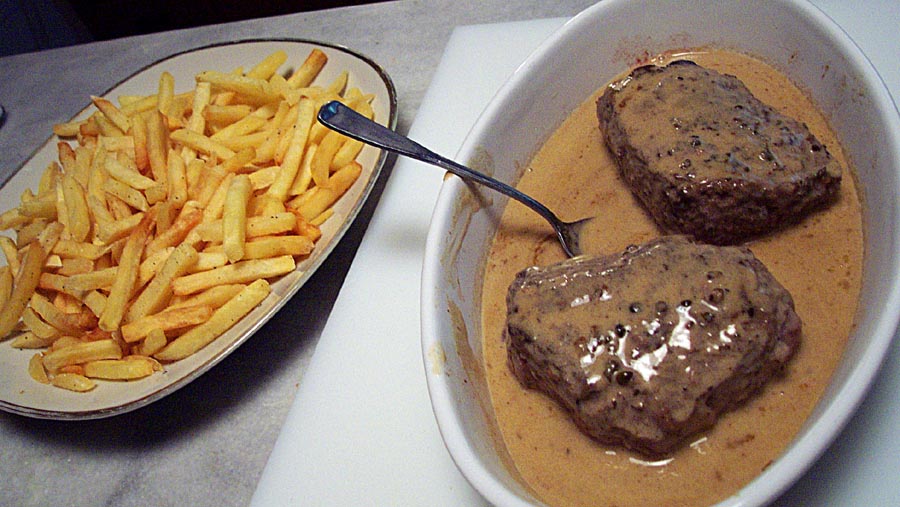
We have a deep fryer (thanks, Cheryl) so now we can make
"proper" frites to go with the steak au poivre.


How do you make it? Rub coarsely ground black pepper or chopped green peppercorns on thick steaks and let them "marinate" in the pepper for 30 minutes to an hour. Then sear the steaks in a hot skillet. Take them out of the pan and deglaze with cognac or armagnac (¼ to ½ cup, I'd say). Let that boil down for two or three minutes, scraping up the pepper and meat juices, and then put in enough cream (French crème fraîche is best of course) to make a nice sauce. Add some salt at various points in the process.

When the cream sauce has cooked down for two or three minutes, put the steaks back in and turn them over to coat them in sauce. Let them heat back up and cook a little to get them the way you like them: rare or medium or whatever.

Serve with french fries or sautéed potatoes and a green salad.

P.S. I bet this would be good made with big thick tuna steaks. Now there's an idea...

28 November 2006

Shepherd's pie & potato varieties

Along with escarole & beet salad, I made shepherd's pie — hachis parmentier in French — this past weekend, using leftover lamb, some tiny lardons cut from good poitrine fumée (a.k.a. lard) that I bought chez Doudouille at the Saint-Aignan market, and lots of aromatic vegetables.

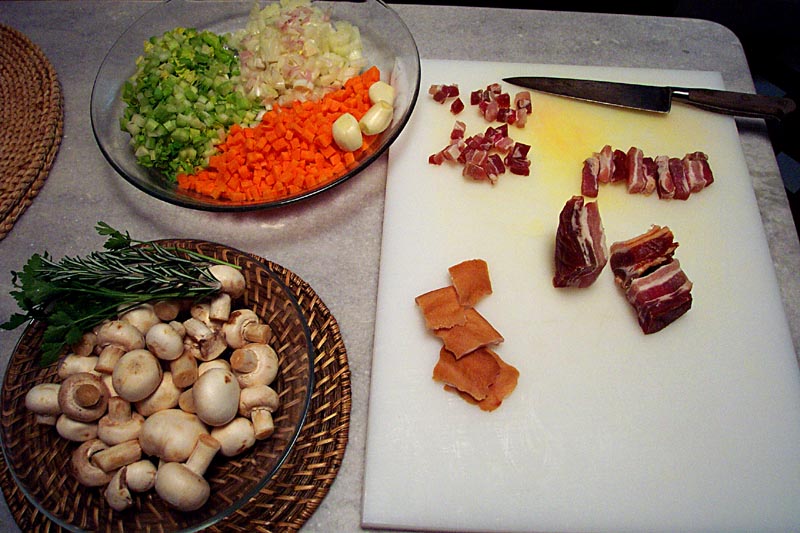
The light brown squares on the cutting board are the rind of the pork
bacon, the couenne. Cook it with the meat and vegetables because
it gives gelatine and flavor to the mixture. Then remove it, along with
any bay leaves you used, before you put the mixture in the baking pan(s).


I spent a lot of time cutting up the vegetables and the meat. I used carrots, onions, garlic, celery, mushrooms, and herbs. I diced all those up very finely. Except the garlic, which I grated. I also chopped up the lamb into very small pieces. That's how I spent my Sunday morning. Sometimes I think I'm crazy (bite your tongue!), but the ends justify the means, I guess. Or the time spent.

L. to r., lamb, garlic, mushrooms, rosemary, parsley, lardons, carrots, celery,
& onions. In the little white pitcher, the cooking juices from the leg of lamb.


Whenever I start thinking I ought to be able to find something more valuable to do with my time, I stop myself and say "no, food is about the most important thing there is." For your health, no less. And then I have always thought it was a good idea to make a pleasure out of something that is absolutely a necessity. Enjoy cooking. Enjoy eating. Try to exercise self-control at eating time. Eat a little bit of everything.

After cooking all the meat and vegetables, moistened with the lamb drippings,
you put that mixture into pans and spread mashed potatoes over the top.
Then you bake it all in a hot oven.


Also, in the back of my mind, is the old saw that says "Waste not, want not." I can't stand to throw food out. I had not only the leftover lamb (and its jus) but celery and carrots in the refrigerator that needed to be used. Another old saw: Use it or lose it. Cook it or toss it.

I also had an overabundance of onions, because I bought a big bag of them the other day. And I had too many heads of garlic, because I bought three heads a week or 10 days ago, and then I forgot so I bought two more later in the week.

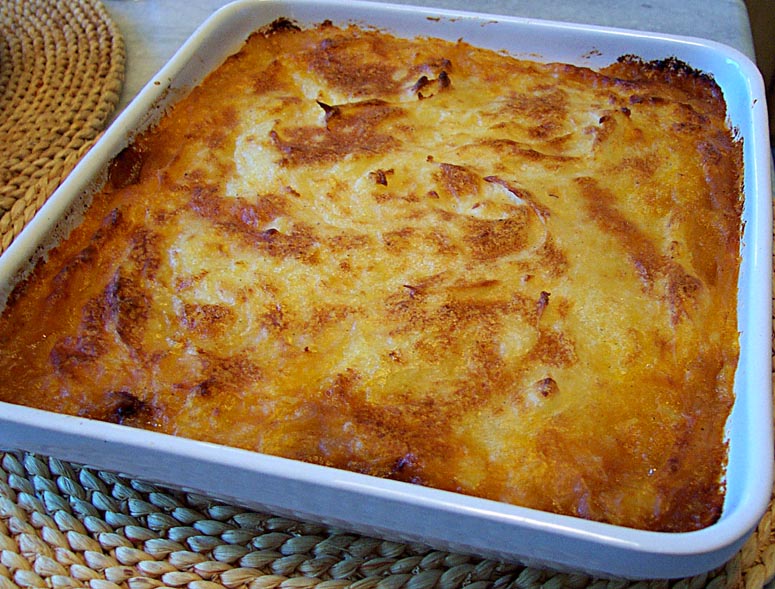
Hot, golden-brown hachis parmentier ready to serve

I went out and bought mushrooms and potatoes and lard (what we would call smoked slab bacon). Buying the lard was really just an excuse to go to the market and talk to Mme Doudouille for a few minutes. I hadn't seen her since before our U.S. trip, back in September.

Speaking of potatoes, on the cooking shows we watch on Cuisine TV, a French channel, the various chefs and home cooking experts always talk about a potato variety called bintje (pronounced beentch). I've been feeling deprived for about 3 years now, because I have never been able to find bintje potatoes in our Loire Valley markets or supermarkets.

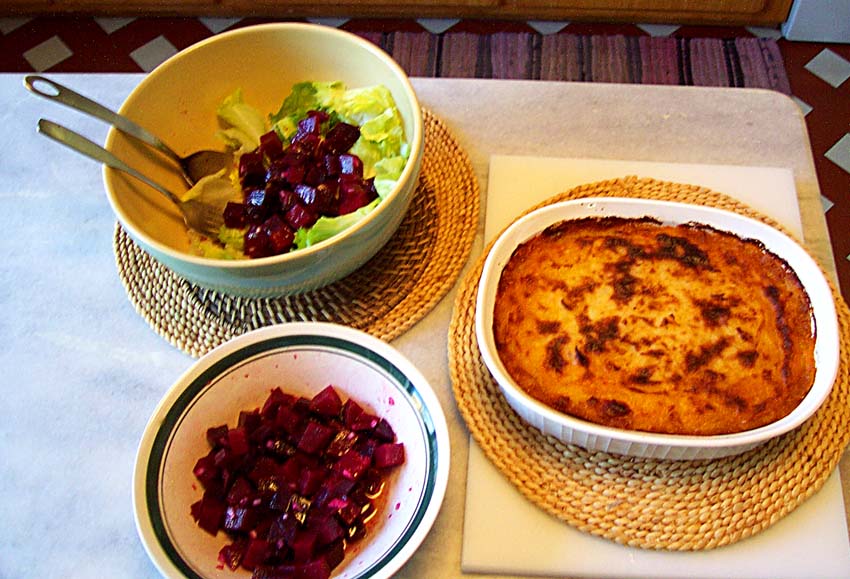
Here's the meat-and-potato pie alongside some beets

I finally did a Google search on the word bintje. It turns out that the variety of potatoes I do find in all our markets, agata, is the same thing. The bintje potato was developed in the Netherlands in the early 20th century, and I think it is grown in Belgium and in northern France. It's good for making frites, purées, and potages (soups) because its flesh is mealy or farineuse.

The agata potato was also developed in the Netherlands, but later, and Wikipedia's article on potatoes in French says it closely resembles the bintje. I used agatas to make the mashed potatoes for the shepherd's pie. The waxy red franceline potatoes that I already had wouldn't have made a good purée at all. I tried mashing them once and ended up with a pot of what could only be called glue (un pot de colle !).

It's interesting and culturally or culinarily significant, I think, that Wikipedia's English-language article on potatoes doesn't include any information about different varieties at all. The French article lists and describes thirty-seven, if I counted right.


18 November 2006

Beef with vegetables

It's Saturday and the sun is just coming out after overnight rain. And the weekend's food is in the oven.

Yesterday we went to buy some Beaujolais Nouveau and some Touraine Primeur wine at the big SuperU up in Contres. While we were there, I picked up some carrots, celery, and beef because I had in my head, on my mind, a nice dish of beef with vegetables for the weekend. It's supposed to rain again tomorrow.

This is the kind of cooking I really enjoy doing, and the kind of food I enjoy eating. It's country cooking, and it's comfort food. I can spend hours in the kitchen washing, peeling, and cutting up vegetables when I know I'm going to get to eat them later.

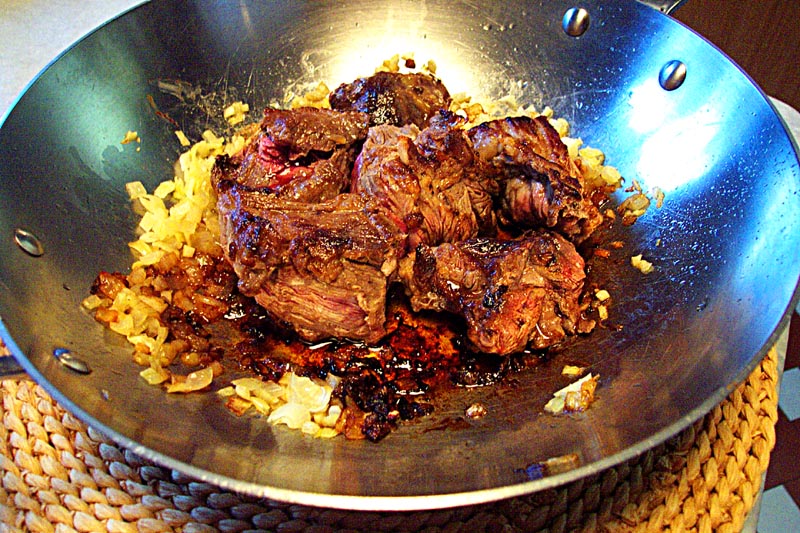
I chopped an onion and a couple of big cloves of garlic and put them in a pan with some butter and oil. I cooked them at a fairly low temperature until they started to soften. Then I pushed them to the side and put in some big chunks of beef (stew beef, I guess we would call it — it's bœuf à bourguigon in French) to brown them. I did the beef in two batches so it wouldn't be crowded in the pan. I let it brown on each side for maybe 5 to 7 minutes.


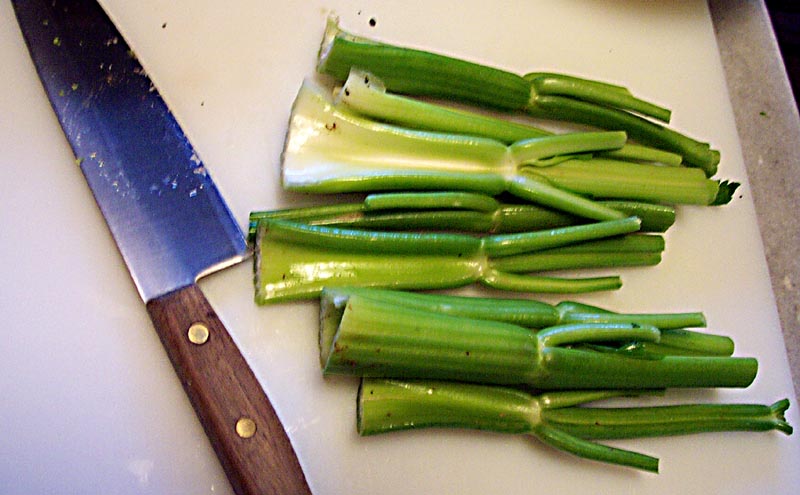
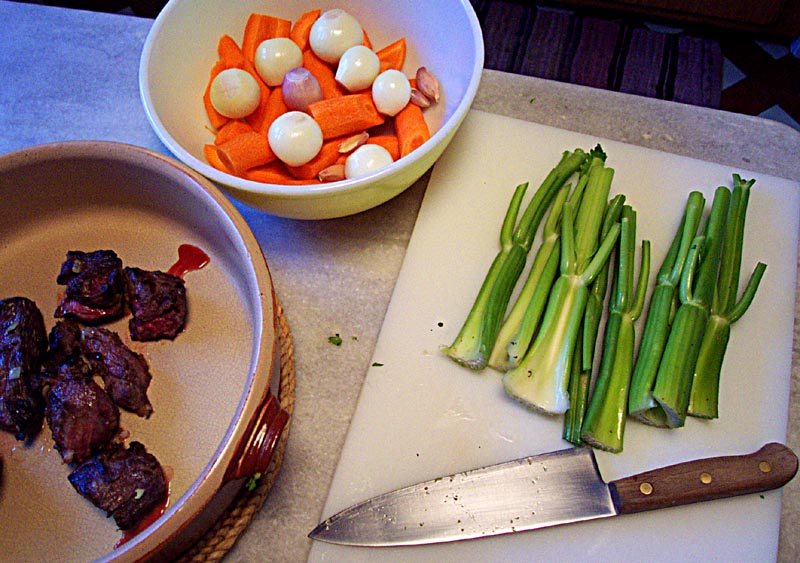
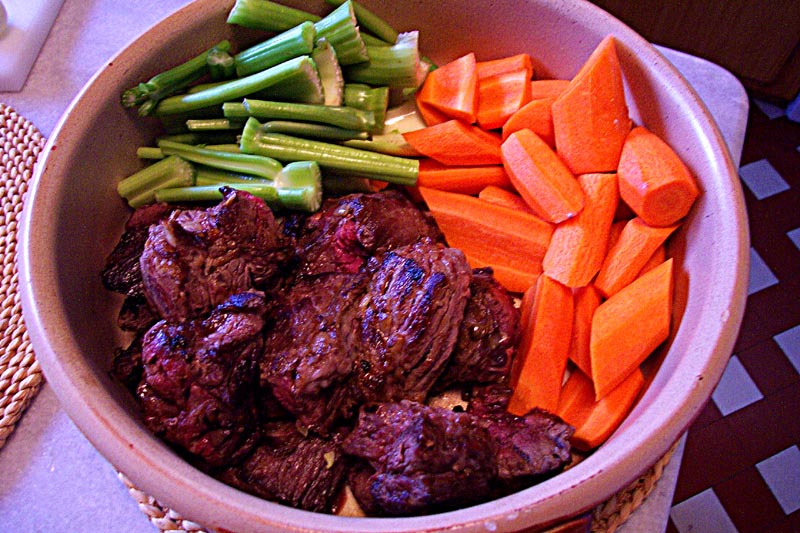
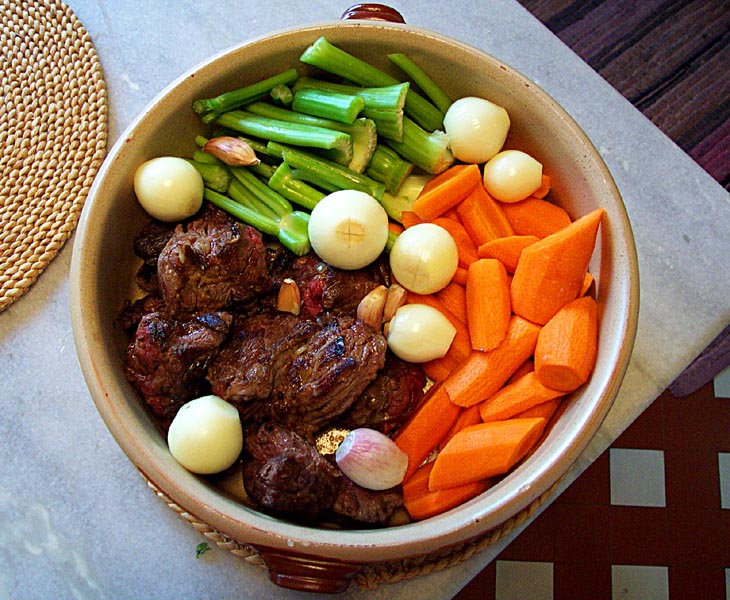
While the beef was browning, I peeled and cut into large pieces about half a dozen big carrots. I peeled half a dozen small onions, leaving them whole. I broke about 6 cloves off a head of garlic and cleaned them up but left on the husks. And I trimmed, washed, and cut into long pieces about 8 stalks of celery.

By the time the second batch of beef was getting brown, I had everything all laid out on the table, ready to be put in an oven-proof dish. I planned to let it all cook in the oven at a fairly low temperature for at least a couple of hours.


Rather than make a stew out of it, I thought it would look better arranged in the dish with the pieces of beef and the two vegetables all in their own place. I put three bay leaves, about 6 allspice berries, and a good dozen black peppercorns on the bottom of the dish before I put in the second batch of browned beef.


Then, after I took the second batch of beef out of the frying pan, I stirred the onions around and put in about a cup of wine and about a cup of water to make a cooking liquid. At that point, I added about a tablespoon of salt and a pinch of dried thyme. On an impulse, I also put in a few drops of liquid hickory smoke and a tablespoon of tomato paste.

I still had the whole "baby" onions and the garlic cloves to put in, so I just scattered them around on top of everything else.


I poured on the cooking liquid, covered the dish, and put the whole thing in a very hot oven to come up to the boil. After 15 or 20 minutes, I turned the heat down to about 375ºF, or 190ºC.

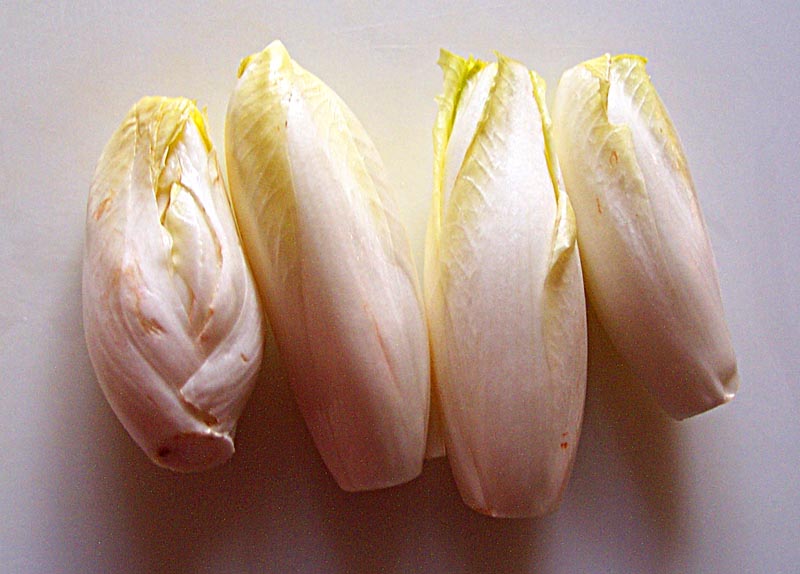
A few minutes later, I had another idea. I had a whole leek in the refrigerator, and some Belgian endives. I washed the leek and cut it into two big pieces (white part only — I save the green tops for making stock). I trimmed up four endives. I opened the oven, took off the cover, laid those extra vegetables over the top of the others, basted all with the sauce, turned the heat down to about 325ºF (160ºC), put the cover back on, and now I'm letting it all cook for about another hour. That'll be about 2½ hours in the oven, in total.

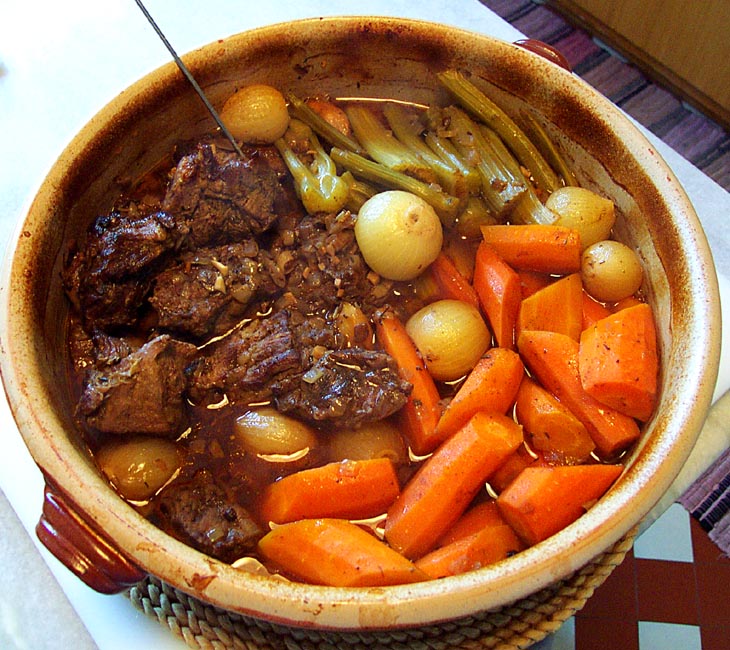
Aftermath: So how did it come out? After all the cooking, I still wasn't convinced the leeks and endives were done. So I took them out, put them in a pan, added some of the cooking liquid, and cooked them for another 30 minutes in a covered pan on top of the stove. Then they were right. Meanwhile, the dish of beef, celery, carrots, and onions just rested in the warm oven. Here's what it looked like when I took it out.


The beef was pretty tender (some pieces more than others), the celery was a little tough still, and the carrots were just the way we like them — cooked but not mushy. It was a good lunch and will make two more meals for us over the next few days.