Showing posts sorted by relevance for query arlempdes. Sort by date Show all posts

26 March 2019

Le Château d'Arlempdes in Auvergne — some history

The château at Arlempdes, south of Le Puy-en-Velay and 15 miles from the source of the Loire River (which is 629 miles long), is mentioned for the first time in a bull published by the pope Clement IV in the year 1267. Building on top of the basalt "dike" continued until the 16th century. The château complex is completely integrated into the volcanic peak, so it's not a typical feudal fortress. The ramparts are extensions of the natural rock and it is almost impossible for anyone to climb to the top. Its purpose was to protect the site against invaders coming down from the north, who coveted this part of the country.


Until the 16th century, the château was owned by several different local families, including some of the most powerful families in the southern part of the Auvergne region. It became a part of the properties around France controlled by Diane de Poitiers (1500-1566) — of Chenonceau and Chaumont fame —when the daughter of a local baron married into her family. Diane's coat of arms is carved into a wall of the Arlempdes château. The family's residence, of which only one wall remains standing, was built during Diane's time. Later in the same century, during the Wars of Religion, it served as barracks for royal troops fighting the local Protestants.

Increasingly neglected by families who owned it in later centuries, the Arlempdes château was completely abandoned by the time of the 1789 French Revolution. The site was no longer strategically important. It fell into ruin, and was quarried by local people who needed stones to build houses and walls. In the 19th century, the château was sold for one symbolic franc to a Catholic charity. In 1963, descendents of some of the old families that had owned it in past centuries bought it back and undertook to restore the château.

— Thanks to the article about Arlempdes on French Wikipédia  for this information. —

25 March 2019

Arlempdes : le premier château de la Loire

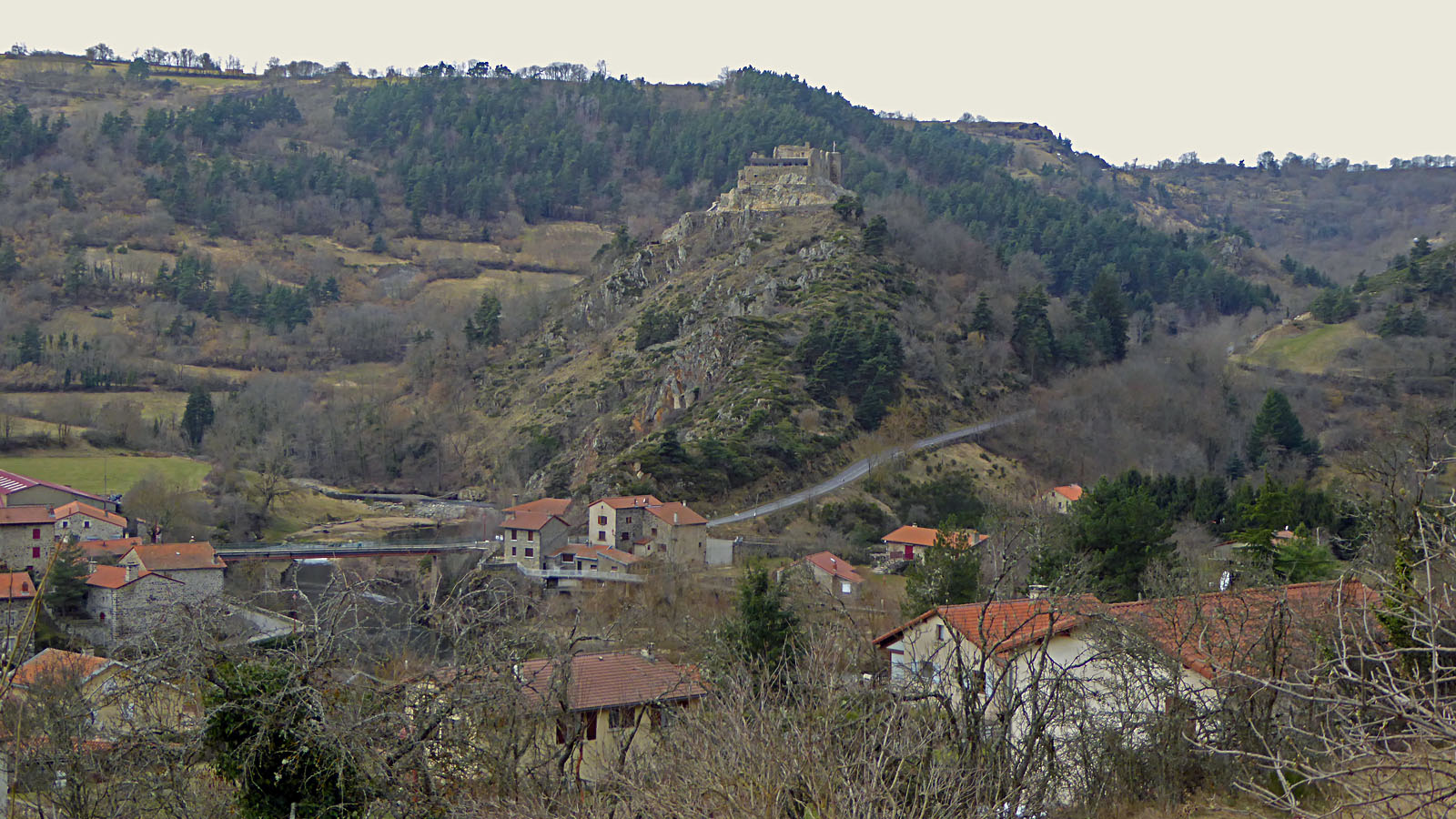
Geographically speaking, the village called Arlempdes is the site of the first château on the Loire River. It's very close to the source of the Loire, 15 miles east. Here's the first view we had of Arlempdes (pop. 134), which is less than 20 miles south of Le Puy-en-Velay in the Haute-Loire département of Auverge.


Obviously, the village cemetery is the most striking thing in this image. There was a Roman camp near here in the first century B.C. The site has been inhabited since the high Middle Ages (between the 6th and 10th centuries), and the church dates back to the 12th century.


Here's a view showing less of the cemetery. Arlempdes is, at least to me, an unusual looking word in French. It derives from an old Celtic term or expression meaning something like "sacred place." According to the article about Arlempdes in French Wikipédia and also the Michelin Green Guide, it's pronounced as if it were spelled Arlandes [ar-'lãd], with ã being the French nasal A vowel.


It's kind of hard to distinguish the ruins of the old château in the first two photos here. They blend into the rock in the background. In this third view, you can see them a little better. The château ruins are open to the public from March 15 to October 15. We were there a few days to early to be able to go in, but we did go for a walk around the village, taking advantage of the improving weather that day.

28 March 2019

Arlempdes et sa pierre noire

Translating a description I found on an Auvergne tourism site in French:

“...People often say that Arlempdes gave the youthful Loire river its first château. However, it is in no way comparable to the magnificent Loire Valley châteaux farther downstream toward the Atlantic ocean.  Here, in the heart of the Massif Central, south central France's high country, the white stone of Touraine seems like a dream. This dark stone, the heritage of long-ago, intense volcanic activity, shapes the lanscapte. Black basalt flows from the approximately 500 extinct volcanoes of Auvergne's Devès range long ago overwhelmed the original white bedrock...”


That dark-colored stone is what was used to build the ancient village church in Arlempdes. The church, known as l’église Saint-Pierre, is older than the château that looms over it.


Again translating: “Typically Romanesque, the church dates back to the 12th century. It was built out of multi-colored volcanic stone (tuff and breccia). The bell tower, built of granite, was added later, as was the lateral granite buttress that props up the older structure... Houses are built up against the church, so you can't walk all the way around it. The beautiful front portal, with its four arches... is typical of the Velay architectural style. Two of the columns that hold up the arches are decorated with different helix patterns....”


The church was closed for the winter when we were in Arlempdes on March 6. The Auvergne tourism site describe the interior as being very plain, which is typical of local churches. Above are a few more exterior photos that I've put together as a slideshow.

27 March 2019

Arlempdes, et la vétérinaire hier

Les Plus Beaux Villages de France — the most beautiful villages in France — is an association founded in 1982 "for the promotion of the tourist appeal of small rural villages with a rich cultural heritage." That's how Wikipedia describes it. Arlempdes in the Haute- Loire (Auvergne) is one of the villages that is a member. I'm not sure when it earned that honor.


I've been doing some research and reading about Arlempdes, but there doesn't seem to be a lot of information about the village available on the internet. It is very small, after all, with just about 135 inhabitants. And it's pretty isolated, though it's only about four miles (7 km) off a main north-south highway, the N88, and only about 25 miles south of Le Puy-en-Velay, the area's biggest town.


This is the village church's bell tower in Arlempdes. I've read that it was added on long after the church was built in the 1100s or 1200s. You can also see it in the other two photos in this post.


On another subject entirely: Yesterday I took Bertie the black cat to the veterinary clinic for his annual checkup and vaccination. The vet who saw us was the same woman who received us when our border collie, Callie, had to be put to sleep in 2017 (link to this post, and the two before it are about that terrible time too.) I wrote about the whole experience at the time, and I posted a copy of the kind sympathy letter that the vet wrote to us after Callie was gone. To my surprise, she told me yesterday that she was surfing the web not long ago and she came upon my blog post. She teared up slightly when we talked about that day nearly two years ago. I probably did too.

29 March 2019

Arlempdes : le village

Arlempdes (pop. 135, pronounced as Arlandes) is officially one of Les Plus Beaux Villages de France. In other words, it's one of the 158 villages that belong to that organization. This is my final post about it. There are a dozen photos in the slide show and it runs for just over a minute.


As you can see, the village, built of the local dark-colored volcanic rock, is pretty rustic. We saw decorative chickens there, but no live ones. We saw only one person, who was doing some maintenance on the exterior of the village hotel. And then that big heating oil delivery truck arrived and managed to fit itself into one of the narrowest of the streets of Arlempdes.


Here is the Google Maps satellite view showing the entire village, from the cemetery in the top left corner to the château on top of a rock in the lower right corner.

22 March 2019

Deux villages en Auvergne : Le Monastier et Goudet

We put our recent trip to the Auvergne region together very quickly, and at the last minute. My birthday was approaching, and I suddenly felt like doing something different that week. We arrived at the gîte we'd rented at Le Puy-en-Velay armed with a Michelin Green Guide, and with internet access linking us to Wikipédia and other sites and pages.

This is the Château de Beaufort, which looms over the village of Goudet in the Haute-Loire.

One excursion I had read about in the Michelin Guide would take us south to places named Goudet, Arlempdes, and Pradelles, three villages on the banks of the Loire river headwaters. We headed south in the car on Wednesday, March 6, heading toward a little mountain town called Le Monastier-sur-Gazeille (pop. 1,800). The drive took much longer than we thought it would because the roads were so narrow and winding.


The Château de Beaufort stands as ruins on top of a big rock.

When we finally got to Le Monastier, it was gusty and rainy, the sky was leaden, and we even saw a few snowflakes. I had read on one web site that Wednesday was market day in Le Monastier, and that it was a very picturesque market that has been a weekly event since the year 1495. Also, I'd read that the Monastérois (the locals) speak a distinctive dialect that I wanted to hear in person.


Tiny Goudet is located on the tiny Loire River in the Haute-Loire département of Auvergne.

Upon arrival, we saw a big sign that said Le Monastier's open-air market sets up on Tuesdays, not Wednesdays, so we were out of luck. We didn't even get out of the car. We just drove around in the rain for a few minutes and then continued on our way. Later, the owners of the gîte where we were staying said I probably wouldn't have heard the dialect spoken anyway, because it has pretty much died out.

The mighty Loire River doesn't look quite so majestic up near its source.

The next village I wanted to see is called Goudet (pop. 59 — not a typo). One of the reasons I wanted to see it is that on of the main landmarks in Goudet is the Château de Beaufort. Since my home county in North Carolina, Carteret Country, has the town of Beaufort as its county seat, I wanted see and take pictures of Beaufort Castle on the Loire River. It was built in the 1200s, and it's now in ruins.


Goudet is a "starry village" — the street lights are turned off at night so residents and visitors can enjoy good sky views.
Here are some of those photos. If you start traveling along the Loire River from its source, heading toward Le Puy, Beaufort is the second château you see along the way, after the one at Arlempdes. More about that to come...


There's at least one hotel in Goudet if you want to spend the night there.

11 April 2019

L'Auvergne : La Cascade de la Beaume

The day we went to see the villages of Le Monastier, Goudet, and Arlempdes in the southern part of the Haute-Loire, we drove back north toward Le Puy and our gîte on little back roads. Along the way, looking at the map, Walt noticed that there was a waterfall along the way, near the village called Le Brignon (pop. 600). We decided to stop and see if we could get a photo of it.


The photo above shows what the countryside around Le Brignon looks like. A small river called la Beaume cuts a fairly deep valley near the village as it flows northeast and joins up with the Loire river. La Beaume is just six miles long, while the Loire is 600 miles long.


Leaving Le Brignon, we came to a turn-out where we could park the car. We were on high ground, and we weren't sure we wanted to walk all the way down to river level at the bottom of the waterfall, la cascade de la Beaume, which is 27 meters (about 90 feet) high. We walked part way down a path and got the view you see above.


We thought the sign above was funny. If you just read the English translation of the French warning, you might get the idea that your valuables are out walking around, clambering to get into your vehicle.

The headwaters of the Loire are somewhere off in the distance in this photo. We didn't drive quite that far south.