08 November 2019

Why are they dying?

I'm talking about trees. They seem to be in some kind of death spiral right now. Let me count the trees: two apple trees in our yard. At least two in our neighbors' yard. One out by the pond — it's is still standing but is completely dead. And don't forget our pear tree, which died about a year ago. Also, two very tall trees in the plot of woods on the north side of our property have come crashing down over the past year or two, for no obvious reason.


Here's a January 2019 photo of the big apple tree we lost last month. It's demise wasn't sudden. We'd been watching it decline for a few years. As I've said, mistletoe may have contributed to the tree's demise, but the parasite may well have just been taking advantage of a tree that was already sickly. We'd been seeing a lot of mushrooms growing around the tree's trunk for a few years. That's a bad sign, I guess.


Compare the photo above of a skeletal tree full of clumps of mistletoe to the one on the right, taken in the spring of 2017. That might have been the last time we had a good crop of apples from this big old tree. It certainly had a lot of blossoms that year.


Here's what happened to the tree about a week ago. Weather too must have contributed to its death, but not wind. Just rain and rot. First the limb on the left crashed to the ground, and a few days later down came the one on the right.


So now we have this view out toward the garden shed from the back door and the greenhouse. I sort of like it this way. It's open and airy.


And here's the view from the back gate toward the house. You can see that the crew that helped us by removing the fallen apple tree also cut up the burnable wood and stacked it for us. Our plan is to burn it in the wood stove starting in 2020.

Finally, and this one is maybe the saddest loss for me, the pecan tree in my mother's back yard in Morehead City, N.C. — behind the house I grew up in and where Ma lived for 54 years — suddenly gave up the ghost this year. I learned about it when I was there in October. There will be no more crops of those delicious paper-shell pecans. It was a tree my mother had grafted and planted back in the mid-1970s. Is all this just weather-related, or is it climate change?

07 November 2019

Timber!

The day before yesterday, we had two sickly apple trees and one dead pear tree in our yard cut down and sawed into firewood. We had lived with those trees for 16 years and had watched as fungi and mistletoe sapped their strength. All three trees were probably about 50 years old. I blame frequent summertime drought, combined with recent mild, damp winters, for their demise.


In October, the biggest of our four apple trees fell — or more precisely, its two main limbs broke off — for no other reason than that the tree was near death. There was rain the day the first limb crashed down, but no wind. A few days later the second big limb dropped. I had just returned from my trip to North Carolina. We basically did nothing about the broken-down tree as we waited for the gardening service we have hired for the past few years to send out a hedge-trimming crew for their annual visit.

The man who runs the business said they would be glad to cut up the dead wood for us as well as trim the hedges, and the five-man crew did the whole job in one eight-hour day. It would have taken us weeks to do that much work — I'm not sure we would ever have got it done. The remaining two apple trees in the back yard seem healthy — with no mushrooms growing on or around their trunks, and no mistletoe growing on them.

The job went pretty fast because the laurel hedge didn't grow much this year. That's because of the severe drought conditions we experienced from June until October. The little pear tree on the northeast corner of our property had suddenly died more than a year ago. The little apple tree by the back gate was so sickly that we put it out of its misery. And of course there was no way to save the biggest apple tree. Sic transit gloria mundi...


06 November 2019

Wheat Semolina Dumplings

I've mentioned before that our big pots of couscous broth usually turn into soup before we consume all the broth and vegetables. That's what we had for lunch yesterday. And now I realize that I probably shouldn't call this "couscous" soup — Moroccan vegetable soup would be a better name for it. Here's a spicy Moroccan vegetable and chickpea soup, with a recipe the author says can be varied at will.


So what are those round-shaped yellow things floating in it? They're dumplings made with wheat semolina. I got the idea first from Thickethouse, who frequently comments on this blog. Dumplings are good in soup. And I made these with semolina, which is what couscous "grain" is made with. So the taste is about the same, but the texture completely different. Recipe below. (In French you might call them quenelles de semoule de blé.)


The vegetables in this soup include tomatoes, green beans, bell peppers, turnips, celery root, rutabaga, onions, zucchini, and eggplant — not to forget chickpeas (aka garbanzo beans). The other important ingredients are the Moroccan spices — powdered cumin, turmeric, ginger, nutmeg, coriander seed, cardamom, black peppercorns, caraway seeds, paprika, fennel seeds, and fenugreek. There's a commerically available Moroccan spice blend call ras-el-hanout that contains some or even all of these spices. Optionally, you can add some meat, and I did so because I had a few pieces of cooked veal and a couple of merguez lamb-and-beef sausages that I diced up and put into the soup pot.


I had more vegetables than broth left, so I added some chicken broth to the soup to thin it slightly. I cooked the dumplings in the chicken broth, then added the broth and the dumplings to the soup. The dumplings were tasty, and they were easy to cut and eat with a soup spoon. Here's how to make them:

Wheat Semolina Dumplings

2 eggs
60 grams of butter, softened (about 4 Tbsp.)
a pinch or two of baking powder
pinches of salt, pepper, allspice, fenugreek, etc.
150 grams of wheat semolina (4 oz., or about ¾ of a U.S. cup)

Put the softened butter in a bowl and stir it until creamy. Mix in the eggs, the spices, and then the semolina, little by little, to make the dumpling dough. Add the semolina in several stages and mix each time until you have a thick dough that can be shaped into dumplings. Add more than the quantity specified here if you need to.

Let the dough rest for 20-30 minutes, preferably in the refrigerator. With two spoons, form the dumplings — with one spoon, take a lump of dough out of the bowl, and with the second shape the dumpling. (If your dough is stiff enough, you can just shape the dumplings using your hands. That's what I did. I made 16 of them about the size and shape of new potato — smaller than an egg.)

You can either let the dumplings cook for 5 minutes in soup (you might end up with small pieces of cooked dough floating in the soup) or you can cook them separately in salted water or broth and then add them to the soup. The cooking liquid should simmer just slightly. Otherwise the dumplings might fall apart.

This dumpling dough very much resembles the dough we make for the fried cornbread called "hushpuppies." Next time, I'm going to make soup dumplings with that kind of cornmeal dough.

05 November 2019

La flotte

Flotte meaning "rain" or "water" is a funny word in French. It's not quite slang, but is marked as populaire or familier in some dictionaries when it has those meanings. Populaire means "of the people" (the unwashed masses is understood). I think we might say "colloquial." I think we would say "informal" for familier. But I hear la flotte used this way all the time. On peut boire de la flotte — drink water, in other words, instead of wine.


Mostly I hear people saying things like Il tombe de la flotte — "it's raining." It's even used as a verb to mean "raining" — Il flottait ce matin quand je suis sorti dehors — "It was raining when I went outdoors this morning." I've been able to say that to myself many times over the past two weeks.


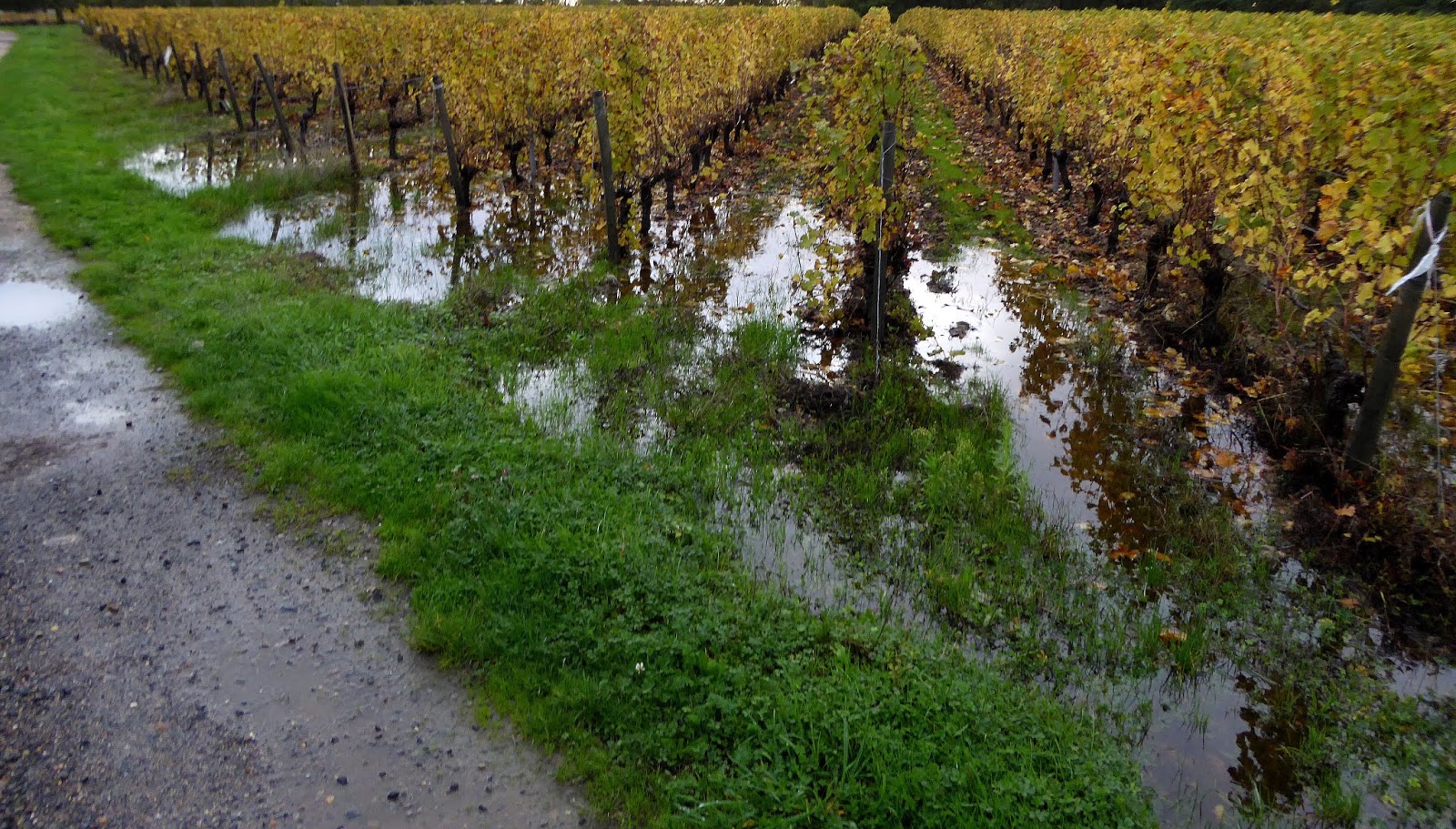
The gravel road through the vineyard is flowing like a shallow stream most days. It rained twice during the two weeks I was in North Carolina. Each time, it rained very hard and the rain stopped after 5 or 6 hours. Then the sun came back  out .


Here in Saint-Aignan, it's been raining constantly. Skies are gray most of the time now. The grass is green again, but even when you think you are stepping on grass you realize you're walking in a puddle.
Here's a photo showing the pond out behind our back gate, the equipment and trailers that have been out there for the past three weeks, and our house in the background.

By the way, the verb flotter means "to float" in more proper French, and the noun flotte means "fleet."