26 October 2007

Taking a break from Saint-Aignan

As far as I know, I won't have access to a high-speed Internet connection while I'm in North Carolina, so I probably won't be posting much. If I do post, I plan to put topics about my American trip in a blog I started last year when I was over there.

So if there's nothing new here, check my U.S. East Coast blog.

* * * *

P.S. I finished tilling up the garden this morning. That was the big thing I wanted to get done before I left for the U.S. It will likely be too cold and rainy in late November, when I get back, to finish the job if I left it unfinished.

The gardener's best friend, the rototiller

Callie loves to chase and bark at the rototiller.
Here, she's just waiting for it to move again.

Now the garden will be ready to plant, after another tilling, in spring. Let's just hope we have a normal spring and summer next year, rather than this past season's hot April and chilly, damp summer months.

25 October 2007

Work now, Paris later

I won't be going to La Défense this weekend, but I will be going to Paris. I'm spending the night at the airport before flying out to Atlanta on Sunday. I'm looking forward to the trip, but I'm a nervous flyer. Traveling is stressful.

The view from La Défense

One way to go to the airport in Paris, of course is to drive. Actually, the airport is in the town of Roissy, north of Paris. It can take anywhere from three to five hours to get there by car from Saint-Aignan, depending on traffic around Paris. It also depends on whether you take the toll road or little local roads. When I went in mid-September to meet my sister, it took me about 3½ hours on the autoroute and the toll was about 15 euros ($20). Fuel for the car is a big expense too.

The EDF building at La Défense — EDF is
Electricité de France, the utility company

The other way to get to Roissy is by train. Again, there are two options. There are the local trains from Saint-Aignan, connecting either through Tours or Vierzon to lines that feed into the Paris Austerlitz station. Or there are TGV trains from Tours either to Paris Montparnasse or directly to Charles de Gaulle airport.

Another ventilation tower at La Défense

The price of the ride on the TGV is between 55 and 75 euros this Saturday morning, according to the railway system's web site. The regular train from Blois to Paris Austerlitz is 23.50 euros, and that's what I'm taking That means Walt has to drive me to Blois. There aren't any trains directly from Saint-Aignan to Paris that work with my schedule. If I left from Saint-Aignan, I'd have to leave early in the morning, arriving in Paris around noontime, and I don't want to do that. The train from Blois is at 1:40 p.m. and takes just under two hours.

By now a familiar view

In Paris, I'll take the metro to the RER line and ride the RER out to Roissy. If I get to Austerlitz at 3:30 or so, I'll have plenty of time. I have a hotel reserved at Roissy, and I'll check in and leave my bags there. Then I'll take the RER or the Roissybus back into Paris. I'm having dinner with some people not to far from Opéra at 7:30 p.m. Then I'll take the RER out to the airport once again.
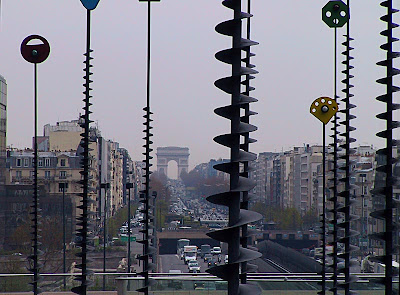
On last view, framed by artwork

The trip is complicated, but you just have to be very zen about it. Did I mention that once I get to Roissy I have to take a shuttle from the RER station to my hotel. And a shuttle back to the RER station or the airport terminals both Saturday night and Sunday morning. I will be spending 6 or 7 hours on public tranportation, and then 8 hours on an airplane.

* * * *

It was hard to blog this morning. The dog needed walking, and then the yard and garden needed attention. We raked some leaves, ate some weeds (as it were), and hauled a lot of trimmings to the compost pile. It's cold and gray here now; you'd think it was December. It's afternoon now. More tomorrow. It will all get done.

24 October 2007

La Défense — why that name?

La Défense means exactly what you would think it means: the defense. But defense of what?

The Arc of Triomphe seen from La Défense

In 1870, long before an office park was planned for the west side of Paris, France was engaged in the first of three wars it would have with the Germans. The first one was the Franco-Prussian War (in French, La Guerre Franco-Allemande). The German armies rolled over the French in several battles in the eastern part of the country. Napoleon III and many thousands of French soldiers were taken prisoner.

Modern artwork at La Défense

In Paris, a coup put a national defense government in place. With the eastern battles won and Napoleon III a prisoner of war, the Germans mounted a siege to try to take Paris. They surrounded the city with as many as 400,000 soldiers, but Paris was well protected — forts had been built all around it. The German military headquarters were set up in Versailles, southwest of the city.

Seen at La Défense

The people of Paris organized themselves into a defensive force and the Germans never did take control of the French capital. Or at least not until the France's provisional government outside Paris signed an armistice a few months later and let the German forces in for a symbolic occupation of the Champs-Elysées. Meanwhile, the Germans had bombarded the city with artillery fire and the people of Paris, cut off from the outside world, had suffered great deprivation.

The old Défense de Paris monument

That was La Défense of Paris. In the 1880s, a grand bronze sculpture was erected out on the western edge of the city to the glory of the soldiers who had defended the city against the Prussian armies. Soon the whole surrounding neighborhood, which became an industrial center, was called by that name: La Défense.

The sculptor was named Barrias

The bronze statue is still there — it was moved to the esplanade of the new business center. It's dwarfed by all the big buildings, of course. All the old industrial facilities and 25,000 residents of the quarter were relocated when the current "business city" was planned and construction began.

23 October 2007

La Grande Arche at La Défense

The Grande Arche de la Fraternité (or de la Défense) was inaugurated in 1989, the second bicentennial of the French Revolution. President Mitterrand was the sponsor of the architectural competition for the building, which was won by a Dane. Earlier presidents Pompidou and Giscard d'Estaing had considered plans for a great architectural monument at La Défense, but it was finally Mitterrand who oversaw the project.

The architect saw his work as a 20th century version of the old Arc de Triomphe, and it stands as an extension of the historic axis of Paris that runs from the Louvre, through the Place de la Concorde and its Egyptian obelisk, and up the Champs-Elysées to the Napoleonic triumphal arch. The Grande Arche is dedicated to humanitarian ideals rather than to military victories.

The Arche is in part an office building. Several government ministries, including Transportation and and Tourisme, have their offices there. On the top floor, there's a computer sciences museum, a convention center, a restaurant, and an observation deck open to the public. The building's elevators are cabins made almost entirely of glass that run on the outside of the building in the center space.

Walt told me I should point out that La Défense is not just a centre d'affaires (a business park) but it is also home to some 20,000 residents. Before construction on the modern complex started more than 40 years ago, about 25,000 people who lived in what was mostly an industrial area were displaced.

Last year, friends of ours said they wouldn't mind seeing La Défense, because they had been to Paris many times without ever venturing out there. We had our car in the city that day, so we drove out. That was a mistake. First of all, there was a lot of traffic on the road from the Porte Maillot out to La Défense, so that turned into a slog.

La Défense in the distance behind the Eiffel Tower

And then you can't really see anything interesting at La Défense (assuming you think there is anything interesting there to see) from the car. You really need to be on foot out on the vast esplanade surrounded by tall, futuristic buildings and the Grande Arche to get an idea of what the place is really all about.