Showing posts sorted by relevance for query "château du Moulin". Sort by date Show all posts

09 February 2016

Le Château du Moulin (2)

We're having really stormy weather right now. Yesterday morning the winds were hard and gusty. When I went out with the dog, it started pouring rain and we got soaked. This morning a new storm front is moving in, so we can expect more of the same.


Meanwhile, here are a few more photos of the Château du Moulin, near the big town of Romorantin. The village right next to the château is called Lassay-sur-Croisne, and at the church there you can see a wall painting showing what Le Moulin looked like centuries ago, before all the modern modifications were made.


When the last descendant of Philippe du Moulin died in the year 1900, the château was bought by a certain Maurice Compaignon de Marchéville, who he spent a dozen or more years having it modernized. His descendant still occupied the place as recently as 15 years ago, when we caught a glimpse of her on our guided tour, and maybe she still does. She discreetly closed the door to what looked like her upstairs kitchen as we trooped into her bedroom to see all the old furniture, furnishings, and paintings.


One of the most interesting rooms to visit is the old kitchen, which dates back to the Renaissance, I think. It features a cavernous fireplace with a spit for roasting meat, and there's a little round cage that they put a dog in. When the dog ran, the spit turned. As the guide told us when we did the tour, that might have been the invention of the hot dog!


The Château du Moulin web site says that Philippe du Moulin's birthdate remains a mystery to this day. There is one figure in a wall painting in the church at Lassay-sur-Croise who might well be du Moulin. He died in eastern France in 1506 in the town of Langres, of which he had become the governor, and he was buried there — but his heart was removed from his body and brought back to the church in Lassay, according to his wishes.

I'm translating from the Château du Moulin web site. All the photos in these posts are ones I took on June 27, 2004, when CHM and I went and walked around the château.

06 February 2008

Le château du Moulin

The first time I ever spent much time in the Loire Valley was in October 2000. Walt and I, with our friend Sue from California, had rented a gîte just outside the wine village of Vouvray, near Amboise and Tours, and we spent a week there. We did day trips every day except the first, when to battle jet lag we decided to spend the day outside on foot, to take in the air and sunshine. That day, we walked down to the village of Vouvray and up into the vineyards at a leisurely pace.

Le Château du Moulin in the Sologne region, near Romorantin

We had planned to go see the main sights in the region, and that means châteaux. Those are castles, but the English word doesn't really describe them very well, because there are so many styles and types of châteaux, from Medieval fortresses built for defensive purposes to Renaissance palaces, mansions, manor houses, and hunting lodges built for living the good life.

The château du Moulin was built at about the same time
that Columbus "discovered" America.

The main châteaux we wanted to see were of course Amboise, Blois, Chenonceau, Chambord, Cheverny, Chaumont-sur-Loire, Azay-le-Rideau, Langeais, Saumur, and Chinon. That gives you an idea how many châteaux there are an within 80 km/50 mi. radius of Tours.

We had also heard of the châteaux at Fougères-sur-Bièvre, Montrichard, Valençay, Montrésor, Loches, and Montreuil-Bellay, and we went to see those too. We obviously did entirely too much, and wore ourselves out driving to, from, and through villages and towns all over the region.

The château originally was surrounded by turreted fortifications,
but they were torn down as France settled into peaceful times.

In my reading and research to plan the trip, I depended mostly on the Michelin Green Guide for the Châteaux de la Loire. On one of the introductory pages on planning a tour of château country, I stumbled upon an aerial photograph of a place called Le Château du Moulin. I'd never heard of it and it looked like it might be worth a visit. Nearby, the Michelin said, there was also a medieval, walled village called Mennetou-sur-Cher. I wanted to see that too.

All tours are guided, and the château du Moulin
closes down for the winter.

I searched my blog and I don't think I've ever posted pictures of the château du Moulin before. I can't believe it. So here are some. (And now I've realized that I've never posted pictures of Mennetou-sur-Cher here either....)

12 October 2020

Le Château du Moulin, en Sologne

Again, I quote from the Cadogan guidebook for the Loire Valley: "The Château du Moulin, lost in the Sologne woods 12 kilometres [7 miles] west of Romorantin-Lanthenay,is the romantic star of the brick châteaux of the Sologne. It's a dreamy place, hidden in the countryside, reached by an alley of oaks you have to walk down, and surrounded by trees dipping their branches into the moat. Swans swim elegantly in its waters. The buildings that remain are fragmnts of a more solid ensemble..."

The Château du Moulin, built in the 1480s (as was the Château de Fougères-sur-Bievre) is about 15 miles east of Saint-Aignan in the Sologne, a "natural region" of sandy soil, ponds, lakes, and pine and birch forests. It's flat and the soil is clay and sand, so bricks were the main building material for houses and châteaux. The Michelin guidebook says that Le Moulin was originally protected by high walls and turrets. Those were torn down in later centuries to make the place airier and more pleasant to live in.


The woman who owned the Château du Moulin lived there until recently (maybe she still does). I remember getting a glimpse of her when we toured the inside of the château in October 2000. We were the on last guided tour of the day, and I think we caught her off guard when we entered a room that was part of her apartments. The pictures in my slideshow here are some that I took in 2004 when, if memory serves, CHM and I visited Le Moulin, which is just 15 miles northeast of Saint-Aignan.

And guess what I just learned — the Château du Moulin is now closed to the public and has been on the market since last January. You can buy it for a couple or three million euros. It's described as having 30 rooms, including 20 bedrooms, and 100 acres (39 hectares) of land. Here's a link.
And here's a video I found on YouTube:

08 February 2016

Le Château du Moulin (1)

The Château du Moulin was built over a period of 25 years starting in the year 1480. It's located near Romorantin, the biggest town in the Sologne region of the Loire Valley, and about 20 miles or 30 km east of Saint-Aignan. The Cadogan Loire guidebook calls it "one of the most romantically moated of all Loire châteaux, among the finest."


Philippe du Moulin was a loyal servant of Charles VIII, who was one of the first French kings to mount a military campaign in Italy. Du Moulin rescued him when ignominious defeat faced the French forces in a battle in 1495. Charles VIII was born in Amboise in 1470, became king at the age of 13, and died in 1498. Du Moulin lived until 1506. That period marked the end of what is now called the Middle Ages, and the beginning of the French Renaissance that was inspired by contact with Italy.


The Château du Moulin was built as a fortress, surrounded by a moat, high walls, and defensive towers. Those forbidding fortifications were torn down in later centuries to let in some daylight and turn the place into a more comfortable residence. As far as I know, it is still privately owned today and occupied for at least part of the year. When we visited for the first time in the year 2000, we caught a glimpse of the owner, a woman who was living in the main tower.


There are quite a few brick châteaux in the flat and forested Sologne region, where there used to be a lot of marshland and there wasn't much building stone readily available. While more Renaissance and less Gothic in style, the Louis XII wing of the Château de Blois is a notable example from about the same period. The author of the Cadogan guide calls Le Moulin "a dreamy place, hidden in the countryside...." The visitor's impression is that it's deep in the woods, really.

28 June 2023

Le château du Moulin

Depuis janvier 2020, le château du Moulin est définitivement fermé à la visite et mis en vente par ses actuels propriétaires.

That's what I just read on French Wikipédia.

Le Moulin was built over the last 20 years of the 15th century by king Charles VIII for his childhood friend Philippe du Moulin. Philippe had saved the king's life in a battle in Italy in 1495 and was knighted by the king. The Cadogan Loire guidebook explains that Le Moulin was built at the time of the transition from Gothic to Renaissance styles.
I've been to the château du Moulin several times over the years, starting in the year 2000. We were staying in a gîte in Vouvray that year. Le Moulin was still lived in by the woman who owned it. We arrived at about 6:30 p.m. on an October evening. The people at the front gate were getting ready to close up for the night, but they did one more guided tour, just for us. Inside the château, at one point we saw the owner discreetly disappear into her private quarters, closing the door behind her. We had surprised her. Here's a link to some of my earlier posts about le Moulin, with many photos.

06 February 2008

Le château du Moulin, suite

The first time we went to the château du Moulin, then, in October 2000, we had spent the day on the road and le Moulin was our last stop before heading back to the gîte in Vouvray for the evening. We had had a busy day, and we didn't arrive at the château until 5:30 p.m.

The château du Moulin seen from the gardens.

To get to the château, you drive a few miles on a narrow country road off the main highway, through a typical little Sologne village (Lassay-sur-Croisne). Then you turn off onto an even narrower paved lane that goes back several kilometers into a forest and you park in the woods in a kind of field at the end of that road. There's a gate at the edge of the field protecting the end of the foot path that goes to the château grounds. The Michelin guide calls the setting « un joli site champêtre » — and it is. There's a 400-year-old oak tree, and there are horses grazing in the distance.

It's just slightly forbidding, wouldn't you say?

It was a cloudy afternoon and it felt like it was already starting to get dark, but we walked on down the path to the château anyway. We weren't likely to make the drive back this far from Vouvray again on this trip, and I really wanted to see the place. I had no inkling that we might one day live just 20 miles away, of course.

The gardens do help to cheer the place up.

The two men working at the ticket window were just standing around smoking, probably waiting to go home at 6:00. We said we wanted to go into the château. They told us it was by guided tour only, and that it was really too late. I talked them into giving us a tour, however. As I said, I was determined.

So there were just the three of us — Sue, Walt, and I — and a young guide. He asked if we spoke French and he said he spoke some English. The tour turned out to be informative, interesting, and a hoot at the same time.

A lot of buildings in the Sologne are built of brick.
It's a region of sandy soils, forests, and small lakes.
There isn't a lot of stone to build with.

The château is — or at least was, just a couple of years ago — still in private hands. The story was that an old woman from Paris still came and spent a good part of the year living there. One of the most interesting things was that I think we saw her, or caught a brief glimpse of her. We followed the tour guide upstairs to see a big reception room stuffed full of 16th, 17th, 18th, and 19th century furniture, porcelaine, and paintings. It was dark and mysterious.

And each time the young guide did his spiel in French about a French Renaissance table, a painting from Holland, or a big porcelaine platter from Rouen, he would point to it with a great flourish and say, just to make sure we had understood: "seventeen centchureee!" or "eighteen centchuree!" We loved it.

A later visit: you can see the group of people on the bridge
waiting for the guided tour to begin.

Then we went to see the chambre du roi — the king's bedroom, reserved for him in case he should pop in some day and want to stay over. As we exited the reception room and stepped onto a landing in front of the bedroom door, a hand reached out from behind the door right next to it and quietly pulled it shut.

I felt like an intruder. In fact, the woman who lives in the château uses the king's bedroom as her own, I read later. I think such a late tour caught her by surprise. She thought she had the place to herself for the night.

04 July 2016

Details — Château du Moulin

Here are a few photos of architectural details at the Château du Moulin, located near the town of Romorantin in the Loir-et-Cher (France). I was there again on July 2, 2016, after previous visits in 2000, 2003, and 2008.


The guide said this elaborate geometrical pattern in the brickwork seems to depict an African game called le jeu des crottes de chameau, played by children in the Sahara Desert. That would be "the camel dung game", for which the "board" is traced in the sand by the people who play it. Nobody knows why the pattern appears on a such an old wall in central France.


This is the coat of arms of the family of Philipped du Moulin, who had the château built in the last quarter of the 15th century. He wasn't really a nobleman, but he had saved the life of the French king during a battle in Italy. The king knighted or ennobled him on the spot and helped him build this château in the Sologne. Those are two lions carved into the stone.


Windows like these, above and below, are called fenêtres à meneaux, or mullioned windows, and are characteristic not of fortified medieval châteaux but of buildings designed to serve as comfortable residences.


Such windows show that the Château du Moulin is a transitional structure, built as the tumultuous Middle Ages and the 100 Years War waned and the more peaceful era called the Renaissance began in France, around the year 1500. The larger windows let a lot more daylight shine into the building, making it a more pleasant place to live.

14 August 2025

Le Château du Moulin

According to another guidebook I have, Les Guides Illustrés (Hachette, 1924) the Château du Moulin was built between the years 1489 and 1502 by Philippe du Moulin, a loyal servant of the French king Charles VIII. The Château du Moulin is less than 15 miles southeast of Cheverny and was built of red and black brick with stone accents. The author of the Cadogan guide to the Loire calls it "the romantic star of the brick châteaux of the Sologne" and says it is "a dreamy place hidden in the countryside." It is surrounded by a wide moat and accessible via drawbridge.

03 July 2016

Fortified

Yesterday afternoon, I drove with our friend Peter Hertzmann, who's here for a long-planned weekend visit, over to the village of Lassay-sur-Croisne, near Romorantin, and spent a couple of hours at the Château du Moulin. It made me think of our friend Cheryl, who passed away at the end of the week, because we went there with her in 2003. Our first visit to Le Moulin was with Cheryl's cousin and friend Sue, in 2000 — 16 years ago already!


Peter and I took the guided tour of the inside of the château, as we had done with Sue and then Cheryl in 2001 and 2003. The tour was much more professionally done that it was back then, and the guide was very informed and informative. The château is no longer occupied by its owner, a woman who was something like 93 when she died in 2010. Before her death, knowing that somebody actually lived in the château made the tours feel like you might be invading somebody's privacy — but it was her choice to open her "house" up to the public. Now it feels more like a tourist attraction than a residence.


The Château du Moulin was built over the last quarter of the 15th century, and in a sort of faux medieval style. At that time, the French Renaissance was gaining steam, some of the grandest Loire Valley châteaux were being built. The new style was to build grand, more comfortable residences than fortified military structures. The guide said the Moulin never saw warfare but was mainly a fancy residence in a forest. It was "moated" and sort of semi-fortified for protection from bandits and highwaymen — and because the man who had it built liked the old style of architecture.

10 February 2016

Le Château du Moulin (3)

Here are a few detail shots of the château from different angles. Just looking at them boosts my morale a little. I can console myself right now with the idea that it will be June again soon and I'll be able to go back to Le Moulin and other beautiful Loire Valley places before too long.


According to the official web site, the Château du Moulin is closed for the winter season until Easter. Even if it were open, I wouldn't have driven there over the past few days, what with the stormy weather we've been having.


Strong winds have blown limbs out of some of our trees. Heavy rains have created torrents of water on some streets, and big ponds of water in low spots. I had to go out in the car yesterday, so I can report from personal experience that it was a wild and woolly day in Saint-Aignan.


But back to Le Moulin: as I've said, I would never have made the hour-long drive from Vouvray, where we were staying, to see it in October 2000 if I hadn't noticed an almost stray photo in the Michelin green guide. I had never heard of it before. It is off the beaten track of the major Loire sights, over in the Sologne woods. As it was, we didn't get there until late in the day — there was a lot to see along the way.


The Cadogan guide says of Le Moulin: "The brick changes colour here and there, going from orange to purple. The typical Sologne lozange patterns in the brick give way at one point to an intriguing pattern of squares within squares." You can see that in my close-up photo above.

24 October 2012

The château at Fougères-sur-Bièvre

Fougères-sur-Bièvre is a village just south of Blois, 20 miles north of Saint-Aignan, and the site of a 15th century château that is fairly unusual in the Loire Valley. It dates back to the years before the great Renaissance castles were built (in the 1500s), and it's in an older style.

The medieval-style château at Fougères-sur-Bièvre, near Blois

The château at Fougères-sur-Bièvre (not to be confused with the bigger town of Fougères in Brittany) looks medieval and seems to have been built so that it could easily be defended. In fact, by the time it was built (1450-1500), this part of the world was basically at peace. The Hundred Years War had ended several generations earlier.

The château is in the middle of the small village of Fougères

So the château at Fougères-sur-Bièvre was already an anachronism when it was built more than 500 years ago. A similar place, built around the same time but in brick, is the Château de Moulin, 25 miles to the southeast. (Here are two links, One and Two, to posts about that château, with photos.) One other difference, in addition to the building material used, is that Moulin still has its moat, while at Fougères the moat was filled in 150 years ago. Also, Moulin is out in the woods near the town of Romorantin, but Fougères is right in the middle of the village.

The Cadogan guide calls the courtyard at Fougères-sur-Bièvre
"wonderfully atmospheric" with its mixture of architectural styles.

The Château de Fougères was used as a mill in the 19th century before being turned into a poor house in the early 20th century. The French government acquired it in the 1930s. The Château du Moulin is still privately owned — or at least it was the last time I visited a few years ago. The woman who owned it was quite elderly and was living there (at least part-time) as late as 2005.

10 July 2016

Strawberries, apples, and pears

Not only do they grow strawberries at the Château du Moulin...


...but they also have a lot of apple and pear trees on the grounds.

I especially liked this tree and the outbuildings in the background.

This last photo is just to remind you what the Château du Moulin looks like.

I'm in Paris this morning, heading back to Blois and Saint-Aignan this afternoon. Yesterday morning I climbed up to the top of the Panthéon, and I'll show some pictures tomorrow.

05 February 2006

Seeing Saint-Aignan for the first time

The nature of blogs is that you read forward, not backward. The problem is that this is the fourth in a series of articles. If you want to read them in order, use these links. Then click Next at the bottom of each article to jump to the next one in the series.

We drove back to the gîte after our first day of house-hunting wondering what Saint-Aignan would be like. If houses were less expensive there, as Bourdais seemed to me to be implying, maybe it wasn’t a desirable location. “Maybe it’s some kind of ville nouvelle, all Soviet-style 1960s architecture, big apartment blocks. Maybe it’s an industrial center. Maybe it’s a ghost town,” I told Walt. Always the optimist, I am. My vision of France was skewed by my familiarity with Paris and its banlieues.

Back at the gîte we got out the map and studied it. It was true that Saint-Aignan-sur-Cher was just ten miles upriver from Montrichard, on the opposite bank. There was nothing near it that we were familiar with, except Valençay, where there is a famous château.
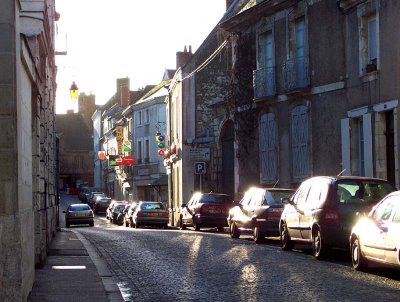
The main street leading into the center of Saint-Aignan

We had lunch in Valençay in October 2000 and enjoyed it. The restaurant was very old-fashioned and the other customers, especially one very bourgeois-looking French woman who was seated facing us, stared at us with cold eyes as we sat waiting to be brought menus. We felt like aliens and wondered what she was looking at. We don’t know if it was because we were two men, because we looked American, or because we weren’t dressed properly. Or maybe she wasn’t looking at us at all. We had a good lunch anyway, with a bottle of the local Valençay VDQS red wine.

Would Saint-Aignan be as old-fashioned as Valençay had seemed? That would be fine with me. I can stare at foreigners with the best of them -- or even at French people all dressed up in their Sunday best. I kind of liked the idea. We decided that since we had Tuesday morning free, the smart thing to do would be to drive over to Saint-Aignan and have a look around. If we hated it, we could tell Bourdais at our 2:30 meeting that we’d rather see houses closer to Montrichard — which didn’t seem old-fashioned and formal but bustling and friendly — or closer to Amboise, which is where we had wanted to start anyway.

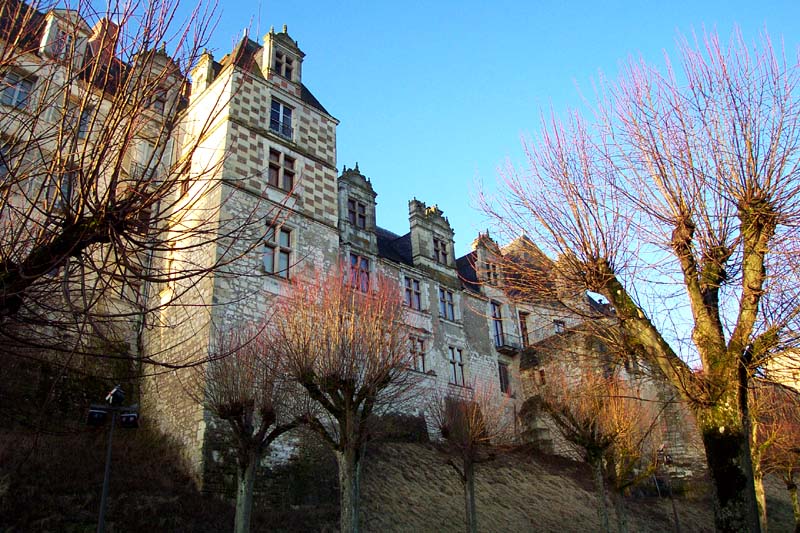
An up-close view of the château de Saint-Aignan

I don’t remember by what route we drove to Saint-Aignan the next morning. Now I know that there are several ways to get here from Amboise or even from Montrichard. I suppose we took the main road, which is the route nationale 76 that runs along the Cher river south of Montrichard, crosses the Cher near the village called Thésée, and then runs along the river north of Saint-Aignan through the town called Noyers-sur-Cher. The stretch from Montrichard to Thésée is especially nice, and is marked as scenic on Michelin maps.

The river valley is wide and open. The banks of the river are wooded, so you don’t actually see the water. On the left are wide fields where sometimes you see the local roe deer grazing. On the right side there are picturesque houses and at least a couple of churches (in the wine villages of Angé and Pouillé) along a secondary road that parallels the route nationale. The houses are built up on wooded bluffs that mark the southern limit of the river valley. To the north, you see the hills on the other edge of the river valley, some of them planted in vines. When you get to Thésée (another wine village) you can see the village church steeple off in the distance, just before you cross the highway bridge over the Cher, where you have a nice view of the river itself.
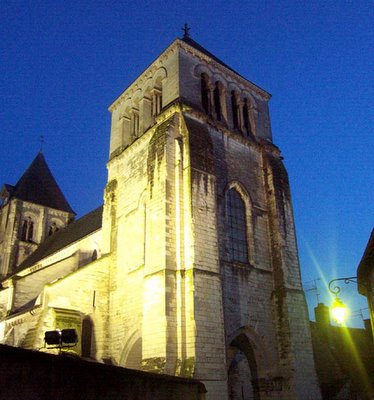
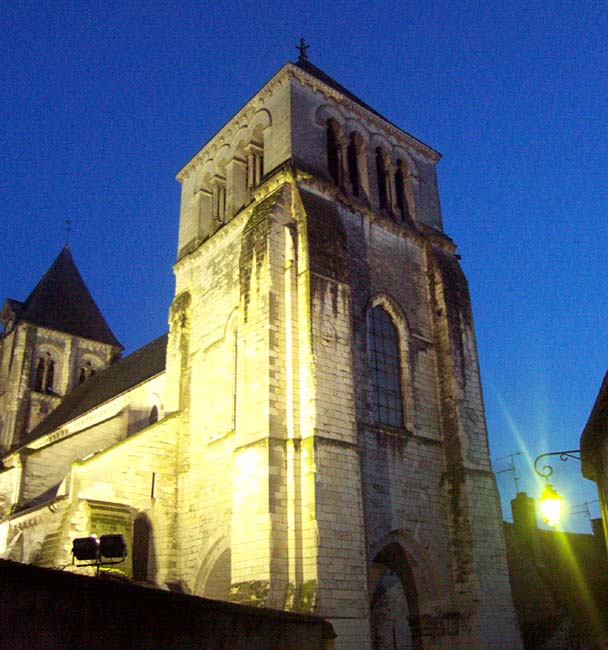
The Saint-Aignan church at dusk on a December day

When you cross over to the north bank of the river, you come fairly soon to a less attractive area. There is a big grain elevator off to the left. Up close, it looks like ... well, a grain elevator. You could be in the American Midwest, or the Central Valley of California. But I maintain now that, from a distance, that elevator looks almost like a big cathedral church. The local people have been known to laugh when I say that. Anyway, the next thing you see is a fairly ordinary looking shopping center on the left hand side of the road -- Intermarché, Bricomarché, L’Univers des Affaires, Sésame, a couple of furniture stores and other businesses, all in corrugated steel buildings that are basically warehouses. There’s also a plant where nut oils are pressed and bottled.

But it you look off to the right as you are driving past the grain elevator and the centre commercial, you can see the massive château de Saint-Aignan sitting up on a high bluff above the river and the town.

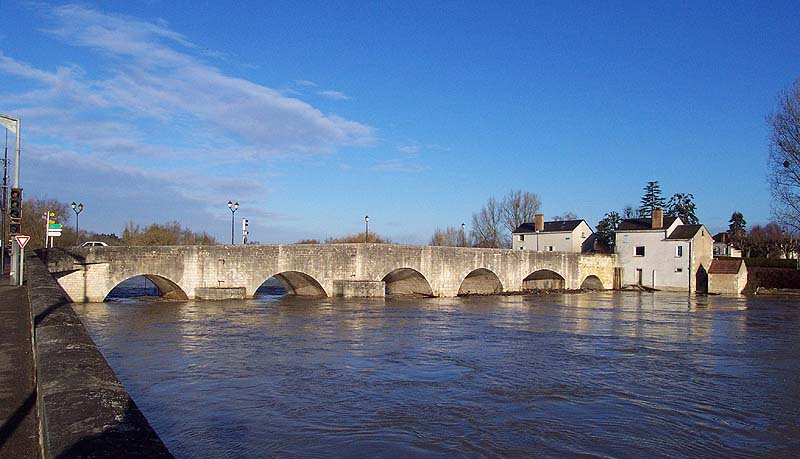
You come to a carrefour giratoire — a traffic circle or roundabout or rotary or whatever you call it — and you take the first road to the right into Saint-Aignan. As you drive in, you are faced with the château high above the bridge and river, and as you come to the old bridge across the Cher there is the big old church off to the left. Saint-Aignan is definitely not about 1960s-style Soviet apartment blocks, and it is not an industrial town. It couldn’t be more typical, ancient French. Cobblestone streets. Houses from the 15th century. A church from the 11th century, and the ruins of a château dating back even further, along with the 16th century Renaissance château.
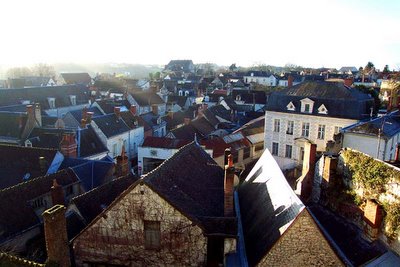
The rooftops of old Saint-Aignan seen from the château grounds

We drove around the town — very small, with a population of 3500 — and knew right off that it was fine. We were not disappointed. It didn’t seem quite as animated as Montrichard, but that was okay. It obviously had all the standard shops — pharmacies, banks, butcher shops, charcuteries, bakeries, a bookstore, a newspaper and magazine shop, restaurants, cafés, hotels, and so on. I don’t know if we took or had the time to walk around — maybe it was too cold and we just stayed in the car. We were still a little dazed and confused.

You can see some pictures of Saint-Aignan here, along with many others scattered through my old photo site and this blog. You can read about the practical side of living in Saint-Aignan here.

There was a hotel/restaurant on the banks of the river near the bridge called the Hôtel du Moulin. The sign out front said lunch was 10 euros per person -- that was $10.00 back then. We decided to try it. We entered by the front door, and there was a bar at a diagonal across the room, with a few café tables. We were directed into a dining room off to the left. There must have been 15 or 20 tables in the dining room. We sat at one. Most but not all the others were already taken. The meal was a set menu with no choices. I remember that there was a pasta salad, with grated carrots in it. It was fine. I think we had chicken in a sauce as the main course, with green beans. There was salad and cheese afterwards, and a dessert. Wine — un quart de litre par personne — was included in the price. Coffee was extra. All in all, it was a satisfactory experience. I kept thinking that, if we lived here, I could come here for lunch every day without breaking the bank and be perfectly happy with the food.
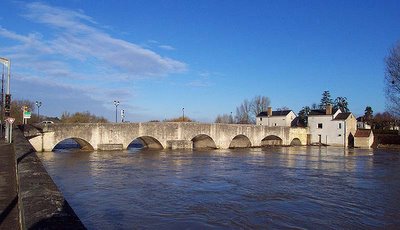
The bridge over the Cher river at Saint-Aignan

The fact is that I’ve never returned to the restaurant at the Hôtel du Moulin. I’m not sure why, except for the fact that we don’t go out to eat much. The price of the lunch has gone up to €11.00 since then. There is another restaurant in Saint-Aignan that offers in a similar deal, and there’s one across the river in Noyers-sur-Cher that does the same. The menu at the restaurant in Noyers has an hors-d’œuvre buffet -- a salad bar -- where you can eat as much as you want before your main course comes, or which you can have as your whole meal for just eight euros. It has two choices for the main course, and the lunch costs fifty eurocents less than the lunch at the Hôtel du Moulin. It too includes wine. The food is good. We drove back to Montrichard after lunch and arrived at Bourdais’ office for our 2:30 appointment. We were ready to see houses near Saint-Aignan.
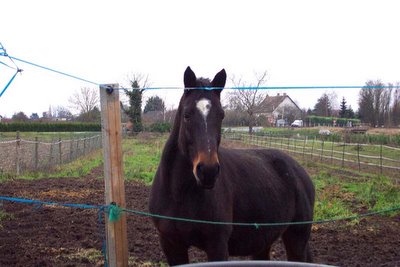
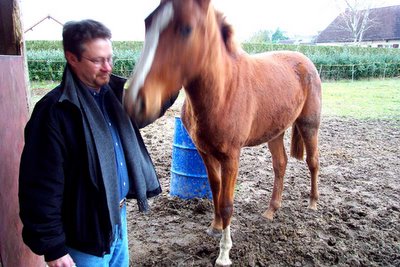
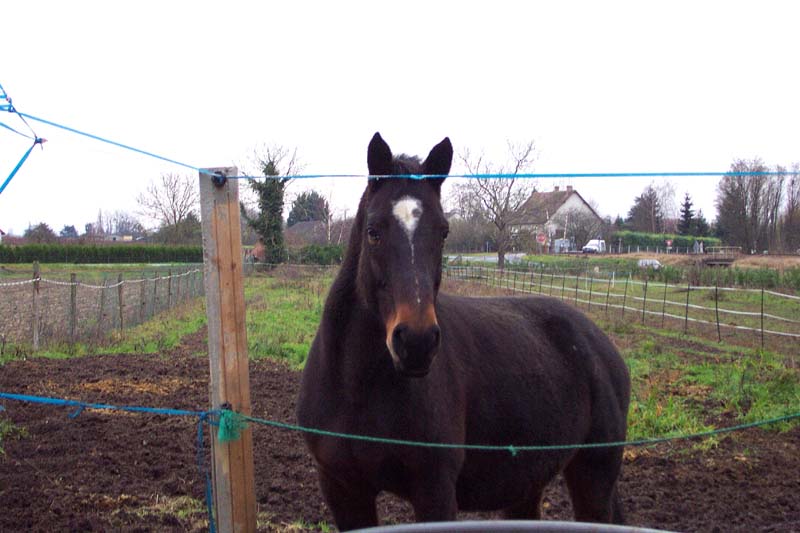
In Thésée we got to meet some horses

The first place he showed us was actually in Thésée, across the river and just a little west of Saint-Aignan. It was the first house where I thought we might be on the right track. It was fairly new, with a modern kitchen that showed some signs of wear and tear but was fundamentally nice. It had three bedrooms upstairs, but you had to walk through one of them to get to another one -- the people living there had children and they used those two bedrooms. The master bedroom was independent and private. I don’t remember if there was a bathroom upstairs -- there must have been.
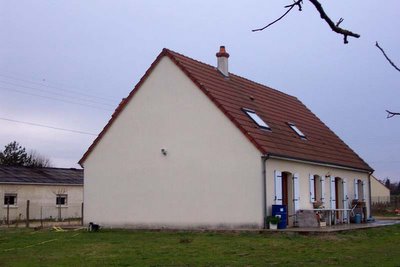
The Thésée house with the bakery building across the street on the left

This house sat on 2 or 3 acres of land, if I remember correctly. The people had horses and there were several outbuildings. Most of the land was used as pasture. On the down side, the house was completely exposed to the road, with no privacy fences or hedges. There was a concrete patio on the back of the house that had a lot of green mold or algae growing on it — that was probably something we could deal with. And the train tracks were very close, so if you lived there you would definitely hear the trains go by. Both passenger and freight trains run on that line.

Across the street, there was a warehouse-type building, which Bourdais told us was a bakery where breads and croissants and other pastries were baked for sale in local farmers markets. He said it would smell really good in the morning. We left thinking that that house was a good possibility for us, though not ideal. It was too much land, really, with nothing on it but horses, which we didn’t plan to keep.

Then we drove over to see houses in a couple of villages closer to Saint-Aignan. First we inspected a house on the side of a hill that had something like five small bedrooms, a small living room, a small dining room, and a kitchen that was just an empty room. It was carpeted throughout with gold-colored shag carpet, very 1970s, and the wallpaper all needed to be redone. There were neighboring houses close by. There was a big garage underneath.

The next house, with the back of the owner's head in the foreground

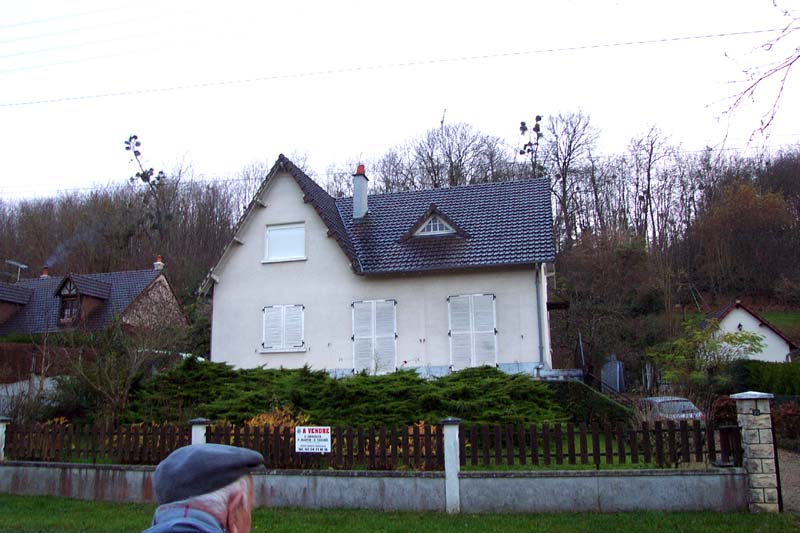
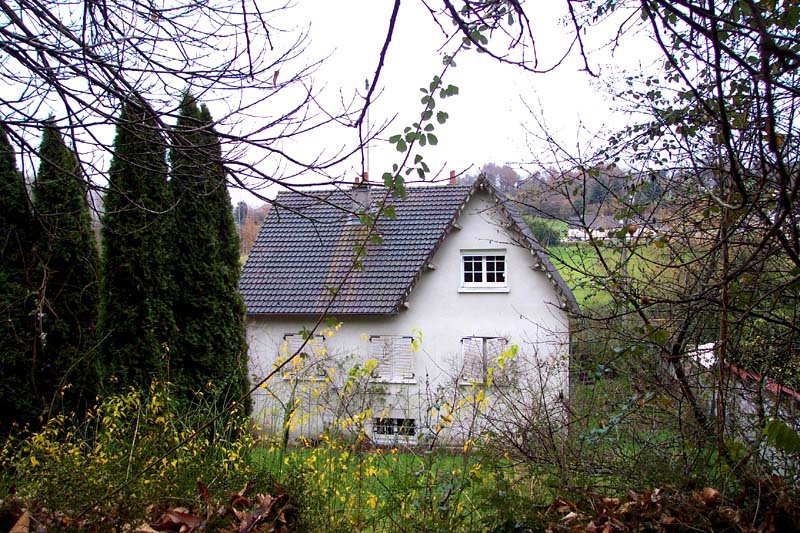
The biggest negative of this house was that the back yard went straight up a hill. It had been nicely landscaped at some point, with little paths and hedges and birdbaths. It had probably been very beautiful, but it was completely overgrown when we saw it. Living on the side of a hill like that is a problem for two reasons. Water runoff is a danger. The other problem is that the yard is basically useless for gardening. We're talking about a very steep hill.
Our house in San Francisco was on a hill like that. Once, when we had very heavy rain for a couple of days, we had water flowing from the back yard, up above the house on the hillside, down under the house and pouring like a fast-flowing stream into our garage and under our electric washer and dryer. We wondered whether the foundations were going to be undermined. We had to scramble to move a lot of things we had stored in the garage to prevent them from being ruined by the water. Luckily there were drains in the garage floor to take the water out of the building. Our next-door neighbor told us she had water flowing under her house and into her garage every time it rained. At least ours was just a one-time occurrence in the eight years we lived there.
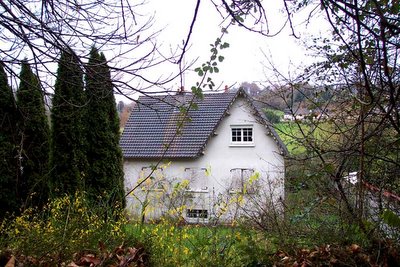
View of the same house from up in the back yard

Another house we saw here in the Saint-Aignan area confirmed the dangers of living on a hill. Its basement had an inch or two of water covering the floor. We ruled that one out immediately for that reason, but also because there were neighbors too close, and because the property, again, was on a fairly steep hill. It would have been a nice place otherwise — it was within easy walking distance of the village center, where there’s a bread bakery, a grocery store, a café, a post office, and a public library. And it was a fairly nice house, though in need of serious decorating upgrades.

The other house we saw that Tuesday afternoon is the one we decided to make an offer on.