Showing posts sorted by relevance for query church saint-aignan. Sort by date Show all posts

23 September 2007

Back home under gray skies

Our rather austere village center — it's not
exactly the thatched-roof cottages you might imagine

I dropped Joanna (my sister) and Janis (a good friend of hers) off at Charles de Gaulle airport yesterday morning at 8:30 and left them to stand in the line to get their baggage checked in. I wanted to hit the road and get back to Saint-Aignan as early as I could. It took me more than four hours.

The little church in our village near Saint-Aignan.
There's been a church here since the year 500.

I decided to drive my regular route through the countryside south of Paris, passing through Milly-la-Forêt, Malesherbes, Tousson, Puiseaux, Beaumont-du-Gâtinais, Bellegarde, Châteauneuf-sur-Loire, Tigy, Marcilly-en-Villette, La Ferté-Saint-Aubin, the Sologne forest, and Romorantin and Selles-sur-Cher before coming down the hill into the Cher river valley just before Saint-Aignan.

View out over the Cher river and the countryside north of Saint-Aignan

It started raining before noon at about Bellegarde, and I drove around the south side of Orléans and into La Sologne in a hard rain to the rhythm of the windshield wipers on the Peugeot. I guess my sister and Janice brought the good weather with them, and then took it home with them. Radio Bleue-Orléans was broadcasting from a very damp festival that was taking place on the banks of the Loire river all day Saturday.

Entering the courtyard of the château in Saint-Aignan

On the blog, I'm running about a week behind events. I told Joanna and Janice that I would do a little travelogue over the next few days so they could remember the names of the places and monuments we visited and match them to their photos.

The château in Saint-Aignan

Last Monday, 17 September, we spend the day in Saint-Aignan. Callie had a late-morning appointment to get her stictches out, after her spaying a few days earlier, and J, J, and I were worn out after our travel adventures over the weekend. It was a morning of rest and of getting some food plans together for the following few days.

Saint-Aignan's château seen from the banks of the Cher

In the afternoon, we went to visit our village outside Saint-Aignan and the town of Saint-Aignan itself. The village has about 1100 inhabitants, who are spread out over a wide territory. The village center is fairly small, with a church, a library, a bakery, a post office, a grocery store, two cafés, and the village hall. We looked around inside the church and walked down to the banks of the Cher river, where there's a campground.

The massive towers of the old church in Saint-Aignan

Then we went on to Saint-Aignan, population 4000, where we walked up onto the grounds of the château, which is privately owned. The owners live there, and you can't tour the interior, but you can walk around the courtyard and enjoy nice views of the river, the surrounding countryside, and the rooftops of the town. Part of the château is about 1000 years old and is in ruins, and another part dates back to the French Renaissance, 500 years ago.

The rooftops of old Saint-Aignan seen from the château's courtyard

We also went into the church, which is a massive Romanesque building. The interior was radically restored about 150 years ago. We walked down into the crypt, which is actually an older church on top of which the "newer" one was built hundreds of years ago. In the old church, there are frescoes painted on the walls between the 12th and 15th centuries.

The church in Saint-Aignan seen from the eastern riverbanks

It was a cloudy day but it was about the only cloudy day we had all week. The next morning we went to Valençay to see the street market and the château there. That afternoon, we had a good time climbing around in the medieval fortress at Loches. And finally, we went on our area's grand châteaux tour, which includes Chenonceau, Amboise, Chaumont-sur-Loire, Blois, and Chambord.

Joanna and Janice in front of the château at Saint-Aignan
17 September 2007


17 June 2006

Saint-Aignan in pictures

Like Palluau-sur-Indre, my town, Saint-Aignan-sur-Cher,  is also an ideal little French village in many ways. It too has a château up on a promontory above a river, and a big old church (11th century) nearby. Part of the château was built in the 11th century too, but the main part you see today dates from the French Renaissance, the 16th century. Here's a view of the town from north banks of the Cher River.

(Click the pictures to see them at full size,
and then pan by using the horizontal scroll bar in your browser.)
Saint-Aignan-sur-Cher seen from across the Cher River

The old town was built around the foot of the château, behind the church, and down to the banks of the Cher. A newer section of town spreads south from behind the church. There's an outdoor market on Saturdays, and the town has dozens of shops and businesses. The population of Saint-Aignan is about 4,000, with another 5,000 or so people living in villages and small towns within a 3-mile radius.

I took all these pictures yesterday morning. The two panoramas are composites of two or three individual photos, which I "stitch" together using software that came with my Canon digital camera. In this picture, you can see the ruins of the medieval fortress (on the right) that existed before the Renaissance château was built in the 1500s.

Church and château at Saint-Aignan-sur-Cher, 16 June 2006

Saint Aignan, by the way, was the bishop of the city of Orléans at the time when Attila the Hun was trying to conquer Gaul, over which Roman power was declining. According to legend, Aignan organized the defense of Orléans, a strategic point on the Loire River, and helped turn the Huns back. All that happened in about the year 450 A.D., long before the town of Saint-Aignan even existed. I don't know what the English name equivalent to Aignan would be. 

View of the town of Saint-Aignan from the east

Saint-Aignan is a more peaceful place now than at many times in the past. The medieval fortress was built on the hill at this location on the Cher River for a reason, after all. The counts of Blois put up the castle to defend their territories against the counts of Anjou. In the early 11th century, the count of Anjou named Foulques Nerra took Saint-Aignan away from his rivals. After that, I'm not clear on what happened down the centuries.

The bridge at Saint-Aignan

During World War I, the Americans had a large base in the area, and there is a monument to the American soldiers of that era on the bridge at Saint-Aignan. Thousands were stationed here, evidently, and there was a U.S. military hospital over in Montrichard, 10 miles away. Then, in World War II, the Cher River was at this point the dividing line between the part of France that was officially occupied by the Nazis and the part that was, in name, still deemed to be Free France. German soldiers guarded the bridge to make sure nobody unauthorized could pass over. 

The little mall on the banks of the Cher at Saint-Aignan

There is only one bridge over the Cher River at Saint-Aignan. More recently built bridges are located about three miles up river and down river (the one down river at Thésée-la-Romaine is a one-lane affair where cars in one direction have to wait for cars coming from the opposite direction to cross before they can continue). 

This old Antar garage on the banks of the Cher is closed up
and just waiting for a new business to move in.

The main streets of Saint-Aignan have been re-paved over the three years since I moved here. When I say re-paved, I mean it literally. There's no asphalt involved; the streets are done up in white paving stones to preserve the look of the town.

A mama duck and her ducklings swimming on the Cher at Saint-Aignan

The Banque Populaire (according to radio commercials, "banque et populaire à la fois!" -- a bank and popular at the same time!) recently moved into this old building on the riverfront in Saint-Aignan. Previously, it was abandoned and boarded up. Two new restaurants have opened up over the past two years, both also moving into old buildings. 

An old Renault 4L parked in front of the new Banque Populaire

On a side street near the river, just yesterday for the first time I noticed this old-fashioned looking shop. Claire is a hair dresser (coiffeur) who takes both Dames and Messieurs as clients. 

 Need a haircut? Call on Claire.

Like many French towns, to the American eye Saint-Aignan looks bigger than it actually is. The population is only 3,000, which makes it a very small town by American standards. But it has an urban look and feel to it. French towns are much more compact than American towns, and the buildings are more solid-looking. Only now is a little sprawl into the countryside starting to take place. Let's hope the local authorities keep it under control. 

Downtown Saint-Aignan seen from just east of town

Saint-Aignan has half a dozen restaurants and two hotels. One is the Grand Hôtel, which is a grand name for an old place right on the banks of the Cher. Rooms start at about 25 euros a night, and there's a good restaurant. The Grand Hôtel de St-Aignan is part of the Logis de France chain, which has a good reputation. 

Need a room on the banks of the Cher River? You can walk into the old town.

When I was out taking pictures yesterday, I was surprised to come upon a sign saying Caution! Quicksand! Who would have thought it? But the fact is, there's a sand-and-gravel quarry on a point of land that the Cher River wraps around on the north side of Saint-Aignan. I think the quicksand is a byproduct of the quarrying process. 

Sables mouvants means quicksand. Saint-Aignan is on the horizon.

18 April 2012

About Saint-Aignan

Saint-Aignan-sur-Cher is a little town — population 3,500 — built around a huge church and an enormous château. It's on the Cher River, in the southern section of the Loire River Valley — the Cher is a tributary of the Loire. Like many medieval towns, Saint-Aignan was built on hilly terrain dominated by a high promontory that could be easily defended from attack.

A Saint-Aignan landmark is the café called
Le Lapin Blanc — The White Rabbit.


Saint-Aignan is more prominent now than it has ever been before on the national level in France. A good part of its modest renown is owed to the existence of the Zooparc de Beauval, an internationally known zoo on the south side of town. Recently, the zoo acquired two giant pandas from China. It's by far the town's biggest tourist attraction, especially since the château is not open to the public.

The church up close — nice pink stone

Saint-Aignan-sur-Cher used to be known as Saint-Aignan-en-Berry. Le Berry is an old French province that no longer has an administrative or official existence. Saint-Aignan is located at the historically rural Berry province's northwest limit, where it borders on another historic province called La Touraine. La Touraine, centered on the ancient city of Tours, is known for its wines and its royal Renaissance châteaus. The wines made in the Saint-Aignan area are AOC Touraine, soon to be AOC Touraine-Chenonceau.

A new street decoration near the church

When I moved to Saint-Aignan in 2003 — my partner and I actually live in a neighboring village, but our house is just two miles from the center of Saint-Aignan — I didn't know the town at all. We had spent a couple of vacations in nearby Vouvray, Amboise, and Montrichard, about ten years ago. It was a real estate agent who told us we should consider finding a house to buy in the Saint-Aignan area if we wanted to relocate to this region. You'll get more for you money, he told us. We are happy that he gave us that advice.

Saint-Aignan's hulk of a church

Yesterday I met up with some Americans who lived in Champaign-Urbana, Illinois, when I did, back in the 1970s. We didn't really know each other then, but we've learned now that we had more than a few mutual friends. Linda and Jack are spending a week in Saint-Aignan with their daughter, Laura, who is spending a year in France. It's always fun and interesting to meet people through this blog. Many people we've met this way have become new friends.

View from the market square

So I went into Saint-Aignan yesterday morning to run an errand and to meet these visitors in a café (Aux Cépages a.k.a. Chez Lily, a wine bar — but we just had coffee!). I took advantage of the outing to take some pictures of Saint-Aignan's church from different perspectives, and a few other scenes. It was a cold gray morning, with a biting north wind. Everybody was talking about the unusually chilly weather. Some were saying it's better to have a cold snap now than in May...

08 December 2025

Where and what is Saint-Aignan?

This is one of the first posts I ever put on my blog, which I started in the autumn of 2005. It was an attempt to explain what life and commerce is like here in Saint-Aignan. Some things have changed over the past 20 years. The population of Saint-Aignan has dropped to about 3,000 souls. A lot of new houses have been built all along the roads near Saint-Aignan. Everybody has a car nowadays, and people do more shopping in supermarkets and less in local open-air markets and small shops in the town. Here's what I wrote in 2005, about a year and a half after we came here to live. Warning: the 20-year-old links in this old post don't work.

What kind of town is Saint-Aignan-sur-Cher? What’s it like to live nearby and have Saint-Aignan as your main "urban" center?

Saint-Aignan itself has a population of about 4,000. But the town just on the other side of the river Cher, called Noyers-sur-Cher, is home to 3,000 or so people. And there are a couple of villages -- Mareuil and Seigy -- on either side of Saint-Aignan that have about 1,000 residents each. In all, the Saint-Aignan/Noyers ‘metropolitan’ area -- l’agglomération, in French -- must number about 10,000 inhabitants.

So how do you pronounce Saint-Aignan? Just the way it sounds, ha ha ha. Seriously, saint in French sounds like sant. Aignan is pronounced ay-NYAWN. Well, except you don't really pronounce the final N -- the third syllable is a nasal vowel. But to get it right, you have to say the T of sant as the first sound of the first syllable of Aignan. You end up with something like san-tay-NYAW[N]. Easy, no? How about Noyers? That would be nwah-YAY. Seigy is say-ZHEE. Don't even ask about Mareuil. In all cases, the sur-Cher suffix is pronounced syur-SHEHR. Cher is Cher as in Sonny and Cher, in other words.

There are three other towns of about 5,000 people within 10 miles of san-tay-NYAW[N] (keep practicing). To the east, Selles-sur-Cher (famous for goat cheese). To the north, Contres (a farming town). And to the west, Montrichard (a lively town dominated by a medieval fortress). Amboise, Blois, and Valençay are all within 25 miles. So Saint-Aignan (known for its zoo and its Touraine wines) is not isolated.

We live about 2 miles from the main square in Saint-Aignan. We are in the country, but we are very close to everything we need in order to sustain our daily life. We normally drive to san-tay-NYAW[N] or nwah-YAY for groceries and other shopping, but we could also easily ride our bicycles or even walk, depending on the weather. That's not to say that we do either very often.
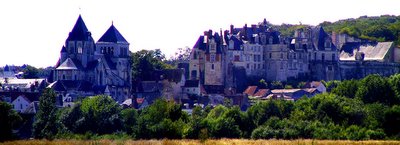
The church and château at Saint-Aignan-sur-Cher

Saint-Aignan itself is built around the base of an enormous château. The original château was a fortified structure built about the year 1000 A.D. Ruins of some of the old towers are still visible. But the main part of the existing château dates from the 1500s or even 1600s, the French Renaissance. That part of the château complex is not fortified. It’s more like a huge mansion than it is a fort. It is still privately owned and the owners live in it. It is not open to the public, but you can go up onto the grounds and into the courtyard to enjoy great views of Saint-Aignan's rooftops and the Cher river valley below. There's also an enormous old church, as you can see in the picture above. There are more pictures on my photo site, and here's a map of France showing where Saint-Aignan is located.

The old part of Saint-Aignan is right on the banks of the river Cher. There are old narrow, winding streets and there are quite a few ancient houses and buildings. There is a single bridge across the river, and it’s a stone structure that has to be hundreds of years old. Here's a series of pictures of places in and around Saint-Aignan.

There’s a main street that runs from the bridge up through town, heading south towards a town called Le Blanc and then on to Limoges (more than 100 miles south). The zoo, which is a big attraction and actually very impressive, with lots of animals and birds from all over the world (including a pen full of raccoons), is south of town on that road.

In central Saint-Aignan, the main street and a semi-pedestrian street that runs perpendicular to the main street are lined with a dozens of businesses. Saint-Aignan has everything you need. In the middle of town, there are:
  • a post office
  • a library
  • a municipal swimming pool
  • four boulangeries/pâtisseries (selling breads and pastries)
  • three pharmacies
  • three grocery stores, including one that specializes in organic products
  • three butcher shops, including one horsemeat butcher
  • two charcuteries (French-style delicatessens that sell pork, sausages, pâtés, salads, and prepared dishes like stews and cooked vegetables you can reheat at home)
  • six or seven restaurants
  • seven or eight cafés
  • two hotels
  • one bookstore
  • one newsstand
  • a half a dozen banks
  • an appliance store
  • an electronics store
  • a hardware/building supply/do-it-yourself store (south of town, actually)
  • two florists
  • five or six clothing and shoe stores
  • four or five gift shops
  • three or four insurance agencies
  • five or six hair salons
  • an optical shop
  • several doctors' and dentists' offices
  • two driving schools
  • three antique/junk shops


And on Saturday mornings there are two outdoor markets in Saint-Aignan. The farmers market is on the central square in the old town, and the vendors include a big fish monger, three pork butchers (charcutiers) , a butcher and a horsemeat butcher, two poultry stands that also sell spit-roasted chicken, rabbits, and pork roasts, two cheese merchants (one sells just goat cheese made on his farm), and four or five fruit and vegetable stands. There's a woman who sells the mushrooms she grows on her farm, a man who sells snails (alive or cooked), a woman who sells produce, cheeses, and eggs from her farm, and a man who sells flowers, potted plants, and seedlings for your garden in the spring.

On the main square in the newer part of Saint-Aignan (5 minutes' walk from the farmers market), there's a Saturday market where you can buy clothes (picture), shoes, table linens, curtains, and other dry goods. On special occasions (two or three times a year), there are big town-wide flea markets with stalls set up all along the main streets and squares. On those days, you can find a great deal of everything you could ever think of to buy, from arts and crafts to cars.

In Noyers, there's a farmers market on Sunday mornings where many of the same vendors sell their products. Ten miles distant, Selles-sur-Cher has a big food and dry goods market on Thursday mornings, Contres has one on Friday mornings, and Montrichard has its own on Monday afternoons and Friday mornings. A little farther afield, Amboise (20 miles away) has a huge market on Sunday mornings -- one of the largest in the region or even in France, they say -- as well as a smaller food market on Friday mornings, and Valençay (15 miles away) has one on Tuesday mornings. I won't even mention the markets and supermarkets in Tours (pronounced TOUR) and Blois (BLWAH), where we go to shop just a few times a year. And in the town of Loches (say LUSH), just half an hour southwest of Saint-Aignan by car!

Within four miles of our house, besides all that, there are four supermarkets, two in Saint-Aignan (Ed and SuperU) and two across the river in Noyers (Intermarché and Champion). There is smaller grocery store, plus a post office, two bakeries, a café, a library, a hair salon (Mme Barbier), a library, and a garage that sells used cars, in our little village, just on the edge of Saint-Aignan. In Noyers there are restaurants, bakeries, cafés, and all the other normal businesses a town might have, including four hotels that I can think of and a great truck-stop restaurant. There are several garages and car dealerships (Citroën and Renault -- the Peugeot dealer, Garage Danger, is in Saint-Aignan). There are a couple of service stations, and three of the supermarkets have gas pumps. There are three big hardware/building supply/do-it-yourself stores, and a big five-and-ten-cent-style store in Noyers. The train station, with service to Tours, Vierzon, and Bourges, is over there. There's also a computer store and there are four furniture/appliance stores.

What don’t we have? There is no cheese shop, and there is no fish market in the area. But the supermarkets have both, and so do the farmers markets, so good cheeses and fresh fish are readily available. There’s no auto supply store, though there is a new tire store. There’s no wine shop, but the whole area is covered with wineries where you can buy wine at retail, in bottles, boxes, or in bulk, and the supermarkets have big wine and beverage sections. Two other shops in Saint-Aignan, one a wine bar and the other a gift shop, sell wines also. There’s no office supply store, so you have to rely on the supermarkets or drive up to Blois (25 miles) or over to Tours (35 miles) for those products. There's a big shopping center south of Blois, about 20 miles from Saint-Aignan.

Mostly, what Saint-Aignan doesn’t have is traffic. The one bridge across the river can get a little backed up on Saturdays or in July and August when there are a lot of tourists around. But the backup might be 20 cars. It’s nothing, of course, compared to the traffic around Paris or big American cities. In fact, it’s nothing compared to the traffic in my home town in North Carolina, which you have probably never heard of. I was there last April and I was amazed at the number of cars on the big wide highways that have been built there. Everybody is going to the Wal-Mart SuperCenter or the Home Depot!

In our area here in the Cher river valley, there is what is called a route nationale that runs along the river connecting Saint-Aignan toTours (pop. 250,000), 35 miles west, and to Bourges (pop. 150,000), 50 miles east. The route nationale is a two-lane road. There is a main north-south route that links Saint-Aignan to Blois (pop. 75,000), 25 miles north. There is an extensive network of smaller two-lane highways linking towns and villages all around the area, and an even more extensive network of narrow country lane covering the countryside. The narrow country lanes often have no pavement markings (no center line, etc.) and are mostly too narrow for two cars to be able to pass each other easily. You have to slow down and pull a little off the road to the right when you meet an oncoming car.

We have a new toll road (autoroute) that ends at Noyers for now. It's a direct link to Paris, which is about a three-hour drive north. The extension that will connect us to Tours and beyond is under construction a will open in a couple of years. The toll to Paris is about $20.00.

The countryside is a little hilly, and the Cher river runs through a fairly wide and fairly deep valley. It's a couple of hundred miles long. At places there are cliffs along the river, but mostly there are just hills. Our house is a the top of a hill right along the edge of the valley, and we are about a mile from the river itself.

Most of the housing is single-family dwellings, with old townhouses in Saint-Aignan and Noyers, but there are several apartment buildings in each town. A lot of people have big lots -- an acre or two is not uncommon. And of course many people own a lot more land than that. Most of the land around here is devoted to vineyards and vegetable gardens. There aren't many cattle to be seen, though there are some horse farms.

If you've read this far, maybe you'd like to see this post (link) from June 2006 that contains a number of photos of the town of Saint-Aignan.

04 December 2005

About Saint-Aignan

What kind of town is Saint-Aignan-sur-Cher? What’s it like to live nearby and have Saint-Aignan as your main "urban" center?

Saint-Aignan itself has a population of about 4,000. But the town just on the other side of the river Cher, called Noyers-sur-Cher, is home to 3,000 or so people. And there are a couple of villages -- Mareuil and Seigy -- on either side of Saint-Aignan that have about 1,000 residents each. In all, the Saint-Aignan/Noyers ‘metropolitan’ area -- l’agglomération, in French -- must number about 10,000 inhabitants.

So how do you pronounce Saint-Aignan? Just the way it sounds, ha ha ha. Seriously, saint in French sounds like sant. Aignan is pronounced ay-NYAWN. Well, except you don't really pronounce the final N -- the third syllable is a nasal vowel. But to get it right, you have to say the T of sant as the first sound of the first syllable of Aignan. You end up with something like san-tay-NYAW[N]. Easy, no? How about Noyers? That would be nwah-YAY. Seigy is say-ZHEE. Don't even ask about Mareuil. In all cases, the sur-Cher suffix is pronounced syur-SHEHR. Cher is Cher as in Sonny and Cher, in other words.

There are three other towns of about 5,000 people within 10 miles of san-tay-NYAW[N] (keep practicing). To the east, Selles-sur-Cher (famous for goat cheese). To the north, Contres (a farming town). And to the west, Montrichard (a lively town dominated by a medieval fortress). Amboise, Blois, and Valençay are all within 25 miles. So Saint-Aignan (known for its zoo and its Touraine wines) is not isolated.

We live about 2 miles from the main square in Saint-Aignan. We are in the country, but we are very close to everything we need in order to sustain our daily life. We normally drive to san-tay-NYAW[N] or nwah-YAY for groceries and other shopping, but we could also easily ride our bicycles or even walk, depending on the weather. That's not to say that we do either very often.

The church and château at Saint-Aignan-sur-Cher

Saint-Aignan itself is built around the base of an enormous château. The original château was a fortified structure built about the year 1000 A.D. Ruins of some of the old towers are still visible. But the main part of the existing château dates from the 1500s or even 1600s, the French Renaissance. That part of the château complex is not fortified. It’s more like a huge mansion than it is a fort. It is still privately owned and the owners live in it. It is not open to the public, but you can go up onto the grounds and into the courtyard to enjoy great views of Saint-Aignan's rooftops and the Cher river valley below. There's also an enormous old church, as you can see in the picture above. There are more pictures on my photo site, and here's a map of France showing where Saint-Aignan is located.

The old part of Saint-Aignan is right on the banks of the river Cher. There are old narrow, winding streets and there are quite a few ancient houses and buildings. There is a single bridge across the river, and it’s a stone structure that has to be hundreds of years old. Here's a series of pictures of places in and around Saint-Aignan.

There’s a main street that runs from the bridge up through town, heading south towards a town called Le Blanc and then on to Limoges (more than 100 miles south). The zoo, which is a big attraction and actually very impressive, with lots of animals and birds from all over the world (including a pen full of raccoons), is south of town on that road.

In central Saint-Aignan, the main street and a semi-pedestrian street that runs perpendicular to the main street are lined with a dozens of businesses. Saint-Aignan has everything you need. In the middle of town, there are:
  • a post office
  • a library
  • a municipal swimming pool
  • four boulangeries/pâtisseries (selling breads and pastries)
  • three pharmacies
  • three grocery stores, including one that specializes in organic products
  • three butcher shops, including one horsemeat butcher
  • two charcuteries (French-style delicatessens that sell pork, sausages, pâtés, salads, and prepared dishes like stews and cooked vegetables you can reheat at home)
  • six or seven restaurants
  • seven or eight cafés
  • two hotels
  • one bookstore
  • one newsstand
  • a half a dozen banks
  • an appliance store
  • an electronics store
  • a hardware/building supply/do-it-yourself store (south of town, actually)
  • two florists
  • five or six clothing and shoe stores
  • four or five gift shops
  • three or four insurance agencies
  • five or six hair salons
  • an optical shop
  • several doctors' and dentists' offices
  • two driving schools
  • three antique/junk shops

And on Saturday mornings there are two outdoor markets in Saint-Aignan. The farmers market is on the central square in the old town, and the vendors include a big fish monger, three pork butchers (charcutiers) , a butcher and a horsemeat butcher, two poultry stands that also sell spit-roasted chicken, rabbits, and pork roasts, two cheese merchants (one sells just goat cheese made on his farm), and four or five fruit and vegetable stands. There's a woman who sells the mushrooms she grows on her farm, a man who sells snails (alive or cooked), a woman who sells produce, cheeses, and eggs from her farm, and a man who sells flowers, potted plants, and seedlings for your garden in the spring.

On the main square in the newer part of Saint-Aignan (5 minutes' walk from the farmers market), there's a Saturday market where you can buy clothes (picture), shoes, table linens, curtains, and other dry goods. On special occasions (two or three times a year), there are big town-wide flea markets with stalls set up all along the main streets and squares. On those days, you can find a great deal of everything you could ever think of to buy, from arts and crafts to cars.

In Noyers, there's a farmers market on Sunday mornings where many of the same vendors sell their products. Ten miles distant, Selles-sur-Cher has a big food and dry goods market on Thursday mornings, Contres has one on Friday mornings, and Montrichard has its own on Monday afternoons and Friday mornings. A little farther afield, Amboise (20 miles away) has a huge market on Sunday mornings -- one of the largest in the region or even in France, they say -- as well as a smaller food market on Friday mornings, and Valençay (15 miles away) has one on Tuesday mornings. I won't even mention the markets and supermarkets in Tours (pronounced TOUR) and Blois (BLWAH), where we go to shop just a few times a year. And in the town of Loches (say LUSH), just 20 minutes southwest of Saint-Aignan by car!

Within four miles of our house, besides all that, there are four supermarkets, two in Saint-Aignan (Ed and SuperU) and two across the river in Noyers (Intermarché and Champion). There is smaller grocery store, plus a post office, two bakeries, a café, a library, a hair salon (Mme Barbier), a library, and a garage that sells used cars, in our little village, just on the edge of Saint-Aignan. In Noyers there are restaurants, bakeries, cafés, and all the other normal businesses a town might have, including four hotels that I can think of and a great truck-stop restaurant. There are several garages and car dealerships (Citroën and Renault -- the Peugeot dealer, Garage Danger, is in Saint-Aignan). There are a couple of service stations, and three of the supermarkets have gas pumps. There are three big hardware/building supply/do-it-yourself stores, and a big five-and-ten-cent-style store in Noyers. The train station, with service to Tours, Vierzon, and Bourges, is over there. There's also a computer store and there are four furniture/appliance stores.

What don’t we have? There is no cheese shop, and there is no fish market in the area. But the supermarkets have both, and so do the farmers markets, so good cheeses and fresh fish are readily available. There’s no auto supply store, though there is a new tire store. There’s no wine shop, but the whole area is covered with wineries where you can buy wine at retail, in bottles, boxes, or in bulk, and the supermarkets have big wine and beverage sections. Two other shops in Saint-Aignan, one a wine bar and the other a gift shop, sell wines also. There’s no office supply store, so you have to rely on the supermarkets or drive up to Blois (25 miles) or over to Tours (35 miles) for those products. There's a big shopping center south of Blois, about 20 miles from Saint-Aignan.

Mostly, what Saint-Aignan doesn’t have is traffic. The one bridge across the river can get a little backed up on Saturdays or in July and August when there are a lot of tourists around. But the backup might be 20 cars. It’s nothing, of course, compared to the traffic around Paris or big American cities. In fact, it’s nothing compared to the traffic in my home town in North Carolina, which you have probably never heard of. I was there last April and I was amazed at the number of cars on the big wide highways that have been built there. Everybody is going to the Wal-Mart SuperCenter or the Home Depot!

In our area here in the Cher river valley, there is what is called a route nationale that runs along the river connecting Saint-Aignan toTours (pop. 250,000), 35 miles west, and to Bourges (pop. 150,000), 50 miles east. The route nationale is a two-lane road. There is a main north-south route that links Saint-Aignan to Blois (pop. 75,000), 25 miles north. There is an extensive network of smaller two-lane highways linking towns and villages all around the area, and an even more extensive network of narrow country lane covering the countryside. The narrow country lanes often have no pavement markings (no center line, etc.) and are mostly too narrow for two cars to be able to pass each other easily. You have to slow down and pull a little off the road to the right when you meet an oncoming car.

We have a new toll road (autoroute) that ends at Noyers for now. It's a direct link to Paris, which is about a three-hour drive north. The extension that will connect us to Tours and beyond is under construction a will open in a couple of years. The toll to Paris is about $20.00.

The countryside is a little hilly, and the Cher river runs through a fairly wide and fairly deep valley. It's a couple of hundred miles long. At places there are cliffs along the river, but mostly there are just hills. Our house is a the top of a hill right along the edge of the valley, and we are about a mile from the river itself.

Most of the housing is single-family dwellings, with old townhouses in Saint-Aignan and Noyers, but there are several apartment buildings in each town. A lot of people have big lots -- an acre or two is not uncommon. And of course many people own a lot more land than that. Most of the land around here is devoted to vineyards and vegetable gardens. There aren't many cattle to be seen, though there are some horse farms.

05 February 2006

Seeing Saint-Aignan for the first time

The nature of blogs is that you read forward, not backward. The problem is that this is the fourth in a series of articles. If you want to read them in order, use these links. Then click Next at the bottom of each article to jump to the next one in the series.

We drove back to the gîte after our first day of house-hunting wondering what Saint-Aignan would be like. If houses were less expensive there, as Bourdais seemed to me to be implying, maybe it wasn’t a desirable location. “Maybe it’s some kind of ville nouvelle, all Soviet-style 1960s architecture, big apartment blocks. Maybe it’s an industrial center. Maybe it’s a ghost town,” I told Walt. Always the optimist, I am. My vision of France was skewed by my familiarity with Paris and its banlieues.

Back at the gîte we got out the map and studied it. It was true that Saint-Aignan-sur-Cher was just ten miles upriver from Montrichard, on the opposite bank. There was nothing near it that we were familiar with, except Valençay, where there is a famous château.

The main street leading into the center of Saint-Aignan

We had lunch in Valençay in October 2000 and enjoyed it. The restaurant was very old-fashioned and the other customers, especially one very bourgeois-looking French woman who was seated facing us, stared at us with cold eyes as we sat waiting to be brought menus. We felt like aliens and wondered what she was looking at. We don’t know if it was because we were two men, because we looked American, or because we weren’t dressed properly. Or maybe she wasn’t looking at us at all. We had a good lunch anyway, with a bottle of the local Valençay VDQS red wine.

Would Saint-Aignan be as old-fashioned as Valençay had seemed? That would be fine with me. I can stare at foreigners with the best of them -- or even at French people all dressed up in their Sunday best. I kind of liked the idea. We decided that since we had Tuesday morning free, the smart thing to do would be to drive over to Saint-Aignan and have a look around. If we hated it, we could tell Bourdais at our 2:30 meeting that we’d rather see houses closer to Montrichard — which didn’t seem old-fashioned and formal but bustling and friendly — or closer to Amboise, which is where we had wanted to start anyway.

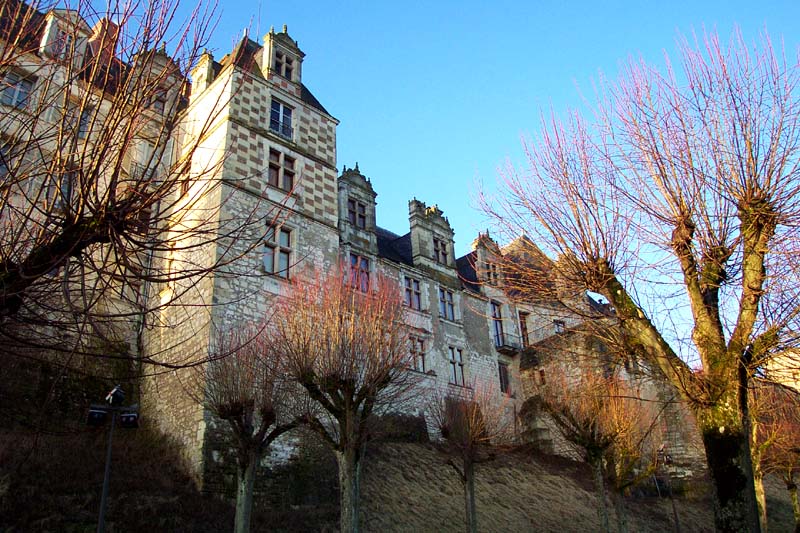
An up-close view of the château de Saint-Aignan

I don’t remember by what route we drove to Saint-Aignan the next morning. Now I know that there are several ways to get here from Amboise or even from Montrichard. I suppose we took the main road, which is the route nationale 76 that runs along the Cher river south of Montrichard, crosses the Cher near the village called Thésée, and then runs along the river north of Saint-Aignan through the town called Noyers-sur-Cher. The stretch from Montrichard to Thésée is especially nice, and is marked as scenic on Michelin maps.

The river valley is wide and open. The banks of the river are wooded, so you don’t actually see the water. On the left are wide fields where sometimes you see the local roe deer grazing. On the right side there are picturesque houses and at least a couple of churches (in the wine villages of Angé and Pouillé) along a secondary road that parallels the route nationale. The houses are built up on wooded bluffs that mark the southern limit of the river valley. To the north, you see the hills on the other edge of the river valley, some of them planted in vines. When you get to Thésée (another wine village) you can see the village church steeple off in the distance, just before you cross the highway bridge over the Cher, where you have a nice view of the river itself.

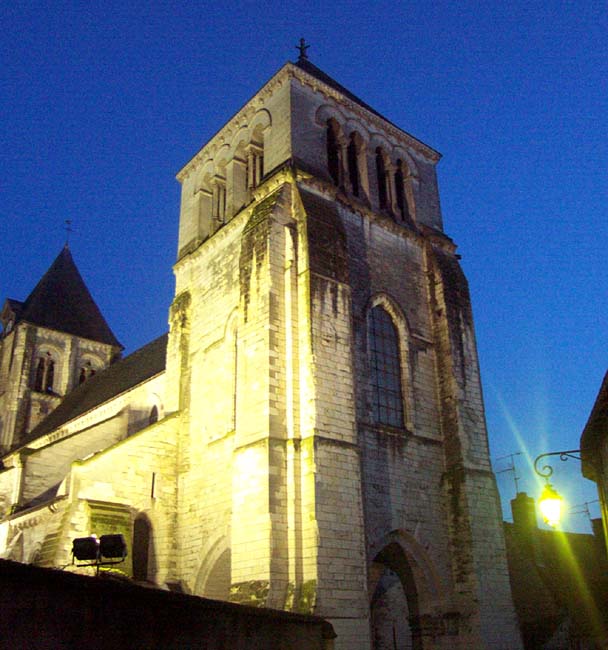
The Saint-Aignan church at dusk on a December day

When you cross over to the north bank of the river, you come fairly soon to a less attractive area. There is a big grain elevator off to the left. Up close, it looks like ... well, a grain elevator. You could be in the American Midwest, or the Central Valley of California. But I maintain now that, from a distance, that elevator looks almost like a big cathedral church. The local people have been known to laugh when I say that. Anyway, the next thing you see is a fairly ordinary looking shopping center on the left hand side of the road -- Intermarché, Bricomarché, L’Univers des Affaires, Sésame, a couple of furniture stores and other businesses, all in corrugated steel buildings that are basically warehouses. There’s also a plant where nut oils are pressed and bottled.

But it you look off to the right as you are driving past the grain elevator and the centre commercial, you can see the massive château de Saint-Aignan sitting up on a high bluff above the river and the town.

You come to a carrefour giratoire — a traffic circle or roundabout or rotary or whatever you call it — and you take the first road to the right into Saint-Aignan. As you drive in, you are faced with the château high above the bridge and river, and as you come to the old bridge across the Cher there is the big old church off to the left. Saint-Aignan is definitely not about 1960s-style Soviet apartment blocks, and it is not an industrial town. It couldn’t be more typical, ancient French. Cobblestone streets. Houses from the 15th century. A church from the 11th century, and the ruins of a château dating back even further, along with the 16th century Renaissance château.

The rooftops of old Saint-Aignan seen from the château grounds

We drove around the town — very small, with a population of 3500 — and knew right off that it was fine. We were not disappointed. It didn’t seem quite as animated as Montrichard, but that was okay. It obviously had all the standard shops — pharmacies, banks, butcher shops, charcuteries, bakeries, a bookstore, a newspaper and magazine shop, restaurants, cafés, hotels, and so on. I don’t know if we took or had the time to walk around — maybe it was too cold and we just stayed in the car. We were still a little dazed and confused.

You can see some pictures of Saint-Aignan here, along with many others scattered through my old photo site and this blog. You can read about the practical side of living in Saint-Aignan here.

There was a hotel/restaurant on the banks of the river near the bridge called the Hôtel du Moulin. The sign out front said lunch was 10 euros per person -- that was $10.00 back then. We decided to try it. We entered by the front door, and there was a bar at a diagonal across the room, with a few café tables. We were directed into a dining room off to the left. There must have been 15 or 20 tables in the dining room. We sat at one. Most but not all the others were already taken. The meal was a set menu with no choices. I remember that there was a pasta salad, with grated carrots in it. It was fine. I think we had chicken in a sauce as the main course, with green beans. There was salad and cheese afterwards, and a dessert. Wine — un quart de litre par personne — was included in the price. Coffee was extra. All in all, it was a satisfactory experience. I kept thinking that, if we lived here, I could come here for lunch every day without breaking the bank and be perfectly happy with the food.

The bridge over the Cher river at Saint-Aignan

The fact is that I’ve never returned to the restaurant at the Hôtel du Moulin. I’m not sure why, except for the fact that we don’t go out to eat much. The price of the lunch has gone up to €11.00 since then. There is another restaurant in Saint-Aignan that offers in a similar deal, and there’s one across the river in Noyers-sur-Cher that does the same. The menu at the restaurant in Noyers has an hors-d’œuvre buffet -- a salad bar -- where you can eat as much as you want before your main course comes, or which you can have as your whole meal for just eight euros. It has two choices for the main course, and the lunch costs fifty eurocents less than the lunch at the Hôtel du Moulin. It too includes wine. The food is good. We drove back to Montrichard after lunch and arrived at Bourdais’ office for our 2:30 appointment. We were ready to see houses near Saint-Aignan.

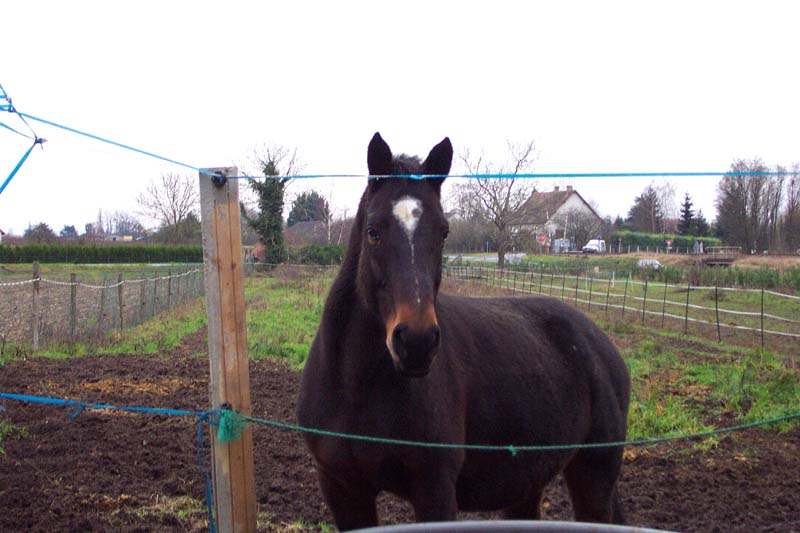
In Thésée we got to meet some horses

The first place he showed us was actually in Thésée, across the river and just a little west of Saint-Aignan. It was the first house where I thought we might be on the right track. It was fairly new, with a modern kitchen that showed some signs of wear and tear but was fundamentally nice. It had three bedrooms upstairs, but you had to walk through one of them to get to another one -- the people living there had children and they used those two bedrooms. The master bedroom was independent and private. I don’t remember if there was a bathroom upstairs -- there must have been.

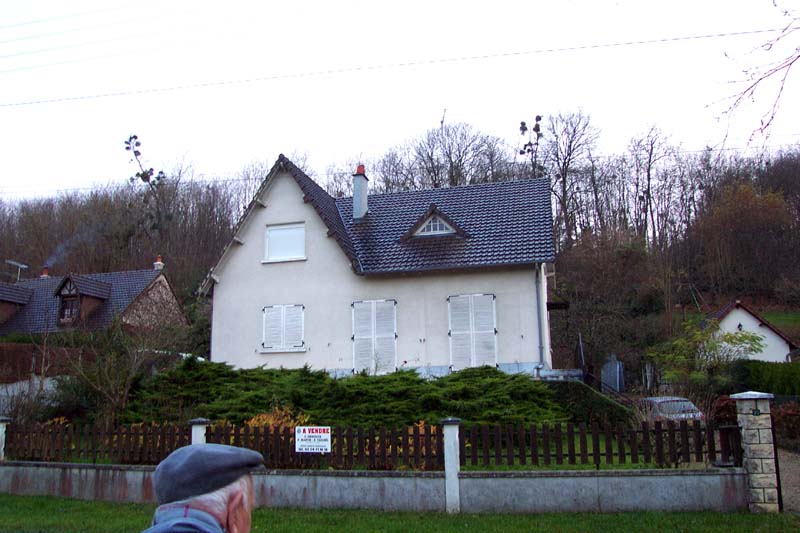
The Thésée house with the bakery building across the street on the left

This house sat on 2 or 3 acres of land, if I remember correctly. The people had horses and there were several outbuildings. Most of the land was used as pasture. On the down side, the house was completely exposed to the road, with no privacy fences or hedges. There was a concrete patio on the back of the house that had a lot of green mold or algae growing on it — that was probably something we could deal with. And the train tracks were very close, so if you lived there you would definitely hear the trains go by. Both passenger and freight trains run on that line.

Across the street, there was a warehouse-type building, which Bourdais told us was a bakery where breads and croissants and other pastries were baked for sale in local farmers markets. He said it would smell really good in the morning. We left thinking that that house was a good possibility for us, though not ideal. It was too much land, really, with nothing on it but horses, which we didn’t plan to keep.

Then we drove over to see houses in a couple of villages closer to Saint-Aignan. First we inspected a house on the side of a hill that had something like five small bedrooms, a small living room, a small dining room, and a kitchen that was just an empty room. It was carpeted throughout with gold-colored shag carpet, very 1970s, and the wallpaper all needed to be redone. There were neighboring houses close by. There was a big garage underneath.

The next house, with the back of the owner's head in the foreground

The biggest negative of this house was that the back yard went straight up a hill. It had been nicely landscaped at some point, with little paths and hedges and birdbaths. It had probably been very beautiful, but it was completely overgrown when we saw it. Living on the side of a hill like that is a problem for two reasons. Water runoff is a danger. The other problem is that the yard is basically useless for gardening. We're talking about a very steep hill.
Our house in San Francisco was on a hill like that. Once, when we had very heavy rain for a couple of days, we had water flowing from the back yard, up above the house on the hillside, down under the house and pouring like a fast-flowing stream into our garage and under our electric washer and dryer. We wondered whether the foundations were going to be undermined. We had to scramble to move a lot of things we had stored in the garage to prevent them from being ruined by the water. Luckily there were drains in the garage floor to take the water out of the building. Our next-door neighbor told us she had water flowing under her house and into her garage every time it rained. At least ours was just a one-time occurrence in the eight years we lived there.

View of the same house from up in the back yard

Another house we saw here in the Saint-Aignan area confirmed the dangers of living on a hill. Its basement had an inch or two of water covering the floor. We ruled that one out immediately for that reason, but also because there were neighbors too close, and because the property, again, was on a fairly steep hill. It would have been a nice place otherwise — it was within easy walking distance of the village center, where there’s a bread bakery, a grocery store, a café, a post office, and a public library. And it was a fairly nice house, though in need of serious decorating upgrades.

The other house we saw that Tuesday afternoon is the one we decided to make an offer on.

09 May 2010

The Saturday market

I didn't mean to imply, yesterday, that the only way to get to the market in Saint-Aignan is to climb over a steep hill, up staircases, through the château grounds. There is a big parking lot right across the street from the place where the market is being held this spring. You can drive in and park just a few steps from the vendors' stalls.

Looking down at the market from the grounds
of the château in Saint-Aignan


Walking up over the hill from the river lot is just the most scenic way to go, and it's good exercise. You can take a lot of nice pictures if the weather is good.

A château was built on the site that is now Saint-Aignan as early as the 9th century. The old fortified towers of that structure, in ruins, remain. The town, then known as Saint-Aignan-en-Berry, grew up around the château.

The market in Saint-Aignan-sur-Cher
is set up on Saturday mornings.


Saint-Aignan sits at the point where three old French provinces — Le Berry, La Touraine, and L'Orléanais — come together. Walt and I bought a house that, while less than two miles from the center of Saint-Aignan, is historically in Touraine — the Berry-Touraine border runs somewhere between us and town.

The building called Les Bernardines
suffered a bad fire a couple of years ago.

One of the most striking landmarks in Saint-Aignan is an old convent and school, Les Bernardines, built I think starting in about 1640. The schools still exists, but in a different building. The original structure was abandoned for years, vandalized, occupied illegally by squatters, and finally, a couple of years ago, ravaged by a major fire. Nobody knows what fate awaits it now. Here's an interesting document (PDF) about Les Bernardines, with quite a few pictures.

The church at Saint-Aignan-sur-Cher

The church is another major Saint-Aignan landmark. It was built in the 11th and 12th centuries on top of an even older chapel. A new side chapel was added in the 15th century, and during the French Revolution at the end of the 18th century the whole church was sold off at auction. It was turned back into a church within about 10 years, however, and new belfry was added in the 1870s.

My destination Saturday morning was the market. I wanted strawberries and goat cheeses, and I wanted to see if my favorite charcuterie vendor, who we call « Madame Doudouille » because the name of her business is Chez Doudouille, would be there.

12 September 2009

L'Auvergne: pre-departure events

It's been a week since we left the Auvergne and returned to the Touraine. And every day for a week, the same thought has crossed my mind. I want to go back to the Auvergne. It was so beautiful and we had such a good time.

Because of the intensely green landscape and the fog and low clouds, it was other-worldly. The land was hilly, even mountainous, and it was emerald-colored. The Touraine isn't exactly flat, but right now it is all parched brown or yellow. It's home, so it's normal now. But the Auvergne is exotic, seen (or remembered) from here.

A valley near the town of Salers in the Cantal

The day we left Saint-Aignan to drive down there, our friends were going in their rented car and we were going in our little Peugeot. We all got up fairly early and had some bread, croissants, butter, and jam for breakfast, with coffee. Walt and I were busy packing for the trip. But Evelyn, Lewis, and Linda, who had already been traveling for a few days, were able to pack up faster than we were.

At about 11:00, they said they were ready and they wanted to go into Saint-Aignan to see the château and the church before we started our journey. That sounded like a good idea. We said we would be along shortly, and we would just find them in the old town, which is pretty small.

The church and château in Saint-Aignan
reflected in the Cher River

Half an hour or so later, we were ready. We had the car all packed, the dog on the back seat, the food in the cooler, and the wine in the trunk. We had closed up the house, except for the garage door, which is the door we enter through when we come back home after driving anywhere. Walt took out his key to lock that door, and it wouldn't work. We fiddled with the key and the lock, cursing it, for what seemed to be ten minutes, with no luck.

"Well, we can't go if we can't lock up the house," Walt said. "We'll just have to stay in Saint-Aignan — or at least I will." We were both pretty stressed. I got out my key and tried to lock the door, but the mechanism was jammed. It seemed hopeless. We would have to call a locksmith, and that might take the whole afternoon. And then suddenly, when W. tried it again, it worked. Success! We were free to leave. We didn't know if we'd be able to get back in without breaking a window, but tough. We were going.

We drove the two miles to Saint-Aignan, and turned off the main street onto the little dead-end lane that runs past the front door of the church up to the base of the château. There they were. Linda hurried into the church to look around while Evelyn and Lewis came to talk to us.

More reflections

"Does Linda know to go down into the crypt to see the frescoes?" I asked. No, they said. "Well, let me run in and show her." They said they would wander back to their car, which was parked a few hundred yards up the street, in the town's biggest parking lot. I pulled off the street, alongside the church, blocking in a car that was already— and illegally, I'm sure — parked there. Walt was going to stay with our car anyway.

I showed Linda the 12th and 15th century frescoes in the crypt of the Saint-Aignan church. It only took a minute or two. At the top of the steps leading down to the lower level, there is a light switch to turn on all the lights down below. There's also a bulb there that gets turned on so you can tell whether the lights in the crypt are on or off. It wasn't shining, so I flipped the switch.

The old frescoes in the crypt of the church at Saint-Aignan
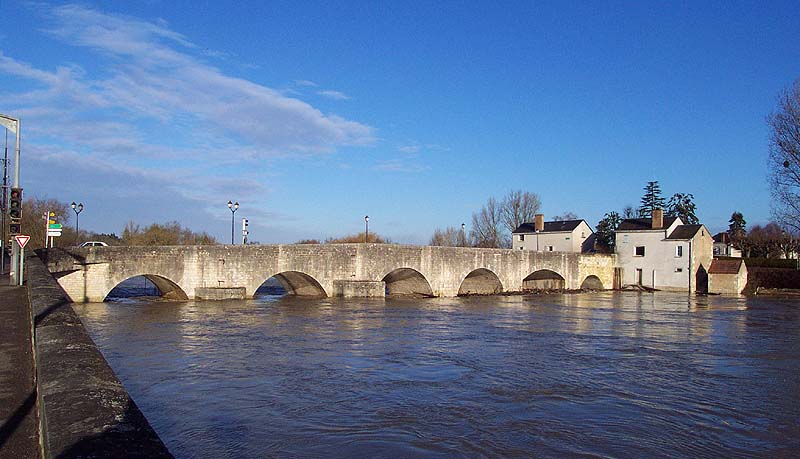
date from the 12th and 15th centuries.

As we started down the steps, I heard a voice — clearly an Englishman's — booming from below. "Have you thrown a switch up there? If so, you've turned off the lights. I'm in the dark!" I yelled out an apology and went back up the stairs to flip the switch again and turn the lights back on.

Having admired the frescoes, we exited the church. Linda walked ahead to join Evelyn and Lewis at their car. I started to back out of my improvised parking space. Now if you've spent some time in France, 7especially in Paris, you know that French drivers are not the world's most disciplined when it comes to parking their vehicles. They drive right up onto the sidewalks and leave their cars there, if they feel like it. The double-park. Parking spaces? Ha! Connais pas !

Short concrete posts installed in front of the church
to keep people from parking their cars there
I backed into one at the worst moment...

To discourage such wildcat parking, the French authorities often erect posts and bollards of different kinds along the edges of streets where they really don't want people to park their cars. Some are tall, and some are short. In front of the church at Saint-Aignan, they've put up low, thick concrete posts for this purpose. I knew there was one such post on the right side of my car, so I wanted to be careful not to scrape against it as I back out of the parking space.

I pulled forward to the left, maneuvered into a position from which I thought I could back straight out into the street before turning right to go down the hill, and I threw the Peugeot into reverse. I didn't exactly floor it, but I backed up without hesitation. And suddenly, there was a grinding crunch and the car stopped short. I had backed squarely into a concrete post that I couldn't see from inside the car and whose existence I hadn't been aware of! Merde !

The crash knocked my Peugeot's back bumper loose.

I wasn't sure at first if the car was still driveable. Walt and I got out to inspect the damage. The man whose car I had parked behind came along, and looked at it with us. "Everybody runs into those damned posts, since they put them up a couple of years ago. I've complained to the mayor, but they won't do anything about the situation," he told us. He said he thought the damage wasn't too bad.

The bumper was — still is, actually — detached from the fenders on both sides of the car, and the muffler and tailpipe seemed to be hanging at a funny angle. Nothing was scraping the back tires, however, so we drove up to the big parking lot where our friends had left their car. I told them what had happened and said I need to go see my mechanic before we hit the road.

L'église de Saint-Aignan

The mechanic's garage had clearly closed for lunch when we got there. It was maybe five past twelve. Luckily, one of the employees was just letting himself out. I accosted him and asked him if he might have time to look at my car for a minute to assure me it was safe to drive. He kicked the bumper, pulled it back into place, and verified that it was not at risk of falling off the car as we drove down the autoroute. He wished us a bon voyage and said he could re-attach the bumper when we got back to Saint-Aignan

We started our five-hour drive, with our friends following us in their car. We hadn't had any brunch or lunch and I was already hungry.