Showing posts sorted by relevance for query pintade. Sort by date Show all posts

24 November 2008

La Pintade farcie

Here's the recipe for stuffed guinea hen with port wine. It's pretty simple, really.

Une pintade or guinea hen

The pintade I bought at the supermarket weighed 1.3 kg or about 2½ lbs.
Stuffed Guinea Hen

a 2½ lb. guinea hen
4 slices of bread
6 Tbs. milk
1 egg
¼ lb. sausage meat
1 Tbs. chopped parsley
4 Tbs. port wine
3 sprigs of thyme
2 Tbs. cooking oil
1 oz. butter
salt and pepper

Trim the crusts off the bread and put it to soak in the milk. Mash it with a fork and add the egg, the sausage meat, 2 Tbs. of port wine, the parsley, and a little salt. Mix this all with a fork (or your fingers) to get a smooth paste.

Put this stuffing into the guinea hen. Sew up the bird. Put the bird in a dish and pour the rest of the port over it, along with the oil and the sprigs of thyme. Cover it and let it rest for 24 hours, turning the hen over twice in the marinade.

Melt the butter in a pan. Take the bird out (saving the marinade) and brown it on all sides on fairly high heat. Then put it in a pre-heated 220ºC/400ºF oven and let it cook, uncovered, for 30 minutes. Baste it with the marinade, cover it, and let it cook for another 20 minutes in the oven.

To serve the guinea hen, cut it up as you would a chicken and arrange the pieces on a warm platter. Take the stuffing out and cut it into slices.
The hen enjoyed a vegetarian diet.

My variations on this mainly have to do with the meat I used for the stuffing. Instead of ground pork sausage meat, I bought what they call chair de volaille or ground poultry. I don't know if it is ground chicken or turkey. It doesn't matter. I also added a chopped shallot to the stuffing because I thought that flavor would be good.

Guinea hen is a little gamier than chicken but not so much so
as pheasant. They are all in the same family.


If you don't know, guinea fowl are relatives of the chicken and the pheasant. They come from Africa but are raised in Europe and America for food now. I remember my great-aunt had guinea hens on her farm in South Carolina back in the 1960s when we first went to visit her.

Here's the recipe in French.
Pintade farcie

1 pintade de 1 kg
4 tranches de pain de mie
6 cuillerées à soupe de lait
1 œuf
100 g de chair à saucisse
1 cuillerée à soupe de persil haché
4 cuillerées à soupe de porto
3 branches de thym frais
2 cuillerées à soupe d'huile
30 g de beurre
sel

Parer les tranches de pain de mie et les faire tremper dans le lait. Écraser avec une fourchette et ajouter l'œuf, la chair à saucisse, 2 cuillerées à soupe de porto, le persil, un peu de sel. Mélanger avec une fourchette jusqu'à l'obtention d'une pâte homogène.

Mettre cette farce dans le ventre de la pintade. Coudre les deux ouvertures, à la base du cou et à l'extrémité opposée. Disposer la pintade dans un plat, la mouiller avec le reste du porto, ajouter l'huile et le thym ; couvrir et laisser reposer 24 heures, en retournant deux fois la volaille.

Faire chauffer le beurre dans une cocotte ; y-mettre la pintade bien égouttée de la marinade (qu'il faut conserver) et la faire dorer de tous les côtés à feu assez vif. Mettre au four préchauffé à 220°C et laisser cuire à découvert pendant 30 minutes, mouiller avec le liquide de la marinade, couvrir et laisser cuire encore 20 minutes au four.

Pour servir, découper la pintade comme un poulet et disposer les morceaux sur un plat de service chaud avec la farce coupée en tranches.
I'll let you know tomorrow how it all came out. It will be tonight's dinner.

05 July 2011

Pintade et patates

I haven't been posting a lot of recipes or food pictures lately, but that doesn't mean I'm not still cooking. Yesterday I cooked a guinea hen — in French une pintade — with mushrooms and some pan-roasted new red potatoes.

It's a really simple recipe that makes a delicious main course. I won't go into how you cut up a pintade — the same way you cut up a whole chicken, duck, or turkey, in fact — because I assume that you either already know, or that you buy poultry already cut into pieces. Here in France we can buy it that way too, but only if we want to use battery-raised chickens.

You can see that the flesh of the guinea fowl is pink,
rather than white like chicken. The taste and texture
are different too, but pintade is not as
gamy-tasting as turkey, for example.


You can make this recipe with chicken, or course, and you could also do it with duck. Pintade, duck, or free-range chicken, with their firm flesh, will give the tastiest result. The first step is to brown the poultry pieces in a mixture of butter and olive oil in a pan. Use a high-sided pan or pot with a heavy bottom. The heavy bottom will distribute heat evenly, and the high sides will prevent grease spattering all over your stove or cooktop.

Sliced and sautéed shitake mushrooms

At the same time, slice up and sauté some mushrooms in a separate pan. I used shiitaké mushrooms but button mushrooms or other varieties like oyster mushrooms would be good too. When the mushrooms have rendered their juice and started to brown, take them off the heat.

Start the pintade or poulet pieces by putting them skin side down in the hot pan. Turn them after three to five minutes, when the skin is well browned and starting to turn crispy. Let them cook about the same amount of time on the other side. Then add a sliced or diced onion or, better, about three shallots to the pan, along with some fresh or dried thyme. Salt and pepper all, and then pour on about a cup of white wine.

First brown the poultry pieces on both sides, and then add
shallots, thyme, and white wine to the pan for the braise.


Add the mushrooms and any mushroom juices to the pan at this point. Cover the pan and let it cook on low on top of the stove, or put it in a 325ºF / 160ºC oven, for 30 to 45 minutes while you cook the potatoes. I like poultry well cooked and tender, so I'd cook it for the full 45 minutes.

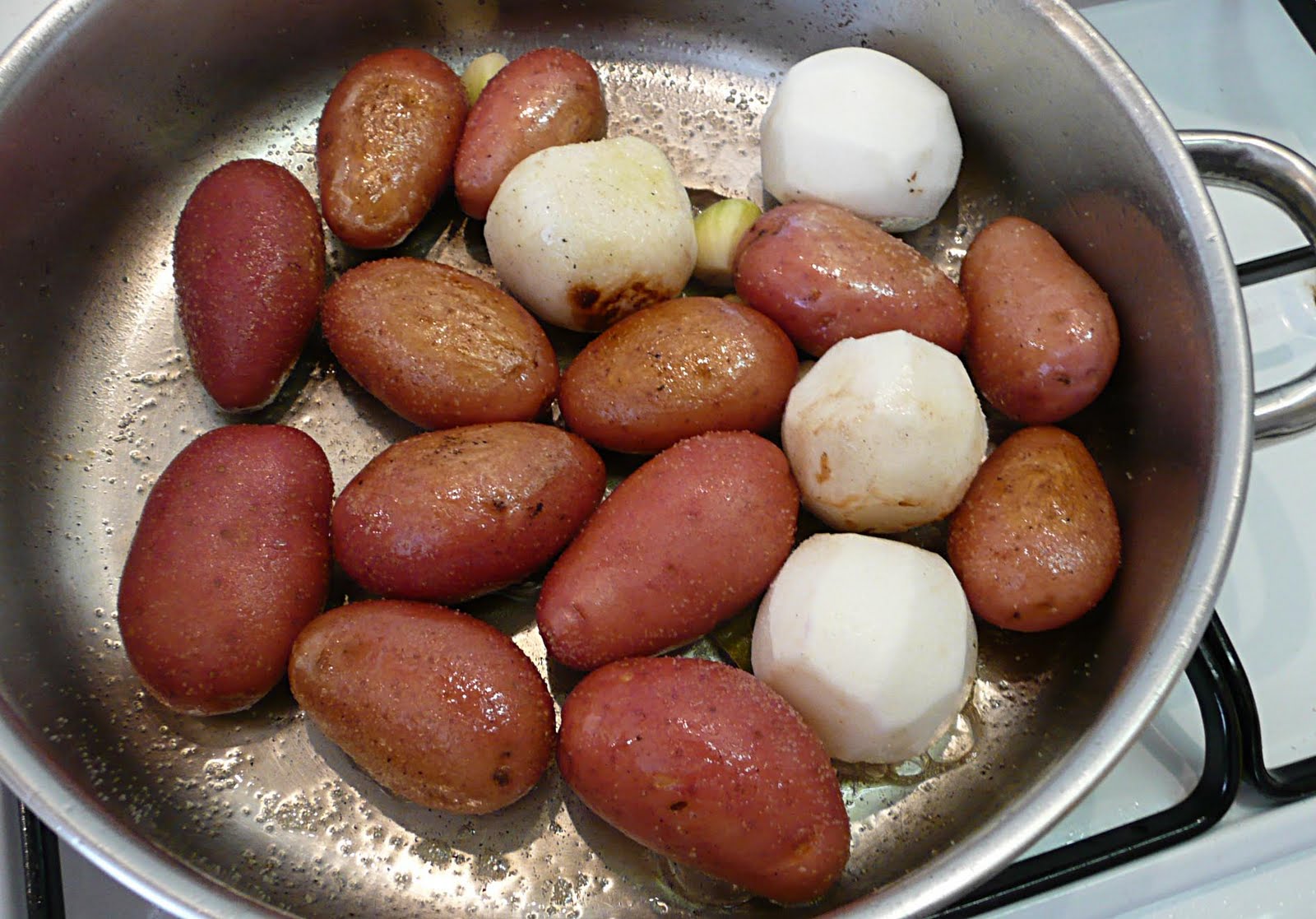
The potatoes are easy. Use new potatoes that are firm-fleshed (red, Yukon gold, King Edward, Charlotte, etc.) and of a fairly uniform size. Wash them but don't peel them. Put them in a separate pan with melted butter and oil, shake them around to coat them with the fat, and let them cook for two or three minutes uncovered. Then add two or three peeled garlic cloves, some thyme, and salt and pepper to the pan. Pour in half a cup of water, cover the pan, and let them steam. Turn the heat to medium or medium-low.

New red potatoes and a few little turnips (my last-minute
addition) roasing in a sauté pan on top of the stove


If the water all boils away or is absorbed by the potatoes, add a little more. Toward the end of the cooking, when the potatoes are getting close to being done, uncover the pan and let most of the water evaporate.

Once the potatoes are roasted and the pintade or poulet is braised, combine the contents of the two pans in a serving dish, pouring on the braising liquid from the poultry. You can strain out the thyme and shallots if you want to, or leave them in. Make sure to deglaze the pan with a little more white wine if there are brown bits on the bottom that would add flavor.

Here's the pay-off:
Pintade braisée aux champignons et pommes de terre nouvelles.


Serve with a green salad on the side or as a separate course. Bread and wine. Cheese afterwards. Don't eat too much. The leftovers will also be very good.

26 December 2018

Un pintadeau, et une farce aux foies de canard

The bird we cooked and ate this Christmas was what is commonly known as a chapon de pintade — a Guinea-fowl capon. You probably know what a capon is. It's a male bird, usually a chicken, that has been fattened to produce tasty, tender meat. The capon has also been surgically castrated, but let's not think about that. As far as I know, capons are not force-fed (gavé).


People call these capons chapons de pintade, so I guess pintade is the generic term for this species of poultry, but it is also the name for a Guinea hen, the female of the family. This kind of capon should, I think, be called a chapon de « pintadeau », which is the Guinea cock. Oh well. The fact is, the pintade and pintadeau, African in origin, are a delicious volaille (fowl) that has been appreciated in Europe since Roman times. This one weighed 2.6 kg, or 5¾ lbs.


We bought the Guinea-fowl capon from our local poultry vendor (volailler), who sells them and all sorts of prepared poultry and poultry products (including rabbits) at the Saturday market in Saint-Aignan and at the Friday market in Montrichard. The processing facility is located in Pouillé, a village just 5 miles from our house. We've been buying poultry from these people (named Clément) for 15 years now.
I noticed at Saturday's market that, according to a sign on the wall of the vendor's market stall, the poultry they sell comes from an abattoir in the village of Ouchamps, just 15 miles north of here, near Blois, and are birds raised on nearby farms. I've driven up there to buy local volailles, but I didn't know that our market vendor bought from the same place. We slow-cooked the pintadeau on the rotisserie (tourne-broche) in our oven, after "stuffing" it with bay leaves, garlic cloves, allspice berries, black peppercorns, red pepper flakes, and coarse salt.


I also made "dressing," which is what I call stuffing that you don't cook inside the bird but in a separate pan. For the dressing, I had sausage meat, duck liver plus the liver of the pintadeau, cubes of my home-made pain de mie, shallot, onion, garlic celery (céleri-branches), pecans from North Carolina, and dried cranberries "rehydrated" in Armagnac. I might have forgotten an ingredient or two... Tasha was attracted by the aroma of the cooked sausage and liver, as you can see below.


We had steamed and then lightly sauteed Brussels sprouts and a purée of potimarron (winter squash) from the 2018 vegetable garden as side dishes with our chapon de pintade, and of course the dressing. We opened a bottle of 2015 Régnié red, which we bought on our quick trip to Beaujolais last March, to wash it all down with.

10 December 2016

Cooking the coq au riesling

Well, it's not a coq, so it's not really coq au vin — at least the way I made it. It's a Guinea hen (une pintade). And it's more like coq au vin than like a classic fricassée. It's a recipe from Alsace, with elements of the two standard French recipes. It's made with white wine, and there's cream in the sauce. Coq au vin is made with red wine, and has no cream in it.


A classic fricassée of poultry, lamb, veal, or rabbit is a white stew. The fricassée sauce contains cream, as does this coq au riesling sauce. But for the fricassée, the poultry or meat is not browned first. The Larousse Gastronomique says it just should be "stiffened" (raidi) in a pan on low heat. For coq au vin or pintade au riesling, the pieces of poultry are first browned well in butter or vegetable oil.


Along with onions, or shallots, one of the main flavor ingredients in coq au vin is chunks of smoked pork belly, or lardons fumés. In this recipe, the pieces of coq, chicken, or pintade are browned first, taken out of the pan or pot, and set in a warming oven to wait. Then onions or shallots and garlic are sautéed with smoked lardons in the same pan. You can cut the lardons large or small. A splash of cognac or armagnac in the pan at this point can't hurt, whether you actually flambez it or not.


And there are mushrooms in it too, as in both fricassée and coq au vin. After the lardons and onions are cooked, you put the poultry pieces back in the pan or pot with them. You pour on, say, half a bottle of riesling wine (it's an off-dry white wine) and then enough water or broth to barely cover the poultry. Spread the mushrooms on top, push them into the liquid a little, cover the pan, and set it in the oven on medium-low heat for at least 40 minutes — or longer.


After an hour or so, take the pan out of the oven. Use tongs or a slotted spoon to lift out the poultry pieces and lardons, which again get set aside in a warm oven. Strain the mushrooms and onions out of the cooking liquid, pouring the liquid into a pot. Set the pot on medium-high heat and let the liquid reduce by about half. Then pour in a cup of cream and let it reduce again, until you like the consistency. Put the mushrooms and shallots back in. Don't waste anything.


Above are the cooked pintade and lardons waiting to be coated with the cream sauce, which you can thicken or not — your choice. Serve any extra sauce at the table, and accompany the coq au riesling with steamed or boiled potatoes, rice, or pasta.

Here's the recipe. If you want a translation, I can post one, or you can let Google translate it. You could also read Nigella Lawson's recipe that was published in the New York Times.

Coq au riesling
 
1 volaille de 1,5 kg
50 g de beurre
200 g de lardons fumés
3 échalotes
1 gousse d’ail
5 cl de cognac
40 cl de riesling
200 g de champignons
20 cl de crème fraîche
Sel et poivre

Découper la volaille (poulet, coq, poularde, pintade…).

Faire chauffer le beurre dans une cocotte. Faire revenir les morceaux
de volaille. Saler et poivrer. Réserver les morceaux de volaille au chaud.

Ajouter dans la cocotte les lardons, les échalotes, et l’ail hachés.
Flamber avec le cognac. Remettre la volaille. Déposer les champignons.
Rectifier l’assaisonnement. Laisser cuire 40 minutes à feu doux.

Retirer les morceaux de volaille et les déposer sur un plat de service.

Laisser réduire le jus de cuisson et ajouter la crème en remuant.

Verser la sauce sur la viande. Servir aussitôt.

18 October 2010

Escargots and other fine specialties

Okay, now the truck drivers in France have decided to get their piece of the action. They are planning to start traffic slow-downs on the autoroutes —what they call « opérations-escargot » — to make clear their displeasure with the governments retirement pension reforms.

On the France 2 news, journalists are pointing out that there isn't much point in slowing down traffic, because in so many regions motorists can't find fuel for their vehicles anyway. The way they will slow it down is to have as many big trucks as there are lanes on the highway driving slowly, side by side, so that nobody can pass them. It's effective.

Yesterday, before our Sunday dinner, I had to make an unexpected trip to Amboise. On the way, I noticed that some service stations were closed but others were open — and I mean stations that would normally be open for business on a Sunday morning.

I had gotten up early to continue my dinner preparations, which had started the evening before. Vegetables were peeled, shallots were sliced already, but the guinea hen needed to be cut into serving pieces. That's what the recipe called for. There were a million things to do around the house, I thought. Many didn't get done, and it didn't matter.

Roasted winter vegetables — turnips, carrots,
rutabagas, shallots, onions, and celery root


If you want the recipe for the main course, here's a link. It's on David Lebovitz's blog, called Living the Sweet Life in Paris. We followed it faithfully, except that we bought a guinea fowl — une pintade — instead of a chicken. That's a little more exotic, and one of the poultry vendors at the Montrichard Friday market (also at the Saint-Aignan Saturday market) sells very nice ones at a very good price (5.20 €/kg).

I also substituted fresh sage for the parsley in DL's recipe, which he says he adapted from a recipe in Susan Herrmann Loomis's French Farmhouse Cookbook. I like sage with poultry or pork.

I had finished cutting the pintade into pieces — two wings, two drumsticks, two thighs, and four breast pieces, plus two pieces of the neck, which was 6 or 8 inches long — and put it in the refrigerator, when the telephone rang. It was a friend who lives in a village 7 or 8 miles south of us. "Do you have petrol in your car?" she asked. I said I did.

"I'm sorry to call you so early on a Sunday morning," she said. It was 9:00. "I really need someone to drive me to the emergency room. I've injured my eye, it's very painful, and I don't think my driving myself to the hospital would be a good idea." I told her I'd be at her house in about half an hour.

I got there and we drove up to Amboise, which is only about 20 miles from Saint-Aignan. We finally found the emergency room — spotty signage — our friend got the treatment she needed, and I was back at home by about 11:45. Walt was working on the dinner preparations all that time.

The long and the short of it is that our friends from Paris were able to make the three-hour drive down from Paris yesterday morning, despite the fuel situation, and they actually arrived early, at 1:00. We didn't expect them much before 2:00. They helped us finish up the work in the kitchen

Then our other friends arrived, with their dog. Gracie the dog was excited to see Callie and all the people. As soon as she came in, she brushed by the coffee table and toppled a glass of sparkling wine with a swipe of her tail. It was white wine so no great damage was done, and our friends from Paris noted that the coffee table was especially shiny and brilliant after we wiped it down with the bubbly! There's a good house-cleaning tip for you.

Roasted guinea hen with caramelized shallots

It's hard to take pictures of food when you are serving it and socializing with guests. I took only two — at the table, without the tripod, so they aren't the best pictures I've ever taken. Our roasted pintade with caramelized shallots was delicious, but it looked nothing like David Lebovits's. It was a mahogany brown. I don't know if that was because it cooked longer than DL's or because it was guinea hen and not chicken.

Whatever, it was delicious. One guest said that she always thought of pintade meat as being drier than chicken meat, but this pintade was not dried out at all. It was moist and flavorful. The vinegar and soy sauce it cooked in had a lot to do with that. The roasted winter vegetables, cooked in olive oil with thyme, salt, and pepper, were good with the bird. Walt's pumpkin raviolis with a buttery sage-walnut sauce were the hit of the day. I think he'll post about those on his blog.

29 April 2013

Une cuisson bien arrosée...

Yesterday I did something I haven't been doing that much recently, because the weather has been so rainy. I went to the market. There is an open-air market on Saturday mornings in Saint-Aignan, and then there's another on Sunday mornings across the river in Noyers-sur-Cher.

The best vendor at the Noyers market is a volailler — a poultry merchant. There are always a lot of people standing in line there, waiting to be served, but yesterday it wasn't too crowded. The weather was nippy but sunny, so waiting outdoors was not unpleasant. And all the food in the display cases — all kinds of chicken, duck, and turkey sausages, and pâtés made from rabbit or duck, for example — was, as always, highly appetizing.


But I resisted all that. I was on a mission to bring home a nice farm-raised pintade — a guinea hen — or, at the very least, a plump chicken. I ended up with a 1.8 kg guinea hen, which the man behind the counter prepared for the oven by gutting it, cutting off the head and the feet, and burning off the last of the bird's pinfeathers with a blow torch.


When I got it home, all I had to do was tie the bird up and put it on the spit for roasting in the oven. After brushing it with olive oil, Walt and I sprinkled the pintade with smoked paprika, cayenne pepper, salt, and pepper. I set a pan of water in the oven under the bird to catch the drippings as it turned on the rotisserie to cook and turn golden brown.

At the market, the poultry man had instructed me to cook the pintade in the oven slowly for 90 to 120 minutes, basting it liberally. « Il faut une cuisson bien arrosée », the man told me with a big smile. « Et il faut en mettre sur la pintade aussi. » I'm not sure I can translate that joke.

25 December 2024

Un chapon de pintade pour Noël

Here's what our Christmas bird looks like this year. We got it from the poultry vendor who sets up at the Saturday morning outdoor market in Saint-Aignan. It's a chapon de pintade (aka une pintade chaponnée). Pintade is French for "Guinea fowl." It's not that different from chicken as far as the meat is concerned, but it's something special to have for Christmas.

A picture of the oven-ready bird taken using my phone's standard photo mode

A picture of the same bird taking using my phone's food photo mode

Bon Noël 2024 à toutes et à tous

07 June 2010

Francos and anglos, apéros and dinner

We had a francophone apéritif and an anglophone dinner yesterday. Unfortunately, the weather turned out damp and cool, with gray skies all day. We didn't get enough rain to do the garden any good. We got just enough drizzle to spoil our plans to have dinner outside under the « le barnum » — that's what the garden tent is called. I don't know what it's called in English. A big top? A tarp? A gazebo?

Anyway, the mayor and her husband invited us, our American friends who just moved into a house nearby, and our across-the-street neighbors for a glass of wine and some finger foods before lunch. A., the mayor, is a very good cook, and she had made three or four different little dishes to go with a chilled bottle of the local Touraine rosé sparkling wine.

A. is the mayor of our village, which has a population of about 1200. She just happens to live in our little hamlet, which is made up of nine houses and fewer than 20 residents.

Among the apéro foods A. served were tiny raisin pizzas with blue cheese melted on them — almost crackers, but in a little pie shell. Another was a little shot glass filled with raw chopped tomato and zucchini (courgette if you're not American) and cooked quinoa, in a balsamic vinaigrette sauce. There were little anchovy fillets folded in half, served on a cocktail pick, and bathed in a spicy lime juice dressing. And there was cubed fresh cantaloupe on picks, plus little spoons filled with oniony, herby cream cheese topped with a little slice of smoked salmon.

We spoke French. The mayor's husband speaks some English, but as far as I know the other neighbors do not. The newly arrived Americans enjoyed the chance to practice their French and said they preferred to speak French rather than English in such situations.

Afterward, we came back over to our house for Sunday dinner and an afternoon together, with frequent glances at the TV to see whether Nadal or Soderling was going to win this year's French Open tennis tournament. English friend S. came for dinner too, so there were five of us plus three dogs! Bertie the Black Cat stayed out of sight for the afternoon.

This is the only picture I took yesterday.
I was too busy to worry about the camera.


For dinner I had cooked a « pintade » — that's a guinea fowl — on the rotisserie in our oven. Walt bought the bird at the Saint-Aignan market Saturday morning, from our favorite poultry vendor there.

When we roast poultry or meat on the rotisserie, I always put a baking dish half full of water on a rack directly under the meat, to catch the drippings. If you don't, roasting meat on the spit can make quite a mess of your oven and can also really smoke up your kitchen.

This time, I had a new idea. Instead of just a pan of water, I set a pan of diced, peeled potatoes, with a little water in the bottom, right under the bird. That way, the potatoes cooked as the pintade did, and bathed in the fat and olive oil dripping down on them. I also tossed in four or five unpeeled garlic cloves and three big bay leaves.

The bird and potatoes were cooked before we walked over to the neighbors' for apéros at 11:30 I just turned off the oven and let it sit while we were gone, for about two hours. J. the American, who likes to cook on a grill, said I should make sure the bird was turned breast side down on the spit, so that the breast wouldn't dry out. That was a good idea.

The pintade was perfect, in fact — even if I do say so myself. The meat was moist and nearly falling off the bone — very easy to carve — and the skin was beautifully browned. It was all very good with the spicy cherry sauce I made a couple of days ago. The potatoes were delicious too. Afterward, we had green salad with a yogurt-cucumber dressing, some goat and cow's-milk cheeses, and a slice of cherry clafoutis that Walt made the day before.

We spoke English, of course, but we talked about life here and local customs, so our English included a liberal sprinkling of French words and expressions. Everybody went home after the tennis match ended (Nadal won), at about 6:00 p.m., and then I took the dog out for a walk. Voilà. Life is good.

12 November 2018

Tian de courge, et pintade au tourne-broche


On Saturday, Walt went to the open-air market in "downtown" Saint-Aignan and bought a pintade — a guinea hen — for our Sunday dinner. Yesterday we roasted it in the oven using the stove's rotisserie feature. As a side dish (or maybe it was the main dish) he made a recipe from Richard Olney's Provence: The Beautiful Cookbook — a Tian de courge, or winter squash gratin. The recipe is below.


A tian is a Provençal gratin dish, and I thought this one was amazingly good. It's made with pureed winter squash — ours was a potimarron that grew in our garden, but butternut or even pumpkin pulp would be good — and with leeks cooked in olive oil, eggs, cream, parmesan cheese, and a grating of nutmeg. The leeks especially, but also the parmesan and nutmeg, add a lot of flavor and make the squash puree really delicious. The topping is grated parmesan and panko (Japanese breadcrumbs).


Walt modified the recipe slightly, because he started by roasting the squash in the oven and then mashing and whipping the squash pulp into a smooth puree, instead of cutting the raw squash into chunks and cooking them down in a pan with the leeks. You can do it either way. We had some julienned and steamed collard greens as a garnish.


The pintade came out really good too. I put sage (we have a plant out back), parsley (growing in pots on the terrace), a dried cayenne pepper, some allspice berries and black peppercorns, a shallot, and two garlic cloves in the cavity. The bird cooked on the spit, turning over a pan of water so that it steamed and roasted at the same time, keeping the meat moist. We ate half of it...

12 May 2014

To everything, turn turn turn...

As Walt blogged yesterday, on Friday we got the new kitchen stove we wanted. It was the only one we could find that had all the features we were set on having: four gas burners on the cooktop, including one called "a double ring" that is ultra-rapide and very hot, along with a voluminous electric oven and a range of programmable cooking modes that include a rotisserie or tournebroche.

When Callie came into the kitchen and saw the pintade turning on the rotisserie, it scared her and she barked like crazy.

We also decided to go with a stainless steel model rather than a white enamel finish, because the white stove we just got rid of was so hard to keep clean. When we replace the 11-year-old refrigerator and the 10-year-old dishwasher, we'll probably get new stainless models of those appliances too. The new stove is Italian, and the brand is Smeg. We use bottled gas (butane) because we don't get gaz de ville out here in the country.

Here's the bird skewered, seasoned, and rubbed with olive oil, ready for the oven.

So yesterday was the big test. Walt bought a pintade (guinea hen) at our favorite poultry vendor's stand when he went to the Saturday market in Saint-Aignan this week. We've been cooking and eating pintades very regularly since 2003, when we moved here, and in a lot of ways they are more delicious than turkey or chicken, birds to which they are closely related.

 The bird turning on the spit over a pan of seasoned cooking liquid

Guinea fowl are standard items in French markets and supermarkets, along with rabbits and ducks, so they are no trouble to find, and they aren't particularly expensive. Walt paid €5.40/kg for this bird, which (with the very weak dollar right now) comes to about $3.50 U.S. per pound. It's easy to pay a lot more than that for a farm-raised, free-range chicken.

The pintade hot out of the oven, after cooking for about 90 minutes

Anyway, I wanted to roast a bird on the rotisserie, to see how well it would work. Well, it works great. As usual, I put the bird on the spit and got it all set up. I put a pan of water — well, water and wine — directly under the bird on a baking pan so that the drippings wouldn't fall onto a hot surface and make an excessive amount of smoke. The resulting cooking liquid makes a nice sauce to have with the poultry and vegetables you serve.

Onions, mushrooms, and bay leaves in the cooking liquid, along with all the guinea fowl giblets, made a good sauce.

That said, I had an even better idea this time. Instead of just setting a pan of liquid under the bird, I added some sliced mushrooms, onions, and garlic to the pan, along with some bay leaves, allspice berries, and salt and pepper. That made a really good sauce after it was cooked. We had mashed potatoes (purée de pommes de terre) with the guinea hen, and a big green salad with the kind of simple vinaigrette that we make and never get tired of (Dijon mustard, vinegar, a blend of olive and sunflower oil, and salt and pepper).

What else can I say? It was a very simple Sunday dinner for an anniversary weekend. It was also Mother's Day in America (but not in France), and I wish all you mothers and grandmothers reading this a belated Happy Mother's Day.

09 December 2016

Un coq... ou pintade... au riesling

Yesterday I made one of the recipes from the Cuisine Alsacienne book that I mentioned here recently. It was the one for Coq au riesling, which turns out to be the same thing, basically, as the Burgundian classic Coq au vin, but cooked with Alsatian white wine rather than Burgundy red.


Getting riesling wine here in the Loire Valley is not a problem. It's widely available in the supermarkets and is usually inexpensive at 4 or 5 euros a bottle. Mushrooms, smoked pork belly cut into lardons... those are easy-to-find standard ingredients too. But the recipe called for cooking a 1.5 kg coq. That's just 3 lbs. and I've never seen a rooster/cockerel that small in the markets or supermarkets around here. The coqs I've cooked in the past weighed in at 7 to 8 lbs.


I could have bought a 3 lb. chicken, but then I noticed that one of the supermarkets had nice farm-raised, free-range Guinea hens on sale at a good price. In French, that's called « une pintade » or, if it's a young bird, « un pintadeau ». It's an African bird that's related to the chicken and the pheasant, and some still live wild in in the countries south of the Saharan Desert. France is the world's biggest producer of domesticated Guinea fowl, according to the Larousse Gastronomique food encyclopedia.

Thighs, drumsticks, wings, and trimmings

The pintade I got weighed in at l.65 kilos, which was about perfect for what I wanted to do. Very young pintades are good oven-roasted like a chicken, but the older, bigger birds are better fricasseed or stewed, and Coq au vin is a variant of the classic fricassée. So therefore is Coq au riesling, with its white wine sauce. (By the way, I remember that my grandfather's sister kept Guinea fowl on her farm in South Carolina back in the 1960s, so I was familiar with the species.)

The Guinea hen breast cut into four pieces

I was a little nervous about being able to cut the Guinea hen up into serving portions, which is what the fricassee recipe calls for. You cut it up just as you would a chicken, but I had a memory of trying to do that in the past but with difficulty. The bones were harder than chicken bones (especially the breast bone), and the wing, leg, and thigh joints were harder to find and cut into. I shouldn't have worried, though. It all turned out to be pretty easy. You can see that the flesh of the Guinea fowl is all more or less "dark meat" — even the breast. It's delicious — firm and meaty.


More about cooking it tomorrow...

21 December 2016

Chickens and capons for Christmas

As I think Walt and I have both said, we've ordered a « chapon de pintade » — a Guinea fowl capon — to cook for our Christmas dinner. We'll probably cook it on the rotisserie in our oven, and we plan to make cornbread stuffing with dried cranberries and walnuts to have with it. We'll also have winter squash (sucrine du Berry) and some garden greens (kale).

Locally, we have a really good poultry vendor who sets up at the Montrichard market on Fridays and the Saint-Aignan market on Saturdays and offers very competitive prices. But even if we didn't, we wouldn't lack for choices in picking a bird to roast for the holidays. Here are ads I've scanned from one of the advertising flyers we got from local supermarkets for this week. It's from Intermarché, which is about four miles from us by car. The store was recently taken over by new management and has experienced a kind of renaissance.


First, you probably know what a capon is, and maybe you can find capons for Christmas where you live. They are male chickens (or other fowl) that have been sterilized (castrated, either surgically or chemically) and fattened. Like neutered dogs or cats, they gain weight easily. On the right in the panel above, you see a Guinea fowl capon for 10.90 €/kg. That would come to about $5.20/lb. in American money. The ad specifies that the capon had lived at least 154 days before being killed and prepared for market, and that it weighs about 2.3 kilos (5 lbs.). It carries the Label Rouge, which is a good indication of superior quality.

Then you see two ordinary quality chicken capons that go for about half the price of the chapon de pintade, weigh about 3 kilos (6½ to 7 lbs.), and don't carry the Label Rouge. No minimum age is specified, but I'm sure they would be younger birds than the more expensive Guinea fowl capon. And I'm sure they would be very good too, if cooked correctly.

On the left in the panel above, you see what is called « une poularde ». What's that? Well, it's the female equivalent of a capon. A Wikipedia article I just glanced at says the poularde [poo-LARD] is a laying hen that is fed a special diet and environment to delay the onset of egg-laying and also is fattening. Such birds are killed after a minimum of 120 days of existence, and their meat is reputedly white and tender with a very fine flavor. This one sells for about $3.75/lb. and weighs about 4½ lbs. When you buy it, you also get a flat 5€ discount on each poularde in the form of credit against future purchases at Intermarché.


If you don't want a chapon or a poularde, you can get a "regular" Guinea hen — farm-raised outdoors and corn-fed for a minimun of 94 days (above left). It weighs about 3 lbs. and goes for close to $3/lb. at today's exchange rate. (By the way, the U.S. dollar is worth nearly a full euro right now.) Or you can get an ordinary turkey (une dinde) weighing just short of 7 lbs. and selling for about $2.30/lb. I actually bought one of these for the freezer yesterday; we'll cook and eat it in January or February, when whole turkeys are not usually available around here.


Again above, you have a 7 lb. chicken capon (well, rooster, of course) raised for 150 days, fed a diet of at least 80% grain, and selling for about $5/lb. These birds can come from one of two well-known producers, St Sever or Loué — both carry the Label Rouge — and you get a full 15€ discount for each one you purchase. On the right is a more affordable 7 lb. Douce France chicken capon that has been raised for 140 days, fed 70% grain, and includes a 4€ discount. I'm sure you wouldn't be disappointed.


Finally, here's a turkey capon, Label Rouge, farm-raised for 150 days (above left). There's no information about the average weight for this one. And on the right, a farm-raised poularde (is there not an English word?), 120 days of age, 75% grain-fed, no weight specified. When the label or ad says « prêt à cuire », it means there are no "giblets" or abats (liver, gizzard, etc. removed). By the way, these are just the whole birds in the Intermarché flyer. There are other, fancier choices in the flyer too, for rolled-and-tied poultry roasts, and so on.

11 August 2020

Summertime foods — pasta and "pterodactyl"

Grilling season. A spur of the moment idea: pintade. "Pterodactyl" as American friends called it years ago when they visited and we bought a pintade at the market. It's a guinea hen. Walt got it from the poultry vendor in the market last Saturday. It weighed nearly 2 kilos (just over 4 lbs.) and sold for 6.50€ per kilo — about $3.50/lb.


I wasn't sure I'd be able to cut it up the way I would cut up a chicken, but it turned out to be pretty easy. The plan, given our current afternoon temperatures in the 35ºC range (that's 95ºF), was to cook it on the barbecue grill on the front deck.


We cooked just one leg and thigh and one half of the breast. The other meaty pieces went into the freezer for later. And with the back, neck, and giblets I made broth (despite the hot weather). It was morning and all the windows were open anyway. By noon it would have been to hot in the house...


This is the liver. I poached it briefly in the broth I was making. It was a tender morsel to enjoy with the grilled guinea fowl pieces, and with a pasta salad on the side.


I made the salad with leftover cooked pasta and steamed cauliflower from lunch a few days ago, plus some chickpeas, green beans, and a lot of fresh basil leaves and tomato.

P.S. Sorry I neglected to take any photos of the grilled guinea fowl pieces. Next time...

20 August 2011

TGIF (or ...T or ...S or ...M or ...W)

This blogging thing is out of control. I just don't have time to keep up right now. And I keep forgetting to take my camera when I go out on excursions and shopping trips with our friend Marie who is visiting from Normandy. I may not be able to post much next week, because I won't have either the time or an Internet connection while we are on "vacation."

The weather finally turned sunny and warm yesterday. Our afternoon mission, after a morning at home cooking and then a lunch that lasted until 3:00 p.m., was a shopping trip. Marie wanted to go to a town called Château-Renault, just north of Amboise, to buy some shoes in a factory outlet store she knew about. She bought three pairs.

The company that makes shoes in Château-Renault is called Arche. The shoes are apparently very stylish and trendy. Marie says the prices at the factory outlet are much lower than prices for the same shoes in the shops in Rouen or Paris. I'll take her word for it. I looked at men's shoes for a few minutes but realized immediately that I'm neither stylish, trendy, nor rich. So I went out and sat in the car (which was parked in the shade), listened to Les Grosses Têtes on the radio, played with the GPS, read maps, and just bided my time.

When we left Château-Renault, we drove little backroads through villages called Morand and Dame-Marie-les-Bois toward Mesland (a well-known Loire wine village) and Onzain. At one point we drove over the Bordeaux-Paris TGV line just as a high-speed train whizzed by, direction Paris. The we crossed over the A10 autoroute, which was crowded with cars and trucks headed somewhere à fond la caisse — "like bats out of hell." We just toddled along on country lanes, looking and talking.

I thought Dame-Marie-les-Bois was especially pretty, and I'd never driven through the village before. I'll go back with my camera one day. Mesland is pretty too. We knew people who lived there when we first moved to Saint-Aignan, so we went up there frequently. Now those friends have moved to Nice.

One of our "goals" on the way back to Saint-Aignan was to buy some food for today's lunch. There's an Intermarché supermarket in Onzain, and I wanted to stop and shop there because it was after 6:00 p.m. and the supermarkets here don't stay open past about 7:00 or 7:30. We might not get back to Saint-Aignan in time to do our courses, I was thinking.

We bought a pintade for today's main meal. That's a guinea hen, and it's a standard bird here in France. Marie asked the butcher if the pintade came with les abats — that's the "giblets," meaning the liver, heart, and gizzard. The butcher said no, no abats. Marie asked why.

"These days, most people don't know how to cook the giblets," the butcher said (I'm translating). "Customers don't usually want them. The people who process the poultry for sale have figured that out, and also realized that they can sell the livers, gizzards, and hearts separately to people who do like them. That way, they make more money." So that's the story of giblets. When we buy chickens or guinea hens from the vendor at the open-air market, les abats are always there inside the bird, ready to cook and savor.

As we looked around in Intermarché, I happened to see pizzas in the freezer cabinet. I told Marie I wanted to buy one for our supper, because Walt especially likes pizza. Marie stopped me. Isn't there a good pizzeria in Saint-Aignan? she said. Let's go there and get pizza. It'll be better. So that's what we did.

The woman who runs the pizzeria, Véronique, is a good businesswoman. She sort of vaguely recognizes me, because I do go there once in a while and used to have dinner there more often. She always greets me warmly, kissing me French-style on both cheeks and generally making a fuss about seeing me again, as if I were a long-lost friend. Besides, the pizzas her restaurant makes really are delicious.

As we parked the car on the market square, I saw our friends C. and D. sitting at a table outside Chez Constant, one of the town's main café-restaurants. They were basking in the warm late-afternoon sun and enjoying a glass of Sauvignon Blanc. We went over and talked to them for a few minutes. Then we came back home, opened a bottle of Chablis Premier Cru (Chardonnay) wine, and sat out on the terrace until about 10:30 eating our pizzas and talking.

La vie est belle, n'est-ce pas ?

14 April 2007

What we got at the market today

We went to the outdoor market in Saint-Aignan this morning and here's what we bought.

Click the picture to see it in full size

Strawberries: these are locally grown (in the Sologne) and are called gariguettes. They are not the same strawberry variety as the ones you get in California, which are, according to what I've read, the same ones they grow in Spain and export to France and the rest of Europe. The gariguette strawberries are sweeter and juicier — as a general rule, anyway. Strawberry season is just beginning here.

Fraises, pain, et asperges

Asparagus: these are also local and in season. They are asperges blanches, white asparagus. We buy them from a man who sets up a table right next to Mme Doudouille's stand. I think the man who sells the asparagus also grows them, and his prices are good (€6 a kilo right now — that would be $3.50 a pound or so with a euro at $1.35, if you can believe that). The ones he had for sale today were just beautiful.

Jambon de Savoie en tranches

Ham: the slices of ham come from Mme Doudouille (yes, she is still here — it's a long story). They are slices of jambon de Savoie, ham from the Savoy region in the Alps — what is called jambon cru, raw ham, in France. Walt is going to use them with the asparagus...

Navets nouveaux — spring turnips

Turnips: these are baby turnips that one of the farmers brings to town to sell. I don't yet know what I am going to do with them, but they looked good.

Bread: the baguette was delivered, before we went to the market, by Roselyne the bread lady. It's made every morning by the baker in our village.

Le rôti de chez le volailler

Roast:
the little rolled roast is a rôti de pintade farci that we bought from the poultry vendor, or volailler, whose stall is right across from Mme Doudouille's charcuterie stall. That's a stuffed guinea-fowl roast. The woman behind the counter said it was stuffed with ground poultry (could be chicken, turkey, or guinea fowl, I guess) and herbs and spices. Volaille means fowl, and the volailler (vuh-ly-AY) is the person who sells poultry.

I'm cooking the roast right now. Here's what it looked like a few minutes after going into the oven.

Rôti de pintade farci — stuffed, rolled guinea-fowl roast

And here's a scan of the paper that the roast was wrapped in. These poultry people are the ones who agreed to pluck a pheasant for me a couple of years ago when our neighbor gave us one he had shot. I like to buy from them because they were so nice about that, and did it for free.

Volailles = fowl, poultry
Lapins 1er choix = "grade A" rabbits
Fromages de chèvre = goat cheeses
Markets: Fri. Montrichard, Sat. St-Aignan

These are also the people from whom I bought a rabbit last weekend. I'm still working on a posting about how I cooked that rabbit.