Showing posts sorted by relevance for query endless summer. Sort by date Show all posts

28 October 2022

Endless summer?

Maybe this is just a mini-summer. You can't even call it Indian Summer, because we haven't yet had any cold weather to speak of. Morning low temperatures match the afternoon high temperatures we used to expect in June or July just a few years ago. Today, we're supposed to be in the mid-70s F, and tomorrow the high might hit 80. It's all very weird. We took good advantage of yesterday's warm weather — Walt got the vegetable garden plot all cleaned up, and I pulled grass and weeds that had started growing up on the gravel walkway around the house. Because of abundant rains after a scorching summer, nature seems to think it's springtime.


The woman reading the news on Télématin just said in French what I wrote above in English. Plants' heads are spinning because of this mild weather. They're growing like they normally grow in April and May. We have weeds galore. In vegetable gardens, squash plants are still blossoming. Bean plants are still producing beans. Sunsets, instead of being gloomy and gray, look like this one. I took the photo above three days ago. It's all bizarre. In the past, the arrival of November has always meant there was a chill in the air and a gray, overcast sky — if not worse. Maybe everything will change next week.


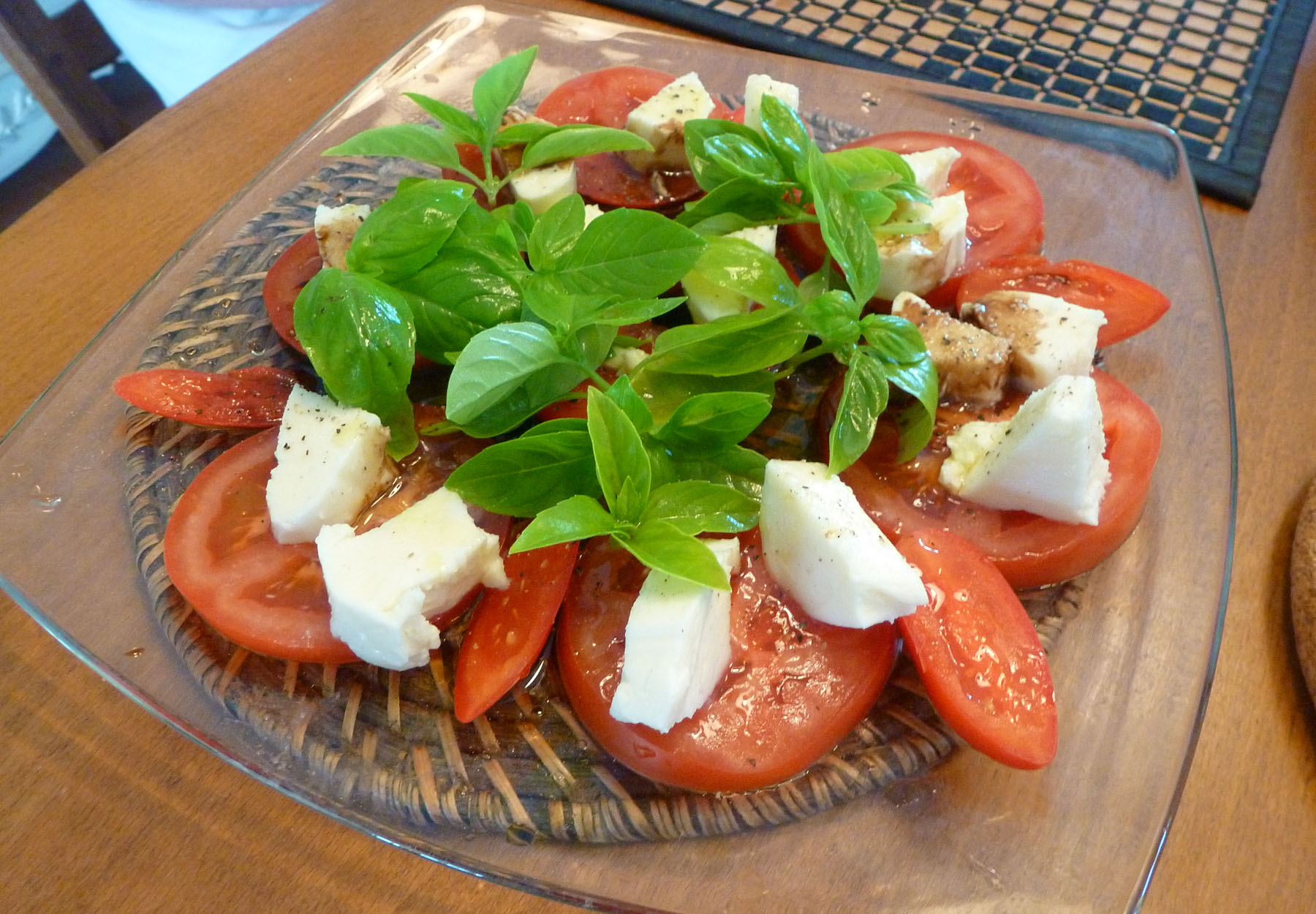
So when Nature hands you hot weather, what do you do? You make summertime food. One of the tomatoes in this salad we had as part of our lunch yesterday came from the supermarket, but the other one came out of the vegetable garden yesterday morning. There are a dozen more garden tomatoes in a basket in the kitchen. Basil is still growing in a pot on the front deck. Today for lunch we'll be having sausages cooked on the barbecue grill. Instead of damp Toussaint days, we're enjoying Quatorze Juillet weather.

29 September 2009

Endless summer

Wishful thinking. I admit it. But summer will end suddenly in 2009. The sun will go behind the clouds, which will open up and drop many hectoliters of cold rain on us. At least, that's the way it will feel, in contrast.

Temperatures are running 10ºF/5ºC higher than normal for late September. The sky is luminously, abnormally blue. The grape harvest couldn't take place under better conditions. Neither could the hedge trimming and general yard clean-up.

Sunrise over the vineyards in late September 2009

It's dry — the last time the grass had to be mowed was July 15. That was more than two months ago, and it has hardly grown at all. The tomatoes and eggplants are still producing. The mornings are a little chilly now, however, and you can tell that that tomatoes plants are finishing up. Just when you think they have given their all, though, they keep on giving.

The garden from out back, and a compost pile full of apples

The Swiss chard is still giving too. I cleaned up the plants last week, pulling all the brown and yellowed leaves off the bottom of each plant. They bore up under the real heat of August, but I can tell that they are happier with September's cool, dewy mornings and sunny, but not quite so hot, afternoons. I pulled out half a dozen plants last Saturday and we ate them, leaves and ribs, in a sauce béchamel enriched with grainy, old-fashioned mustard (called moutarde de Meaux or moutarde à l'ancienne). They're good that way.

Chard from the garden, pulled up roots and all

The collard greens will probably experience a burst of growth as the temperatures continue to moderate. They are a late fall crop. I'm surprised they didn't bolt during the long hot spells of July, August, and earlier September. I'm hoping for some bigger, fleshier leaves. I've been watering them. Now I think I'll fertilize them.

Collard greens, getting ready to really grow, I hope

The corn, lima beans, and pole beans are gone. So are the tomatillo plants, cherries, pears, and plums. Apples, however, keep raining down, and we pick up wheelbarrow load after wheelbarrow load of them to compost over the winter. I told Walt that maybe we should cut down the biggest apple tree, the one that produces so many tons of fruit every second summer, but he doesn't think so. It's true that it's an attractive shade tree. Of course there are two others next to it that are just as nice. Don't stand under them right now — you'll get conked on the head.

A wheelbarrow load of apples — the umpteenth — from the big tree

The hedge trimming and clean-up work continue apace. We don't work on it that many hours a day, but we do put in our time. There's lunch to cook, however, and to recover from in the afternoon. And there's a certain dog that wants a walk every morning and every evening. It's nice to have the luxuries of time, good food, and nice weather.

Hedge trimmings and the clean-up — I finally realized that
piling the leaves on a tarp, bundling them up in it, and
dragging them to the burn pile was the best way to do it.

On our walk yesterday, Callie and I ran into Chantal Guerrier out on the paved road. She and husband Jean-Noël are busy bringing in the grapes. But like all the other local vignerons, they aren't in a very big hurry, because the weather is cooperating. The grapes are sunbathing, and ripening.

Tomates confites are roasted for 2½ hours in a slow oven
with olive oil, garlic, salt, pepper, and a pinch of sugar.
This is a mix of yellow and red tomato wedges.

Sunday afternoon, Carolyn (who leaves comments here) and her husband came by for a light lunch. They were spending about a week in the area, as they often do this time of year. We had roasted red peppers and slow-roasted tomatoes (tomates confites) from the garden, with local goat cheese and local wines.

Surfinia flowers in a planter under the kitchen window
have been spectacular all summer.

They brought a bottle of Muscadet and some local rillettes de porc, and we had a little pot of pâté de lapin (rabbit) that I bought at the market in Noyers. Walt made an apple tart with a calvados-flavored custard base and apples from out back. It was a nice afternoon around a table out in the back yard.

18 September 2018

The state of things today

The vet told us yesterday afternoon, after looking at x-ray images, that Tasha's injury is "just" a sprain. All the little bones in her "wrist" are in place. Nothings broken, but the lower part of the leg is swollen. The vet gave her a shot of anti-inflammatory medicine, and gave us pills of the same kind to give her once a day for the next week or 10 days. The good news is that her limping is already visibly reduced this morning. She's putting her foot down on the floor or ground and walking carefully, but almost normally. Things are looking up!


Meanwhile, around here, our weather continues to be weirdly hot and dry. This is starting to seem like a major drought, but nobody is talking about it. It hasn't rained since mid-July. Yesterday, I did hear one woman on France Inter radio say that she's fed up with this endless summer (j'en ai marre de cet été éternel...). I kind of feel that way too. I will welcome some rainfall, so that things will feel normal again. France is supposed to be gray and damp most of the time. Then you can really enjoy the warm, sunny days that come along, instead of finding them oppressive.


We've pretty much had to give up on the vegetable garden and outdoor plants. There are still a lot of tomatoes on the vines, but they are sun-damaged and blighted at this point. The kale and chard plants are puny and sad-looking. With everything that's been going on — driving back and forth several times a week to the computer store, figuring out how to order parts from internet sites and install them, researching dishwashers and getting a new one ordered — not to mention doing all the dishes by hand! — there just isn't enough time in the day. Having to carry the dog up and down stairs for the past two days has been stressful.


Life continues, however. The grape harvest, especially. Above is a photo of a winery that's just a ten-minute walk from our house. Obviously, it's not a tourist destination. At this point out in the vineyard, most of the white wine grapes — Sauvignon Blanc, Chenin Blanc, and Chardonnay — have been taken in now. Yes, those Chardonnay grapes on the north side of our yard have finally been harvested. The photos here show how mechanical harvesting machines leave the vines looking. The harvester shakes the vines hard enough that the ripe grapes fall off the stems (the stems that the grapes, or grains de raisin, grow on to form bunches, or grappes, is called la rafle in French, I think — I'm not sure if we have a word for that in English). The red grapes are still on the vines...

11 May 2011

Meat pies and hachis

It's interesting to read about shepherd's pie and cottage pie. An anonymous comment on yesterday's post called my attention to them and the terminology. When I was growing up in North Carolina, we made and ate shepherd's pie, and we made it with potatoes and ground beef. And then I came to France and had hachis parmentier, which was to me approximately the same thing.

We didn't use the term "cottage pie" for the version made with beef. But then, we didn't eat mutton or lamb at all. It wasn't part of our diet, which was based on pork, beef, chicken, and fish/seafood. So for us there was no distinction to be made. I wonder if other Americans used the term cottage pie. Walt says his family didn't, and his mother's shepherd's pie was also made with beef.

"Meats of France"

Here's what Wikipedia says about it:
The term cottage pie is known to have been in use in 1791, when the potato was being introduced as an edible crop affordable for the poor (cf. "cottage" meaning a modest dwelling for rural workers).

In early cookery books, the dish was a means of using leftover roasted meat of any kind, and the pie dish was lined with mashed potato as well as having a mashed potato crust on top.

The term "shepherd's pie" did not appear until the 1870s, and since then it has been used synonymously with "cottage pie", regardless of whether the principal ingredient was beef or mutton. There is now a popular tendency for "shepherd's pie" to be used when the meat is mutton or lamb, with the suggested origin being that shepherds are concerned with sheep and not cattle. This may, however, be an example of folk etymology.
The American Joy of Cooking book has an entry and recipe for shepherd's pie in which it mentions that the British make a distinction between such casseroles made with lamb or mutton — "shepherd's pie" — and ones made with beef — "cottage pie." It says such pies are a favorite "pub food" in England and Ireland.

My Webster's New World Dictionary (1974) has an entry for "shepherd's pie" — "a meat pie baked with a top crust of mashed potatoes," it says, without specifying the meat used. The same dictionary has no entry for "cottage pie."

Yesterday's sky at sunset

As an aside, let me mention that when I was growing up in North Carolina, people distinguished the two kinds of potatoes available this way: there were "Irish potatoes" and "sweet potatoes."

Sometimes the simplest, most common things have a very complicated history. And geographical differences in language complicated things even more. That's why some say that the English language is gradually breaking down into dialects that are no longer mutually comprehensible. I know I often have trouble understanding British or Irish speakers of English, especially when they are talking with each other and not directly to me. Accent, vocabulary, and unfamiliar expressions get in the way of comprehension.

I'm making another salt-cured duck breast "ham"
this one flavored with dried rosemary and black pepper


A cottage in England, for example is one thing, and we Americans, I think, know the British meaning — a small, modest dwelling out in the country. But if you mention "cottage" where I grew up, the image the term calls up is a summer house at the beach. The summer house might be small and "cottage-like" in the British sense of the term, but it is just as likely to be a grand structure on two or three stories with many bedrooms and bathrooms. Wealthy people owned beach cottages — they would be called résidences secondaires in French.

And then there's hachis parmentier in France. I've seen recipes that vary widely in the number of layers of mashed potato and chopped or ground meat. The simplest version is just hash on the bottom and potato on top. And the Larousse Gastronomique gives a recipe in which the meat hash is stuffed into baked potatoes ("jacket potatoes" in British) that have been partially scooped out. There are as many versions of hachis parmentier as there are cooks, it seems.

I'm also working on this glass block window —
cleaning, sanding, and painting the sills and the grouting.


The Parmentier of hachis parmentier fame, by the way, was a French scientist who greatly promoted the potato as a food for human consumption, back when the plant was grown mostly as an ornamental — the tubers were fed to livestock. He died in 1813. The Paris Faculty of Medecine had declared potatoes edible in 1772, but people were still reluctant to eat them. They were thought by some to cause leprosy. Tomatoes, too, were considered dangerous or poisonous for many many generations before Europeans finally figured out they were not only edible but delicious.

Here's a link to a recipe for hachis parmentier au canard on the French Marmiton cooking site. That's a kind of shepherd's pie made with a hash of chopped or shredded meat from slow-cooked duck legs and thighs. And here's a recipe for a parmentier de lapin, purée au chèvre — a pie made with a hash of rabbit meat and vegetables, and mashed potatoes that include melted goat cheese. I guess the possibilities are endless.

20 November 2013

Winter soup

The temperature this morning is a mere 1ºC, or about 34ºF. That's the coldest temperature we've had in many many months. To prepare, I've now brought in all the big potted plants — aloe, jade, agave, etc. — that spent the summer and fall outdoors. We haven't had snow, but the region around Lyon has as much as 6 or 8 inches on the ground.

A potée of pork and winter vegetables

And to fortify myself, today I'm making soup. I said a few days ago that we were having a potée — a big boiled dinner of vegetables and pork. I haven't blogged about it since, so I'm putting a couple of pictures here.

The view last week over the back hedge at La Renaudière, outside Saint-Aignan in the Loire Valley

The vegetables that went into the potée were collard greens and kale, onions, carrots, leeks, and potatoes. The meats were a salt-cured pork shank, a fresh pork loin roast, and a couple of smoked Montbéliard sausages from eastern France. Herbs like parsley, coriander, and bay leaves lent flavor, along with some garlic cloves and some clous de girofle (cloves), plus black peppercorns. And the cooking liquid was chicken broth left over from poaching a bird a few days earlier.

A lunch of leeks (foreground), carrots, potato, greens, pork, and sausage

We've had two meals of potée since Saturday. There's still some left, and that's what I will make into soup today. I'll spent a little time dicing up all the leftover vegetables and meats, and then heat them up in the potée broth, which is pretty richly flavored at this point. That should warm us up despite the chilly temperatures outdoors.

Peaceful daily walks around the vineyard with Callie have replaced the long commutes
and endless traffic jams that I had to deal with back in the 1990s.

My father died 23 years ago, in November 1990, at the ripe old age of 64. He and I were both born in March. That means I have officially outlived him now, because I turned 64 last spring. Was quitting work, selling everything in California, and moving to France the right thing to do, from today's perspective? It was. I wonder what the state of my health would be if I were still in California, fighting the traffic, the noise, the cypress pollen, and the work stress.

13 October 2018

Préparatifs pour l'hiver et la saison des pluies

We've been getting a lot of work done around the yard and garden. Finding I now have the energy and inclination to prepare our property for winter makes me realize how lethargic I was over the long hot summer we lived through this year. I felt lousy, and a lot of it was because of the seemingly endless stretch of hot days and nights we had to endure. Sitting still was easy during that time, but sleeping well was difficult, and doing physical work outside was no fun at all.


So many plants out there needed trimming. Tall, tough grasses were growing up along the gravel path that runs through the middle of the yard, as well as up into the wire fencing we had put up back in 2004 to keep the dog in and the deer and hares out. The four patches of irises we have around the yard had brown, sunburned leaves and were full of weeds. I've cut a lot of that stuff down.


Walt mowed the lawn, mostly to take down the spiky, deep-rooted weeds that had grown up. The grass itself, or what passes for grass in our prairie-like yard, hadn't grown much because of the drought. I continued clipping branches off the overgrown rosemary bush that we wanted to save, and we cut the unwanted rosemary plant off at ground level. I think both of them will come back quickly once the rains return.


The biggest task was getting the plants pulled out of the garden, including 30 tomato plants, a lot of bush and pole beans, and a few out-of-control zucchini and winter squash (potimarron) plants. Walt did most of that. I still haven't tilled up the vegetable garden plot, but I'll try to get that done this coming week. I'm sure our clay and limestone soil is like concrete — we desperately need more rain, and we may get some tomorrow. It hope it's not too much, because it's hard to work in mud with the rototiller.


The new back gate is a big improvement. Not only is the metal gate much sturdier and better-looking than the old falling-down wooden gate was, but it is also more securely attached to the concrete gate posts than the rickety old gate was. Now we're just waiting for a local gardening service to set a date for this year's trimming of the tall, wide laurel hedge that wraps around three sides of our yard. It's more than 100 meters (375 ft.) long and 8 or 9 feet high in places.