29 May 2011

Cherries... not sure

The cherry tree out on the edge of the vineyard is amazing this spring. It's really loaded down with bright red fruit, and nobody is picking any of it. Not the people who came and picked a lot of cherries last year. Not me. Not even the birds.

These are so-called "sour" cherries — cerises acides — that are best used in their cooked form. Pies, clafoutis, tarts, preserves, jam, sauces either sweet for dessert or sweet-and-sour to accompany duck or pork or turkey... those are perfect uses for them.

For some reason, I'm not into it this year. I really don't need to make more confiture. I still have many jars of plum jam down in the pantry, and it's my favorite. We're not eating duck right now. And I'm finding green vegetables — haricots verts, okra, collard and mustard greens, lettuces, spinach, grapevine leaves — more appetizing than sweet-and-sour sauces to go with meat.

A friend did bring us a bag of sweet cherries that she picked in her yard, and Walt made a clafoutis and a couple of batches of cherry ice cream. All that was really good. The same friend gave us a jar of her home-made cherry sauce, which we really enjoyed over home-made vanilla ice cream. Another friend called to say her cherry trees were also really loaded down, and told us to come a pick some. We haven't taken her up on the offer.

Maybe those really succulent, juicy, dark sweet cherries killed my taste for sour cherries this year. What I do want to try, though, is growing a sour cherry tree from the pits of cherries harvested on the nearby tree. And maybe if we had one growing right in our yard, I'd be more motivated.

I may still find myself out there picking sour cherries today or tomorrow morning. We'll see.

P.S. — Two hours later. We were out working in the garden when two people came to pick cherries. Their car is not registered in our département. I went out to talk to them and ask them if they own the land that the cherry tree is on, and which adjoins our property. They said their aunt owns the land, and said: « Elle est en Bretagne, la dame. » — "The lady who owns it is in Brittany."

I don't know if that means she lives in Brittany, or is just on vacation there. Anyway, I told them I'd really like to have that land cleaned off and tended to, because it has become a huge blackberry bramble. And the blackberry vines are starting to pull down our fence. They're already growing over into our yard all along that border. Keeping them cut back is a constant battle.

They said they'd talk to their aunt about it. I understand you can require your neighbors to keep their property in good condition. You have to get agreement from the mayor. I also asked the cherry-pickers if they thought their aunt would want to sell that piece of land. They said they'd mention it to her. Maybe that's a first step. We've thought about the possibility of buying it for years.

28 May 2011

Ways to save water

Here's a checklist I just found on a French government site recommending ways for families to reduce their water consumption. It's part of an public awareness and education campaign and explains some common-sense steps that are easy to take. If you live in California, you've heard all this before, but in English.
Chacun de nous, en modifiant ses habitudes, peut réduire sa consommation d’eau de 30 % :

Robinets/tuyauterie
Vous pouvez réduire le débit de vos robinets en les équipant d’un mitigeur, d’un aérateur, d’un économiseur ou d’une pomme de douche avec aérateur (économies d’eau de 30 à 40 %). Vous pouvez également économiser 15 % de l’eau d’une douche en installant un mitigeur thermostatique qui permet de trouver instantanément la bonne température.

En réparant les robinets et la chasse d’eau, car un robinet qui goutte, c’est 100 litres d’eau perdus chaque jour, et une chasse d’eau, c’est 1 000 litres d’eau. Les fuites peuvent représenter 20 % de la consommation d’un foyer.

Salle d’eau
Savez-vous que l’utilisation de la chasse d’eau représente 20 % de la consommation d’eau des ménages ? Pour réduire le volume d’eau utilisé, installez une chasse d’eau à double débit (3 à 6 litres d’eau au lieu de 10 litres) ou placez une brique dans le réservoir.

Privilégiez la douche au bain (50 litres au lieu de 150 litres) et interrompez le flux d’eau durant le savonnage. Vous diviserez ainsi par trois votre consommation.

Si vous coupez l’eau quand vous vous brossez les dents et quand vous vous lavez les mains, cela réduira votre consommation d’eau de moitié !

Cuisine
Très gourmands en eau, les lave-linge et les lave-vaisselle sont néanmoins la solution la plus économe quand ils tournent à pleine charge. Le mieux est d’investir dans des machines de classe AAA : plus efficaces, elles consomment moins d’eau : de 15 à 40 litres pour un lave-vaisselle et de 60 à 130 litres pour un lave-linge.

Jardin
Arrosez votre jardin le soir, quand l’évaporation est moins forte ; vous ferez une économie d’eau de 50 % en moyenne pour la même efficacité. On conserve plus longtemps l’humidité en installant un paillage au pied des plantes.

Optez pour des techniques économes en eau : goutte-à-goutte, tuyaux suintants… Utilisez l’eau qui a servi à laver votre salade. Depuis 2007, bénéficiez d’un crédit d’impôt pour installer un équipement de récupération et de traitement des eaux de pluie.
Dry ground out around the faux well

What does it say? That people can easily reduce the amount of water their household uses by 30%. Take showers, not baths, and you'll use a lot less water. And don't let the water run while you are soaping up in the shower. Don't leave the water running while you're brushing your teeth either.

Use an energy- and water-efficient dish-washing machine instead of washing your dishes by hand. The machine uses much less water. Always do full loads in the dishwasher and clothes-washer — running them half-empty is wasteful.

Put flow restrictors and aerators on all your taps and faucets. Watch out for dripping faucets too. A lot more water than you think goes down the drain because of dripping faucets.

Don't flush the toilet more than absolutely necessary. Most new French toilets have two flush buttons, one for a full flush and one for a "half flush" that uses a lot less water. If your toilet doesn't have that kind of control, then put a brick (or my suggestion, a full plastic water bottle) in the toilet tank to cut down on the amount of water that goes into the bowl and down the drain.

Water your garden in the evening; you'll use half as much water to the same effect. Lay down mulch or straw under your plants to hold in more moisture around their roots. Use drip irrigation or soaker hoses for watering. Don't throw out the water when you wash vegetables and salad greens in the kitchen — water your plants with it. And collect rainwater. The French government gives people who install new water-collection equipment a tax credit.

A gardening expert on Télématin right now says an easy way to prevent water loss by evaporation in the garden is to put cardboard down on the round around the plants. Some people think that looks trashy (« Ce n'est pas très esthétique ! », said William, the Télématin host) but the expert says it's very effective. It would keep weeds down too, I'm sure.

27 May 2011

The drought deepens

Still no rain. I went out with Callie yesterday afternoon and I was stuck by how dry and crunchy the grass is all around. Under trees, where it's shaded, are some patches of green. But in unshaded spots everything, including weeds, is all burned and brown.

Our département, the Loir-et-Cher, is now under mild water restrictions. Départements all around us have put on tight water-usage policies. Walt and I wonder if the fact that three major rivers — the Cher, the Loire, and the Loir — flow through the Loir-et-Cher has anything to do with that difference.

Here's the back of our house and part of the yard,
to show how brown the grass is now.


However that might be, it's clear that the situation is getting worse. More than half the départements in France have now been declared drought-stricken. This morning, skies are gray but we don't expect any precipitation. Yesterday a front went through, but all we got was gusty winds, puffy clouds, and a significant drop in temperature.

The roses don't seem to mind dry weather.

I'm watching Tanya Young give the weather report on Télématin right now. She says our skies will clear this afternoon. Temperatures are normal for the season: a low of 12ºC and a high today of about 19ºC. That's cooler than it has been recently — low 55ºF, high 66ºF — but no wetter.

Another shot of the linden tree in bloom

As usual — we have been in this situation before — we are supposed to be observing water-usage restrictions, but I'm not sure exactly what they are. Walt says he heard something about watering your garden only at night. I assume that means the vegetable garden, not the lawn. We will water our new plantings, but the grass will turn browner and browner unless it rains soon. We won't waste water on it.

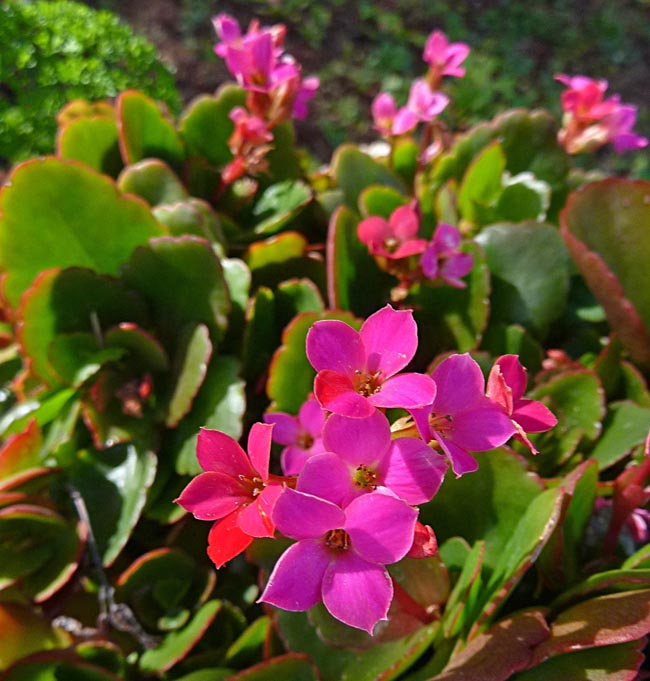
Kalanchoe plants also thrive in arid situations.
These are in a pot outside.

We collect rainwater and have used it for watering plants over the past month or so. But there's been so little rain that the collected water is now all used up, and it's not being replenished. I won't wash the car, but when there's no rain and mud, it doesn't really need to be washed anyway. Even Callie doesn't need a rinsing-off after our walks these days, because everything is so dry that she doesn't get dirty.

I guess water restrictions apply especially to large-scale consumers, and that means farmers and factories. Farmers can't irrigate their crops. In the immediate area around us, the only crop is grapes, and in France irrigating grapevines is prohibited anyway. The wine varies in quality and quantity from year depending on weather conditions — moisture and sunshine. Irrigating the vineyards would alter the natural process.

A close-up of Monet's 1878 painting La Rue Montorgueil,
just because I like it and used to live there

Grapevines have very deep roots, and the vineyard is green. I'm sure the growers would be happy to have a little more moisture right now, but not too much. Down in the river valley, however, between Mareuil and Pouillé in particular, there are big fields planted in feed corn. Corn needs a lot of water, but it's not getting it this year. Many crops all around the country are suffering and already being declared a loss.

26 May 2011

Under the linden

Yesterday afternoon Callie and I spent a couple of hours sitting under the linden tree — le tilleul —out back. It's in full bloom right now, and it's covered in bees and butterflies. When you walk or sit under it, the distinctive buzz of swarming insects fills your ears.

Tilleul is pronounced [tee-YUHL]. In British English, a linden tree is usually called a lime tree. That's confusing to this American, because limes are something entirely different — citrus trees. In North America, the linden is also called a basswood. Linden, lime, basswood, and tilleuls — genus Tilia —grow throughout the temperate Northern Hemisphere, from eastern North America across Europe and into Asia.

Bees in the linden flowers...

At this time of year, when the linden is in flower, it dominates the "yardscape." Not only is is buzzing with insects, but the fragrance of the flowers is unmistakable and pleasant. They have medicinal uses. They're steeped in boiling water to make what is called an infusion — an herbal "tea," we say, even though real tea leaves are not necessarily part of the mixture — that can be used to treat anxiety, hysteria, migraines, indigestion, nausea, irregular heartbeat, insomnia, rumatism, gout, and a host of afflictions. It's a diuretic, and it tastes good too, at least to some people.

...and a butterfly

Sitting under a tilleul in flower is also therapeutic. The shade, the buzz, the fragrance — all of it encourages you to relax, or even doze, in a reclining chair. It doesn't hurt that you can enjoy all that only when the weather is warm and there's no wind. Yesterday, I sat under our lawn tent — le barnum, it's called in French, after P.T. — threw the tennis ball a liitle for Callie to chase, listened to the radio, and sipped a glass of white wine.

Grape vines under linden flowers

Earlier, I had cut some nice tender leaves from our few grapevines — not leaves from the vineyard, which are sprayed with various chemicals, but leaves from our yard, where we don't use insecticides or herbicides. We made a batch of stuffed grapevine leaves — dolmas, or feuilles de vigne farcies — for lunch today.

The linden and the laundry

I've posted about dolmas before, including a recipe for the rice and herb stuffing. This time, I chopped up some golden raisins — sultanas — because didn't have any little currants — raisins de corinthe — and I chopped up some shelled pistachio nuts to use in place of the pine nuts — pignons de pin — because pine nuts are so expensive. We tasted a couple of the stuffed leaves yesterday afternoon, and they are good.

Callie basking in the sun — notice how parched the grass is

We're making Greek-style chicken wings to have with the dolmas at lunch. I'm not sure people in Greece have a particular affinity for chicken wings, but I'm marinating these using the ingredients for a Greek chicken recipe I found: olive oil, lemon juice, garlic, rosemary, thyme, and oregano. We're lucky to have the herbs growing in the garden and yard.

The tilleul and the « barnum » seen from an upstairs window

Blog friends are coming for lunch. We've tidied up, run the vacuum cleaner, and prepared the lunch for the visit. The people visiting are some we have never before met in person. Those who've been reading this blog for a while, and the comments, would know who I'm talking about if I said the name. More about that later.