04 June 2010

Rouen, 7 years ago

Seven years ago, when Walt and I came to live in France, we first drove up to Rouen, in Normandy, to spend a few days with friends there. They lived in the center of town near the old marketplace and the cathedral, and they had a studio apartment they let us stay in. The pictures in this post are ones I took on June 3, 2003.

I lived in Rouen for a year in the early 1970s. I was 24 years old and I had a job as an English teacher in the illustrious Lycée Corneille — formerly called Le Collège Royal — there. It was a part-time job, and my purpose for being there was to improve my French. I made good friends and my French was pretty much fluent by the time I went back the the States.

One of the symbols of the city of Rouen is this old clock
in a tower over one of the main streets.


In 2003, the great Canicule — the weird European heatwave — had already started, but we didn't know it yet. The Normandy climate is essentially damp and cool, but by early June seven years ago the weather was already hot and strangely sunny.

Buildings around Rouen's Vieux Marché — the old market.
The one in the middle all decked out in red flowers is La Couronne,
the restaurant where Julia Child had her first meal in France.


The reason we were in Rouen was that our friends who had the studio apartment were going to lend us some sheets, towels, and other essentials that we could take with us to Saint-Aignan. Those things would tide us over until our container arrived in July, with the furniture and other belongings we had shipped from California. I thought we might buy a car there too, but we ended up driving the rental car down to the Loire Valley.

Walt and 11-year-old Collette in front of
the Eglise Saint-Ouen in Rouen


Rouen is a magnificent old city with one of the most impressive cathedrals in France, two other fine churches, and the old tower where Joan of Arc was supposedly held prisoner before she was burned at the stake in the city's old marketplace in 1431. Historically, Rouen was considered the capital of Normandy. Victor Hugo called it « la ville aux cent clochers » — the city of 100 church towers. The novelist Stendhal called Rouen “the Athens of the Gothic era” for its great architectural treasures.

The city of Rouen is an open-air, living architecture museum.

Rouen is also a big port city. Ocean-going ships come up the Seine from Le Havre to unload their cargo. The historic center is on the right bank of the Seine. On the left bank is a newer urban area, and the whole metropolitan area has a population of half a million. There's a new tramway that runs underground through the old part of the city. Rouen less than 90 minutes from Paris by train.

But Rouen in not just a museum — there are many
nice cafés and restaurants to enjoy too.


I haven't spent nearly as much time in Rouen over the past seven years, since moving to Saint-Aignan, as I did back in the 1990s. But I'll go back there this summer, if everything works out. CHM and I are planning a trip for the end of July. Walt and I went to Rouen to visit friends in August 2006 — I posted about it here. A few years ago I did a series of four topics about Rouen and the time I spent there in the early 1970s. It starts here, and there's a link at the bottom of each topic to take you to the next one.

03 June 2010

Dolmas — stuffed grape leaves

I used to buy stuffed grapevine leaves — in French, feuilles de vigne farcies — in tins when I lived in the U.S. I'm sure they must be available that way here in France, but I've never seen any in our Saint-Aignan supermarkets. For some reason, I got the idea of making some late last summer. They are a Greek concoction called Dolmas.

When I read about making dolmas, all the recipes said you must use the tender young leaves that appear on the grapevines in the spring. That meant I had to wait the better part of a year before I could try my hand at it. I know you can buy grape leaves in jars and cans, probably in Paris and maybe in Tours or Blois, but not around here.

Untreated grapevines with tender green leaves,
in our back garden

So I had to use fresh grape leaves. Lucky for us, we have a dozen or so grapevines in our back yard. They have hardly ever produced enough grapes to be of any great interest — maybe they need to be fertilized or otherwise sprayed and treated, and we don't do anything to improve them. They are pretty to look at, and they have very nice leaves. We know, at least, that those leaves haven't been sprayed with any noxious chemicals. They're perfect for home-made dolmas.

Une feuille de vigne

After washing and de-stemming the grape leaves, you need to blanch them. That means to cook them in simmering salted water for at least 3 minutes to soften them and make them pliable (literally, foldable). As soon as they are blanched, put them in a cold water bath to stop the cooking.

Blanched leaves soaking in brine

I picked 50 leaves off our vines, trying to get ones that were tender and green but also large enough to be wrapped around a ball of stuffing. I blanched them in batches of 10, cooled them in cold water, and then spread each leaf out and made a neat pile of them in a deep round dish. Pour salted water over them — use the liquid they blanched in after it has cooled. This way you can store them for a day or two in the refrigerator.

Lots of parsley and lemon juice for the rice stuffing

Then make the stuffing. There are many recipes, of course, and some include meat. The three essential stuffing ingredients, however, are cooked rice, herbs, olive oil, and lemon juice. Onions and toasted pine nuts are common ingredients, and the herbs used often are parsley and either dill or mint.

Rice with herbs, pine nuts, and currants (raisins de Corinthe)

Here's the meatless recipe I came up with after looking at a few in both English and French on the Internet:
Rice stuffing for Dolmas

1¼ cups (150 g) raw rice
1 onion, finely chopped
2 Tbsp. olive oil
2 cups chicken broth (or water)
½ cup toasted pine nuts
¼ cup dried currants (tiny raisins)
¼ cup (or more) chopped fresh parsley
¼ cup (or more) chopped fresh mint
½ tsp. cinnamon
½ tsp. allspice
3 Tbsp. white wine
salt and pepper to taste
1 lemon (for the juice and the rind)

Cook the onion in olive oil until it softens. Add the rice and cook it in the olive oil for a couple of minutes. Add the broth and cook on low heat until the liquid is absorbed, stirring occasionally. The rice doesn't need to be completely cooked at this point, because it will cook later for quite a while inside the grape leaves.

Toast the pine nuts and add them to the warm rice along with with the currants (raisins), herbs, and spices. Mix well and and add the juice of a lemon and a little white wine — save the lemon rind to cook with the stuffed leaves. Season the rice mixture with salt and pepper, stir well, and let cool.
To stuff the leaves, take them one by one out of the brine, spread it on the work surface, and put a teaspoon or two of the rice stuffing just where the stem was. Fold up the bottom of the leaf and then the sides. Roll the leaf up into a little log shape, filled with the stuffing.

Place a bit of stuffing on the leaf and roll it up.

Pack the stuffed leaves in a single or double layer in a pan so that they won't come apart when they cook. Pour on a cup or two of hot water — not quite enough to cover the leaves completely. Drizzle in a couple of tablespoons of olive oil, and scatter the cut-up lemon rind on top. Cover the leaves with a an oven-proof plate to hold them in place.

Stuffed leaves ready to be transferred to a pan and cooked

Put the pan on top of the stove and bring it to the simmer. Be careful not to let it scorch on the bottom. Then put it in a 300ºF/160ºC oven and let it cook gently for 45 minutes to an hour. Lower the heat it if it boils too hard. Most of the liquid will evaporate, leaving a lemony olive oil sauce in the bottom of the pan.

The stuffed grapevine leaves after an hour
in the oven at low temperature

Let the stuffed leaves cool in the pan before removing them to a serving platter. Then put them in the refrigerator for at least an hour before you serve them. They are good with a glass of wine cold white, rosé, or red, as you prefer. They will keep for a few days in the refrigerator.

The grapevine leaves, parsley, and pine nuts give the dolmas a resiny taste that is brightened up by the lemon juice and enriched by olive oil. Mint and raisins lend just a little sweetness.

Serve the dolmas cold or at room temperature.

My memories of Greek foods like Dolmas come from both France and the U.S. One year in Paris, I was in classes at the Sorbonne with a Greek woman from Salonica. At Christmastime she went home to spend the holidays with her family, and when she came back to Paris is January she brought us a batch of stuffed cabbage leaves that she called Dolmades, which her mother had made. They were rich and lemony in taste, stuffed with ground meat. It was a great dinner.

In the 1970s I also lived near Chicago for a few years and had friends whose parents or grandparents had immigrated to the U.S. from Greece earlier in the century. We used to enjoy going to the restaurants in Chicago's Greektown neighborhood, eating Dolmas and many other Greek dishes.

02 June 2010

Seven years already

It was on June 2, 2003, that we arrived in France to take possession of our new house. We had been granted long-stay visas early in May, after a two-month wait. We had sold our house in San Francisco and had to move out in March, so we'd been homeless for a while.

Friends took us in. Cheryl for several weeks, and Sue for a week, in California, before we decided to head east and wait for the visas, with bated breath and our fingers crossed that we'd get them. It was fun spending time with good friends, but we didn't want to wear out our welcome. Actually, some friends from France had made plans to visit in April and, because we had just sold our house and moved out, Cheryl took them in too. It was like a house party.

CHM in Southern California and friends Harriett and Tom in Illinois each kept us for a few days as we drove across the continent. They were all very kind to take in two nomads and their old dog. Fact is, we've all been friends going back as far as 40 years. Our temporary destination was my mother's house in North Carolina — the house I grew up in. Ma had invited us to come spend as much time with her as we needed to, waiting for the visas.

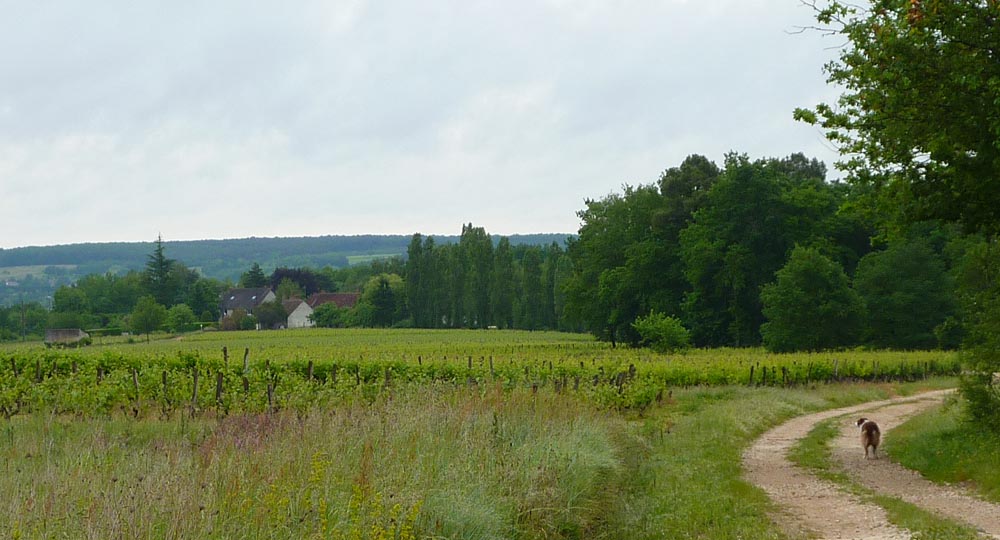
Early June 2010 in Saint-Aignan. Look how green
the Renaudière vineyard is now.


The trip across the country took about a week. It was my fifth such drive, and Walt's third. We drove through Phoenix, Flagstaff, and Gallup. We had a good stopover in Santa Fe and a great meal at the Inn of the Anastasi (on their site, look at that lunch menu!).

We spent the night in Tucumcari, New Mexico, where we decided it was time to telephone Allied International in Oakland and tell them to go ahead and put our container load of furniture, kitchen gear, and books on the boat, destination Le Havre. We were optimistic that we would be in Saint-Aignan by the predicted arrival date in early July. In fact, we were required to be here to sign for it.

We stayed in Days Inn motels Motel 6 rooms as we drove across the country, because we knew Motel 6 would welcome the dog. We drove on through Amarillo, Oklahoma City, Tulsa, Joplin, Rolla, and St. Louis — and then into Illinois, my old stomping grounds. Outside Urbana, we had the thrill not only of seeing Harriett and Tom again, but also enjoyed a loud and lightning-filled Midwestern thunderstorm.

We left Illinois and drove down through Louisville and past Lexington. In eastern Kentucky we saw funnel clouds in the sky and listened to severe weather warnings on the car radio. We made it to Knoxville without getting blown off the road, driving through blinding rain. We spent the night in Pigeon Forge, where it rained harder than I remembered it could, after 18 years in California.

Here's Callie on her way home after a good walk.

We wanted to drive through the Great Smoky Mountains National Park, just to see it. The rain continued, however, and that drive the next day was just a green blur punctuated by swipes of the windshield wipers. On to Winston-Salem, Greensboro, Durham, and Raleigh we went, and down to the coast. We stopped and bought a couple of pounds of good Eastern N.C. barbecued pork at Wilber's restaurant in Goldsboro.

The day after we arrived at my mother's house on the N.C. coast, we got the phone call from the French consulate in San Francisco informing us that our visas had been approved. We could come in to pick them up at our convenience, but they had to be picked up in person. Actually, the consulate had kept our passports for the duration.

After some negotiating, we arranged for our passports with the visas in them to be sent to the French consulate in Atlanta. We had to drive there, and Atlanta is 500 miles from where we were, Morehead City. So we packed the dog and some clothes in Walt's 1992 Jeep Cherokee and took one last long drive. We took advantage of the trip to Atlanta to go see Savannah and Charleston on the way back.

It rained all that month on the Carolina coast. There was water standing everywhere, in yards and along roadsides. We sold the Jeep, with regrets. We managed to get plane tickets from Washington Dulles airport to Paris CDG on June 1. We had wanted to arrive in France to start this new life on June 1, our 20th anniversary together. But it wasn't to be. We arrived instead on June 2, with a load of baggage and 11-year-old Collette in her kennel.

We went to Etretat on the English Channel
for lunch on June 5, 2003, when we were
staying with friends in Normandy.


Because we didn't have any furniture yet, we planned to spend some time with friends in Rouen before heading south to Saint-Aignan. But we were too antsy. Less than a week after touching down, we packed up again and drove to the house we had bought and now live in. We basically camped here for more than a month, before the container got here. 2003 was the year of the Great Heat Wave — la canicule. It started out as a real adventure, and it continues.

01 June 2010

Mostly good news, but some bad

Which do you want first? Okay, let's go positive.

Good news: today marks 27 years that Walt and I have been living as a couple. We met in Paris in 1981. Then we moved back to the States and got an apartment together in Washington DC in June 1983. From 1986 until 2003 we lived and worked in California.

Tomorrow will be the seventh anniversary of our arrival in France to start this new life. It's still hard to believe.

The new floor...

More good news concerns the attic conversion: Jacques and two of his young workers showed up yesterday morning. They arrived with a truckload of pine boards — that's the flooring for the attic. It's tongue-and-groove. And the two workers started nailing it down. The nails go into the groove on the edge of each board, so they are not visible in the finished floor.

...is about half done.

As Walt said on Facebook, I think, the crew had laid down a few boards over the sub-floor to see how they were going to fit together. I went up and saw them, and they looked fine to me. I came back downstairs and told Walt he should go see what they were doing, just to be sure. He did. When he came back downstairs, he said: "The had the boards laid down back-side up. They were going to put them in the wrong way."

There's a top side and bottom side, because the planks are chamfered. In French, ce sont des planches avec chanfrein. What that means is that the top edges of each board are beveled, so that there is a shallow groove between the boards where they fit together.

Pine boards with chamfered edges

Now for the bad news. Our English friend S. called late yesterday afternoon. “I have some news about Coco,” she said. Coco is the masonry/tile/drywall specialist who has been the senior member of the work crew. Last year he put down new tile for us on our front terrace. Over the past two months, he has done all the plasterboard walls up in the attic, as well as putting in the new staircase.

Anyway, I told Starr that Coco hadn't come to work here that morning but that the laying of the floor was proceeding apace, thanks to Jacques and the two guys who work for him. “Okay,” S. said, “but here's the news: Coco was doing some work at his own house this afternoon. Unfortunately, he fell and got his legs tangled up in a ladder. He has suffered a nasty broken leg. Jacques called it « une fracture ouverte ». I'm not sure exactly what that means, but Coco is in the hospital over in Romorantin.”

A view from a different angle

Poor Coco (his real name is Jacques too). He's a man who is always all smiles, who whistles while he works, and who is a craftsman. He is proud of his work, and has a right to be. Now he'll be laid up for I don't know how long.

Now some people who read this blog have said that we should leave that last wall, the one directly over the stairs, in its natural brick state. Well, it looks like it will stay that way for at least a while longer, unless the other Jacques finds another drywall man to finish the job. I don't know who will install the closet doors.

I guess we'll be able to start varnishing and painting as soon as the floor is finished.

View coming up the stairs

Dry. That's what we wish the weather would be. It's supposed to rain again today, but they're promising us warm — even hot — sunny days for a while starting tomorrow. Oui, demain — toujours demain. We'll be making a batch of dolmas — stuffed grape leaves — this afternoon. I picked and blanched 50 grapevine leaves yesterday afternoon.