Showing posts sorted by relevance for query château,blois. Sort by date Show all posts

26 March 2008

Blois on a foggy day in March

The Loire, the bridge, and the cathedral at Blois

Blois is the big town closest to Saint-Aignan; it's 25 mi./40 km north. Because you have to make the trip on little roads and either drive the direct route through a half-dozen villages or take a much less direct route through open countryside to get there, the going is slow. It takes a good 45 minutes to drive the 25 miles to get there. We don't go very often.

The population of Blois is only about 75,000. While that is 20 times bigger than Saint-Aignan, Blois is a small city compared to nearby Tours and Orléans. But as an old royal town, Blois has historical and cultural significance much greater than its importance as an urban center. It's also the administrative city for our département, the Loir-et-Cher. In other words, the national government has its offices and services there.

The towers and spires of the 12th-century Eglise St-Nicolas
seen from the south bank of the Loire through fog

In the Middle Ages, the Counts of Blois ruled over two large territories in France. One was the area that includes Blois, of course, but also Chartres to the north, closer to Paris and Normandy. The other territory they controlled was Champagne, where the wine of the same name is made, east of Paris.

The cathedral rises high above the streets of Blois

One of the Counts of Blois married William the Conqueror's daughter, all those centuries ago, and their son became King Steven of England in the year 1135. The most powerful of the Blois counts was Thibaud IV, who died in 1152.

Two years later, Henri II Plantagenêt, count of Anjou in France, became king of England. At the same time, the House of Blois turned its attention to its territories in Champagne, leaving the Blois area under the thumb of the Plantagenêts, who held the lands down the Loire River toward Chinon and Angers, as well as the English throne. Henri II Plantagenêt was married to Eleanor of Aquitaine (southwest France), so his French holdings were vast.

The old bridge at Blois seen from the cathedral above town

Some 250 years later, in 1392 during the 100 Years War, the last of the counts of Blois sold his territories in the Loire Valley to the Duke of Orleans, who was the brother of the French king Charles VI. The French royal court moved to Blois for a time. Charles VI, who was known as Charles le Bien-Aime — the Beloved — later became known as Charles le Fol — Mad King Charles — because he went insane.

The Eglise St-Nicolas seen from
the terrace of the château in Blois

A couple of generations later, in 1498, King Louis XII, who was born in Blois, moved the French royal residence there again. When Louis XII, known as "the father of the people," died and his successor the great king François Ier rose to the throne, he set up his residence in Blois and built a new wing onto the château. He also began construction of his masterpiece, the château/hunting lodge at Chambord, nearby. Those were the real glory days of Blois, at the beginning of the French Renaissance and before the Wars of Religion between Catholics and Protestants ravaged the country.

Window shopping on the narrow streets in old Blois

As you can see, Blois played a main role in French history, with the actors being the descendents of William the Conqueror and the Plantagenêts, who gave England several kings, and finally several great French kings.

In more modern times, Blois has been known as the political fiefdom of the Socialist Party "heavyweight" Jack Lang — one of the éléphants of the party, as they have been called. Lang was mayor of Blois, member of parliament, and Minister of Culture under President François Mitterrand in the 1980s and '90s. He is still a major figure among French socialists.

A wing of the château in Blois: La Façade des Loges

Lang's father was an Americanophile, evidently, and that's how he came to name his son Jack instead of Jacques. As a national figure, Jack Lang was a major force in Blois, bringing big changes to the city. Many were viewed as positive by the local people — new museums, renovated gardens and monuments, pedestrian shopping streets downtown, for example — but some were not.

"Main Street" in the business district of Blois

One more controversial contribution Mayor Lang made to Blois was the construction of major housing projects for low-income residents on the west side of the city. Nowadays Blois has a greater proportion of its citizenry living in subsidized, low-rent housing than any other city in France except Marseilles, my friends from Blois tell me.

Looking across to the Blois neighborhoods
on the south bank of the Loire

Outside its historical interest, we find Blois to be much less "useful" as an urban center than Tours, which is not much farther from us and which is a much bigger city. Blois seems to have a lot of the problems of modern cities, one of the greatest of which is heavy traffic, but not many of the advantages of a major urban center. We more often go to Blois to do special shopping or to go to concerts.

The cathedral of Blois rises above the rooftops of the town

Blois is very picturesque, as you can see from these photos I took one day in March two years ago. The town sits on the banks of the Loire at a point where there are high bluffs on the north side of the river. The cathedral sits high above the town. I've published other pictures of Blois here and here. I seem to have spent a lot of time in Blois in March 2006.

20 June 2009

A painting in Blois

Yesterday afternoon after lunch, we drove up to Blois to see the château there. CHM, who is visiting from Paris (but who lives in the U.S. most of the time) learned from a cousin earlier this year that a painting depicting Joan of Arc at Blois in 1429 — and painted by CHM's grandfather in 1901 — hangs in the chapel at the château.

An archtectural detail at the Blois castle

Blois is an old royal town that played a central role in French history for many centuries. The most powerful counts of Blois, in the Middle Ages, were grandchildren and great-grandchildren of William the Bastard — a.k.a William the Conqueror — after he defeated the English in the Battle of Hastings in 1066. At least one, Etienne (King Stephen in English), became king of England in 1135.

The Louis XII wing at the château de Blois

King Louis XII of France was born in Blois in 1462. He had a "new" wing built onto the château there — the earliest existing sections and buildings at the château date back to the 1100s. Then François 1er, the mastermind behind the nearby Château de Chambord, took up residence in Blois in the early 1500s and had another major wing constructed, in Italianate style. Finally, in the 1600s, a third big wing was built, in French Classical style.

François 1er's wing includes this famous staircase
dating back to the 1500s

So it's a long history. CHM's grandfather, who was a painter in Paris in the 1800s, finished the painting of Joan of Arc at Blois just a few years before he passed away. The family donated the painting to the city of Blois, and now it hangs in the chapel on the grounds of the château. That's what we went to see yesterday. It had been 53 years since CHM last laid eyes on his grandfather's painting.

Above: CHM's grandfather's painting on a wall in the chapel at Blois

Below: my photo of the painting modified to correct the perspective
Blois is only 25 miles north of Saint-Aignan. It takes 40 minutes or so to drive up there. While we were in the château, a big group of Americans came in. They were probably on a bus tour. It was interesting to listen to their English, which was definitely Southern.

The St-Nicolas church (ca. 1200) and the Loire River at Blois

As we were leaving the château, a 60-year-old American — obviously American because dressed in bermuda shorts — arrived at the door just as we did. CHM stepped back and let the man go through first. "Age before beauty," CHM said as he passed. The man looked surprised and then laughed at the joke. I don't think he expected to be spoken to in English.

22 September 2006

Blois and Vierzon excursions

In topics over the past few days I was describing Saint-Aignan and its Grand Hôtel. Yesterday I looked for some pictures and found this blog entry from a few months ago: Saint-Aignan in Pictures.

Between the adventures Gabby and Margaret had at the laundromat in Saint-Aignan Tuesday morning and our rustic dinner in the village of Thésée that night, we took a nice afternoon drive up to Chambord and Blois. On the way we drove by the château de Chémery, of which I have posted pictures several times before. Here's one:

Château de Chémery, near Saint-Aignan, a 15th-century building

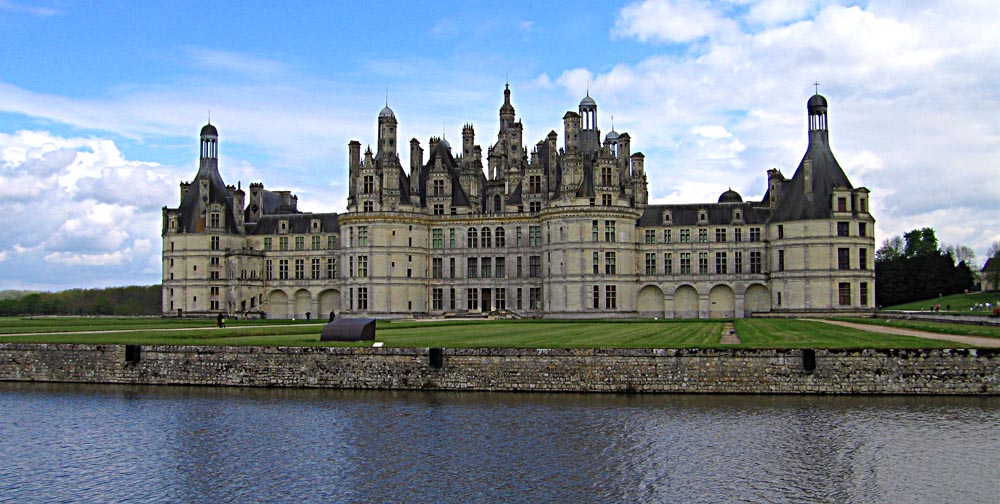
Tuesday afternoon was nice and sunny. Chambord, one of the major Loire châteaux, was impressive and luminous in the afternoon sunlight. Here's a picture of the enormous Renaissance castle that I took last spring:

Chambord, 26 April 2006

After Chambord, we drove down along the Loire toward Blois, through the village of Saint-Dyé and on to a viewpoint where you can see Madame de Pompadour's château called Menars:

Le château de Menars, near Blois on the Loire

At Blois, we parked the car and took in the panorama of the city from the riverfront on the south side of the Loire:

Blois in a picture taken last spring. Click the image to see it full-size.

We went up to the cathedral and into the park at the Hôtel de Ville just behind it, to enjoy the views. Here are a couple of previous blog entries with pictures of that part of Blois: A Sunday in Blois and Lunch in Blois.

So it was a nice afternoon and we all enjoyed it, I think. Gabby and Margaret had seen Chambord many years ago, but it's always worth another quick visit. Neither G. nor M. said she could remember ever having been in Blois before, so I'm glad we went.

I already wrote about our dinner in Thésée Tuesday evening.

Wednesday morning, I went to the Grand Hôtel to pick up G. and M. and ferry them over to Vierzon, where they had a rental car waiting for them. They were headed to Burgundy for a few days.

On the way to Vierzon, 35 miles or so east of Saint-Aignan along the Cher, we stopped to see the château and church in the town of Selles-sur-Cher, and then we took a spin through the old walled town of Mennetou. I've posted pictures taken in Selles and Mennetou before.

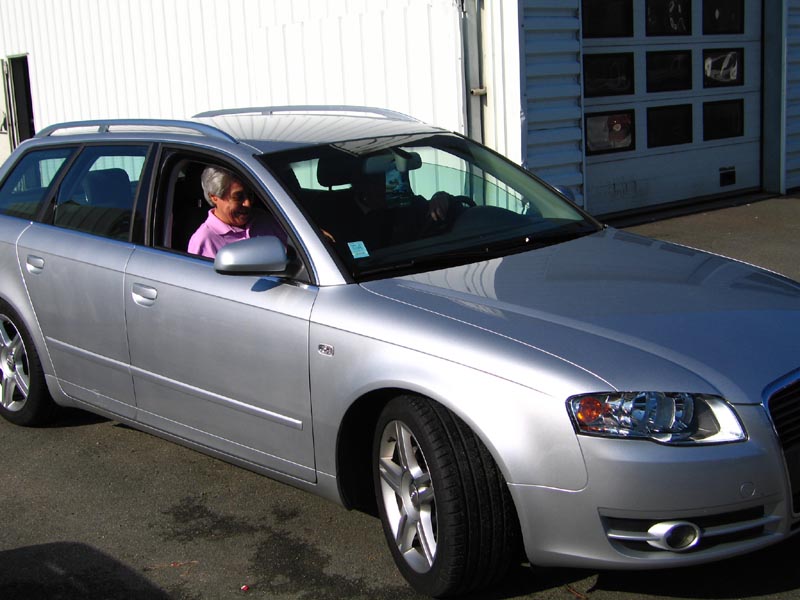
At Vierzon, the Europcar rental office was located in an Opel car dealership. The woman at the desk processed the rental papers quickly and efficiently. She told me she had had a lot of trouble finding a car with an automatic transmission, but she had been successful: a silver Audi A4 station wagon parked out front was the one. It had arrived just a few minutes before we did.

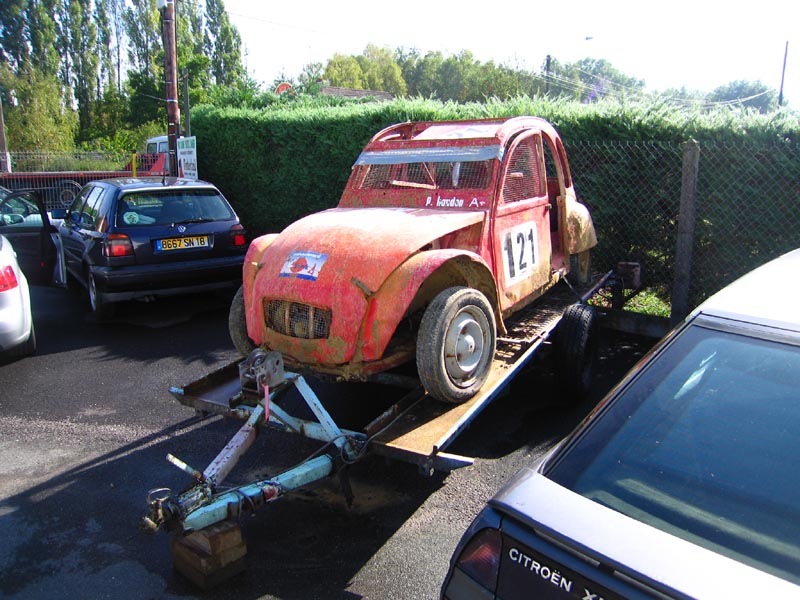
No, it wasn't this car!

Here's a picture of our friends in their car, heading out toward Auxerre.

Off into the wilds of Burgundy

02 April 2012

Cheverny's sordid past

If you've visited or read much about the château de Cheverny, you might know this already. The present-day château at Cheverny exists because a woman stepped out on her husband.


The château was built on the site of an older, medieval château-fort that had been demolished. The owner was Count Henri Hurault, who was the gouverneur of Blois during the reign of the great French king Henri IV (« Paris vaut bien une messe » and "a chicken in every pot" were his mottoes).


Hurault married a young wife (whose name was Françoise Chabot [he he]) and shut her up in his château at Cheverny to make sure she would stay faithful to him. It was all in vain, it turned out, because the Count came home from Blois one day to find her in the arms of a lover. He stabbed the lover, mortally wounding him, after the poor man had jumped out a window and broken his leg while trying to escape. Hurault then forced his wife to commit suicide by drinking poison.

Hurault was banished from Blois exiled to Cheverny by the king for his crimes, and he later remarried. To wipe away the memory of his treacherous first wife once and for all, he had the old château-fort torn down. He entrusted to his new spouse the task of overseeing the construction of a "modern" edifice on the old site. An architect (Boyer) and painter (Mosnier) from Blois were instrumental in designing and decorating the château as we see it today.

Unfortunately, both Henri Hurault and his second wife, Marguerite Gaillard de la Morinière, departed this world before the château could be completely finished. It was left to their dear daughter Elisabeth to get the job finished.

That's the story that has passed into legend. The photos here show some of the decoration inside the château.

21 July 2011

Saint-Aignan, Amboise, and Blois

When I said that it had turned cold yesterday, I exaggerated slightly. Before going out, I put on a fleece jacket over my corduroy shirt, but then I was too warm during the day. And it didn't rain until late in the afternoon. We had some nice sunshine around mid-day.

We took our friends to Saint-Aignan for a walk up to the château grounds and enjoy the views out over the town's rooftops and the river. The château itself is privately owned and not open to the public, so you can only see it from the outside. Then we drove over to Châteauvieux, a neighboring village, to see the château and church there. I posted about Châteauvieux, with photos, just a few days ago.

Saint-Aignan, on the banks of the Cher River

Lunch was a galette bretonne in the crêperie in Saint-Aignan called Le Bigouden. A galette is a buckwheat crêpe (crêpe de sarrasin) filled with savory, not sweet, ingredients. My galette, for example, was wrapped around a slice of ham, some melted cheese and cooked mushrooms, and an egg that still had a soft runny yolk. It was topped with a spoonful of chunky stewed tomatoes.

We also had dessert crêpes — some topped with hot fudge sauce and vanilla ice cream, others with the same chocolate sauce along with whipped cream and chopped ripe banana. Cups of espresso coffee finished off the meal. The Bigouden is a good restaurant. It's too bad there weren't many other customers there. Earlier we had driven past the zoo in Saint-Aignan and noticed literally hundreds of cars in the parking lots out there. I guess that was where it was happening yesterday, not in Saint-Aignan's old town.

Our next stop was Amboise, a 30-minute drive distant. What a difference! We drove through the old town looking for parking space, but every space along the narrow old streets was taken. There was quite a bit of traffic, especially on the wide boulevard that runs parallel to the Loire River past the old town and the château. We finally found a parking space in the big lot along the river, near where the Sunday morning outdoor market is held.

Amboise, on the south bank of the Loire River

We walked back to the château, which our friends wanted to go into. It was no surprise, after seing the number of cars in town, to find a big crowd going into the château. We paid 10 euros ($14 U.S.) each for tickets. The sky had clouded over and there were short showers of drizzle and a stiff breeze as we wandered around the big terrace that surrounds the château and took in the views out over the town and the Loire River.

We saw the little chapel on the château grounds that is the site of Leonardo da Vinci's tomb. The Italian genius spent the last three years of his life in Amboise — he died there in 1519 — at the invitation of the French king François 1er. A big tour group with a French-language guide got there just before we did, so we had to wait for them to leave before we could really see the interior of the chapel and Leonardo's tomb.

We went inside the château and it was just as crowded with tour groups and hundreds of tourists just shuffling along looking at paintings and old furniture, many either reading the brochure they give you when you buy your ticket or listing to the audio guide with headphones that you can rent at the entrance. The château has been heavily restored over the past two centuries and is furnished in the 19th-century style.

It got quite hot inside the château because of the crowds of tourists. It didn't help that there were a lot of stairs to climb, and I was dressed in corduroy and fleece because of the gray weather outdoors. We had noticed, earlier in the day, that the interior of the church in Saint-Aignan, where we went to admire the 800-year-old frescoes painted on the walls of the crypt, was actually very warm. Normally you expect it to be chilly inside the big old stone churches and châteaux in this part of France, but the weeks of hot weather we had earlier in the summer have warmed up the stone. The contrast with the cool outside temperature yesterday was striking and unusual.

As we left the Amboise châteaux, real rain moved in. Three of us hadn't brought along umbrellas or rain jackets, and we got fairly soaked walking the 10 minutes back to the car. It was getting to be time to drive our friends to Blois, where they were going to catch a train back to Paris. The rain kept up, sometimes falling lightly, sometimes a lot harder, for the rest of the day.

Blois, on the north bank of the Loire
As always, you can click the picture to see an enlargement

Walt and I dropped our friends at the train station at 5:15 and then went to do some shopping in a specialty food shop in Blois before driving back to Saint-Aignan. As we left Blois and headed south, it was raining very hard between Cour-Cheverny and Soings-en-Sologne. We took narrow country lanes over to Chémery and then through Noyers-sur-Cher before we crossed the river on the Saint-Aignan bridge and got home at 7:00.

Callie was very happy to see us after spending about eight hours alone at home. It was still raining hard outside, and when I tried to take her for a short walk, she didn't want to go. I gave up. Walt and I fixed ourselves salads from leftovers (we had made a big salade niçoise for dinner the night before) and had a glass a wine. The rain stopped so I took Callie out at about 8:00 p.m. It was still broad daylight and the rain had let up.

Instead of going for a walk in the vineyard — I was afraid the rain might start falling again at any minute — I just let Callie wander around the yard for a while while I did some weeding under the tomato plants in the garden. The dog ate grass for a while, I noticed — it's growing tall and green after the recent rains — and then just sat down and watched me work, waiting.

We came back in the house, I dried Callie off with a towel, and we settled in to relax for an hour in front of a TV documentary with segments about châteaux and vineyards down in the Dordogne, and then about islands off the Normandy coast, before turning in. The rain started falling again and raindrops made a pleasing noise slapping against the roof tiles and the skylight windows upstairs. When we went to bed at about 9:30, it was still light outside, but we were tired after a long day of sight-seeing.

15 February 2024

Artist C.H. Michel's painting of Joan of Arc in Blois

On the afternoon of June 19, 2009, my friend Charles-Henry and I drove up to Blois to see the château there. Charles-Henry was visiting from Paris, where he was spending the summer. He had recently learned from a cousin that a painting by his grandfather depicting Joan of Arc at Blois in the year 1429 was on display at the château there. Blois an old royal city that is on the Loire River less than an hour's drive north of Saint-Aignan.

That was the first time Charles-Henry had laid eyes on this painting of his grandfather's in 53 years. Charles-Henry was 84 years old in 2009. His grandfather had finished the painting in 1901 at the age, I think, of 87. It must have been Charles-Henry's father, born in 1860 in Paris, who donated it to the Château de Blois.

The plaque above explains that Joan of Arc was in Blois in the year 1429 during the 100 Years War when she raised an army and proceeded to march her soldiers to the city of Orléans to liberate it from the English forces who had occupied it. The English would burn Joan at the stake up in Rouen in Normandy just two years later. It also says that it is one of the few existing depictions of Joan's time in Blois.

By the way, Blois is a city that played a central role in French history for many centuries. Back in the Middle Ages, the powerful counts of Blois were the grandchildren and great-grandchildren of  William the Conqueror, who had come to be called "the Conqueror" after his army defeated the English army in the Battle of Hastings in 1066. William became the king of England and at least one of his Blois descendants, named Étienne (Stephen), was also the king of England from 1135 until his death in 1154.

27 September 2007

The grand tour

Wednesday of last week was the day of the grand tour of the Loire Valley châteaux that are within 25 miles of Saint-Aignan. That includes Chenonceau, Amboise, Chaumont-sur-Loire, and Chambord. I'm leaving out Blois and Cheverny, because we didn't have time to stop at either of those, and Valençay, which we saw a couple of days earlier.

There are many more châteaux nearby that are worth a visit, but it would take several days to see all of them. Le Gué-Péan, Chémery, Montrésor, Le Moulin, La Bourdaisière, Villesavin, Beauregard, Troussay, Selles-sur-Cher, and Fougères-sur-Bièvre are just a few of the others. Not to mention Saint-Aignan.

Chenonceau, 19 September 2007

But when it is your visitors' first tour of the Loire Valley, you have to hit the high spots. It's not too hard to get "chateaued out," if you know what I mean. It's like churches. After the fifth or sixth one, you find yourself yawning and muttering "okay, another church."

To really get to know the Loire Valley area, or any other, you have to spend a few weeks, and vary your pleasures by seeing a château or a church now and then but also taking days off to enjoy long walks along the rivers or through the vineyards. Stopping in a winery for a tasting and having a few nice meals made from ingredients you buy in the street markets is also a good idea. And restaurants.

A main shopping street in Amboise —
it wasn't too crowded at lunchtime.

Anyway, time is usually short and a certain amount of rushing around is necessary. Otherwise, visitors go away with the idea that they didn't really get to see all that they had wanted to see. Driving from château to château over the course of a long day is also a good opportunity to chat, relive old memories, and laugh it up with guests you don't get to see as often as you would like.

Speaking of my driving, I only managed to make Janice scream once while we were in the car. Joanna didn't scream at all, or at least not that I can recall. Remember, I had never met Janice before this visit, even though she has been a friend of my sister's for 20 years. She probably thought I was a madman as we raced around on our area's narrow curvy roads, and sped through villages that were often a tangle of traffic.

Joanna took this picture of the château in Amboise.

Janice's scream didn't come until the very last day of the trip, in Paris. We were driving around the bouldevard périphérique from our hotel near the Porte d'Italie toward the Porte de Bagnolet and the A3 autoroute that takes you out to Charles de Gaulle airport. A big truck was in the right lane and its driver was weaving back and forth over the line dividing his lane from the empty one between him and us. I needed to move over to make my exit.

I watched the truck weave for a few seconds until I thought I detected a pattern in his movement. No, he wasn't actually planning to change lanes. So that empty lane was mine for the taking. I stepped on the gas to try to get ahead of the truck and I started moving to the right. Problem was that he picked that moment to weave left. That's when Janice screamed. "Kenny, watch out for that truck!" she yelled, her life passing in front of her eyes.

But we made it. I've gotten better screams than that out of Walt. Once in Spain... oh well, we survived and so did the car, so there's no point going into the details. I also remember a woman I didn't know, a friend of a friend who came to visit, letting out a tiny scream one day when I decided suddenly to pull off the highway for a good view of the château at Chaumont-sur-Loire from across the river. I hadn't realized that the gravel shoulder of the road was so pitted and rutted. The car went sliding but the anti-lock breaks kicked in and saved us. Since we were wearing seat belts, our heads didn't even hit the roof of the car. And we got a great view of the château, way up on a bluff above the Loire.

The weather was nice, but it was a little too chilly to eat outside in Amboise that day.

Last Wednesday, there wasn't too much excitement of that kind. We walked the river path at Chenonceau in the morning. Then we went over to Amboise and had lunch. The restaurant I wanted to try, one that I've been wondering about for years, was of course closed on Wednesdays. So we went to a pizzeria down the street, directly under the high walls of the château d'Amboise. It's called La Florentine. The food was good. I had a pizza, Joanna had spaghetti with meat sauce, and Janice had onion soup and a big salad with lots of cheese in it.

Chaumont-sur-Loire

After lunch and a walk through some of the busier streets of Amboise, we drove on over to Chaumont. I parked around back, in the "secret" parking area I discovered a couple of years ago. When you park there rather than down in the village, you don't have to suffer through a long, steep hike up the hill to get to the château. You're already on top of the bluff, so you just stroll over to the château on flat ground through a wooded park.

Joanna also took this picture of me at the wheel
of the Peugeot. That's the cathedral and the bridge
at Blois that you see through the windshield.

From Chaumont, Blois is a short ride. We stopped on the south bank of the Loire and admired the panoramic view of the city, with its château, an old convent, three big churches, and the old stone arches of the bridge across the river. We didn't cross the bridge so we didn't go into the main part of town. No time.

Chambord

We pressed on toward Chambord, with me pointing out the château de Ménars on its bluff across the river. Mme de Pompadour lived there in the 18th century and had the place refurbished by the finest architects of the day. It isn't open to the public.

At Chambord, there were plenty of people but it wasn't what you'd call mobbed. It never is, in my experience, not the way Chenonceau can be. I guess the grounds are just a lot more spacious and the château de Chambord just about dwarfs all the other châteaux around here. We took pictures and looked around in the château's gift shop as well as some of the other souvenir stores on the grounds before we headed back to Saint-Aignan.

The many ornate chimneys at Chambord

When we got home at about 6:30, Joanna, Janice, Walt, and Callie went for a walk out in the vineyard while I copied my pictures onto my hard disk and started organizing and processing them. They seemed to have a nice walk, and Joanna took some pictures of — what else? — grapes. It was a good but long, busy day for us all.

25 June 2009

Taking the train from Onzain to Paris

Yesterday I drove CHM up to Onzain. We've figured out that that's the best nearby train station for passengers going to Paris from here. Onzain is on the Loire River just downstream from Blois toward Amboise, and about 30 to 35 minutes from Saint-Aignan by car. The drive to Onzain is on a scenic country road and is very pleasant.

Of course you can take the train from Saint-Aignan all the way to Paris, but you have to change trains in either Tours or Vierzon. Depending on connections, that takes extra time. And you can drive to Blois to get the train there, but that takes longer than driving to Onzain. You can drive over to Tours and get the TGV there, but that takes even longer and the TGV, while faster, is more expensive than the regular trains.

The Château de Chaumont-sur-Loire seen from across the river

The ride from Onzain to Paris Austerlitz station takes 2 hours on the regular train. The full price second-class ticket costs about 25 euros. In February and in April, W. and I were able to get discounted tickets at 10 euros each by purchasing them on-line well in advance. CHM's first class ticket, with a senior discount (which I now qualify for too, because I'm 60), was a little less than 20 euros.

Close-up of the same view — the houses down on the
riverbank show you how massive the château is.


Anyway, Onzain is now our gare of choice for the train ride to Paris. The little town is right across the river from Chaumont, which is the site of a famous château up on a bluff above the Loire. Yesterday, we left far in advance of the time we needed to get to Onzain for CHM's train. I told him we could stop and take a walk (not to mention some photos) in the park of the château at Chaumont. The weather was beautiful.

The SNCF — Société Nationale des Chemins de fer Français
is the French national railway system.


When we got there, however, we found big changes. The park is no longer open to the public for free. You used to be able to walk in and walk right up to the château and to the edge of the bluff it sits on, which gave you great views out over the river. You always had to pay to get into the château itself, and you had to pay to get into the gardens. But now you have to pay to get into the park.

For us, because we only had 20 or at most 30 minutes, it just wasn't worth the price of admission (8€ per person) yesterday. So we drove on over the bridge and then along the river road across from Chaumont to get some views of the château in the distance. I took pictures from over there, using my zoom lens.

I like this old silo next to the train station in Onzain.

As we were stopped off the side of the road, a big tractor trailer truck roared by hauling two pre-fabricated homes on its flat-bed. There's a vacation park — a big trailer park, basically — located between Onzain and Blois a few miles from the river. It's owned by a British company, and we know somebody who works there. I figured the truck was hauling those "mobile homes" to that park.

You can see the château from pretty far away
on the opposite bank of the Loire


When we drove into Onzain, we needed to go under an overpass to get to the train station. It turned out that the tractor-trailer had taken that same road, and it was stopped under the train tracks for some reason, blocking all car traffic. Luckily, we had plenty of time.

Again, a closeup of the château seen from
farther back, away from the river


It's always a good idea to allow extra time when you are going to catch and train or plane. You never know what might happen. In this case, a dozen or more cars were lined up behind the big truck and had been there long enough that a lot of the drivers were out of their vehicles, standing in the middle of the road looking to see what the problem was.

I told CHM we would try to go around the traffic jam. We drove west toward Amboise on a little back road, though green fields of corn and sunflowers and barley. The road was lined with ditches filled with bright red poppies. After two or three miles, we found a road going north that went over a bridge across the railroad tracks. Then we backtracked to Onzain, headed for the station. By the time we got there, the stuck truck was gone and traffic was flowing normally. It didn't matter — we weren't late and we had had a nice ride in the countryside.

The train to Paris about the pull out of the gare d'Onzain

CHM got on the train at 11:30. At about 2:30 he called and said he had arrived back at home and was making lunch. The trip had been easy. I think he took a taxi from the Gare d'Austerlitz in Paris to his apartment. He had been here for just short of two weeks and we did a lot of touring around during that time. W., Callie, and I are going to try to get up to Paris to see him later in the summer, before he goes back to the States.

01 October 2019

The Château de Blois (1)

The Cadogan guidebook for the Loire Valley, a mine of information and entertainment, says thats the château at Blois is a group of "mismatched wings" and describes them as "clashing styles shoved next to each other." The author says, however, that the overall effect "is by no means unattractive; it's even rather amusing and certainly extravagant." Each wing is a grand example of its period's style, and the people who built them were some of the finest craftsmen of their time.
The Louis XII wing was the first to be built. Construction began in 1499, and the brick building is "essentially late Gothic in style" with just a few Italianate features. Louis XII was the king who brought the Italian Renaissance to France. He was born at Blois in 1462 and reigned from 1498 until his death in 1515. His predecessor and cousin, Charles VIII, had started a series of wars with the goal of conquering the Duchy of Milan, and Louis XII continued the campaigns. Thus did the French discover the treasures and charms of Italy.
What is now called the French Renaissance was the result. The French adopted Italian styles and imported Italian architects, landscape architects, artists and other experts (including Leonardo da Vinci). The country emerged from the Middle Ages and a new era dawned. Depicted here on horseback in a 19th century statue on the outer façade of his château, Louis XII came to be known as Le Père du Peuple. For a few years, Louis controlled not only Milan but most of the Italian peninsula. It didn't last long. Louis was in his 50s, and age and failing health caught up with him. He died in 1515, leaving no male heirs.
Louis had presided over the marriage of his daughter Claude to François d'Angoulême, who was the presumptive heir to the throne because Louis had no surviving male children. François would reign has François 1er from 1515 until 1547 — the glory days of the French Renaissance. He has a wing in the Blois château complex too, but that's another story.

Later, the wing you see on the left was built at Blois. Doesn't it look very different? Almost austere. Certainly not inviting.
The Michelin Guide says politely that this part of the complex contraste avec le reste de l'édifice... and implies that it is difficult to judge équitablement. Above is a photo of its façade on the opposite side of the courtyard from the Louis XII wing. To the left is a view of the building from the street below, not far from the Église Saint-Nicolas. This wing was built in the classical style in the 17th century when Gaston d'Orléans, a duke but never a king, lived at Blois. His father was the famous king Henri IV (assassinated in 1610), who gave up Protestantism so that he could become king, and promised all French families a chicken in every pot for their Sunday dinner. Gaston, known also as Le Grand Monsieur, was the younger brother of king Louis XIII, who in turn fathered the Sun King Louis XIV. The seat of the French monarchy had moved away from Blois and the Loire Valley, back to Paris, Fontainebleau, and Versailles.