17 December 2009

Snow and ice

The good news is that we have plenty of wood. And that the central heating system in the house seems to be working fine. The car is in the garage. There's no need to go out, because the freezer, the pantry, and the cupboards are full.

The temperature this morning is -6ºC — that's +21ºF, and that's very cold by Saint-Aignan standards. This is not record-breaking cold, but it feels frigid. The temperature where I am sitting, downstairs by the front door where my computer is, was 11ºC — 52ºF — when I came down half an hour ago to write this. I turned the heat on and it's up to 12º now.

The sunset from our back gate yesterday afternoon

According to the TV, the ground is already snow-covered up in Normandy, and north of Paris in Picardy. We are in a flow of air coming down from Scandinavia and Russia, they say. It's supposed to start snowing in Paris early this morning and then the snow will move south and west to cover the Loire Valley and surrounding regions.

We live up on the high ground along the south side of the Cher River, and the hill to get up to our hamlet is pretty steep. I can walk up it without too much trouble, but I can't really ride a bicycle up it — I'm not in that kind of shape. If it gets snowed over, and then ice forms, the little road will be impraticable for cars.

And from out on the dirt road a few minutes later

I went out yesterday and stocked up on groceries, in anticipation of the roads being slippery today and tomorrow. Some reports say it will be even colder in Saint-Aignan next week.

Did I tell you the bad news we got this week? Our morning bread delivery has been cut from five to four days a week. I know, that's not a tragedy. It is, however, a move in the wrong direction, as far as I am concerned. The Monday bread run was not profitable, the bread lady said, so it has been cut.

Bruno was out pruning his vines as the sun set.
The temperature was at freezing, but Callie didn't mind.


It sure is easy to get spoiled by mild weather and frequent bread deliveries. Now I have to go walk the dog.

Snow just beginning at 11:15 a.m.

A few days ago I read an article about a University of Missouri study of people's success in walking daily for exercise. It said that people who walk dogs are more likely to go out for a walk more faithfully every day, and they end up walking a lot faster than people who walk with other people. They get more exercise in both ways. Dogs are less likely than a human walking companion, the study pointed out, to say to their buddy: "Are you sure you want to go today? It's too hot/damp/cold. Let's just skip it for today and go tomorrow instead."

16 December 2009

Restaurants and taxes

Saint-Aignan, pop. 4,000, is home to about a dozen restaurants, including two pizzerias, a crêperie, and a Turkish shish-kebab place. Five "downtown" restaurants — operating in the old centre-ville — are full-service restaurants serving French food.

Saint-Aignan's most upscale restaurant these days is "The Frog Eater."

The most up-scale place is a relatively new restaurant called Le Mange-Grenouille — The Frog Eater. That's a pretty funny name. The menu does include one frog dish — Fricassée de grenouilles au beurre persillé (fricasseed frog legs in parsley butter) — but that's only one I see. Le Mange-Grenouille opened for business just three or four years ago, and it's nicely decorated. There is outdoor seating when the weather is nice.

Here are Le Mange-Grenouille's à la carte choices.

Another Saint-Aignan restaurant is located on the main square, where the food market is set up on Saturday mornings, and is called Chez Constant. I've eaten there three times in just more than six years, including a lunch about two weeks ago. It's pretty good, but the food served there has never really knocked my socks off.

Chez Constant, on Saint-Aignan's main square. Notice the
outdoor table, with ashtray, even in December —because
smoking is now forbidden in all French restaurants and bars.


At lunch a couple of weeks ago, I had the daily special — partly because we were being treated to the meal and I didn't want to order anything expensive. The plat du jour was a lightly curried turkey sauté, with rice. I asked whether it was turkey white meat or dark meat, and the server said the morsel used for the dish was what is called the sot-l'y-laisse in French.

« Le sot-l'y-laisse » means, literally, "the fool leaves it there." It is the little "oyster" of meat near the bird's thigh, on the carcass. It's pronounced [soh-lee-less]. The fool leaves it there — in other words, ignores it or doesn't even know it exists. The irony is that it is the tenderest, most succulent morsel of meat on the bird.
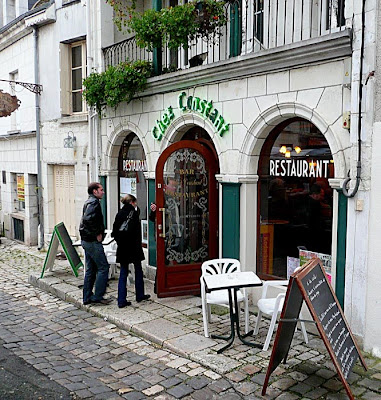
Chez Constant has a nice old bar in the front room
and a big dining room in the back.


Anyway, the curried turkey morsels were good but it was a dish I could easily make at home. I feel more and more that way about restaurant food these days. It's expensive and I can make the same food for a much lower cost at home. The main point of going to a restaurant is to spend time socializing with people whose company you enjoy. And of course restaurants are very useful when you are traveling.

So what's happening with restaurants and taxes in France? Until about six months ago, the value-added tax — VAT in English, TVA in French for Taxe sur la Valeur Ajoutée, the kind of sales tax you pay here in Europe — was something like 20% on restaurant food. Full-service restaurant food, that is. The VAT charged on fast food, like McDonald's hamburgers, was only 5.5%. I'm not sure why or how the discrepancy came about.

Le Mange-Grenouille's courtyard is set up
as an outdoor dining space in summer.


About 6 months ago, the French government — President Sarkozy took credit for it — decided to reduce the tax on "slow" restaurant food to 5.5% as a measure designed to lower prices for consumers. Restaurants were not required to lower their prices, but were encouraged to do so. Some restaurants said they would rather pay their employees better salaries, for example, with the extra money they would make by maintaining their prices and paying less in taxes.

Now the government has expressed its displeasure at the way restaurant owners have dealt with lower tax. Prices have not come down as much as it had hoped. Are owners just pocketing the profits? There is at least an implied threat that the VAT on restaurant food will be put back to the old, high level. It still seems like it would be fair to tax all kinds of restaurants at the same rates, doesn't it?

Le Mange-Grenouille's set-price menus —11.50 or 14.00 € at
noon, 19.50 € for dinner, with a children's menu for 8.80 €.
If you just have the plat du jour at lunch, it's 8.50 €.


Does the government want a policy that encourages people to eat in fast-food restaurants rather than full-service restaurants? I hope not. I know governments like Sarkozy's don't want to be seen as raising taxes, so maybe they thought that lowering taxes on traditional restaurants was the only way to level the playing field.

Bringing the tax rate on fast food up to the rate paid by other restaurants was probably not ever in the cards, but maybe a compromise rate could have been found. What about 10% or 12% on all restaurant food?

Whether it was intended or not, you can see how consumers might think that full-service restaurant owners and operators are trying to get away with something. They are paying lower taxes now, but not lowering prices. Are they gouging the consumer? At the same time, the big fast-food chains are unsullied — they haven't had to make any changes.

All this can't be good for the traditional French restaurant business. Whether by design or inadvertently, the government appears to be encouraging the growth of the fast-food industry in France. That's too bad.

15 December 2009

Saint-Aignan's Père Noël

When you come into Saint-Aignan from the north this time of year and cross the bridge, the most brightly colored thing you see is Father Christmas. Okay, it's a plywood cutout, but it is boldly painted.

Santa, a reindeer, and an elf in Saint-Aignan

Santa Claus, or more correctly Le Père Noël, has an interesting face and a toothy smile.

How jolly can he get?

If you look up above Père Noël's head and over the rooftops of the houses behind him, you see the back side of the Château de Saint-Aignan.

The Château de Saint-Aignan looms over the town...

And if you look left, up the main street leading into town, you see the tall tower of the church high above the rooftops.

...as does the church

The weather is literally freezing, but there's no more talk of snow. It's beginning to feel a lot like Christmas anyway.

P.S. The weather forecast has now changed. They are predicting snow here and all around on Thursday and Friday. Maybe we will have a white Christmas this year.

14 December 2009

Chez le volailler

The market in Saint-Aignan is usually held on Saturday mornings, and it operates year-round. Sometimes in summer and on holiday weekends there are more vendors than at other times, and once in a while a vendor will take some time off and be absent for a week or even two, but otherwise most of the same stalls are open every Saturday.

At Christmastime, the market is often rescheduled to match up with Christmas Day and New Year's Day. This year, for example, instead of a market on Saturday, Dec. 26, the market will be held on Thursday, Dec. 24 for Christmas Eve. And the same schedule will hold for Dec. 31 — a market that day but not on Sat. Jan 2. It's pretty convenient, and I'm sure it's more profitable for the vendors that way.

Chickens, ducks, and rabbits at one of the
poultry vendors' stands in Saint-Aignan


Saint-Aignan's is not an enormous market. It's smaller than the ones at Selles-sur-Cher on Thursdays or Amboise on Sundays. The vendors present, though, cover the spectrum of food needs for the people of the town and surrounding area. There are at Saint-Aignan half a dozen vendors selling fresh fruits and vegetables; two poultry stands that also sell spit-roasted chickens, rabbits, and pork roasts; four pork butchers selling sausages and pâtés as well as fresh cuts of meat; one butcher selling other meats; one full-service cheese stand plus two or three vendors selling the local specialty, goat cheeses; and finally, one big fish and shellfish stand.

Rolled, tied, and larded roasts of turkey (dinde),
guinea fowl (pintade), and duck (cane or canard)

I've probably left a few vendors out. In fact, I don't want to forget the local mushroom lady, who is always there. There are also a couple of bakers selling breads, cakes, and pies. And there's a man who sells escargots — snails — and another who seems to specialize in apples. I'm sure I've still forgotten two or three of the smaller local vendors, who sell produce from their own gardens and goat cheeses they make on the farm. Recently, there's also been an Asian food stand where you can buy spring rolls and pre-cooked noodle or rice dishes.

Rabbits, a goose, a rooster, and some little pigeons for sale

A lot of the vendors come in special market trucks that open up into full display cabinets and counters, where you can view all the products for sale. I took pictures of a few of these on Saturday to post here.

We ordered our goose. The woman who took the order wrote it down in a notebook where a lot of other orders had already been recorded. We knew from the price list that a goose would cost 8.50 €/kg (a little less that 4.00 €/lb. — that's not quite $6.00 U.S. at current rates) but we didn't know how much one weighed. The woman said they went from 3 kg up to 10 kg.

Market trucks that open up to reveal refrigerated display cases

We told her we needed a small one because it was basically just for the two of us. She pulled one out of the display case and said it was a fairly small one. She weighed it to give us an idea — it was nearly 5 kilos. I hope we'll get one smaller than that, but we'll take and pay for what we get.

If the goose is really big, I'll probably cut off the legs and cook them separately in goose fat to make what's called confit d'oie. Then I can use the confit later with dried beans to make a cassoulet. We'll cook the breast and wings for Christmas dinner, with chestnut-sausage stuffing and some Brussels sprouts. Maybe I'll make some biscuits using duck or goose fat instead of butter, to go with it.

Another market truck selling fresh and cured pork products

P.S. I just stepped outside to get our daily baguette from the bread lady and saw that we actually got a dusting of snow overnight. The bread lady told me that we should start putting some bread in the freezer so that if it snows and she can't drive up the hill to our house, we won't have to go without. She doesn't know about our biscuit and pizza baking skills.