10 December 2005

Memories of summer food

To make up for all the talk of ducks and mutton, I thought I'd put in a recipe for something more vegetarian, and more summery. I have to thank Peter Hertzmann for this idea (see Peter's web site for many other great ideas about French cooking and eating).

We grow eggplant, zucchini, bell peppers, and tomatoes in our summer vegetable garden. Those are most of the ingredients for ratatouille, a Mediterranean speciality in which these vegetables (along with onions, olive oil, thyme, and garlic) are cooked together on top of the stove until they break down completely and the flavors blend. Some recipes call for mashing the vegetables in a mortar when they are done.

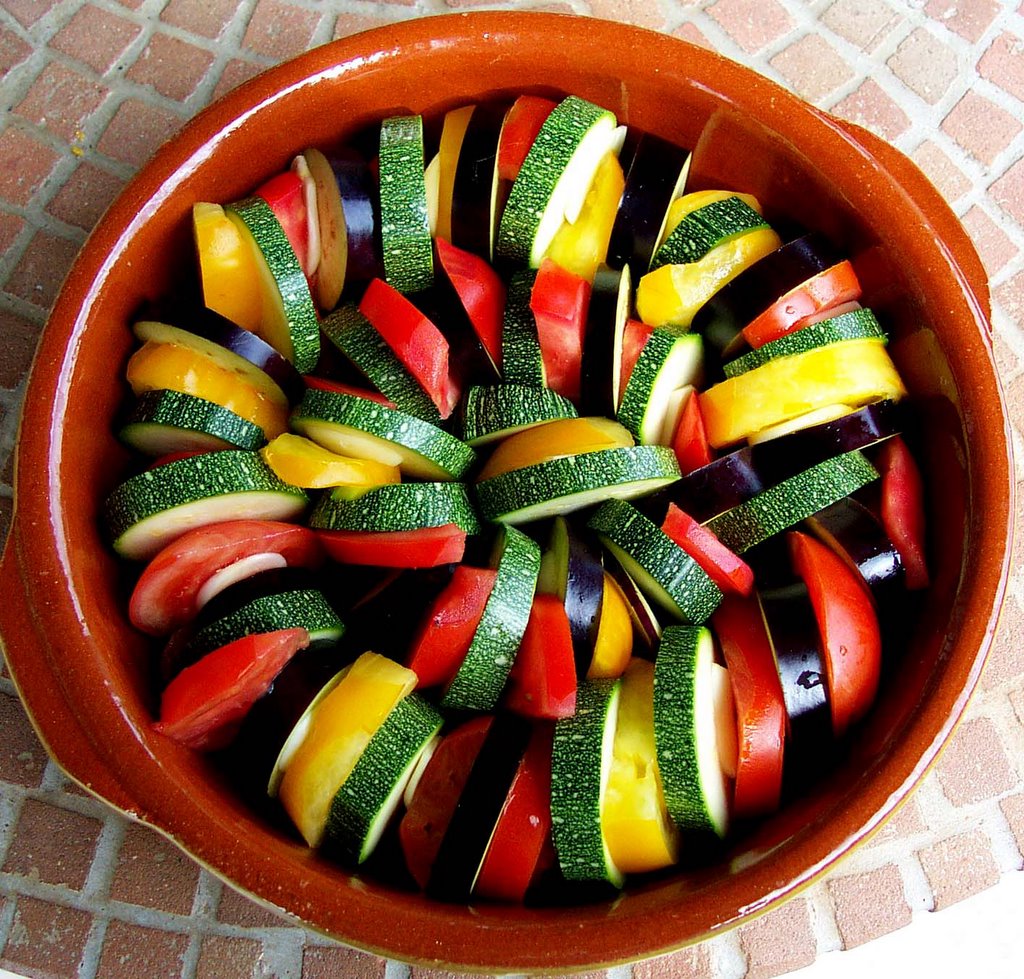
Here's a way to make ratatouille in the oven, preserving the shape and texture of the different vegetables but getting good flavors at the same time. Cut eggplants, zucchini, and tomatoes into round slices. Arrange them in an oiled baking dish so that the slices are standing on end. Here I have red and yellow tomatoes, but all red tomatoes is fine of course. Add slices of bell peppers, red or green, if you want. Pack the dish pretty tightly. Alternate eggplant, zucchini, bell pepper, and tomato slices so that you have a good mixture.

When the baking dish is full, thinly slice a couple of cloves of garlic (more or less to taste) and insert the garlic slices between the vegetable slices so that garlic is spread all through the dish. Sprinkle on salt, pepper, and thyme to taste. Put in a couple of bay leaves if you want. And then drizzle olive oil over the whole thing.

Mid-way through the cooking (or done, if you like it this way)

Put the dish in a medium oven (325ºF -- that's 160ºC) for an hour or more, until all the vegetables are cooked and the kitchen smells like Provence. Serve hot, warm, or cold.

This looks cooked to me.

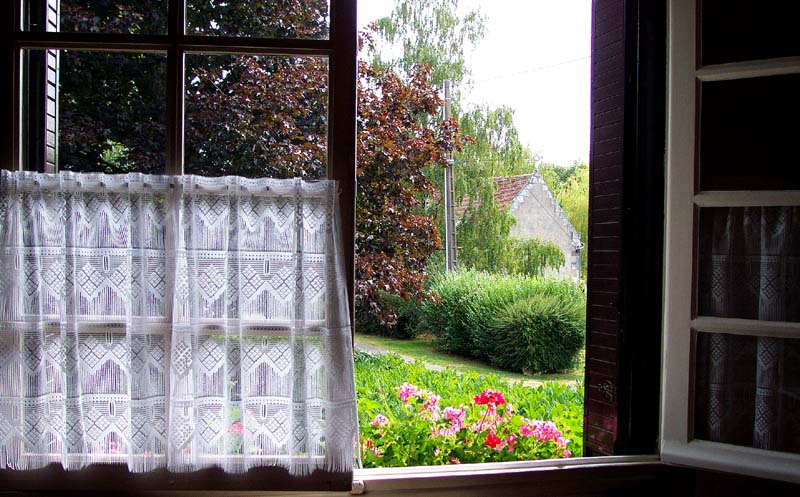
Here's a view out of our kitchen window in summertime.

09 December 2005

The mutton caper, Part Un

At Thanksgiving Walt asked our friend Gisèle, who keeps sheep and geese and parakeets and cats and a dog at her place on the other side of the village, along with a big vegetable garden, if she planned to kill a lamb this winter. Two years ago, she had one slaughtered and we bought half of it from her, all prepared for cooking or freezing.

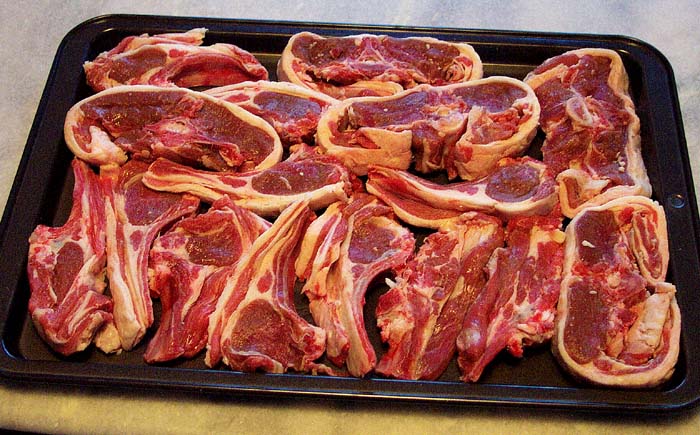
A leg to roast, a shoulder to roast or stew, a big freezer bag full of stew meat, and plenty of ribs and chops — that was the take. And the price was right. More importantly, the meat was delicious. When we bought it, she said to be sure not to cook it or put it in the refrigerator or freezer for about a week, but just to keep it in a cool place so that it could age, or ripen, or whatever. That seemed strange to us, even though we know the best meat is aged. We followed her advice, and the result was excellent.


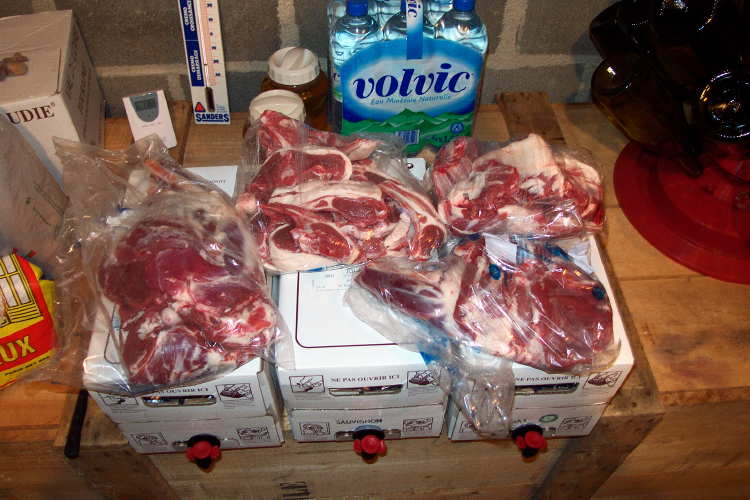
The freezer bags full of lamb aging in our cellar,
on top of the boxes of wine, in December 2003


This year, Gisèle said yes, she was going to have the rest of her sheep slaughtered and replace them with new stock. We signed up to buy another half -- is that called a side in English? it's a moitié in French -- but it means that this year we will be getting mutton rather than lamb, I think. I hope it will be good. I know we can make stew out of a lot of it, or make curries -- Walt brought back some cans of curry powder from London in September when he passed through there on his way to New York to visit his family. I suppose we can run some of the meat through the grinder and make moussaka -- we have eggplant and tomatoes in the freezer from last summer's vegetable garden. We also have the big new freezer.

And I have a recipe all planned out in my head for the gigot, the leg roast. It's called a gigot de sept heures -- seven-hour leg of lamb ( or mutton). I saw Eric on CuisineTV do it a couple of weeks ago. You brown the leg and then put in it a pan with some vegetables including onions, garlic, and carrots, some herbs of course, and you roast it in a slow oven, covered, for seven hours (hence the name). When it's done, it's falling off the bone, succulent (moelleux, in French), tender, and tasty.

Last Friday, we went over to see our friend Brassia in the village called Mesland (that's may-LAW[N]), up on the Loire about 30 miles north of here. She had invited us for lunch. Brassia is a great cook -- her father was Senegalese and her mother Vietnamese, so she cooks West African and Southeast Asian dishes that you don't see much out here in the French countryside. She does catering. She and her husband Gilles moved here from Paris about five years ago. He sells real estate now, and they also rent out a gîte rural, a vacation rental that is a house on their property there in Mesland, which is a famous wine village.

Well we were talking about food and we mentioned the side of lamb or mutton that we will be getting from Gisèle. Brassia's ears perked up and she immediately asked if we thought she might get in on the deal. We told her that Gisèle had said she was planning to have all her sheep slaughtered this month, so it seemed like a possibility and we would ask. We didn't really know how many sheep Gisèle had, but it seemed like we had seen half a dozen or so out in the pasture.

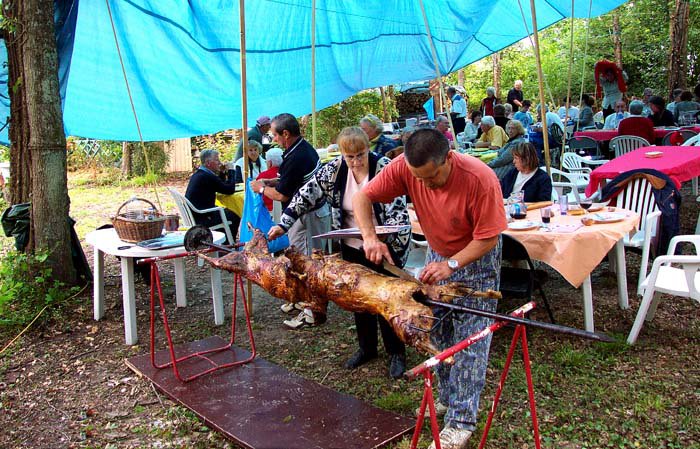
By the way, last summer Gisèle and her S.O. (concubin, in French) Jean-Luc had thrown a big barbecue known as a méchoui, which is a North African term for a spit-roasted lamb. They had had two lambs slaughtered then and they roasted both of them for a crowd of about 50 people.
The méchoui at Gisèle's last summer

We were lucky enough to be invited. Here's what it's like here: we remarked to Gisèle (she's 75 years old) that the méchoui lamb was delicious. She said, oh yes, that's Madeleine (or some such name). We were eating a lamb that she had named and petted and adored. And it was delicious.

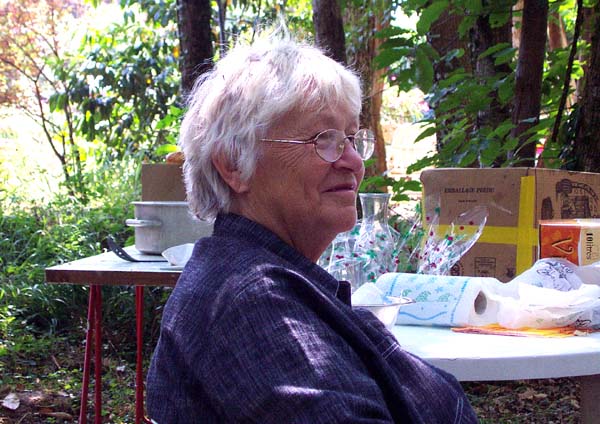
Notre amie Gisèle
Gisèle stopped by night before last just to say hello. One of the first things she wanted to talk about was something that had her very upset.

She had misplaced and had been turning her house upside-down searching for a cherished book of recipes for making jams and jellies. She was very upset that she couldn't find it. Well, we said, it's a good thing you mentioned it, because it's here, and here it is. Walt had immediatly run and got it. She had loaned it to us about three weeks ago, and even though jelly-making season is over, we had taken it because she insisted. Then she had forgotten the whole incident, obviously. She was so thrilled to get her book back that she had tears in her eyes, and she hugged us and kissed us both on the cheek.

Then we asked her whether it would be possible to get a whole lamb or mutton carcass for Brassia. She said her animals were all spoken for, but she would talk to the man who does the slaughtering and butchering, because he keeps livestock too. When she left our house after about 30 minutes, she forgot her purse. We called her cell phone to tell her we had her sac à main, and Jean-Luc answered. He was in his car on his way home, and he said he would be there in 15 minutes or less. He expected Gisèle would be there too. We said we'd drive over with the purse.

When we got there, Gisèle was happy to have her purse back even though she hadn't yet realized she had left it behind. Jean-Luc opened a bottle of Anjou white wine and we settled in for a little apéritif. Gisèle got on the phone and called her butcher friend to see about the lamb. He told her yes, he could supply the lamb, and the slaughtering and butchering would cost 30 euros. He wasn't sure about the price of the lamb itself until he picked one out and weighed it. We finished our apéro and drove back home to watch Star Trek on TV.

Driving to Gisèle's, by the way, we rode out through the vineyards behind our house and startled a couple of deer out there. And over closer to Gisèle's, on the other side of the village, we saw at least half a dozen more deer in the fields. I was surprised to see them out so early in the evening. They are very pretty when you catch a glimpse of them in the car headlights, and it reminds you that you really do live in the country.

Yesterday, Gisèle stopped by at lunchtime to give us the news about the meat. Our friends Adrienne and Jean, who live near Amboise, were here for lunch. They've met Gisèle before, so it worked out nicely. I asked Gisèle to stay for lunch, but she hesitated. "Qu'est-ce que vous allez manger?" she said -- "What are you having?" -- and everybody laughed. She was a little embarrassed, but just a little. I told her I had made a North Carolina lunch -- vinegary Eastern N.C.-style barbecued pork, a pan of cornbread dressing, and some collard greens. She said no, she wouldn't stay for lunch, but she would be glad to take home a piece of the cornbread dressing if I didn't mind. I wrapped a big piece up in foil and gave it to her. "C'est tout chaud!" she said -- "It's hot!" I had just taken it out of the oven.

It turned out that the price of the lamb is 100 euros. The animal weighs 40 to 50 kilos -- that's 90 to 110 lbs. That's on the hoof, of course, so there will be less meat than that, but it's a good price for farm-raised, fresh mutton. I immediately called Brassia to see if 130 euros (about $150 at today's rates) sounded OK and she said of course. She has two children, a husband, two freezers, and a catering business, so she'll go through that much mutton in a hurry, I imagine.

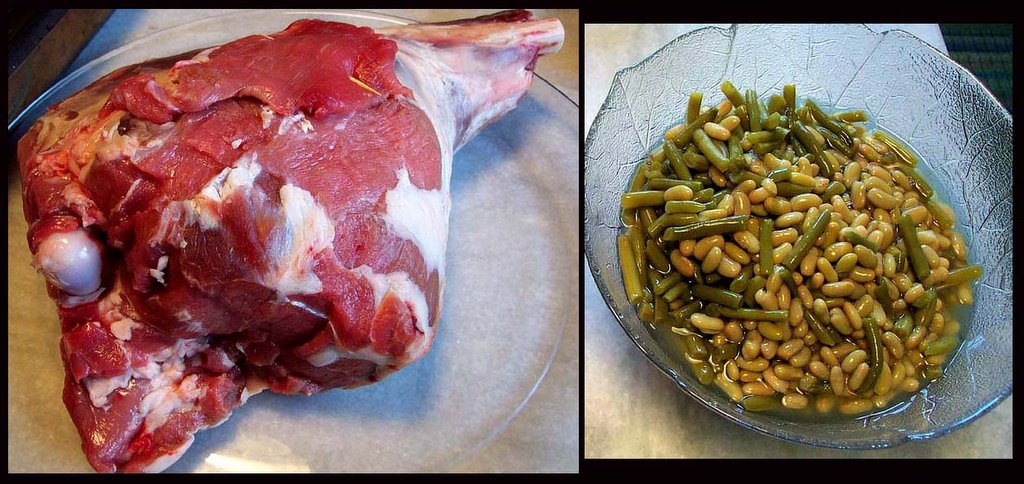
A gigot d'agneau ready for the oven,
with the classic flageolets on the side


Gisèle said that she needed us to bring her cash before Monday, and that she would also need some big freezer bags to put everything in. In addition, she said that she would need us to put some of the lamb skin and other débris into big garbage bags Monday evening and get rid of it for her. We said Tuesday is garbage day for us, so that will not be a problem.

Oh, the other thing Gisèle had news about was some wine she had "scored". The same man who keeps and slaughters and butchers livestock, it turns out, makes wine. She had just gotten some and had brought over a five-liter jug of it so that we could taste it. She said it was rosé wine made from Sauvignon Blanc grapes. Now normally you need red grapes to make rosé wine, so rosé made from white grapes seemed like a novelty. She said we ought to taste it, it is really good. Walt wondered if she could tell us where she got it, and she said it was a secret. If we wanted some, she could buy it for us.

We poured some of the wine out of the jug and into a pitcher, and then served five little glasses so everybody could taste. It wasn't rosé at all, but white of course -- Sauvignon Blanc is a white grape (comme son nom l'indique, as they say in French). But Gisèle persisted in saying it was a rosé wine. Whatever the color, it was pretty good. It had a very slight fizz, it was dry and clean-tasting, and it was sufficiently fruity. It cost less than two euros a liter -- that's about $2.00 a bottle. We said we would take 10 liters, and I went downstairs to the cellar and got her a 10-liter jug that she could have the guy put it in. Gisèle was clear that we couldn't keep the jug she had brought over -- that was hers. She gulped down her little glass of it, and then I asked if anybody wanted a second taste because there was still some in the pitcher. Gisèle said we were doing more than a tasting at that point, so I did really little pours and then poured the remainder of the "rosé"out of the pitcher back into her plastic jug. We carried her jug, ours, and some other things out to her car and she drove off -- hopefully not too tipsy, but with her square of cornbread dressing in one hand and her sac à main, this time, in the other.

06 December 2005

Making confit out of a duck

As I said, I have lots of free time these days. I spend much of it preparing good food, using local products or good-quality products available at the local supermarkets. This fall, the Intermarché supermarket had ducks on special (en promotion) twice. The first time, it was canettes (ducklings) — smaller, leaner birds that are good for roasting or poaching.

A couple of weeks later, Intermarché had canards gras (fattened ducks) en promotion. These are the ducks that have been fattened up so that their liver will make a good foie gras. After the livers have been "harvested," the duck carcasses are sold off at good prices.

I got a flyer in the mail one Monday saying Intermarché would have the canards gras on special starting the next day. So I drove over there the next morning and stood in a long line at the butcher counter. The butcher seemed to have a long-standing personal relationship with every one of the five or so people in line ahead of me. He chatted with them all, sharing and enjoying a lot of banter and local gossip. I must have waited in line for 20 minutes.

When my turn came, I held up the advertising flyer and told the butcher that I wanted a canard gras. « Désolé, monsieur, il n'y en a plus. J'ai tout vendu. » They're all sold out. « Déjà ? » I exclaimed. I think there was a little edginess in my voice. This wasn't the first time I had gone over to Intermarché on the first day of a sale, only to be told on arrival, and usually after waiting in line for a while, that the item advertised en promotion was already sold out. "I drove all the way over here just for the duck, and now you tell me they are already all sold," I complained. I didn't tell him it was only a five-minute drive. "We might get some more in tonight, but I can't guarantee it," he said. "You can always call me in the morning to see if I have any." I bought some other things we needed, but I left the store unhappy, muttering to myself that I would just have to stop shopping at Intermarché.

The next day I had some other reason for going over to Noyers, where the Intermarché store is located. So I stopped in to see if the ducks had been restocked. I got to the butcher counter and the same butcher was on duty. He was waiting on a woman that he seemed to know (my first clue: they said tu to each other). When he saw me walk up, he looked startled. He dropped what he was doing and spoke to me. « Bonjour, monsieur. Qu'est-ce que c'était que vous vouliez — des magrets ? » What was it you wanted, duck breast? I told you to call me to see if... No, I said, I wanted a canard entier — a whole duck.

"Oh, we got some in this morning..." he was saying when the woman he had been waiting on said « Eh moi, alors ! Tu m'oublies comme ça? » Have you forgotten all about me? The butcher blushed and went back to waiting on the woman. She and I looked at each other and smiled.

When the butcher came back to me, he said, "Look at these ducks. Look how beautiful they are. Are you sure you just want one? They are ready for the freezer. And we won't be getting any more." It worked: I bought two. He wrapped them in butcher paper for freezing.

So that's how I came to have two ducks that are perfect for making confit de canard, one of the prime ingredients in cassoulet. I made confit out of one of them over the past few days. I was surprised when I saw that the ducks I was buying still had their heads on them. That is one way the seller makes sure you know what you are buying. They were definitely ducks, as you can see.

Un canard gras, avec tête

"Few days?" you're wondering. Well, yes. I started early Saturday morning, and I finished late Monday afternoon. Making confit is a way of preserving duck (or goose or pork or turkey) so that if will keep for months in the refrigerator or a cold cellar. You cook the meat slowly in fat and then you cover it in the same fat so that it is sealed and protected from the air. Sealed that way, the meat improves with age — at least for a few months. Before refrigeration and freezers, making confit was a way to make sure you had a winter's supply of good meat.

Don't get squeamish about cooking the duck in fat. Just think of fried chicken. It's cooked in fat. But it's coated in bread and flour that absorb the fat, and that you eat. The duck doesn't absorb the fat like fried chicken does. And think about ground beef — hamburgers — that is 20% fat in the U.S., if not more. Not to mention fries, chips, sausages, donuts, and ... should I continue? I'd rather have duck confit.

Besides preserving it, cooking the duck in duck fat also gives it great flavor and texture. You start by cutting the duck into pieces and marinating it for hours or days. I marinated this one for 48 hours.

The first step is to cut up the duck. I cut off the head and put it in a ziploc back in the freezer, so that I could throw it away on garbage day (Tuesday). I also saved the neck in a ziploc bag in the freezer, thinking I would make broth with it one day and then pick off the meat for Collette.

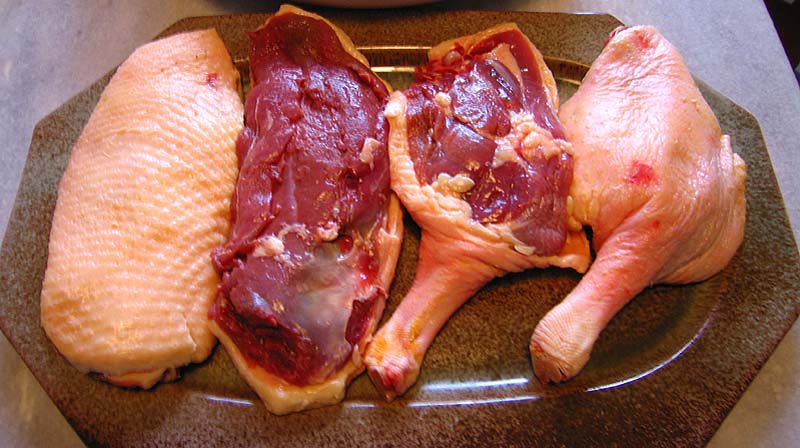
Once the duck was was cut up, I ended up with two (large) breasts, two thigh/leg pieces, and two wings (the first joint, which has some meat on it). I trimmed the extra fat and skin from around all the pieces, but I didn't entirely remove the skin.

Trimmed duck pieces

The next step is to take all the fat and skin that you trim off the duck pieces and the carcass and to render it out. Put all the fat in a pan with about a cup of water and set it on low heat. Let it simmer for an hour or more, covered. Then remove the rendered pieces with a slotted spoon and set them aside. Pour the liquid fat through a strainer to make sure it's all cleaned up. You can make cracklings with the duck skin, but that's another story...

While the fat is rendering, prepare a marinade for the duck pieces that will become confit. Chop up an onion or two, or an onion and a shallot. Thinly slice a couple of big garlic cloves. Prepare a dozen or so black peppercorns, and a dozen or so allspice berries (if you have them). Instead of allspice berries (known as piment de la Jamaïque in French), you can use three or four whole cloves. Add some thyme and three or four good bay leaves. Most importantly, rub all the duck pieces with a good quantity of gros sel — coarse salt. In France, they will always tell you that the best salt is sel gris, unrefined sea salt that is gray in color because it hasn't had all the good minerals refined out of it. Sel de Guérande, a famous place on the Atlantic coast of France, is highly recommended. This is a dry marinade. I did mine in a ziploc bag this time, and I put it in the refrigerator for two days.

This was a canard gras, a fattened duck, and it had a lot of fat on it. Once it was rendered, I had about two cups of pure duck fat. I wasn't sure that would be enough for the cooking process, but I also had two small jars of duck fat that I had bought at the market (you never know when it might come in handy, and it keeps indefinitely). Also, I had saved the fat from another duck I cooked a month or so ago, and that was about two cups. So altogether, I had at least six cups (1.5 l) of duck fat I could use to cook and preserve the duck in. That seemed like a good amount. (I know, most of you are thinking you would never do something like this — but then you don't live in France!).

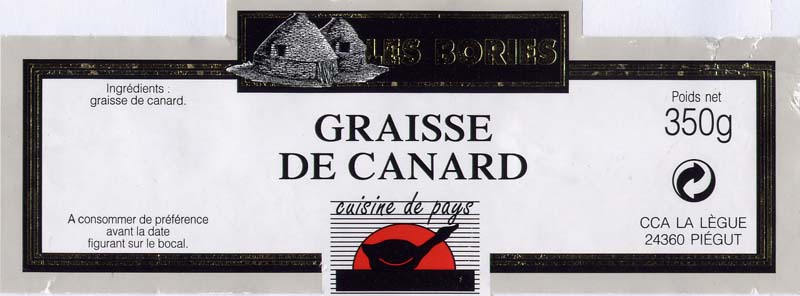
Jars of duck and goose fat are sold at Intermarché and other French supermarkets. You can use it to sauté potatoes. You can add a little bit to vegetables in the place of butter or olive oil as a seasoning. You can baste a roasted chicken with it. I put a tablespoon of melted duck fat in my cornbread batter before I bake it, for example. It gives good flavor.

Label from a store-bought jar of graisse de canard — duck fat

After the duck pieces have marinated for 12, 24, 36, or 48 hours, wipe them off to remove the peppercorns, allspice berries or cloves, and the excess salt (if it hasn't all melted). Get rid of the chopped onion, shallot, and garlic, and the bay leaves. Put the duck pieces in a pot or dish and cover them with melted duck fat (the six or more cups of it you've saved or bought). Add some "fresh" peppercorns, allspice berries, and bay leaves if you want, and throw in about 10 unpeeled garlic cloves. Put the pot on the stove (or the dish in the oven) and cook it slowly for several hours — some recipes say 12 to 24 hours, but that seems excessive to me. I cooked this batch for about 6 hours on top of the stove, at the lowest temperature. If you put it in the oven, set the temperature at 200ºF or even 180ºF (85 to 100ºC). When the duck is done, remove the pieces from the fat.

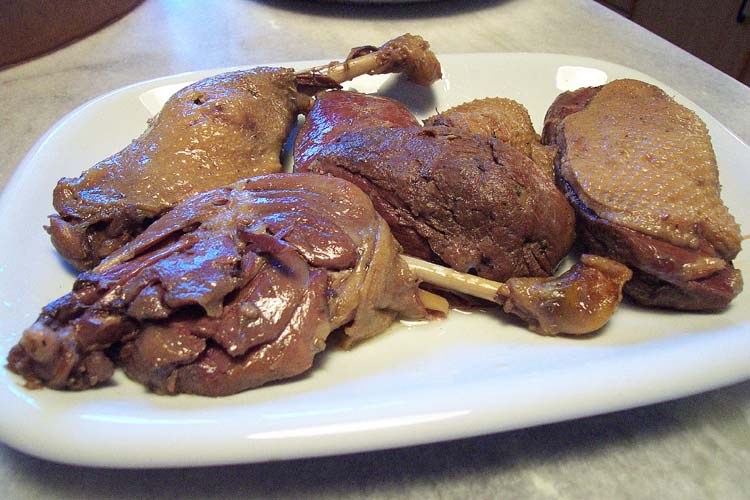
Canard confit

Put the pieces in a deep dish. Strain the fat to remove the peppercorns, allspice berries, bay leaves, and garlic cloves. Pour the fat over the cooked duck pieces. Make sure they are completely covered and protected from the air. Save the garlic cloves, which are also confits at this point — squeeze the garlic flesh out of the husks and eat it on bread, crackers, or toast. Yum. Store the confit for weeks or even months in the refrigerator or some other cool place. It's better if you keep it for two or three weeks before you eat it. Store the duck fat, too, and use it when you are cooking or seasoning vegetables.

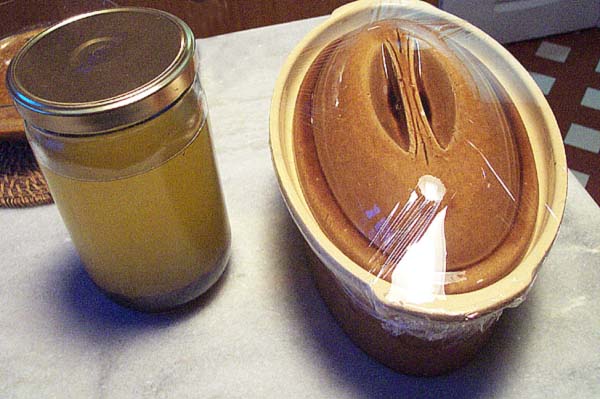
A jar of duck fat and a crock of duck confit

When you're ready to eat the confit, you can heat up the crock in the oven (at low temperature) or in the microwave (on low) to melt the fat. Then remove the pieces you want to serve and let the rest cool down again for storage in the refrigerator or cellar. Drain the fat from the pieces of duck by setting them on a rack or on paper toweling, and then heat them up in the oven or on the grill. Serve them with salad, a green vegetable, or sauteed potatoes or carrots or turnips. Or with beans. Why not make a cassoulet?

04 December 2005

About Saint-Aignan

What kind of town is Saint-Aignan-sur-Cher? What’s it like to live nearby and have Saint-Aignan as your main "urban" center?

Saint-Aignan itself has a population of about 4,000. But the town just on the other side of the river Cher, called Noyers-sur-Cher, is home to 3,000 or so people. And there are a couple of villages -- Mareuil and Seigy -- on either side of Saint-Aignan that have about 1,000 residents each. In all, the Saint-Aignan/Noyers ‘metropolitan’ area -- l’agglomération, in French -- must number about 10,000 inhabitants.

So how do you pronounce Saint-Aignan? Just the way it sounds, ha ha ha. Seriously, saint in French sounds like sant. Aignan is pronounced ay-NYAWN. Well, except you don't really pronounce the final N -- the third syllable is a nasal vowel. But to get it right, you have to say the T of sant as the first sound of the first syllable of Aignan. You end up with something like san-tay-NYAW[N]. Easy, no? How about Noyers? That would be nwah-YAY. Seigy is say-ZHEE. Don't even ask about Mareuil. In all cases, the sur-Cher suffix is pronounced syur-SHEHR. Cher is Cher as in Sonny and Cher, in other words.

There are three other towns of about 5,000 people within 10 miles of san-tay-NYAW[N] (keep practicing). To the east, Selles-sur-Cher (famous for goat cheese). To the north, Contres (a farming town). And to the west, Montrichard (a lively town dominated by a medieval fortress). Amboise, Blois, and Valençay are all within 25 miles. So Saint-Aignan (known for its zoo and its Touraine wines) is not isolated.

We live about 2 miles from the main square in Saint-Aignan. We are in the country, but we are very close to everything we need in order to sustain our daily life. We normally drive to san-tay-NYAW[N] or nwah-YAY for groceries and other shopping, but we could also easily ride our bicycles or even walk, depending on the weather. That's not to say that we do either very often.
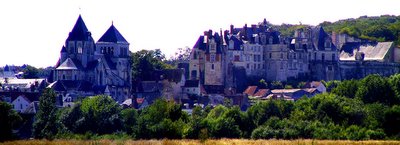
The church and château at Saint-Aignan-sur-Cher

Saint-Aignan itself is built around the base of an enormous château. The original château was a fortified structure built about the year 1000 A.D. Ruins of some of the old towers are still visible. But the main part of the existing château dates from the 1500s or even 1600s, the French Renaissance. That part of the château complex is not fortified. It’s more like a huge mansion than it is a fort. It is still privately owned and the owners live in it. It is not open to the public, but you can go up onto the grounds and into the courtyard to enjoy great views of Saint-Aignan's rooftops and the Cher river valley below. There's also an enormous old church, as you can see in the picture above. There are more pictures on my photo site, and here's a map of France showing where Saint-Aignan is located.

The old part of Saint-Aignan is right on the banks of the river Cher. There are old narrow, winding streets and there are quite a few ancient houses and buildings. There is a single bridge across the river, and it’s a stone structure that has to be hundreds of years old. Here's a series of pictures of places in and around Saint-Aignan.

There’s a main street that runs from the bridge up through town, heading south towards a town called Le Blanc and then on to Limoges (more than 100 miles south). The zoo, which is a big attraction and actually very impressive, with lots of animals and birds from all over the world (including a pen full of raccoons), is south of town on that road.

In central Saint-Aignan, the main street and a semi-pedestrian street that runs perpendicular to the main street are lined with a dozens of businesses. Saint-Aignan has everything you need. In the middle of town, there are:
  • a post office
  • a library
  • a municipal swimming pool
  • four boulangeries/pâtisseries (selling breads and pastries)
  • three pharmacies
  • three grocery stores, including one that specializes in organic products
  • three butcher shops, including one horsemeat butcher
  • two charcuteries (French-style delicatessens that sell pork, sausages, pâtés, salads, and prepared dishes like stews and cooked vegetables you can reheat at home)
  • six or seven restaurants
  • seven or eight cafés
  • two hotels
  • one bookstore
  • one newsstand
  • a half a dozen banks
  • an appliance store
  • an electronics store
  • a hardware/building supply/do-it-yourself store (south of town, actually)
  • two florists
  • five or six clothing and shoe stores
  • four or five gift shops
  • three or four insurance agencies
  • five or six hair salons
  • an optical shop
  • several doctors' and dentists' offices
  • two driving schools
  • three antique/junk shops

And on Saturday mornings there are two outdoor markets in Saint-Aignan. The farmers market is on the central square in the old town, and the vendors include a big fish monger, three pork butchers (charcutiers) , a butcher and a horsemeat butcher, two poultry stands that also sell spit-roasted chicken, rabbits, and pork roasts, two cheese merchants (one sells just goat cheese made on his farm), and four or five fruit and vegetable stands. There's a woman who sells the mushrooms she grows on her farm, a man who sells snails (alive or cooked), a woman who sells produce, cheeses, and eggs from her farm, and a man who sells flowers, potted plants, and seedlings for your garden in the spring.

On the main square in the newer part of Saint-Aignan (5 minutes' walk from the farmers market), there's a Saturday market where you can buy clothes (picture), shoes, table linens, curtains, and other dry goods. On special occasions (two or three times a year), there are big town-wide flea markets with stalls set up all along the main streets and squares. On those days, you can find a great deal of everything you could ever think of to buy, from arts and crafts to cars.

In Noyers, there's a farmers market on Sunday mornings where many of the same vendors sell their products. Ten miles distant, Selles-sur-Cher has a big food and dry goods market on Thursday mornings, Contres has one on Friday mornings, and Montrichard has its own on Monday afternoons and Friday mornings. A little farther afield, Amboise (20 miles away) has a huge market on Sunday mornings -- one of the largest in the region or even in France, they say -- as well as a smaller food market on Friday mornings, and Valençay (15 miles away) has one on Tuesday mornings. I won't even mention the markets and supermarkets in Tours (pronounced TOUR) and Blois (BLWAH), where we go to shop just a few times a year. And in the town of Loches (say LUSH), just 20 minutes southwest of Saint-Aignan by car!

Within four miles of our house, besides all that, there are four supermarkets, two in Saint-Aignan (Ed and SuperU) and two across the river in Noyers (Intermarché and Champion). There is smaller grocery store, plus a post office, two bakeries, a café, a library, a hair salon (Mme Barbier), a library, and a garage that sells used cars, in our little village, just on the edge of Saint-Aignan. In Noyers there are restaurants, bakeries, cafés, and all the other normal businesses a town might have, including four hotels that I can think of and a great truck-stop restaurant. There are several garages and car dealerships (Citroën and Renault -- the Peugeot dealer, Garage Danger, is in Saint-Aignan). There are a couple of service stations, and three of the supermarkets have gas pumps. There are three big hardware/building supply/do-it-yourself stores, and a big five-and-ten-cent-style store in Noyers. The train station, with service to Tours, Vierzon, and Bourges, is over there. There's also a computer store and there are four furniture/appliance stores.

What don’t we have? There is no cheese shop, and there is no fish market in the area. But the supermarkets have both, and so do the farmers markets, so good cheeses and fresh fish are readily available. There’s no auto supply store, though there is a new tire store. There’s no wine shop, but the whole area is covered with wineries where you can buy wine at retail, in bottles, boxes, or in bulk, and the supermarkets have big wine and beverage sections. Two other shops in Saint-Aignan, one a wine bar and the other a gift shop, sell wines also. There’s no office supply store, so you have to rely on the supermarkets or drive up to Blois (25 miles) or over to Tours (35 miles) for those products. There's a big shopping center south of Blois, about 20 miles from Saint-Aignan.

Mostly, what Saint-Aignan doesn’t have is traffic. The one bridge across the river can get a little backed up on Saturdays or in July and August when there are a lot of tourists around. But the backup might be 20 cars. It’s nothing, of course, compared to the traffic around Paris or big American cities. In fact, it’s nothing compared to the traffic in my home town in North Carolina, which you have probably never heard of. I was there last April and I was amazed at the number of cars on the big wide highways that have been built there. Everybody is going to the Wal-Mart SuperCenter or the Home Depot!

In our area here in the Cher river valley, there is what is called a route nationale that runs along the river connecting Saint-Aignan toTours (pop. 250,000), 35 miles west, and to Bourges (pop. 150,000), 50 miles east. The route nationale is a two-lane road. There is a main north-south route that links Saint-Aignan to Blois (pop. 75,000), 25 miles north. There is an extensive network of smaller two-lane highways linking towns and villages all around the area, and an even more extensive network of narrow country lane covering the countryside. The narrow country lanes often have no pavement markings (no center line, etc.) and are mostly too narrow for two cars to be able to pass each other easily. You have to slow down and pull a little off the road to the right when you meet an oncoming car.

We have a new toll road (autoroute) that ends at Noyers for now. It's a direct link to Paris, which is about a three-hour drive north. The extension that will connect us to Tours and beyond is under construction a will open in a couple of years. The toll to Paris is about $20.00.

The countryside is a little hilly, and the Cher river runs through a fairly wide and fairly deep valley. It's a couple of hundred miles long. At places there are cliffs along the river, but mostly there are just hills. Our house is a the top of a hill right along the edge of the valley, and we are about a mile from the river itself.

Most of the housing is single-family dwellings, with old townhouses in Saint-Aignan and Noyers, but there are several apartment buildings in each town. A lot of people have big lots -- an acre or two is not uncommon. And of course many people own a lot more land than that. Most of the land around here is devoted to vineyards and vegetable gardens. There aren't many cattle to be seen, though there are some horse farms.