04 November 2018

Two churches in Niort for a Sunday

These Niort landmarks are not ancient churches. The first one is the Église St-André. It was an important Romanesque edifice in the Middle Ages, and then it was drastically altered and enlarged during the Renaissance. Worse was to come: St-André was reduced to ruins during the Wars of Religion in the late 1500s. It was rebuilt and then enlarged again in the late 1600s. During the Vendée Wars of the late 1700s, at the time of the French Revolution, the church was used as a barn for the storage of livestock feed. Finally, St-André was again rebuilt between 1855 and 1863. It is considered to be a fairly faithful copy of a 13th century Gothic church. Thanks to French Wikipedia for the history.


The church below is called St-Étienne du Port. It was built in the neighborhood called Le Port, north of the donjon de Niort, on the other side of the river, where there was no church at the time, but only a small chapel. The people of the neighborhood protested the fact that they had to cross the river and go to churches in other neighborhoods. Napoleon III gave permission in 1853 for the construction of this new church. It was nearly 30 years later when land was acquired for the project by the bishop of the city of Poitiers, who personally borrowed the money to purchase it. Groundbreaking happened in 1893, and by 1896 the church walls were standing. During the excavations for the church's foundation, the tusk of a prehistoric woolly mammoth was unearthed on the site. The church's organ and bells were in place by 1902. Thanks to Wiki-Niort for the history.


I'm cooking sauerkraut for lunch today. I put the raw choucroute in the slow-cooker last night with white wine, onions, carrots, and spices. It looks and smells pretty good this morning. Now I just have to steam some potatoes, and Walt will cook some sausages and chicken on the barbecue as accompaniments. The weather is supposed to be spring-like today and until Wednesday, so we want to take advantage of it by cooking on the grill. Bon dimanche...

03 November 2018

The Vendée gîte : cette foutue poutre

If there were one thing that I could change about the Vendée gîte we stayed in, it would be this low beam at the top of the stairs that lead up to the bedrooms and bathroom. No matter how careful I tried to be, I banged my head on it 4 or 5 times over the course of the week we stayed there.


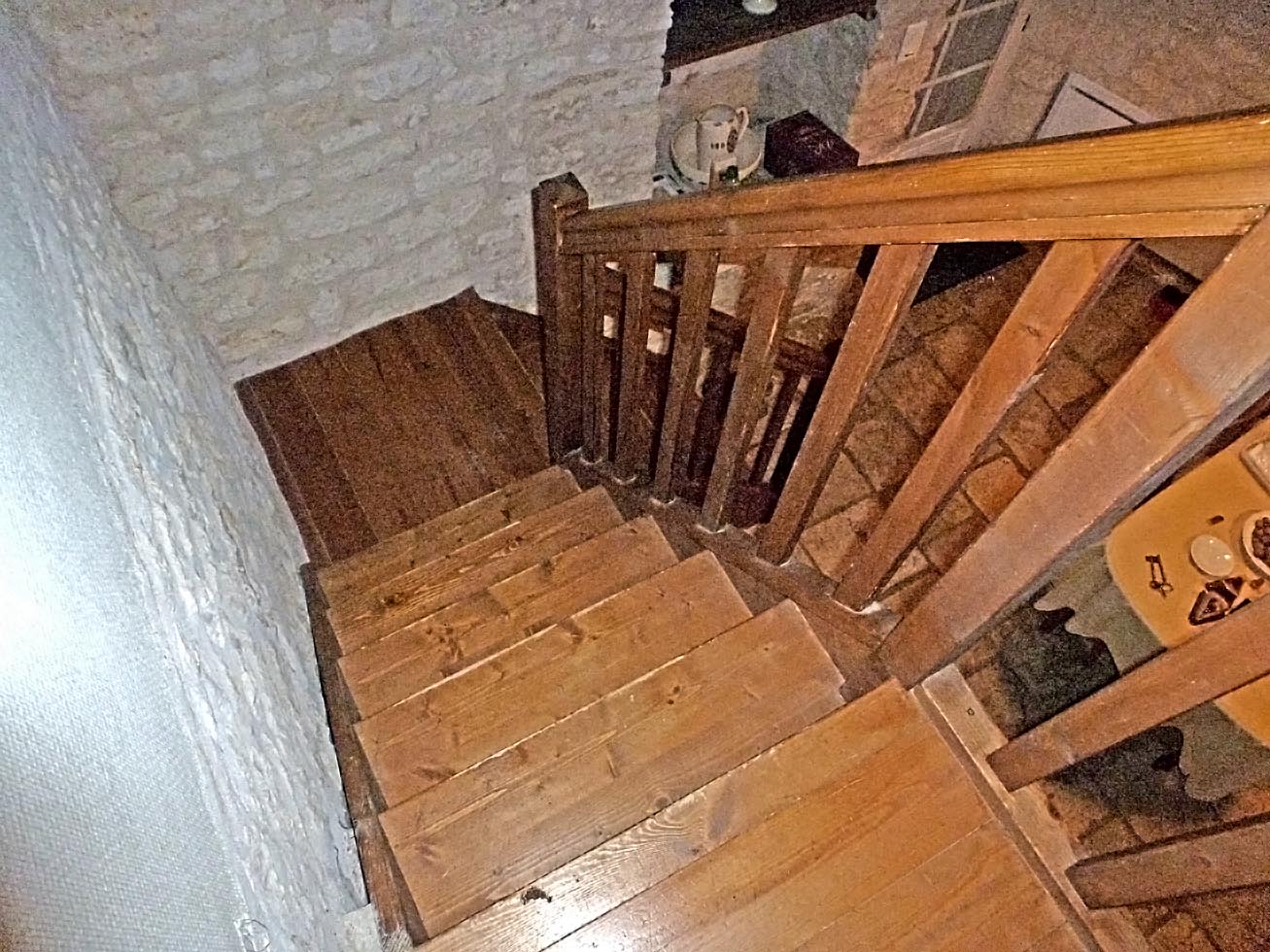
The beam runs across two rooms and the hallway. One of the  rooms is the second bedroom, where you surely noticed the low beam over the head of the bed in the photo I posted a couple of days ago. In the photo above, taken from the hallway, you can see through the stair rails down into the kitchen — those are the stairs. The beam is not much more than 5 feet — shoulder height to me — above the floor. The little yellow plastic tag hanging by a string off the beam helped me remember to duck, but if I got distracted... well, bang on the noggin.


And the beam ran across the bathroom, right in front of the shower area, at that same height. I'm not sure I hit my head on it more than twice, but the last one was on the last morning we were there as I was packing toiletry articles up for the trip home. I must have leaned over the pick up the two shower gel/shampoo bottles off the steps leading down into the shower, and when I stood back up I nearly knocked myself out cold.


It's too bad about the beam, because other than that hazard, the house was very pleasant to live in. It was quiet, spacious, and well furnished. Overall, we enjoyed being there (except for my aching head). The dog was welcome to stay with us. Above you see the stairs down from the upstairs hallway into the kitchen. The owner of the gîte is a very nice young guy who was very helpful in giving us information about the principal sights to see in the area. (He's also a major fan of U.S. football and watches a lot of games on TV.)


Finally, here's a Google Maps aerial view of the property, which is called Les Gîtes de Brillac. If you enlarge the image, you'll see my labels. That's the Vendée river, with its river walks, at the top of the photo, We stayed in La Petite Maison. The other gîte, called L'Etable ("The Stable"), was also occupied while we were there, by a French family from Toulouse. If we were to go back to Brillac, I'd definitely want to try staying in that gîte.

02 November 2018

The Vendée gîte : la salle d'eau et les W.C.

Here's the bathroom in the gîte. It was upstairs with the bedrooms. It was spacious, and there was a nice electric towel warmer on one wall. That was the only radiator in the house that we turned on during the week we were there. It was nice to have a warm towel to dry off with after the morning shower.


All the woodwork upstairs was beautiful, and the bathroom walls were nicely tiled. The upstairs floors, however, were just boards laid down and nailed or screwed to ceiling joists or beams, with no air space, insulation, or moisture barrier under them. It was noisy when the dog or Walt walked around up there and I was down in the living room, but no big deal. One morning, though, both of us were sitting in the living room, directly underneath the bathroom, and we suddenly started hearing a tap-tap-tapping noise.


At first I thought it was my laptop going haywire, but I quickly realized that the sound was being made by water dripping down from the ceiling and hitting the coffee table right behind the laptop screen. At least it wasn't dripping into the keyboard! I had just come downstairs after brushing my teeth. We raced upstairs to see if the water was running up there. Maybe the sink was overflowing. But no, it was just a small leak in the sink faucet. Water was running down across the sink counter and dripping onto the floor. Then it just went right through the floor and dripped into the living room. We were very careful about that faucet from then on, and we told the owner about it when we were leaving. He said leaks like that are always really hard to find and stop. The leak was minor and intermittent, seeming to depend on what position the faucet's control wand was in, and we didn't have any more trouble with it because we made sure to dry off the countertop after each use.


Here's the shower. It was definitely one of the most unusual features of the house. Because the bathroom is built under the slope of the roof of the house, there wasn't enough overhead space to put the shower in at floor level and still have enough headroom. So it was set down into the floor, meaning that the ceiling in the downstairs half-bath (les W.C.), right under it, had been lowered to accommodate it. By the way, there was no bathtub in the house.


So you had to step down three steps to get to the recessed shower pan. And it was a pretty tight space too, but we're used to that in France. These are the kinds of solutions you have to find when you are trying to install modern conveniences like plumbing, heat, and electricity in old stone houses like this one (built in the 18th century) and dealing with cramped spaces. Anyway, the water was good and hot and the pressure was fine. However, there was no light in the shower. Some light came from one of the bright halogen or LED bulbs in the fixture over the mirror and sink, across the room. It was strategically aimed.


This is what the downstairs WC, just off the kitchen, looked like. It was clean and functional. There was only cold water in the little sink, but the kitchen sink with hot water was just steps away. Both upstairs and downstairs baths had perfectly fine toilets. The biggest problem with the upstairs bathroom was actually a very low ceiling beam. I banged my head on it a couple of times as I was climbing up out of the shower. More about that tomorrow.

01 November 2018

More about the Vendée gîte : les chambres à coucher


One thing you have to understand about French gîtes is that they are designed as short-term accommodations for people who arrive by car. Some owners don't provide bed or bath linens. People bring their own, packed in the trunk of the car. Other owners provide sheets and towels upon payment of a surcharge. We usually take our own, now that we live in France. There are always blankets, bedspreads, and pillows in the gîte.

A gîte is normally located out in the countryside — hence the name gîte rural — so you need a car anyway, just to get around. You can bring your own computer, your own food, your own knives or other kitchen things, and even your own TV. The ads for gîtes normally tell you what conveniences are provided and how the place is furnished. If something you need or want is not on the list, bring it yourself. If you don't want to bring all these things, stay in a hotel or find a more expensive, luxurious vacation rental. We paid the bargain price of 300 euros for 7 nights in this gîte. Usually, the minimum stay in a gîte is a week, but sometimes weekend (3 nights) or mid-week (4 nights) plans  are offered.
In the case of the gîte we stayed in, a good television and a satellite system were provided. The beds were completely made up when we arrived, and bath and hand towels were provided. The kitchen was equipped with everything you'd need, plus a dishwasher and a washing machine. There was no dryer but there was a folding rack for hanging wet laundry up to dry.  (French people mostly don't have clothes dryers. It's cheaper and more environmentally friendly to hang clothes up to dry.)
I posted a floor plan of the gîte a while back. There were two bedrooms upstairs, with sleeping space for 5. In the bigger bedroom, there was a queen-size bed as well as a single bed in a little nook off to the side. There was a wardrobe (armoire) too. The smaller bedroom was furnished with a double bed and a big chest of drawers (all drawers empty). The door into the smaller bedroom isn't shown on the floorplan; it was directly across from the bathroom (S.E. = salle d'eau, meaning there's a shower but no bathtub.)