22 December 2016

On sait qu'on est en France...

...when the biggest ad for holiday foods in the whole supermarket flyer is for escargots. N'est-ce pas ?


"An Enchanted Christmas" with snails — two dozen of them for 10 euros, with a 3€ rebate in store credit. It's tempting. Walt and I ate snails, actually, as the appetizer course for his birthday dinner yesterday, just because we like them. The frozen ones above can be had à la bourguignonne (that's what we had: snails in garlic-parsley butter, like the ones in the picture above), or au Chablis (the famous white wine of Burgundy), or aux morilles (morel mushrooms). If you can't decide, there's an assortment package available as well.

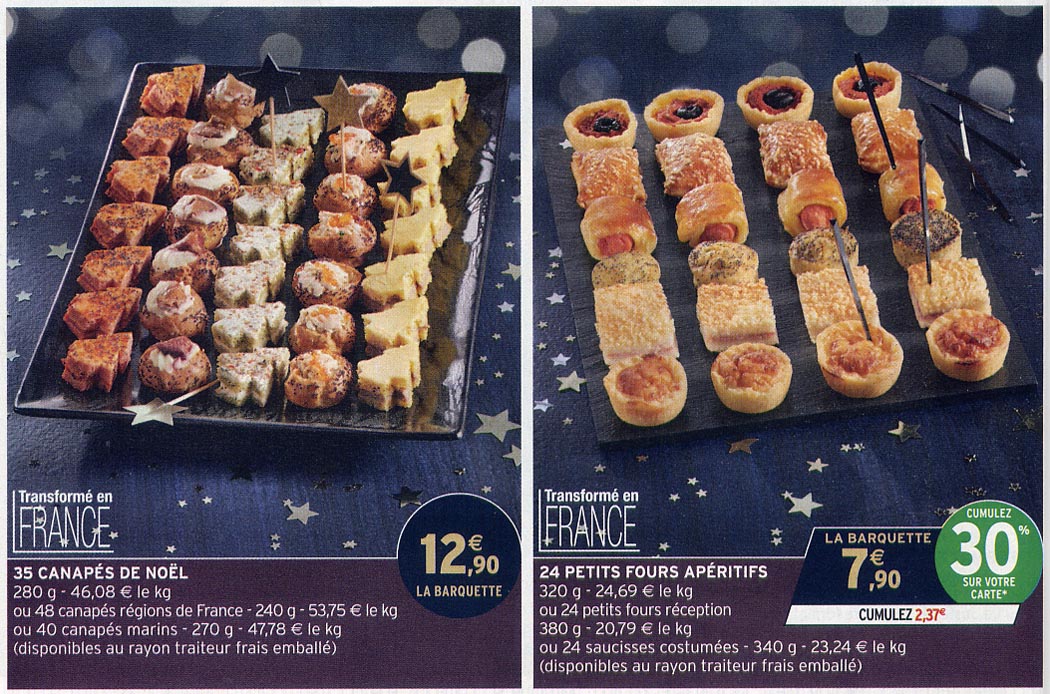
Besides snails, there are other choices. How about some canapés? Or a few petits fours? They'd go well with a glass of champagne.


Because of this ad, I learned the difference between these two classic French treats. Canapés are little pieces of bread, sometimes toasted or fried, garnished with things like foie gras, pâté, cheese, mushrooms, or anything tasty you want. Chicken liver paste, anchovies, or smoked eel , for example. The ones on offer here include Christmas specialties (canapés de Noël), regional treats (canapés régions de France), or fish and seafood flavors (canapés marins). You pays your money...

Petits fours, meanwhile, are (according to the Grand Larousse Gastronomique encyclopedia) little bite-size pieces of baked pastry with a garnish. They can be savory or sweet. Their history goes back to the 18th century, when such delicacies were cooked in masonry or stone ovens at low temperature — « à petit four » was the expression meaning "in a slow oven", which was cooling down after the big roasts or loaves of bread had already been cooked. Described in the ad are petits-fours to serve with cocktails or wine, and others to serve at a reception or party. The difference is not obvious to me. But I really like knowing that some are called « saucisses costumées » — "costumed" or "disguised" sausages — in other words, "pigs in a blanket".

21 December 2016

Chickens and capons for Christmas

As I think Walt and I have both said, we've ordered a « chapon de pintade » — a Guinea fowl capon — to cook for our Christmas dinner. We'll probably cook it on the rotisserie in our oven, and we plan to make cornbread stuffing with dried cranberries and walnuts to have with it. We'll also have winter squash (sucrine du Berry) and some garden greens (kale).

Locally, we have a really good poultry vendor who sets up at the Montrichard market on Fridays and the Saint-Aignan market on Saturdays and offers very competitive prices. But even if we didn't, we wouldn't lack for choices in picking a bird to roast for the holidays. Here are ads I've scanned from one of the advertising flyers we got from local supermarkets for this week. It's from Intermarché, which is about four miles from us by car. The store was recently taken over by new management and has experienced a kind of renaissance.


First, you probably know what a capon is, and maybe you can find capons for Christmas where you live. They are male chickens (or other fowl) that have been sterilized (castrated, either surgically or chemically) and fattened. Like neutered dogs or cats, they gain weight easily. On the right in the panel above, you see a Guinea fowl capon for 10.90 €/kg. That would come to about $5.20/lb. in American money. The ad specifies that the capon had lived at least 154 days before being killed and prepared for market, and that it weighs about 2.3 kilos (5 lbs.). It carries the Label Rouge, which is a good indication of superior quality.

Then you see two ordinary quality chicken capons that go for about half the price of the chapon de pintade, weigh about 3 kilos (6½ to 7 lbs.), and don't carry the Label Rouge. No minimum age is specified, but I'm sure they would be younger birds than the more expensive Guinea fowl capon. And I'm sure they would be very good too, if cooked correctly.

On the left in the panel above, you see what is called « une poularde ». What's that? Well, it's the female equivalent of a capon. A Wikipedia article I just glanced at says the poularde [poo-LARD] is a laying hen that is fed a special diet and environment to delay the onset of egg-laying and also is fattening. Such birds are killed after a minimum of 120 days of existence, and their meat is reputedly white and tender with a very fine flavor. This one sells for about $3.75/lb. and weighs about 4½ lbs. When you buy it, you also get a flat 5€ discount on each poularde in the form of credit against future purchases at Intermarché.


If you don't want a chapon or a poularde, you can get a "regular" Guinea hen — farm-raised outdoors and corn-fed for a minimun of 94 days (above left). It weighs about 3 lbs. and goes for close to $3/lb. at today's exchange rate. (By the way, the U.S. dollar is worth nearly a full euro right now.) Or you can get an ordinary turkey (une dinde) weighing just short of 7 lbs. and selling for about $2.30/lb. I actually bought one of these for the freezer yesterday; we'll cook and eat it in January or February, when whole turkeys are not usually available around here.


Again above, you have a 7 lb. chicken capon (well, rooster, of course) raised for 150 days, fed a diet of at least 80% grain, and selling for about $5/lb. These birds can come from one of two well-known producers, St Sever or Loué — both carry the Label Rouge — and you get a full 15€ discount for each one you purchase. On the right is a more affordable 7 lb. Douce France chicken capon that has been raised for 140 days, fed 70% grain, and includes a 4€ discount. I'm sure you wouldn't be disappointed.


Finally, here's a turkey capon, Label Rouge, farm-raised for 150 days (above left). There's no information about the average weight for this one. And on the right, a farm-raised poularde (is there not an English word?), 120 days of age, 75% grain-fed, no weight specified. When the label or ad says « prêt à cuire », it means there are no "giblets" or abats (liver, gizzard, etc. removed). By the way, these are just the whole birds in the Intermarché flyer. There are other, fancier choices in the flyer too, for rolled-and-tied poultry roasts, and so on.

20 December 2016

Champignons farcis

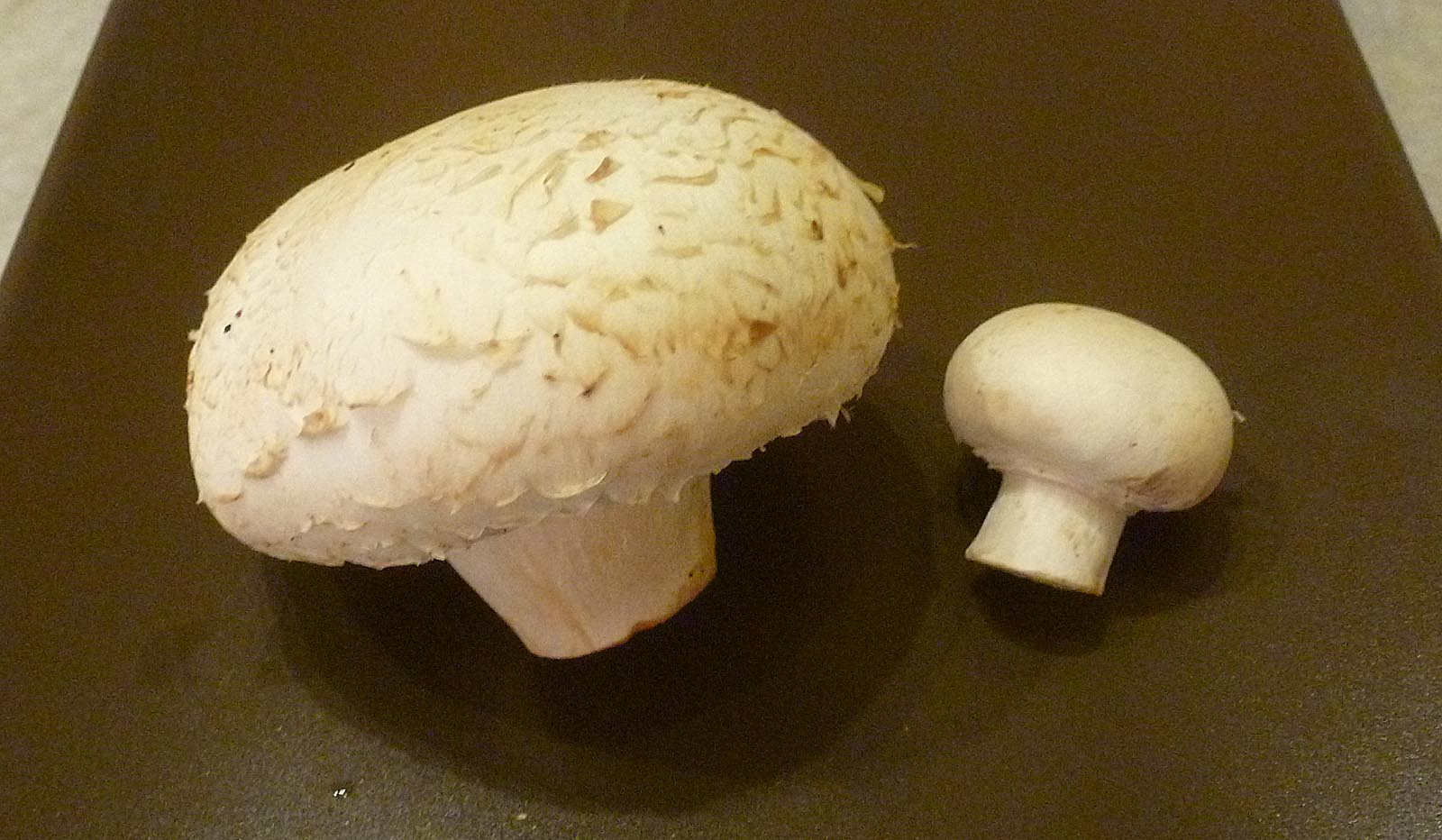
Do you find huge "stuffing mushrooms" where you shop? I bought some a few days ago and made champignons farcis. Here's a photo of one of the champignons à farcir next to a normal-size button mushroom. I bought eight of these gigantic specimens, grown in Holland, at Intermarché.


When you get such huge mushrooms, you can pull out the stems and chop them finely to start your stuffing. Sauté the chopped mushroom with some diced onion and garlic and then let them cool. Mix them with some herbs, bread crumbs, and grated cheese, and finish with cream and an egg. Optionally, add some chopped cooked ham, bacon, or chicken — whatever you've got or like. (I had little cubes of cooked ham and leftover chicken.)


Then blanch the mushroom caps for five minutes in boiling water, turning them over a couple of times. Pre-cooking them means they'll be tender when they come out of the oven and not hard or tough — because after you fill the mushrooms with the stuffing you've made, you bake them in the oven for 25 to 30 minutes, to cook the egg and melt the cheese. I used some goat cheese, and it was good.


I had a little more stuffing than I needed for eight mushrooms, so I also filled two big zucchini rings that I had in the freezer. They had been blanched and frozen last fall. Above are a photo I took before baking the blanched and filled mushroom caps and one after they had cooked in the oven.

Tomorrow is Walt's birthday. We have to go shopping for some birthday dinner foods today, and Callie has an appointment with the vet for a booster shot of some kind. The dog doesn't get rabies shots because there is no rabies here, but she does get vaccinated against diseases carried by ticks and other pests.

19 December 2016

Tortilla à l'espagnole — sunshine for a foggy day

Fog is still all the news. Today will be our third in a row of being completely socked in. It's bad in England too. I read yesterday that more than 150 flights had to be canceled at London's two big airports over the weekend. I haven't heard of cancellations in France, but I wouldn't be surprised if some planes have been grounded, given the poor visibility around here.


So with no sun in the sky, I found a substitute in the kitchen. It's a Spanish "tortilla" — a potato omelet. I had four or five steamed potatoes in the refrigerator from a lunch I made a few days ago. I sliced those up thinly, and I chopped a small onion and a big clove of garlic. All that went into a frying pan with some olive oil, on low temperature so that the onion would soften but the potato would heat up but wouldn't actually brown.

Then I cracked five eggs into a bowl and beat them together lightly with a fork, just to break the yolks up. I deviated from the purely Spanish recipe by adding not only salt and pepper to the eggs, but also about half a cup of grated cheese and a pinch of dried thyme. When the potatoes were good and hot, and the onion was cooked, I poured that mixture into the beaten eggs and stirred everything around gently. The hot potatoes start cooking the eggs. Don't stir too hard because you don't want to mash up the potatoes too much.

Pour the tortilla mixture back into the frying pan and set it on low heat to cook the bottom of the omelet. Now you have two choices. You can do it the traditional way by sliding the partially cooked omelet out onto a plate and then sliding it back into the pan with the uncooked side facing down. (Good luck!) Let the other side cook. Or you can cheat as I did and just set the pan in the oven on low and wait for the top of the tortilla to brown a little. Then slide it out onto a serving dish. Don't burn your hand on the hot frying pan handle the way I did. Ouch.