21 December 2012

Peanut butter lunch

We are American, so you might think our peanut butter lunch would consist of sandwiches with PB and jelly (a.k.a. jam, confiture) on them. But no. We made a spicy peanut sauce out of the peanut butter and served it with broccoli, pasta, and a satay of skewered turkey breast meat.

The main thing about this meal is, of course the peanut sauce, and it's easy. Combine in a blender (or in a bowl if you want to use a stick blender) all the ingredients:
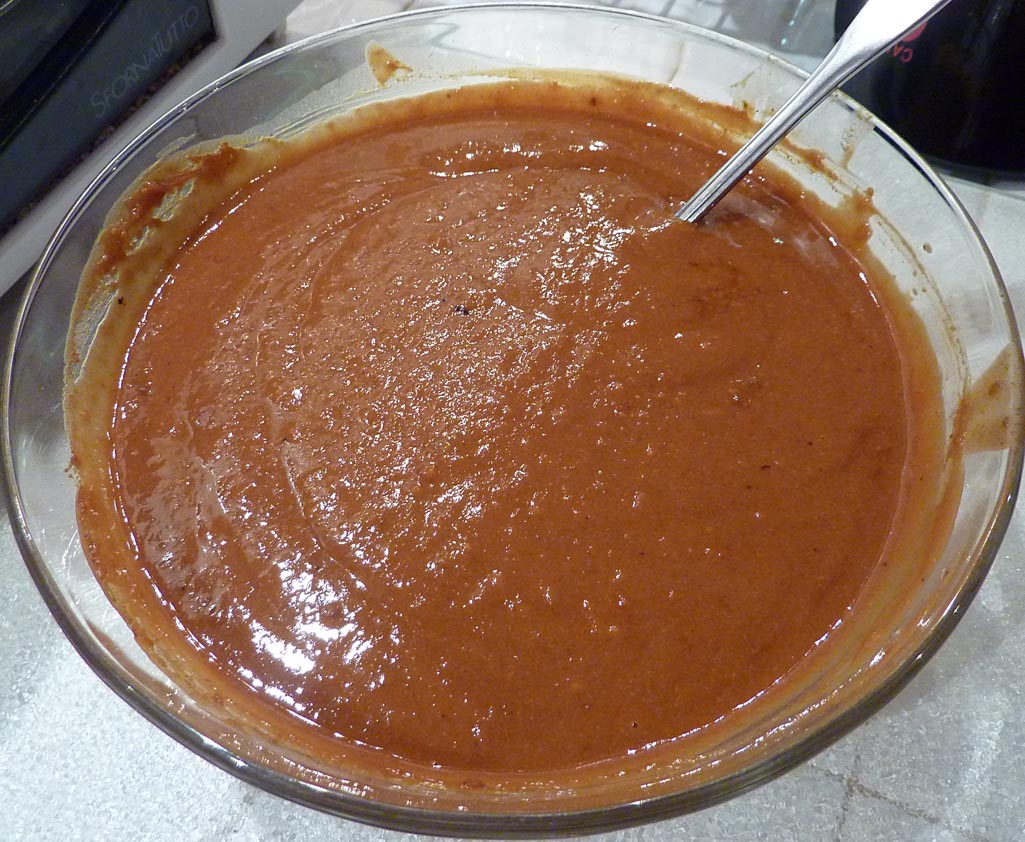
Spicy peanut sauce
¾ cup peanut butter
2 Tbsp. molasses (or black treacle)
¼ cup hot water
¼ cup cider or rice vinegar
2 Tbsp. soy sauce
1 tsp. lemongrass
1 clove garlic
1 Tbsp. chopped onion
1 Tbsp. fish sauce
1 Tbsp. hot chili sauce
1 Tbsp. chopped or grated ginger


The lemongrass and fish sauce are optional. Blend all the ingredients to a smooth paste. Cook the sauce on low heat for 15 minutes, adding pinches of salt, pepper, and sugar to taste. Add more hot water as needed to get a medium consistency, neither too thick or too thin. Add a little more hot sauce (tabasco, for example) if you want to make an even spicier version.

Meanwhile, marinate a couple of boneless turkey (or chicken) breast filets in a mixture of fish sauce, soy sauce, chopped onion, chopped garlic, and chopped ginger. As you can see, I added an herb too — it's kaffir lime leaf, from a jar. Instead, you could use basil, or even some lemon zest or juice.

You can let the meat marinate in the refrigerator, covered, for as long as four hours if you have the time.


Wipe or shake most of the marinade ingredients off the turkey filets and flatten them slightly with a meat mallet if necessary.

Cut the meat into strips about 2 cm (1 inch) wide and thread them onto skewers. Brush them lightly with vegetable oil.

Put the skewered turkey strips on a rack. When the broccoli is ready, broil or grill them for two or three minutes on a side, until they are just cooked through.


Serve the turkey skewers with some of the peanut sauce at the table.

I was a little bit skeptical when I read somewhere that stir-fried broccoli would be good with spicy peanut sauce. Now I know that it is delicious. We get beautiful broccoli here right now, at the supermarket. I imagine it comes from Spain, but I forgot to look at the label.

I had half a red bell pepper left over from another meal, so I sliced it up and cooked it with the broccoli.
I stir-fried the broccoli and red pepper in vegetable oil, adding in the marinade I had saved from the turkey breasts. Then I added a little bit of water to the pan and put on a lid so that the vegetables would cook through just enough to stay slightly crunchy.

At the end, I added some cooked pasta (linguine here, but any pasta would be good), and spooned in a good amount of the peanut sauce. As soon as the peanut sauce had melted and I could stir everything around, it was done. Add a little hot water to thin the sauce if you need to. You don't want it gloppy.

20 December 2012

Driving like a chauffard *

It's raining again this morning, and it's supposed to rain for another 36 or even 48 hours. On devient des palmipèdes, if you know what I mean — nice weather for ducks, though we see ourselves more as swans. Bon.

It was raining yesterday when we went out for the Peugeot's first blow-out-the-carbon drive. We filled up the tank at the Intermarché gas station after pouring the recommended fuel additive in. We headed toward Montrichard, where we had a couple of errands to run. Along the way, I turned up a side road toward Pontlevoy, which is up a fairly steep hill from the river valley.

Typical winter weather, looking down the hill toward the river valley, past the trees.
that I'm afraid will fall on the electric lines in the next windstorm.

I kept the car in third gear, as Dominique the mechanic had instructed me to do. The compte-tours (tachometer) on the little Peugeot's instrument cluster shot up to 4000 RPMs at some points and stayed steadily at 3000 or even 3500 RPMs for long stretches. When the speed limit dropped from 90 kph to 50, I put the car in second gear and kept the RPMs at what I until recently would have considered totally unreasonable if not dangerous levels. Actually, the red danger zone on the compte-tours starts at 5000 RPMs.

Winter vineyard scene, between rain showers

After stops at the bank and a couple of supermarkets in Montrichard, we headed west toward the villages of Chissay, Chisseaux, and Chenonceaux. Our destination was the wine cooperative called La Gourmandière, in Francueil, across the river from the château de Chenonceau. We were revving all the way. Since it was raining, there wasn't much traffic (though it was hard to find a parking space in Montrichard).

At the co-op, we bought 30 liters of our own preferred carburant or fuel — red wine — for the holidays (Walt's birthday is tomorrow — et que la fête commence). Local Gamay, Côt, and vin de pays rouge either filled our own jugs or came home with us in bag-in-box packaging. We didn't drink any, so I could continue my Formula 1 style of driving on the way back to Saint-Aignan. Sorry, but because of the rain, I didn't take any photos.

At the supermarket in Montrichard, we bought some of the little sausages called
crépinettes for our lunch. That's caul fat (crépine) wrapped around them.

I got the impression that the car really enjoyed the workout. A couple of hours running at 3000 RPMs and up to 4500 RPMs (in bursts) should have had the desired effect. I was a little disppointed that I didn't see any smoke coming out of the tailpipe — as Dominique had led to believe me I would — but of course I was concentrating on the narrow, curvy little roads ahead of me, and not the tailpipe. And don't get me wrong — I didn't speed, I just drove the speed limit in gears lower than I'm used to shifting into.

We cooked the crépinettes for lunch with pasta and some of our own tomato sauce.

Thinking back, I used to drive that way all the time, and especially when we came to France for vacations and rented cars. Downshifting and using the car engine's braking power in curves and when coming to a stop was how we drove back then. I've always driven cars with manual transmissions (90+ per cent of the cars in France have stick shifts, not automatics) and I therefore much preferred renting vehicles in France than wimpy little automatics in the U.S.

Next week, we plan to take the autoroute over to the big town of Vierzon, 35 miles east on the Cher River, to continue the blow-out. I'll drive at the legal speed limit of 130 kph (81 mph) in fourth gear, which should get the RPMs up. I hope the car — and the employees at the contrôle technique shop — will thank me.

* A chauffard is a reckless or aggressive driver — a real menace on the roads.

19 December 2012

2012 French food poll

Here's the list of dishes that the 2012 poll asked French respondents to choose from as their favorites, and their rank. Each person polled could choose as many as five dishes. Which ones would you choose? Do you know them all? I think this is an interesting snapshot of French cuisine today.


Here's the list in English:

  1. Grilled or pan-roasted duck breast filets
  2. Mussels cooked in while wine served with French fried potatoes
  3. Couscous (North African meat & vegetable stew)
  4. White veal stew with onions and mushrooms
  5. Prime rib
  6. Roast leg of lamb
  7. Steak and French fries
  8. Beef Burgundy
  9. Raclette (melted cheese with cold cuts and potatoes)
  10. Stuffed tomatoes
  11. Grilled salmon steak
  12. Boiled beef dinner with vegetables
  13. Belgian endives with ham in cheese sauce
  14. Scalloped potatoes in cream sauce
  15. Chicken and French fries
  16. Scalloped potatoes with bacon and cheese
  17. Lasagne
  18. Pizza
  19. Spaghetti with meat sauce
  20. Rabbit in mustard sauce
  21. Ratatouille (stewed summer vegetables)
  22. Confit (slow-cooked duck leg/thigh pieces)
  23. Paëlla (Spanish-style rice with seafood)
  24. Sauerkraut with sausages, cured meats, potatoes
  25. Buckwheat crepes filled with cheese, ham, etc.
  26. Pork tenderloin with mustard sauce
  27. Cheese fondue
  28. Shepherd's pie
  29. Pasta carbonara (cheese & bacon sauce)
  30. Cassoulet (white beans with pork, duck, lamb, etc.)
  31. Chicken curry
  32. Sushi
  33. Moroccan-style lamb stew
  34. Salt cod with mashed potatoes
  35. Omelet
  36. Steak tartare (raw ground beef with condiments)
  37. Chitterling sausages
  38. Mediterranean fish soup
  39. Hamburger
  40. Chili con carne
  41. Elbow macaroni with ham

18 December 2012

La Blanquette

I've heard the French term « blanquette » translated into English as "blanket" — "blanket of veal." That makes me laugh, because I imagine trying to bite into and chew up a wool or fleece bed cover. Ugh. I guess the two terms are related, but the idea that the French word conveys is « blanc » or "white." A blanquette is veal or some other white meat — chicken, turkey, pork, or even lamb — cooked in and served with a white sauce.

Saturday's blanquette de veau at our house

We had blanquette de veau for dinner a couple of days ago. It's a wintertime dish. Comfort food. Bourgeois cooking (which means good home cooking). And it's a classic in France. Poking around in the blog this morning, I noticed a pattern. For us, blanquette seems to be a December dish.

It's not always veal, but it was last December (2011) as it was this past week. In December 2010, it was a blanquette de dinde — blanket of turkey, I guess you'd say. And in December 2009, it was a blanquette de poulet, but American-style: we call it chicken and dumplings. For all of them, the recipe I follow comes from a 40-year-old French cookbook that I like, and I posted it here.

A generous portion of blanquette de veau, to which I added champignons noirs
and petits oignons this time, served with noodles

What place does the blanquette de veau occupy in the French diet? There's an annual poll asking French respondents what their favorite dish is. In 2012, blanquette came in fourth, after finishing as number 1 in the same poll six years ago. The dishes that came it ahead of it this year are magret de canard (duck breast, often grilled), moules-frites (mussels and French fries), and couscous (a North African spicy meat stew of meat and summer vegetables served with couscous "grain").

More about the French food poll to come...