I always tease my good friend Marie, who is an English teacher in Normandy, about the weather up there. She gets tired of it, I'm sure, but she's a good sport. It really doesn't rain in Normandy all the time.
You see, I lived in Rouen for a year, way back when I was a young teacher. One of the first things I learned there was something told to me, maybe facetiously, by the principal of the high school where I worked. To help me adapt to the climate, he said: "Remember, in Normandy, it doesn't rain very much. It just rains all the time." It's that fine, misty drizzle that can get to you.
Well, this time, when we entered Normandy through Blangy-sur-Bresle, we caused quite a splash. Literally. Here we were, two American senior citizens (me a sexagenarian — that's less fun than it might sound — and CHM an octogenarian — no, no tentacles) tooling around in our Renault Kangoo utility vehicle, when suddenly the skies opened up. The bottom really fell out.
It was a rainstorm that people in North Carolina might call a frog-strangler. Des trombes d'eau, they say in French. Raining buckets. And we were on little back roads through hilly country, with very few road signs. For part of the way, we drove through dense forest. The Michelin guide for Normandy calls this region of Normandy "the Bray Buttonhole" — "Wide and deep undulations were formed" here by movements of the Earth's crust in the Tertiary area, when the Alps were pushed up farther south. "The whole area is a watershed," Michelin says. I was convinced.
The sections of road that go through forest are shown on the map in the Michelin Road Atlas as scenic routes. We couldn't see much, though — it was too dark. Many of the roads we were on didn't have route numbers on the map. The ones that did have numbers on the map were as often unmarked as marked by signposts. We just had to keep going, hoping we might be headed vaguely in the right direction. The rain kept pouring down.
It's only about 30 km/18 miles from Blangy-sur-Bresle to Mesnières-en-Bray, our next stop. It seemed a lot longer. The two forests we drove through are called La Haute Forêt Domaniale D'Eu — Eu is a town near the coast — and La Forêt du Hellet. I liked a lot of the local place names: Croixdalle, Bonnerue, Smermesnil, Houppelande, Fresnoy-Folny, Mesnil-Follemprise, and Saint-Vaast-Equiqueville, to cite just a few. As you can imagine, the rain and a focus on driving on curvy roads prevented me from taking any pictures.
Finally, we found a little narrow country lane called the Route de Lucy — Lucy is a village — and we knew we were almost there. I remember passing two tourists on bicycles. They were a middle-aged couple, probably English or Dutch. We were going down a steep hill at the time, which meant they were trying to pedal up it. I flashed my bright lights so that they would be sure to see us coming. They smiled at us gamely as they struggled up the hill in the driving rain.
Our destination was the town — village? — called Mesnières-en-Bray. There's a château there. Since the 1820s, the building — a Renaissance edifice reminiscent of the Loire Valley castles we know so well — has been used as a school that teaches general courses as well as horticulture. We didn't expect to go inside. We just wanted to see it from the outside, maybe just from the car windows. Maybe get out and take a picture or two. But with the rain that was falling, it seemed increasingly unlikely that we would get even a glimpse of it.
We drove into the village from the east, where the Route de Lucy intersected with the main road through the town. We turned right, toward the Dieppe to the north, looking for the château. I remember roads that were flooded, and people out in slickers with brooms, trying to unclog storm drains so that the water could run off rather than pond up. In a couple of minutes, we found ourselves back out in rase campagne — open country — a realized we had gone too far and in the wrong direction.
Where was the château? In such a small town (pop. 706, according to Wikipedia), an enormous building shouldn't be all that hard to find. Blame it on the rain. We were having a hard time seeing much at all. I pulled off the road and turned around. A big tractor-trailer rig roared by, sending spray everywhere. A couple of miles south, right in the middle of the village, this time we noticed a sign — Château >> — pointing to the right.
And the rain suddenly slacked off. By the time we drove a mile up the road and found the entrance to the château, it had pretty much stopped. There was a ray of sunshine, and everything look and smelled fresh and clean. There was a little parking lot for maybe 10 cars, and it was empty. We parked there and even got out of the car.
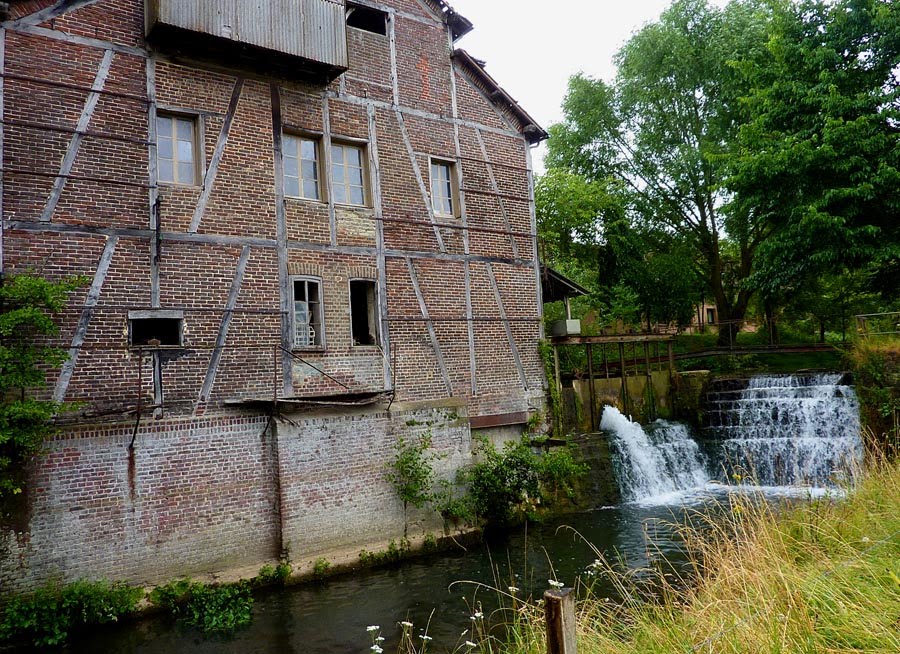
So I got some pictures after all. Snapshots of the Château de Mesnières. And in a pen on the grounds, near the parking lot, there were chickens, roosters, geese, ducks, and goats. We enjoyed being out of the car for a few minutes and not having to walk too far to find something interesting to look at and photograph. Sometimes what you actually see is more interesting that what you set out to see.
08 August 2010
07 August 2010
Le Château de Rambures
We were driving around, lost, and soon to be caught in a storm. Well, we weren't exactly lost, and we were making good time. We just didn't know how to get to where we wanted to go. The rain would soon start falling in sheets (tomber des cordes is the French expression, or pleuvoir comme vache qui pisse), and that wouldn't help matters. We had a map, but it would be impossible to read the road signs. It was Wednesday, July 21, 2010.
Earlier, after lunch in Poix-de-Picardie, we had left the main highway at a place called Aumale, about halfway between Amiens (in Picardie) and Rouen (in Normandie). We drove up the valley of the Bresle river, through towns called Vieux-Rouen-sur-Bresle, Bouafles, and Hodeng-au-Bosc. At one point we crossed the river on a little bridge and we headed back into Picardy to find the Château de Rambures. I certainly had never heard of it, but CHM had (I think). He found it on the map.
It wasn't raining at that point. After driving around a while on unmarked roads, we turned left at Foucacourt-Hors-Nesle and before long found our way to Rambures and the château. Along the way, I stopped and took some pictures of cows. This is the Neufchâtel cheese production area, and Neufchâtel is one of my favorite cow's milk cheeses — so I needed a picture of a cow, n'est-ce pas ? This Neufchâtel, by the way, has nothing to do with the cream cheese we call by the same name in America. It's more like a Camembert, only saltier and... well, you'd have to taste it.
The Château de Rambures was — wouldn't you know it? — closed on Wednesdays. The Michelin green guide hadn't been clear on that point. There was a parking lot, but it was empty and even barricaded. A couple of other cars stopped as we took some pictures of the château through the big iron gates. One young woman came up to talk to us. She too was disappointed to have driven all that way, only to find she couldn't enter the château or even the grounds.
According to its web site, the Château Fort de Rambures has been owned and occupied by the same family since the 11th century — that's 1000 years. There have been three different fortified castles built on the property during that time but, even so, the one that exists now dates back to the 14th and 15th centuries. It was fortified because the 100 Years War between France and England was raging at the time it was being designed and erected. Lord Rambures is mentioned in Shakespeare's Henry V.
At Rambures, there's a 25-acre park with a fine collection of ferns and a rose garden planted with 420 varieties, both modern and heirloom. There's an English-style garden that was planted in the 1700s, when exotic trees including a sequoia and a black walnut were brought to Rambures from America and Asia. Of course, we didn't get to see any of that — but I'm not sure we would have taken the time to do so even if the château and grounds had been open that day.
It was when we left Rambures and drove into Normandy at the town called Blangy-sur-Bresle that the heavy rain started. We were on our way to a place called Mesnières-en-Bray to see a château there, and then on to Neufchâtel-en-Bray for a night in a hotel there and a dinner featuring the local cheese.
06 August 2010
OVNIs farcis — Stuffed patty-pan UFOs
You have to admit that they do look like some kind of « OVNI » — that stands for « Objet Volant Non Identifié » in French. An Unidentified Flying Object. But they are patty-pan squashes. They don't actually fly, but they grow so fast you might think they should be featured in a science fiction movie.
We had a whole batch of them last week — in French they're called « pâtissons » — and I decided to make stuffed squash, a.k.a "squash boats," out of them. Or squash flying saucers (soucoupes volantes) in this case. As I type this, there are six more patty-pans on the work table in the kitchen. I'm going to stuff them with ground pork — chair à saucisse in French — this morning and put them in the freezer for eating over the winter.
Patty-pans are summer squashes like zucchinis/courgettes
and can be cooked the same way. The taste might
remind you a little of artichoke.
Last week, I wanted to make a different meat stuffing for the patty-pans, with tomato sauce. I had about a pound each of beef and lamb in the freezer. The beef was chunks of stew beef (bœuf à bourguignon) and the lamb was slices of gigot d'agneau — leg of lamb. Walt put all of that meat through the food grinder to mince it up.
Cook the patty-pans in boiling water (or steam them)
to soften the skin and flesh before you hollow them out.
The easiest way to get the patty-pans ready for stuffing is to cook them in a big pot of boiling salted water for 10 minutes or a little longer, until they are partially cooked. Then take them out of the water and let them cool to the point where you can handle them without burning your fingers.
Save most of the squash flesh and mix in some raw rice
or millet — plus some paprika. Put this mixture
in the bottom of the baking pan.
Cut the top — or the bottom actually — of each patty-pan off with a sharp knife and then scoop out the seeds and part of the flesh of the vegetable, without piercing the skin. I've discovered that it's easier to cut out the bottom, and not the stem side, without making a hole in the squash. Chop the squash flesh and seeds coarsely and set it aside. You'll use some of it in the stuffing, and some will go into the bottom of the baking dish, along with some rice, as a bed for the squash to sit on.
For the stuffing, chop a big onion and some garlic and cook them in butter or oil until they are softened. Add to the pan some of the chopped squash flesh and the ground beef and lamb (or one or the other, of course — whatever you have or want) and cook that with salt, pepper, other spices, and a little tomato sauce until you have a kind of thick, fairly dry meat sauce — like what you would serve with pasta, but with less liquid.
Let the meat sauce cool and then mix in plenty of chopped fresh herbs — parsley, basil, thyme, rosemary, etc. — and a good amount of grated cheese. Fill the patty-pans with this mixture. Add a little of the meat sauce to the extra squash flesh and mix in a good handful of raw rice (I used millet instead). Stir that together and put a layer of it in the baking dish you plan to cook the squash "flying saucers" in.
Put the stuffed squashes in the pan and pour in just enough water to cover the rice in the bottom of the pan. As it all cooks in a medium oven for 20 to 30 minutes, keep adding a little water so that the rice cooks completely without drying out.
Serve the stuffed squashes with a tomato or cheese sauce. They are tasty. Here's a post about another way of stuffing patty-pans, with rice and aromatics — no meat. There are plenty of French recipes for pâtissons farcis on the web — and American recipes too.
We had a whole batch of them last week — in French they're called « pâtissons » — and I decided to make stuffed squash, a.k.a "squash boats," out of them. Or squash flying saucers (soucoupes volantes) in this case. As I type this, there are six more patty-pans on the work table in the kitchen. I'm going to stuff them with ground pork — chair à saucisse in French — this morning and put them in the freezer for eating over the winter.
Patty-pans are summer squashes like zucchinis/courgettesand can be cooked the same way. The taste might
remind you a little of artichoke.
Last week, I wanted to make a different meat stuffing for the patty-pans, with tomato sauce. I had about a pound each of beef and lamb in the freezer. The beef was chunks of stew beef (bœuf à bourguignon) and the lamb was slices of gigot d'agneau — leg of lamb. Walt put all of that meat through the food grinder to mince it up.
Cook the patty-pans in boiling water (or steam them)to soften the skin and flesh before you hollow them out.
The easiest way to get the patty-pans ready for stuffing is to cook them in a big pot of boiling salted water for 10 minutes or a little longer, until they are partially cooked. Then take them out of the water and let them cool to the point where you can handle them without burning your fingers.
Save most of the squash flesh and mix in some raw riceor millet — plus some paprika. Put this mixture
in the bottom of the baking pan.
Cut the top — or the bottom actually — of each patty-pan off with a sharp knife and then scoop out the seeds and part of the flesh of the vegetable, without piercing the skin. I've discovered that it's easier to cut out the bottom, and not the stem side, without making a hole in the squash. Chop the squash flesh and seeds coarsely and set it aside. You'll use some of it in the stuffing, and some will go into the bottom of the baking dish, along with some rice, as a bed for the squash to sit on.
For the stuffing, chop a big onion and some garlic and cook them in butter or oil until they are softened. Add to the pan some of the chopped squash flesh and the ground beef and lamb (or one or the other, of course — whatever you have or want) and cook that with salt, pepper, other spices, and a little tomato sauce until you have a kind of thick, fairly dry meat sauce — like what you would serve with pasta, but with less liquid.
Let the meat sauce cool and then mix in plenty of chopped fresh herbs — parsley, basil, thyme, rosemary, etc. — and a good amount of grated cheese. Fill the patty-pans with this mixture. Add a little of the meat sauce to the extra squash flesh and mix in a good handful of raw rice (I used millet instead). Stir that together and put a layer of it in the baking dish you plan to cook the squash "flying saucers" in.
Put the stuffed squashes in the pan and pour in just enough water to cover the rice in the bottom of the pan. As it all cooks in a medium oven for 20 to 30 minutes, keep adding a little water so that the rice cooks completely without drying out.
Serve the stuffed squashes with a tomato or cheese sauce. They are tasty. Here's a post about another way of stuffing patty-pans, with rice and aromatics — no meat. There are plenty of French recipes for pâtissons farcis on the web — and American recipes too.
05 August 2010
The jam jam
Through a combination of favorable circumstances and sheer willpower, I managed to avoid making any cherry jam this summer. But now the plums have come in. Blame the neighbors for my latest jam-making spree. Now I'm in a jam.
When M. brought us three kilograms of golden mirabelle plums, what was I to do? You can't just sit down and eat three kilograms of plums, can you? You can put them in the freezer, I guess, but they'll take up a lot of room that you'd rather use for tomatoes and eggplant. Jam is the only logical thing to do with them.
Thirteen Bonne Maman jars full of home-made plum jam,
plus one nearly full one that went directly into the fridge.
Never mind that there are several quarts of plum jam down in the pantry, from a batch that I made in 2007. There it sits. We don't eat much jam, it turns out. My resolution to make a lot of jelly-roll cakes last winter fell flat. Did I mention that I also have six or eight jars of Asian plum sauce, spiced with hot red pepper and ginger root, both down in the cellar and in the refrigerator? We can't seem to eat that up either.
The neighbor's mirabelles, combined with about a kilo of our own reine-claude plums, made beautiful jam. It's thick and red, with big chunks of fruit in it. I'd certainly eat some this morning, except for the fact that we have completely run out of bread. The bread lady doesn't come by until after 10:00, and that'll be too late. We have errands to run.
There were fourteen jars of the new jam. I already gave one away — no, not to a passer-by, but to an old friend who stopped by yesterday afternoon. I'm not sure she wanted it. She mumbled something about making plum jam herself, because her trees are full too. But she took it. That's what counts.
Here's another plum idea: a clafoutis made with little red plums
given to us by other neighbors. It is delicious,
and you don't even have to pit the plums.
Who's next? Stop by when you can and get yours.
When M. brought us three kilograms of golden mirabelle plums, what was I to do? You can't just sit down and eat three kilograms of plums, can you? You can put them in the freezer, I guess, but they'll take up a lot of room that you'd rather use for tomatoes and eggplant. Jam is the only logical thing to do with them.
Thirteen Bonne Maman jars full of home-made plum jam,plus one nearly full one that went directly into the fridge.
Never mind that there are several quarts of plum jam down in the pantry, from a batch that I made in 2007. There it sits. We don't eat much jam, it turns out. My resolution to make a lot of jelly-roll cakes last winter fell flat. Did I mention that I also have six or eight jars of Asian plum sauce, spiced with hot red pepper and ginger root, both down in the cellar and in the refrigerator? We can't seem to eat that up either.
The neighbor's mirabelles, combined with about a kilo of our own reine-claude plums, made beautiful jam. It's thick and red, with big chunks of fruit in it. I'd certainly eat some this morning, except for the fact that we have completely run out of bread. The bread lady doesn't come by until after 10:00, and that'll be too late. We have errands to run.
There were fourteen jars of the new jam. I already gave one away — no, not to a passer-by, but to an old friend who stopped by yesterday afternoon. I'm not sure she wanted it. She mumbled something about making plum jam herself, because her trees are full too. But she took it. That's what counts.
Here's another plum idea: a clafoutis made with little red plumsgiven to us by other neighbors. It is delicious,
and you don't even have to pit the plums.
Who's next? Stop by when you can and get yours.
Subscribe to:
Posts (Atom)


