Both of us like to cook and both of us like to watch cooking shows on TV. They are often on in the background, but sometimes we sit down and really pay attention to them.
One of the nice things about the cooking shows nowadays is that you can often go to the Internet and look up the recipes for dishes you see the cooks and chefs prepare on TV.
We used to have two cooking channels on our cable system, Cuisine.TV and another one, the name escapes me, that was run or owned by the famous chef Joël Rebuchon. Rebuchon's channel went off the air a year or so ago. BBC Prime, which is the BBC's entertainment channel for Europe and the Middle East, also shows a few cooking shows every week.
Cuisine.TV shows a dozen or more French cooking shows but also runs a lot of shows from the U.S., the U.K., Australia, and Canada (Québec, that is). For example, it runs a lot of British cooking star Jamie Oliver's shows.
The first shows of Jamie's that were shown in France were perfectly dubbed in French. That wasn't too bad, even if it took some getting used to. The French actor's voice was actually really well synchronized with Jamie's mouth movements.
Later, the truly dubbed versions were replaced by what I call over-dubbed versions of Jamie Oliver's shows and others. Over-dubbing is surely a less expensive, less time-consuming process that involves laying down a French soundtrack on top of the original English soundtrack to carry the translated script. In other words, rather than hearing Jamie Oliver speak French, what you hear is Jamie speaking English is the background and a slightly louder French narrator reading a translation of the patter in the audio foreground.
Well, that's very annoying. If you didn't speak English much or at all, I suppose it could be okay. If you speak English but not French, it's irritating not to be able to hear the background track, which is Jamie Oliver (or another host) speaking his native language, very clearly. When you speak both English and French, you end up not being able to focus on or hear either soundtrack as well as you'd like to.
Here's a sample. The video isn't very good because I'm shooting pictures of the TV screen with a digital camera, but it gives you the flavor:
One Cuisine.TV show that we (and some special friends of ours in California) really enjoy is called Le Menu d'Eric. It's hosted by a chef named Eric Léautey, assisted by a woman named Anne Allegrini. Anne is Eric's foil. He is teaching her how to cook, more or less, and she represents the target audience of the show, I assume.
Are you watching, John and Candy?

04 December 2006


03 December 2006
Laurie and the piano at Montrésor
On his blog yesterday, Walt posted a video of our friend Laurie playing the organ in a church in Anniston, Alabama, that we visited back in late October. He mentioned that Laurie had visited us here in Saint-Aignan in February 2005 and played the historic piano at the Château de Montrésor. That brought back a nice memory. I didn't take a video of her playing, but I did take some still pictures.
Here's what I wrote in an e-mail to friends the next day:
 The village called Montrésor, one of the prettiest in France
...Laurie and I drove on to Montrésor, which was the highlight of the afternoon. The sun came out, the wind died down, and the rain & snow stopped. Montrésor has the L'un des Plus Beaux Villages de France designation, and it is pretty with its château, church, and old houses.
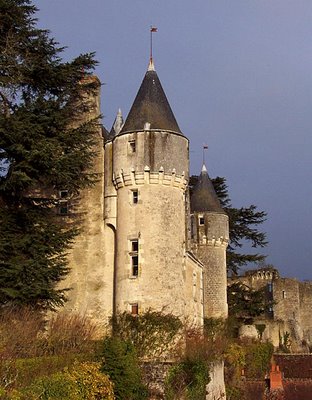 One of the château towers
Laurie and I parked in the lower town and walked up the hill to the church, which I had visited before and found very interesting. But it was closed — there was a sign on the door that said something like l'église est temporairement fermée à cause de dégradations. I have no idea what the dégradations were, but we couldn't visit the building...
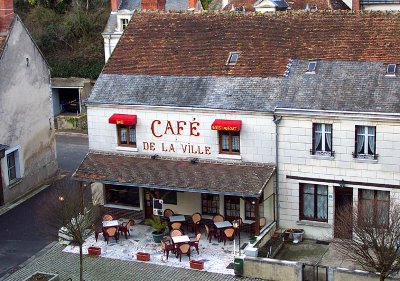 Montrésor's main "watering hole" seen from the château
We walked on from the church along the high road to the entrance of the château. A man came out and called to us in French and then in English, saying we could take the tour en visite libre if we wanted to. Laurie said "Let's do it!" and we did. It was very interesting. Six or seven rooms on two levels were open to visitors, and they were full of 18th and 19th century furniture and lots of paintings.
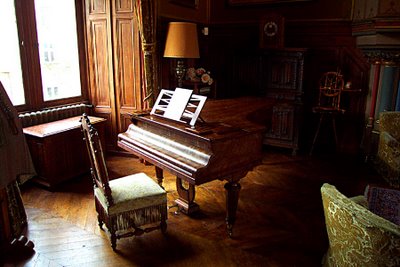 The piano at Montrésor is a 200-year-old Erard
But the best part was the piano — it is one that came from Paris and had been played by Chopin. The man from the entrance had come up at the end of the tour to show us the trésor or treasure of the Château de Montrésor — a locked room full of gold and silver platters, beer steins, coins, etc. He mentioned the piano, and I told him that Laurie is a musician. He insisted that she play the piano, and she did. It was beautiful -- she's quite accomplished.
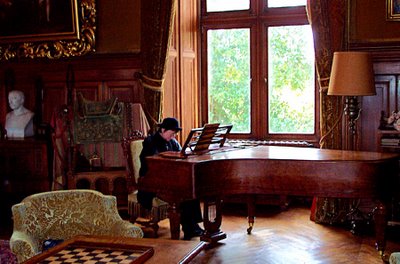 Laurie playing the piano that Chopin played and composed music on
The man of the château was genuinely impressed and was very happy to have her play it. Laurie was impressed to find that it had recently been tuned by a professional who had done the work for free, saying it was an honor to work on such a fine instrument.
If you want to see more pictures of the town and château, here's a posting about Montrésor from May 2006.
Here's what I wrote in an e-mail to friends the next day:
 The village called Montrésor, one of the prettiest in France
...Laurie and I drove on to Montrésor, which was the highlight of the afternoon. The sun came out, the wind died down, and the rain & snow stopped. Montrésor has the L'un des Plus Beaux Villages de France designation, and it is pretty with its château, church, and old houses.
 One of the château towers
Laurie and I parked in the lower town and walked up the hill to the church, which I had visited before and found very interesting. But it was closed — there was a sign on the door that said something like l'église est temporairement fermée à cause de dégradations. I have no idea what the dégradations were, but we couldn't visit the building...
 Montrésor's main "watering hole" seen from the château
We walked on from the church along the high road to the entrance of the château. A man came out and called to us in French and then in English, saying we could take the tour en visite libre if we wanted to. Laurie said "Let's do it!" and we did. It was very interesting. Six or seven rooms on two levels were open to visitors, and they were full of 18th and 19th century furniture and lots of paintings.
 The piano at Montrésor is a 200-year-old Erard
But the best part was the piano — it is one that came from Paris and had been played by Chopin. The man from the entrance had come up at the end of the tour to show us the trésor or treasure of the Château de Montrésor — a locked room full of gold and silver platters, beer steins, coins, etc. He mentioned the piano, and I told him that Laurie is a musician. He insisted that she play the piano, and she did. It was beautiful -- she's quite accomplished.
 Laurie playing the piano that Chopin played and composed music on
The man of the château was genuinely impressed and was very happy to have her play it. Laurie was impressed to find that it had recently been tuned by a professional who had done the work for free, saying it was an honor to work on such a fine instrument.
02 December 2006
Baking feats and treats
Walt's been busy baking this week. A couple of days ago, he made an excellent quiche using some yellow summer squash that he put in the freezer last summer.
 A pre-baked pastry shell filled with a mixture of sautéed summer squash and onions
To freeze the squash flesh, he grated it finely and packed it uncooked into a sealed plastic bag. After he took it out and thawed it the other day, he squeezed most of the water out of it with his hands. Then he cooked it for a few minutes in a frying pan on low heat with butter and a chopped onion, salt, and pepper.
 The quiche as it came out of the oven, all puffed up, golden, and tasty
The squash-onion mixture went into a pre-cooked pastry shell along with some grated comté cheese — you could used whatever cheese you wanted — and then was covered with a mixture of eggs and cream. It took about 5 eggs and maybe ½ to ¾ cup of cream (or milk). A pinch of nutmeg in the eggs gives good flavor, and some extra cheese sprinkled on top before baking gives the quiche a nice golden color. It spent about 45 minutes in the oven at 375ºF (190ºC).
Later, after a trip to the store to get some ground hazelnuts and other supplies, W. made a batch of Spicy Nut Bread that we had seen a chef on Cuisine TV make a week or so ago. Here's a link to the French recipe, called Gâteau Épicé aux Noix. And here's my translation: Spicy Nut Bread.
The ingredients are the ground hazelnuts, chopped walnuts, raisins, rum, butter, eggs, flour, baking powder, sugar, lemon zest, and spices — ginger, allspice, and cinnamon. The French recipe also calls for fromage blanc*, which I think you could substitute yogurt or sour cream for in the states.
 Shaping the nut bread dough into loaves
The French recipe doesn't mention kneading the dough, but on the TV show Eric definitely kneaded it for a while, very gently, before he shaped it for baking.
 Spicy nutbread loaves cooling on a rack
After the loaves cooled, we sliced them and ate them like that. No complaints.
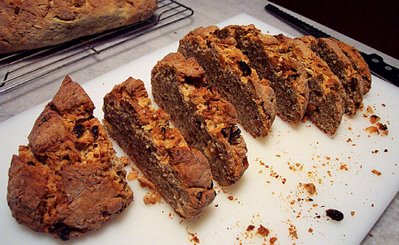 The cooled loaf sliced
It was obvious that this was actually a recipe for biscotti, however. I've never seen biscotti (which are Italian) in France, though I'm sure you can buy them in Paris and other cities. Walt used to make biscotti at Christmastime when we lived in San Francisco.
Walt cut up the second loaf and put the slices in a slow oven for 30 minutes or so to dry them out. Sure enough, we ended up with biscotti. I think the nut bread is even better this way because the walnuts and ground hazelnuts have a toastier flavor, and the raisins are sort of candied.
 Spicy nut ... biscotti
 A pre-baked pastry shell filled with a mixture of sautéed summer squash and onions
To freeze the squash flesh, he grated it finely and packed it uncooked into a sealed plastic bag. After he took it out and thawed it the other day, he squeezed most of the water out of it with his hands. Then he cooked it for a few minutes in a frying pan on low heat with butter and a chopped onion, salt, and pepper.
 The quiche as it came out of the oven, all puffed up, golden, and tasty
The squash-onion mixture went into a pre-cooked pastry shell along with some grated comté cheese — you could used whatever cheese you wanted — and then was covered with a mixture of eggs and cream. It took about 5 eggs and maybe ½ to ¾ cup of cream (or milk). A pinch of nutmeg in the eggs gives good flavor, and some extra cheese sprinkled on top before baking gives the quiche a nice golden color. It spent about 45 minutes in the oven at 375ºF (190ºC).
* * * * *
Later, after a trip to the store to get some ground hazelnuts and other supplies, W. made a batch of Spicy Nut Bread that we had seen a chef on Cuisine TV make a week or so ago. Here's a link to the French recipe, called Gâteau Épicé aux Noix. And here's my translation: Spicy Nut Bread.
The ingredients are the ground hazelnuts, chopped walnuts, raisins, rum, butter, eggs, flour, baking powder, sugar, lemon zest, and spices — ginger, allspice, and cinnamon. The French recipe also calls for fromage blanc*, which I think you could substitute yogurt or sour cream for in the states.
 Shaping the nut bread dough into loaves
The French recipe doesn't mention kneading the dough, but on the TV show Eric definitely kneaded it for a while, very gently, before he shaped it for baking.
 Spicy nutbread loaves cooling on a rack
After the loaves cooled, we sliced them and ate them like that. No complaints.
 The cooled loaf sliced
It was obvious that this was actually a recipe for biscotti, however. I've never seen biscotti (which are Italian) in France, though I'm sure you can buy them in Paris and other cities. Walt used to make biscotti at Christmastime when we lived in San Francisco.
Walt cut up the second loaf and put the slices in a slow oven for 30 minutes or so to dry them out. Sure enough, we ended up with biscotti. I think the nut bread is even better this way because the walnuts and ground hazelnuts have a toastier flavor, and the raisins are sort of candied.
 Spicy nut ... biscotti
___________________________________________
* Fromage blanc, according to my Larousse Les Fromages book, is a product obtained by slow coagulation of whole cow's milk with rennet at 15ºC for 24 hours. It can be eaten with sugar (for breakfast or dessert) or flavored with herbs and spices (as a dip, for example). It's always available in French supermarkets, and I paid one euro for a litre at SuperU the other day. Plain fromage blanc has a slightly sour taste and the texture of yogurt or sour cream.
01 December 2006
Already December 1
Can you believe it? I can't. I guess the fact that we spent the month of October in the U.S. has something to do with it.
 Sunrise, 8:00 a.m., 01 December 2006, at La Renaudière
The weather is a factor too — northern France is having its warmest autumn since 1950, according a report I heard on the radio the other day. It was much colder at this time last year, that's for sure. Though the low this morning was about 38ºF, so the cold weather is coming. But we are supposed to have a mild weekend, with more rain.
 A November puddle on the rue de la Renaudière
Back in the 1970s when I lived in Paris, they used to say that landlords would turn on the heat in apartment buildings on October 15, whether you needed heat or not. Mostly you did. And then they would turn the heat off on April 15, whether you still needed it or not. And often you did.
 A blackbird sitting in the top of our bay laurel tree, with fall colors
Earlier this week I took all my succulents and houseplants outdoors and cleaned up our little sun porch for the winter. I will eventually need to bring in all the outdoor plants that can't take frost, and I needed to make room for them. But this week I left even the houseplants outdoors for about 48 hours, hoping it would rain and water them for me. It just sprinkled a little and the temperature didn't go down below 45ºF.
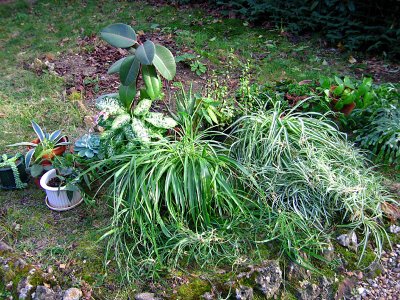 Houseplants getting some fresh air on a late-November afternoon
We've been turning our heat on in the morning and leaving it for two or at most three hours. But then the house is almost too warm, so we turn the heat off. Late in the afternoon, if it's a little chilly, we either turn the boiler on again for an hour or two to get the radiators warm for the evening, or Walt builds a fire in our new wood stove. The wood stove is going to be really nice this winter, and wood is much less expensive than fuel oil.
 Recent view out our bedroom window past the neighbor's yard to the vineyards
I see on CNN this morning that a big snowstorm blew across the U.S. Plains States and the Middle West overnight. I wonder when we will get our first snowflakes this year. I do need to get the geraniums in this weekend.
 The neighbors' birch trees on Thanksgiving weekend 2006
I just looked at weather.com to see what's going on in Champaign-Urbana, Illinois. That's the last place we stayed in the U.S., early in November. Well, our friends there didn't get the worst of the big snowstorm, it appears. Still,they are supposed to get two to four inches of snow before noon on Friday, and the winds are supposed to be howling. Then the temperature will drop to -8ºC by Saturday morning — that's 18ºF, very cold compared to what we are used to here in the Loire Valley.
 Sunrise, 8:00 a.m., 01 December 2006, at La Renaudière
The weather is a factor too — northern France is having its warmest autumn since 1950, according a report I heard on the radio the other day. It was much colder at this time last year, that's for sure. Though the low this morning was about 38ºF, so the cold weather is coming. But we are supposed to have a mild weekend, with more rain.
 A November puddle on the rue de la Renaudière
Back in the 1970s when I lived in Paris, they used to say that landlords would turn on the heat in apartment buildings on October 15, whether you needed heat or not. Mostly you did. And then they would turn the heat off on April 15, whether you still needed it or not. And often you did.
 A blackbird sitting in the top of our bay laurel tree, with fall colors
Earlier this week I took all my succulents and houseplants outdoors and cleaned up our little sun porch for the winter. I will eventually need to bring in all the outdoor plants that can't take frost, and I needed to make room for them. But this week I left even the houseplants outdoors for about 48 hours, hoping it would rain and water them for me. It just sprinkled a little and the temperature didn't go down below 45ºF.
 Houseplants getting some fresh air on a late-November afternoon
We've been turning our heat on in the morning and leaving it for two or at most three hours. But then the house is almost too warm, so we turn the heat off. Late in the afternoon, if it's a little chilly, we either turn the boiler on again for an hour or two to get the radiators warm for the evening, or Walt builds a fire in our new wood stove. The wood stove is going to be really nice this winter, and wood is much less expensive than fuel oil.
 Recent view out our bedroom window past the neighbor's yard to the vineyards
I see on CNN this morning that a big snowstorm blew across the U.S. Plains States and the Middle West overnight. I wonder when we will get our first snowflakes this year. I do need to get the geraniums in this weekend.
 The neighbors' birch trees on Thanksgiving weekend 2006
I just looked at weather.com to see what's going on in Champaign-Urbana, Illinois. That's the last place we stayed in the U.S., early in November. Well, our friends there didn't get the worst of the big snowstorm, it appears. Still,they are supposed to get two to four inches of snow before noon on Friday, and the winds are supposed to be howling. Then the temperature will drop to -8ºC by Saturday morning — that's 18ºF, very cold compared to what we are used to here in the Loire Valley.
Subscribe to:
Posts (Atom)