21 June 2020

Food or landmarks?

This morning I've been looking back to some photos I took in 2009 in the Cantal department, in the Auvergne region, of central France. But I also have some photos of food from yesterdays lunch. 'What to post? What a dilemma!


I guess I'll go with food. CHM says I always fall back on cooking and food when I'm not sure what to post. Yesterday morning, on the spur of the moment, I decided to make a gratin dauphinois — scalloped potatoes in cream in the style of the Grenoble area. Well, maybe not exactly, because I put some grated cheese in it. We ate it with steaks that Walt bought at the market earlier in the morning and cooked on the grill. That's them above — the cut is called bavette and is similar to skirt or flank steak.


What you do is cut some potatoes into thin slices. Boil some milk or a mix of milk and cream seasoned with salt and pepper, garlic, and bay leaves. When the potatoes are partially cooked, put half of them into a buttered baking dish. Sprinkle on some grated cheese — I had grated Edam from the Netherlands and grated ewe's milk cheese called Osso-Iraty from Basque country. White cheddar or Monterey Jack cheese would be good. One top of the cheese layer, spoon in the rest of the partially cooked potatoes and then sprinkle more cheese on top. Pour the hot milk/cream into the dish until the potatoes are just barely covered with liquid. Set the pan in the oven and let the melted cheese turn golden brown as the milk evaporates until the potatoes are tender. Serve in the baking dish. Voilà.

To round it all out, we had a few florets of steamed broccoli as a side dish.


Oh, and as a first course we ate some radishes dipped in a little salt that you sprinkle on your and served with French bread and butter. That's a classic French appetizer. When we get radishes that come with fresh, unblemished leaves, like these, we use the leaves to make pesto the way you would make pesto with basil. Delicious.

20 June 2020

Un clafoutis aux prunes

Think of it as eating a watermelon that has seeds in it. I know, seeing how far you can spit a watermelon seed is something kids like to do, but don't try that when eating a wedge of clafoutis in the house. Just delicately purse your lips and slide the pit into your spoon. Then place it on the edge of your plate. Clafoutis [klah-foo-TEE) is a pretty informal kind of dessert, especially if made with cherries or plums that still have their pits in them. Some say the pits give good flavor to the clafoutis.


The classic clafoutis is made with cherries. They can be tart sour cherries or sweet black cherries. You can make a clafoutis with other fruits too — blueberries, apples, bananas, peaches, apricots, or plums. I made this one yesterday with little red plums that are just slightly larger than plump cherries. They are the fruits of a tree I grew in a pot from plum pits more than a decade ago and later planted in the ground in the far corner of our back yard. Larger fruits would need to be cut up to go into a clafoutis.


I'm not sure I'd ever made a clafoutis with these particular plums before. Often the birds get them before I get out there to pick some, but for some reason not this year. These are not what is called a "freestone" fruit. It's not easy to pit them, especially when they are very ripe. You end up with a handful of mush, and you can't really scrape the pulp off the pit. The pits I planted all those years ago were from freestone plums, but that's not what the resulting tree produces. Their flavor is very good, however. Last year I made plum jelly because that was an easy way to get rid of the pits too.


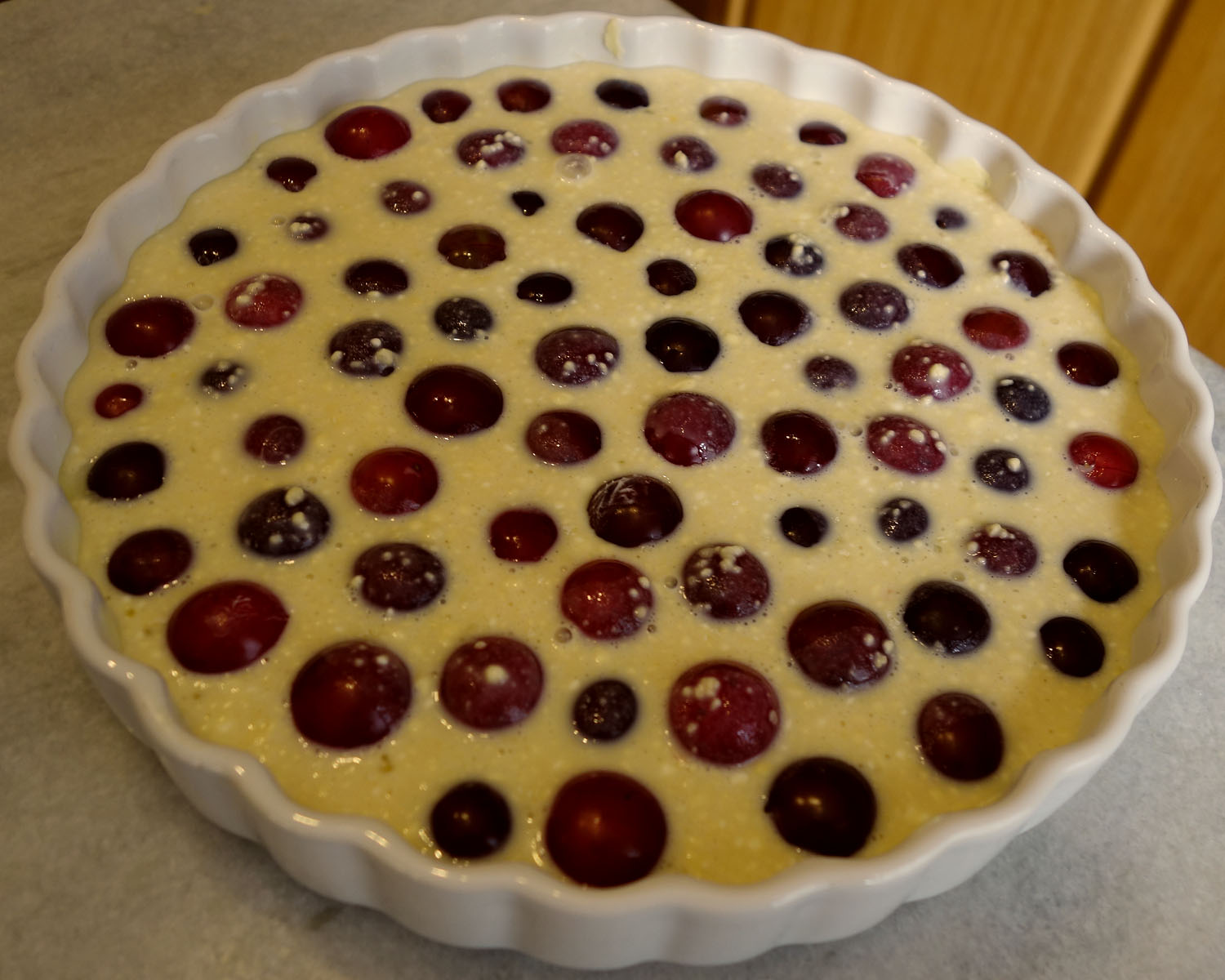
It turns out that baking these plums is perfect, and the way to bake them is in a clafoutis. Arrange them in a buttered baking dish, pour on a sort of custard made with eggs, milk, flour, and sugar, and bake the clafoutis in the oven for 40 to 45 minutes. When you eat the clafoutis, the fact that it's basically a soft custard makes it easy to find the plum or cherry pits with your tongue and politely dispose of them. No problem. Delicious. Like eating a seedy watermelon in summertime.


The clafoutis I made yesterday is one I found somewhere as a recipe for a clafoutis aux quetsches. Here's one, in French. There are many more, with photos, here. What are quetsches [kwetch]? They are large, blue or purple damson plums. Large enough that they need to be cut in half and pitted to go into a clafoutis. Not really like my little red plums except in taste. Notice in the photo above how the clafoutis puffs up when you bake it, even though it is not leavened. It will "fall" as it cools, like some kind of soufflé.


Yesterdays plum clafoutis rose up so much that it started to overflow the baking dish. Tant pis. As I said, this is an informal, rustic kind of dessert. The recipe I used calls for 125 grams of flour, 125 grams of sugar, three eggs, and 500 ml of milk to make the custard. There's no crust involved; the floury custard will form its own kind of crust around the edge of the baking dish. I just noticed that I made a clafoutis with little yellow mirabelle plums six years ago and posted the recipe here. I like to eat clafoutis and most desserts with a spoon, but you can eat it with a fork if you want to.

19 June 2020

La maison de la voisine


This is the view from our back gate, looking toward the left. It's a part-time neighbor's house. In other words, it's used as a vacation place — une résidence secondaire. When we first moved here in 2003, the house was lived in full time by a woman who died about 10 years ago at age 95. Her son and daughter inherited the house and the son bought out his sister. Then he passed away (cancer). His wife, who lives — as they both did —  in the Paris area, now has a lifetime right to live in the house, I believe. She has children and grandchildren who will inherit the house when the time comes. Under French law, children cannot be disinherited by their parents. The neighbor is in her early 70s, like me.

Partly because of the coronavirus pandemic, I assume, the neighbor has not driven down here from Paris since last fall. We had a very rainy winter, and such weather does not encourage city people who own houses out in the country to come spend time in them. Just as the weather started to improve in March, France declared the grand confinement, requiring people to stay at home. Travel to a résidence secondaire was not allowed. So here's what the neighbor's yard looks like now. Nobody is tending to it.


Despite all that, the many rose bushes in the neighbor's yard have been covered in blooms over the past three months. Only now, after three weeks of rainy, gray, and almost chilly June weather, have some of the roses started to show signs of stress. These red ones are still looking good.


And these pink ones are right next to them. They grow between the road and the low wall that surrounds the neighbor's yard. She also owns a strip of land out behind her house and yard that has five or six apple trees growing on it. The grass and weeds under those trees is now chest high.


We walk by the neighbor's yard every time we go out into the vineyard with Natasha the Sheltie. It's been beautiful and it's too bad the part-time neighbor hasn't been able to enjoy it. I have no idea when she might come back to Saint-Aignan, or if — ne parlons pas de malheur ! — she might have contracted Covid-19. If she had, somebody would probably have told us.


Not all the rose bushes look as healthy as the ones above, of course. This one, for example, has seen better days. I assume the neighbor suspects that her yard is in sad shape. She must be trying to get somebody to come clean it all up, but I'm sure that's not an easy task when you live three or four hours away. Personally, I think having two houses to look after would, in practicality, be a real pain in the neck. Not to mention expensive and a source of stress...

18 June 2020

Une boule de pain complet


I made another « boule » loaf yesterday morning, this time with farine complète (whole wheat flour). Actually, I used a mixture of about two-thirds whole wheat flour (type 110) and one-third bread flour (type 65). I made the bread with yeast from China that I ordered from amazon.fr.


I used the same bread-making method that I used earlier in the week: make a "high-hydration" dough, with 80% of the amount of water by weight based on the amount of flour. In this case, it was 400 grams of flour and 320 grams of water. The dough was very sticky but I was able to shape it on a floured work surface. I baked it in a covered, pre-heated pot in a hot oven (450ºF, 230ºC). Here's the result.


This is my boule alongside two baguettes that Walt bought at the village bakery yesterday. It's always good to have bread on hand. In our experience, bread like this freezes very well. Thawed and then heated up at low temperature in the oven, it tastes as fresh as when you have just bought it home from the boulangerie.


Another photo of the same boule — we didn't eat any at lunchtime, because it was still too hot and fresh to slice.


But we did slice the boule in the evening, toasted the slices, and enjoyed them with some rillettes (potted pork, French style) and cornichons (pickled gherkins).