I'm going out today to start the New Year. I have to go to the pharmacy, so I'll be able to wish a Bonne Année to all the employees there. I've gotten to know the six or seven of them over the past 7½ years — to the point where a few of them always shake my hand when I go in, rather than just say bonjour.
Then I'm going to go over the village of Seigy to buy some wine from the vigneron whose rosé and Gamay red wines we prefer over all the others we've tried in the area. Again, I've gotten to know the man, his wife, and his daughters over the years.
On Saturday I'll go to the morning market in Saint-Aignan to greet the vendors who I buy products from most often. Then I need to go over the the garage one day soon and make an appointment to have the car worked on one more time — before Christmas they couldn't do the front-end alignment because there was a part they needed to order first. That'll be another round of Bonne Année greetings.
Meanwhile, I'm trying to get my U.S. Social Security pension set up. I turn 62 in March, so I should be able to start collecting my pension on April 1. A couple of months ago, I went on line and saw that nowadays you can apply for your SSA pension over the Internet. That seemed easy enough. And then I got a letter from SSA saying I ought to apply three months in advance of the date when I expect to start receiving payments.
So last week I went back to the Social Security Administration's web site and started working through the process. It only took a minute for me to find out that I was not eligible to apply for benefits on line. Why? Because I don't live in the U.S. My primary residence for tax and legal purposes is here in France.
The instructions told me I needed to contact the Federal Benefits Unit at the embassy in my country of residence. The link showed me that I could contact that office, which is in Paris, either by phone or by e-mail. I sent an e-mail. I got a couple of responses from an agent there who said he'd call me. I'm still waiting for that call. I guess I'll have to phone the FBU in Paris this morning if I don't get a call today.
Everything international gets complicated really fast. Straddling two cultures, two legal systems, two tax systems, and two currencies makes nearly everything twice as hard to deal with. You have to get used to that if you come to live here.

04 January 2011


03 January 2011
Gâteau de riz – rice pudding
One of my favorite rice pudding recipes is this one (in French, it's a gâteau de riz or "rice cake"). You make the pudding on top of the stove and then you put it in a caramelized mold and let it set up in the refrigerator. I think a pyrex loaf pan makes a good mold, because with pyrex you can make the caramel in the microwave right in the loaf pan itself. An other way to do it would be to make the caramel in a saucepan on top of the stove and then pour it into the loaf pan.
The recipe doesn't have any eggs in it. It calls for milk, which I assume to be whole milk. Since I usually have only skim milk in the house, I always add some cream to enrich the pudding. This time, I put in 40 cl of liquid cream (30% butterfat) and 60 cl of skim milk (0% butterfat).
 The caramel in the cake pan liquefies in contact
with the cooked rice mixture and gives good flavor.
The recipe also calls for a vanilla bean, but a teaspoon of American-style vanilla extract works just fine. I used riz rond — short-grain rice — because I like its texture cooked this way, but I'm sure long-grain rice would be good too. The recipe doesn't specify a type of rice.
Speaking of the recipe, it comes from the little Cuisine pour toute l'année cookbook written by a woman named Monique Maine and published in Paris in 1969. I use this book all the time. It's full of simple recipes that are quick and easy to make. Here's the rice pudding recipe:

And a fairly literal translation:

The recipe doesn't have any eggs in it. It calls for milk, which I assume to be whole milk. Since I usually have only skim milk in the house, I always add some cream to enrich the pudding. This time, I put in 40 cl of liquid cream (30% butterfat) and 60 cl of skim milk (0% butterfat).
 The caramel in the cake pan liquefies in contact
with the cooked rice mixture and gives good flavor.
The recipe also calls for a vanilla bean, but a teaspoon of American-style vanilla extract works just fine. I used riz rond — short-grain rice — because I like its texture cooked this way, but I'm sure long-grain rice would be good too. The recipe doesn't specify a type of rice.
Speaking of the recipe, it comes from the little Cuisine pour toute l'année cookbook written by a woman named Monique Maine and published in Paris in 1969. I use this book all the time. It's full of simple recipes that are quick and easy to make. Here's the rice pudding recipe:

And a fairly literal translation:
Finally, here is the recipe in American format:Monique Maine's Rice Pudding
1 teacupful of rice, 1 liter of milk, 1 vanilla bean, 175 grams of granulated sugar, 12 lumps of sugar, half a glass of water
Pour the rice into a strainer; wash it under running water. Drain it. In a big saucepan, boil the milk with the granulated sugar and the vanilla bean, split open. Pour the rice into the boiling milk, turn down the heat. Cook on very low heat for about 45 to 50 minutes, stirring once in a while. At the end of this time, the rice is cooked; turn off the heat. In a high-sided cake mold, make a golden caramel sauce using the 12 sugar lumps and the water, spread it all over the bottom and sides of the mold, which you will fill with rice. Let it cool, put it in the refrigerator for at least 3 hours. Unmold when ready to serve.

Rice pudding in a caramelized moldFor the rice pudding:
1 cup rice
1 quart milk (or half-and-half)
1 tsp. vanilla extract
¾ cup sugar
To caramelize the mold:
4 Tbsp. sugar
3 Tbsp. water
Put the rice in a wire strainer and rinse it thoroughly in running water. Drain it and set it aside.
In a big saucepan, put the milk on to boil. Add the sugar and the vanilla extract. When the mixture comes to the boil, add the rice and turn down the heat to the lowest setting. Let it cook very slowly for 45 to 50 minutes, stirring occasionally. When it's cooked, take it off the heat.
Make a caramel sauce in a loaf pan. You can do it in the microwave: put the sugar and water in the bottom of a pyrex pan. Put it in the microwave oven on high heat for three or four minutes. Watch it carefully — it will burn in an instant. When the sugar starts to turn golden brown and thicken up, take the mold out of the oven and turn the pan from side to side so that the caramel coats the sides of the pan an inch high or so.
When the caramel has cooled slightly and firmed up, spoon the rice pudding into the mold. Press it down with the back of a serving spoon and smooth off the top. Let it cool and then put it in the refrigerator for at least three hours. The caramel will liquefy and make it easy to unmold the rice "cake" — when you're ready to serve it, turn it over on a plate or platter. Be careful, the caramel will be liquid and will go all over the place! Cut slices of the cake and serve with a little caramel sauce.
02 January 2011
All about oysters
Just now, looking for an English name for the oysters that are commonly called « huîtres creuses » in France, I came across a very good web site about oysters. Here's a link. The author, John McCabe, has done a great service for us English-speakers who want to describe and discuss oysters and the oyster industry in France.
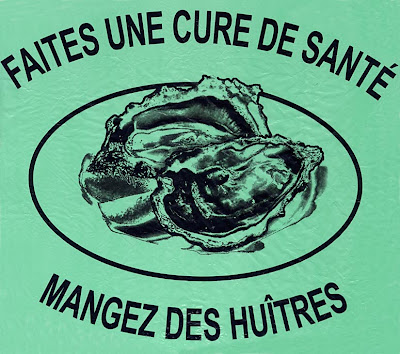 "Eating oysters is good for what ails you."
Huîtres creuses literally means "hollow oysters" or maybe "bowl-shaped oysters." These are oysters that have one shell that is deeply concave or "cupped" — the other is much flatter, and it fits over the top of the cupped shell like a lid on a bowl. In English, however, "hollow oysters" — and they aren't really hollow, because the succulent oyster flesh is inside there — are just called "Pacific oysters."
 Red wine vinegar with chopped shallot and black pepper makes
a mignonnette sauce that's good with oysters on the half shell.
That's where the species came from — the Pacific Ocean. The history of the French oyster business is fairly complex. The oysters that make up by far the largest portion of the total haul in France were imported to French waters from Japan a couple of decades ago. That's because the native French oysters had been nearly fished out and then decimated by a parasite.
 Don't forget to eat your oysters...
The Pacific oysters we had for our New Year's Eve dinner were my favorite ones. They are produced down near the town of Marennes, which is on the mainland just across from the tip of the Ile d'Oléron. That's between La Rochelle and Bordeaux on France's Atlantic coast. Walt and I spent a week on the island in 2008 and I blogged about it here.
 Our platter of Pacific oysters from Marennes-Oléron
We actually had two kinds of Pacific oysters in the batch we enjoyed consuming on December 31. The ones we paid for were Pacific oysters "fattened" in salt ponds called « claires », and are known as « fines de claires » [feen-duh-KLEHR] — fines because they are "fine" or "refined" oysters. The claires are man-made basins dug out of the mud in salt marshes along the coast. They're fairly small, Mr. McCabe says, at about 500 square meters (say 50 x 100 sq. ft.), and they are shallow — maybe 1 or 2 feet deep.
 « Fines de claires » oysters
Oysters are gathered in the beds in coastal waters where they breed and live and they are put into these salt ponds to fatten up under nearly ideal conditions. Like fine French cheeses, oysters go through a process of « affinage » or "refinement" before they are taken to market. Cheeses kept in proper conditions of temperature and humidity improve with age, and oysters that spend two or three months in salt ponds to feed and fatten up also benefit greatly. In the ponds, they are not subjected to tides and currents that can at times leave the oyster beds high and dry, and leave the oysters exposed to the hot, baking sun for hours at at time.
So we bought a dozen and a half fines de claires oysters, and as a bonus the vendor selling them at the market threw in a few oysters of the same variety that had not been fattened in claires. Those are called « huîtres de pleine mer » — "open-sea oysters" that are gathered out in the offshore beds. Some people say they like them better because they taste more natural and wild — and of course they are less expensive.
 Huîtres plates (and a few huîtres de pleine mer on the right)
We also bought a dozen « huîtres plates » — the "flat oysters" that are the original Northern European species. These native oysters were nearly fished to extinction in the last century, and then a parasite decimated the remaining population. They were first replaced in France by oysters imported from the waters off Portugal and that were actually more like the Pacific "cupped" oyster. Then the « huîtres portugaises » also caught a disease and were wiped out too. That's when new seed oysters were brought in from the Pacific Ocean — about 40 years ago.
The native French flat oysters are also called « belons » because they were originally cultivated and fattened at the mouth of the Belon river in Brittany. Only ones that have been farmed and fattened in Brittany can legally be called belons in France — the same oysters that come from other areas (like Marennes-Oléron) are just huîtres plates.
 After eating raw oysters, a nice escarole salad with croûtons,
bacon, and a garlicky vinaigrette dressing can be refreshing.
I thought the flat oysters we bought had a muddy taste compared to the crisp, clean taste of the fines de claires. Maybe it was just those particular ones, because the flat oysters are reputed to have a distinctive metallic taste and to be saltier (plus iodé) than the fines de claires. I didn't find that to be the case. I'll probably stick to fines de claires from now on. But maybe I will soon try some real belons from Brittany.
 "Eating oysters is good for what ails you."
Huîtres creuses literally means "hollow oysters" or maybe "bowl-shaped oysters." These are oysters that have one shell that is deeply concave or "cupped" — the other is much flatter, and it fits over the top of the cupped shell like a lid on a bowl. In English, however, "hollow oysters" — and they aren't really hollow, because the succulent oyster flesh is inside there — are just called "Pacific oysters."
 Red wine vinegar with chopped shallot and black pepper makes
a mignonnette sauce that's good with oysters on the half shell.
That's where the species came from — the Pacific Ocean. The history of the French oyster business is fairly complex. The oysters that make up by far the largest portion of the total haul in France were imported to French waters from Japan a couple of decades ago. That's because the native French oysters had been nearly fished out and then decimated by a parasite.
 Don't forget to eat your oysters...
The Pacific oysters we had for our New Year's Eve dinner were my favorite ones. They are produced down near the town of Marennes, which is on the mainland just across from the tip of the Ile d'Oléron. That's between La Rochelle and Bordeaux on France's Atlantic coast. Walt and I spent a week on the island in 2008 and I blogged about it here.
 Our platter of Pacific oysters from Marennes-Oléron
We actually had two kinds of Pacific oysters in the batch we enjoyed consuming on December 31. The ones we paid for were Pacific oysters "fattened" in salt ponds called « claires », and are known as « fines de claires » [feen-duh-KLEHR] — fines because they are "fine" or "refined" oysters. The claires are man-made basins dug out of the mud in salt marshes along the coast. They're fairly small, Mr. McCabe says, at about 500 square meters (say 50 x 100 sq. ft.), and they are shallow — maybe 1 or 2 feet deep.
 « Fines de claires » oysters
Oysters are gathered in the beds in coastal waters where they breed and live and they are put into these salt ponds to fatten up under nearly ideal conditions. Like fine French cheeses, oysters go through a process of « affinage » or "refinement" before they are taken to market. Cheeses kept in proper conditions of temperature and humidity improve with age, and oysters that spend two or three months in salt ponds to feed and fatten up also benefit greatly. In the ponds, they are not subjected to tides and currents that can at times leave the oyster beds high and dry, and leave the oysters exposed to the hot, baking sun for hours at at time.
So we bought a dozen and a half fines de claires oysters, and as a bonus the vendor selling them at the market threw in a few oysters of the same variety that had not been fattened in claires. Those are called « huîtres de pleine mer » — "open-sea oysters" that are gathered out in the offshore beds. Some people say they like them better because they taste more natural and wild — and of course they are less expensive.
 Huîtres plates (and a few huîtres de pleine mer on the right)
We also bought a dozen « huîtres plates » — the "flat oysters" that are the original Northern European species. These native oysters were nearly fished to extinction in the last century, and then a parasite decimated the remaining population. They were first replaced in France by oysters imported from the waters off Portugal and that were actually more like the Pacific "cupped" oyster. Then the « huîtres portugaises » also caught a disease and were wiped out too. That's when new seed oysters were brought in from the Pacific Ocean — about 40 years ago.
The native French flat oysters are also called « belons » because they were originally cultivated and fattened at the mouth of the Belon river in Brittany. Only ones that have been farmed and fattened in Brittany can legally be called belons in France — the same oysters that come from other areas (like Marennes-Oléron) are just huîtres plates.
 After eating raw oysters, a nice escarole salad with croûtons,
bacon, and a garlicky vinaigrette dressing can be refreshing.
I thought the flat oysters we bought had a muddy taste compared to the crisp, clean taste of the fines de claires. Maybe it was just those particular ones, because the flat oysters are reputed to have a distinctive metallic taste and to be saltier (plus iodé) than the fines de claires. I didn't find that to be the case. I'll probably stick to fines de claires from now on. But maybe I will soon try some real belons from Brittany.
01 January 2011
Say it now!
One night this week on the TF1 evening news, the anchorman announced that it is permissible, according to les bonnes manières and people who practice them, to express happy new year wishes starting on December 26!
Until now, the rule in France has always been that expressing such wishes prior to midnight on December 31 was bad form. I guess that's a French custom (or superstition) that is changing. Fact is, nearly everybody here is still very careful not to say Bonne Année before January 1. If somebody does say it, he or she apologizes or qualifies the expression to acknowledge that a rule is being broken.
One French friend who now knows a lot of "Anglo-Saxon" expatriates in the Touraine region told me the other day that she now has to cope with expressing two sets of holiday greetings at year's end. The Anglo-Saxons expect a Christmas card and a Merry Christmas, whereas French people are indifferent to Christmas greetings of that sort. Sending Christmas greetings is just not important in the culture. People might say « Bon Noël » to you in the shops and markets on December 23 or 24, but they might as well be saying « Bon appétit ! » The family dinner on Christmas Eve is sacrosanct. Meanwhile, you won't get any Christmas cards from friends and neighbors.
French people do celebrate Christmas, of course. It's a family holiday, are religious holiday. It has become more commercialized, with present-buying, especially for children, at fever pitch in the days before December 25. There are decorations and lights in the cities, towns, and villages, and even on some houses, at Christmastime. But the holiday itself is a private affair.
However, French people do expect new year's greetings in January. This month, it is very important and polite to seek out friends, close acquaintances, neighbors, and others who are important to your daily life and "present your best wishes" — presenter vos meilleurs vœux — to them for a happy and healthy 2011. A telephone call will do, and it's nice to send a Happy New Year card to special people. You have until January 31 to express or send greetings and wishes, I've been told. Don't mention prosperity, however, the way we Americans tend to do. Talking about money is in bad taste.
So today I can finally say it:
Until now, the rule in France has always been that expressing such wishes prior to midnight on December 31 was bad form. I guess that's a French custom (or superstition) that is changing. Fact is, nearly everybody here is still very careful not to say Bonne Année before January 1. If somebody does say it, he or she apologizes or qualifies the expression to acknowledge that a rule is being broken.
One French friend who now knows a lot of "Anglo-Saxon" expatriates in the Touraine region told me the other day that she now has to cope with expressing two sets of holiday greetings at year's end. The Anglo-Saxons expect a Christmas card and a Merry Christmas, whereas French people are indifferent to Christmas greetings of that sort. Sending Christmas greetings is just not important in the culture. People might say « Bon Noël » to you in the shops and markets on December 23 or 24, but they might as well be saying « Bon appétit ! » The family dinner on Christmas Eve is sacrosanct. Meanwhile, you won't get any Christmas cards from friends and neighbors.
French people do celebrate Christmas, of course. It's a family holiday, are religious holiday. It has become more commercialized, with present-buying, especially for children, at fever pitch in the days before December 25. There are decorations and lights in the cities, towns, and villages, and even on some houses, at Christmastime. But the holiday itself is a private affair.
However, French people do expect new year's greetings in January. This month, it is very important and polite to seek out friends, close acquaintances, neighbors, and others who are important to your daily life and "present your best wishes" — presenter vos meilleurs vœux — to them for a happy and healthy 2011. A telephone call will do, and it's nice to send a Happy New Year card to special people. You have until January 31 to express or send greetings and wishes, I've been told. Don't mention prosperity, however, the way we Americans tend to do. Talking about money is in bad taste.
So today I can finally say it:
Très Bonne Année à Toutes et à Tous.
En vous souhaitant une année 2011
pleine de joie et de bonheur —
et surtout bonne santé ! —
je vous envoie tous mes bons vœux...
Happy New Year
En vous souhaitant une année 2011
pleine de joie et de bonheur —
et surtout bonne santé ! —
je vous envoie tous mes bons vœux...
Happy New Year
Subscribe to:
Posts (Atom)