02 March 2006

Lunch in Blois

Over the weekend Mme V. called and invited us to come for lunch on Wednesday at her new apartment in Blois. Mme V. is the woman who recently sold her house in the country to friends of ours from California. We met her last September, and this was the first time she had invited us over to her place. She had lived in the country, 10 miles south of Saint-Aignan, for eight years, after a career in the Paris area. She decided last year to leave the country, where she was lonely, and move to the “city.”

To my eyes, Blois doesn't really qualify as a city. It is a large town, population 75,000 or so. That said, it is the biggest town in our département, and is the administrative capital.

Panorama of Blois taken from the south bank of the Loire river
(click on the picture to see a larger view)

We drove up to Blois yesterday morning. Weather reports called for snow, but it was bright and sunny when we left Saint-Aignan at 11:00 a.m. We stopped at the Intermarché in Contres to fill the fuel tank and buy a bouquet of flowers to present to Mme V. when we arrived at her house.

It takes about 45 minutes to drive to Blois from our house. It’s only 25 miles, but you have to drive through the middle of several towns and villages along the way — Saint-Romain, Couddes, Contres, Cormeray, and Cellettes — so it’s slow going. There always seems to be some road works project going on as well, so that slows you down.

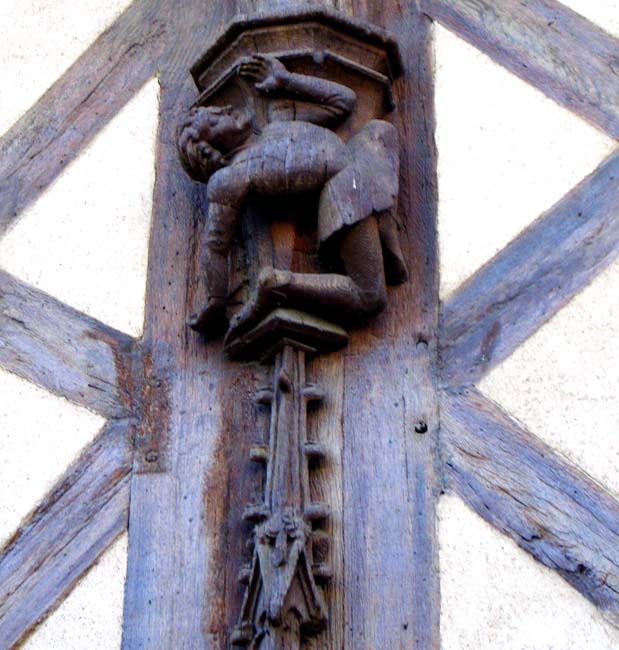
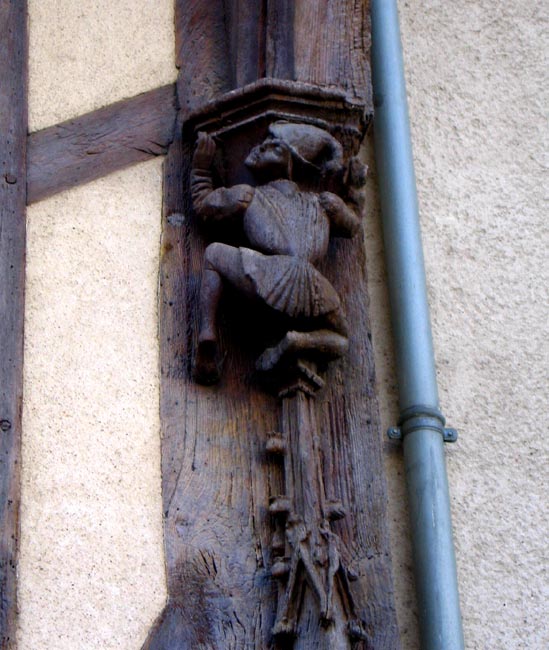
An old half-timbered house near the cathedral and,
below, architectural details from the same house


The town of Saint-Romain, a wine village, has been redoing its main street for more than a year now, putting in stone curbs and dozens and dozens of head-in parking spaces along the road. It’s a small village with no tourist attractions or supermarkets, so I don’t know who they think will ever park there.

Contres is a town (population 3,000, maybe) with a very narrow main street that is also the highway to Blois. If two big trucks try to pass at the same time, the roadway is too narrow and sometimes one driver has to back up and let the other pass through the narrow section before he can proceed. It happens more often than you’d think, and it ties up traffic for a few minutes. There is no bypass around the town.

Central Blois, with the cathedral dominating the old town.
By afternoon, clouds had rolled in and there were snow showers.

In Cellettes, closer to Blois, there’s a big canvas banner strung across the road with a message saying that 15,000 vehicles pass through there every day and demanding that a bypass be built to take traffic out of the center of the town.

Anyway, we made it to Blois in the usual amount of time. There’s a big road construction project going on there too, on the east side of town, which is how we get into town. That is another bottleneck.

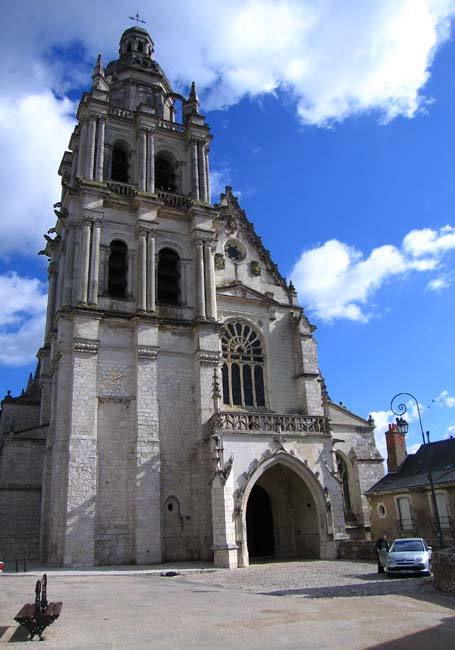
La Cathédrale St-Louis à Blois

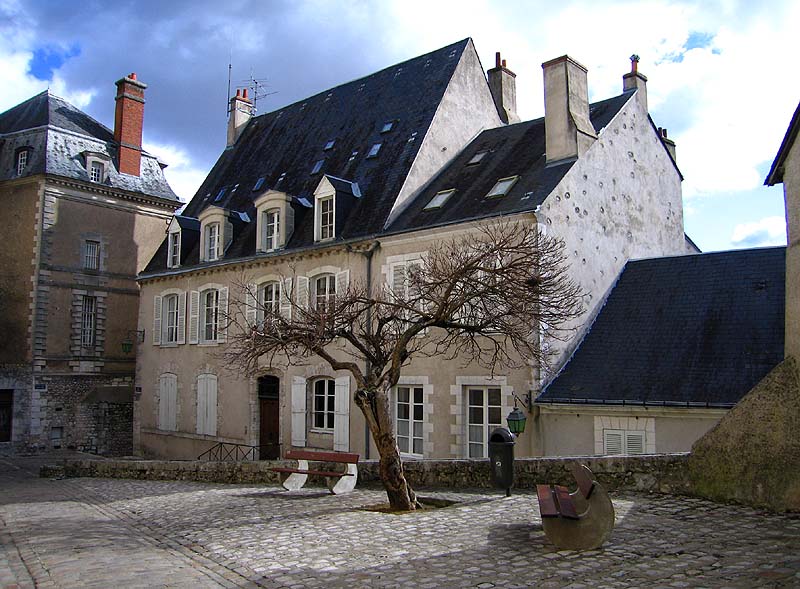
Mme Vallée lives near the cathedral in the old part of Blois. We hadn’t been to her apartment before. She just moved in December. I wasn’t sure what kind of building it would be. Somehow I had in my head that it would be a modern apartment in a fairly new building. But it wasn’t. It’s a nice old stone building, as you can see in the pictures posted here.

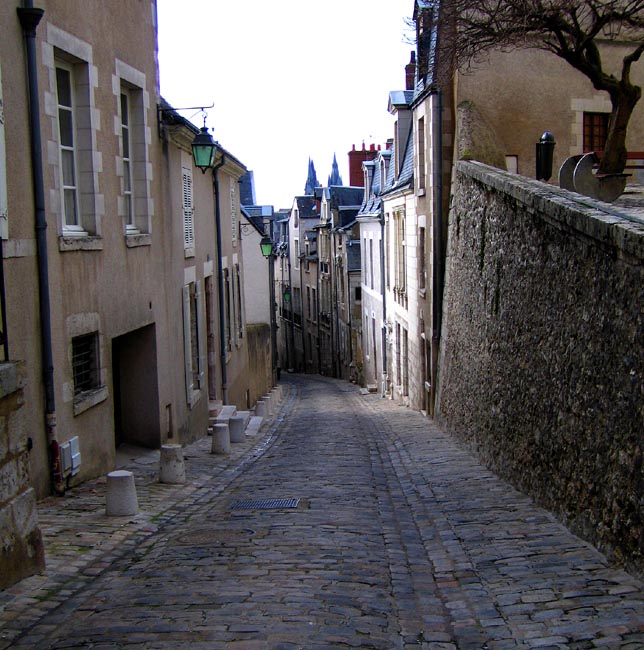
We parked near the cathedral, at the top of the hill, at noon. We hadn’t studied the map carefully enough, and we ended up walking down the wrong street, all the way to the bottom. We realized our mistake and had to walk all the way back up on a steep, cobblestone street.

This is the street we had to walk up after we got lost.

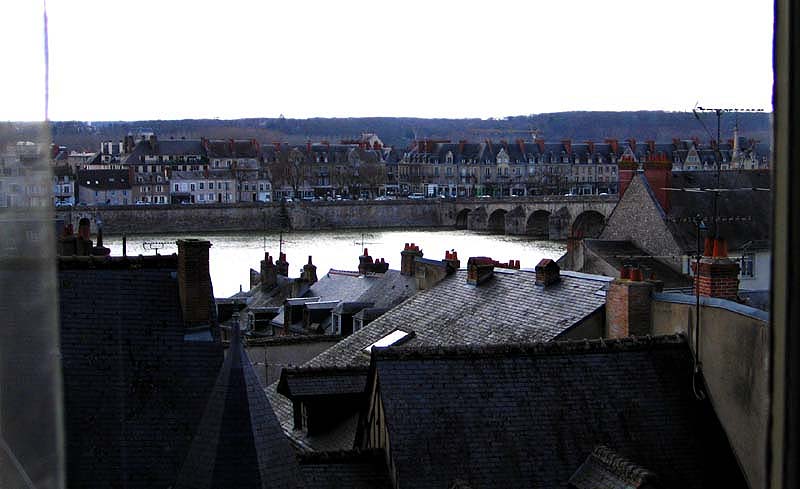
Mme. V. has a very nice old apartment. From the living room window, there’s a fine view out over the rooftops of the old town, down to the Loire and the town’s old bridge. The window faces south, so it’s very bright, and you can see the horizon on the other side of the Loire, which is nice.

The view from the living room window in the apartment

There were four of us for lunch. Mme V. had invited a friend named Mireille who lives near Montrichard but is thinking about selling her house and buying one in Chinon, on the other side of Tours.

This is the building our friend's apartment is in

We had a kir as an apéritif before Mme V. served lunch. Lunch itself started with an appetizer of céleri rémoulade (shredded celery root in a mustard sauce) and sliced avocados. The main course was braised beef with mushrooms and potatoes. Then came salad and a couple of cheeses (one a local goat cheese, the other a comté or gruyère from the Alps). Dessert was an apple tart Mme V. made. She spread some cherry preserves over the top to glaze the apples. It was all very good, I thought. Oh, and the wine was a 1993 St-Emilion from the Bordeaux area. We had coffee after dessert. This was a very typical French meal.

Mme V. seems happy in her apartment, and it is beautiful, but she says she misses being in the country. In Blois, she says, she can walk to the cinema, as well as to a couple of theatres to see plays. She can also walk to the train station and catch the train to Paris, which is less than two hours distant. She has children and grandchildren who live there, near Vincennes. Her daughter-in-law is American.

Blois is an old royal town. There is an enormous château, which was built over the centuries and includes buildings and wings in a variety of architectural styles -- medieval, Gothic, Renaissance, and Classical. The cathedral was almost completely destroyed by a violent windstorm in 1678, according to the Michelin Guide, and rebuilt in Gothic style. City hall and a big rose garden are located just behind the cathrdral, and from there you get great views of the town and the river.

The Eglise St-Nicolas and an old convent on the banks of the Loire in Blois

I’m just starting to discover Blois, after living here for nearly three years. Up to now, it has seemed to me to be a large town with all the disadvantages of a city -- traffic, mainly -- but few of the advantages. Maybe it’s because our trips to Blois often involve going to the train station on the edge of town to pick people up or drop them off, to the police headquarters to get our residency papers, to the big shopping center in what is charmingly called the zone industrielle south of town, and to the hospital to visit friends who are ill. And just getting to Blois sometimes feels like a chore, as I described above.

Last August we had lunch with our other friends who live in Blois but own the house across the street from us. They took us on a walk around the old town in the afternoon. I was surprised to see the steep old cobblestone streets and the panoramic views. We also had a very nice Thanksgiving dinner at another friend's house in Blois. The town has a lot more charm than I had realized.

28 February 2006

A typical morning in Saint-Aignan

Last night the weather report on France 2 television said we were going to have snow here (and in Paris) beginning at about 3:00 a.m. When I got up at 7:00 or so, there was no snow. The sky was gray and there was a gusty wind, but that was all.

At about 10:00, I left home to go run some errands in Saint-Aignan and across the river in Noyers. Saint-Aignan is all of two miles from the house. When I got there, the street that forks off the river road and leads to central Saint-Aignan was barricaded. There were several EDF (Électricité de France) and GDF (Gaz de France) trucks in the intersection, along with one firetruck and a Gendarmerie vehicle.

People were hanging out their windows watching the scene in the street below, which I couldn't see. I noticed one of my neighbors, Ludovic, who works for the municipality, out directing traffic, and waved at him. There was a woman out taking pictures of the curb and roadway, where they seemed to be digging a trench. I could see the flash of her camera. There were big metal barricades closing off the streets. I still don't know what was going on, but it was big excitement for Saint-Aignan.
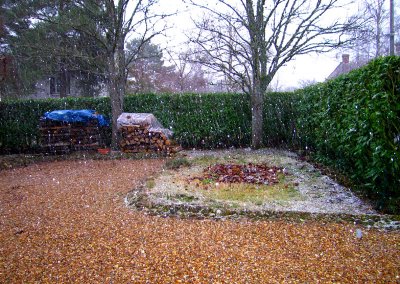
We had big snowflakes for a few minutes this afternoon.

I drove on along the river, hoping to take the next road into town. It's just a couple of blocks, but it too was blocked off -- by a Gendarmerie vehicle. The gendarme himself was standing there to make sure nobody tried to turn onto that street. I saw a parking space on the opposite side of the road, but I was afraid to try to take it by driving in from the wrong direction or making a U-turn, because the gendarme might give me a ticket.

Last Saturday I heard a song on the radio that said:

Quand un gendarme rit,
Dans la gendarmerie,
Tous les gendarmes rient,
Dans la gendarmerie...

The third street into town was clear. It's a very narrow lane between two buildings, but just a couple of hundred meters in there is a small parking lot. Luckily, there was a space free. It was only a short walk up to the pharmacy and the optical shop, where I had business to do.

The pharmacy was relatively crowded, but there are five or six employees in the shop so I didn't have to wait long. I said bonjour to the blonde woman there who is always friendly and smiling. I didn't see Madame Smith, the pharmacist whose husband is Scottish and who usually comes out and shakes my hand in greeting when I enter the shop.

After a minute, one of the three men who work there, the short young one, waited on me. I was picking up monthly prescriptions for myself and Walt, so there was a list of them. (Getting old is hell.) I waited for a while, and I noticed the pharmacist searching shelf after shelf in the back of the store, behind the counter. He finally went to the computer and looked something up. Then he came over and told me that one of my medications was out of stock. "Don't worry," he said, "I'll go to the pharmacy down the street and get some for you. I won't be long."

I told him I had an errand to run across the street, so I would go get that done and come right back. That was fine.

The boutique across the street from the pharmacy is an optical shop. My favorite pair of glasses was giving me trouble. The right lens kept falling out when I was cleaning it. I tried to tighten the screw myself so that it would stay in, but to no avail. When I walked into the shop, the optician on duty was waiting on a woman who was getting glasses for her son, who lives in the Alps, from what I gathered.

He had put his glasses in his pants pocket when he went out skiing and had somehow broken them, she said. He sent them to his mother, who took them to be repaired. She chatted with the optician, telling her how her house was lonely now because her son was in school in the Alps and her husband was off on an extended business trip. Her only company was her cat, and it wasn't a very good conversationalist. As the two women chatted, the optician carefully packed the repaired glasses into a box and started to tape it up, but the woman said no, I have a note I wrote to my son that I want to put in the box. So she reopened it, took the glasses back out, waited while the customer carefully folded her note to fit, and the put everything back in the box. The note needed to go on the bottom, she pointed out.

After she put about 25 pieces of tape on the box to seal it well, she told the customer woman that she should send it via Colissimo at the post office. That would be the fastest way, even though the post office would not guarantee next-day delivery. That was a thing of the past, she said. But it was the best she could do. If you go to the post office right now, she said, your son might have his glasses back by Thursday. Oh no, I don't have the address with me, the woman said. I have to go home to get it first. I'll try to get back to the post office later, or tomorrow.

Time was passing very slowly, I thought.
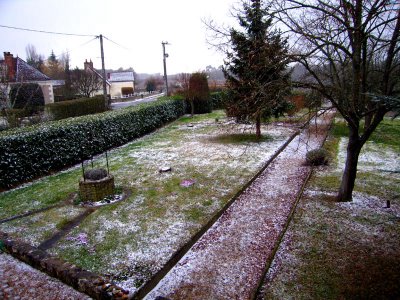
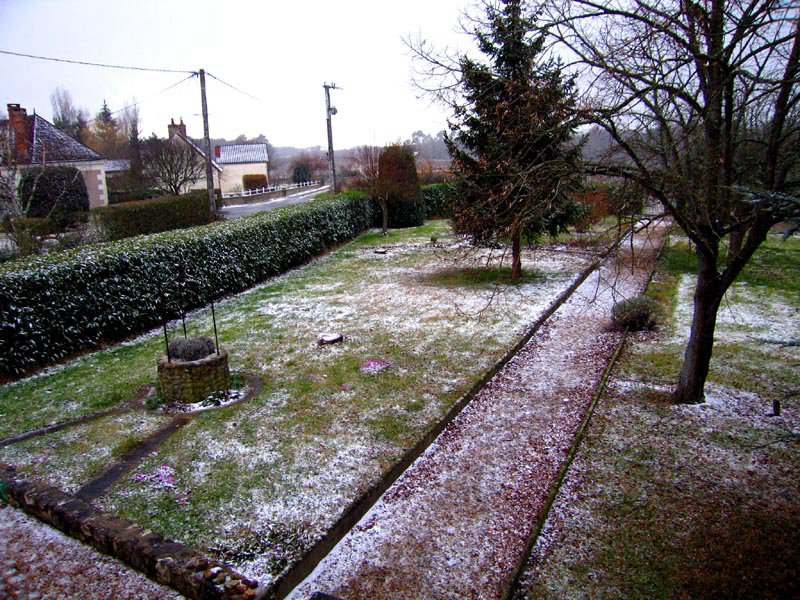
We got our usual light dusting of snow on the back yard.

The next customer was an older man who was a little confused by the whole process of dealing with an optician, I thought. He went and sat at the little table where the optician has her computer and the tools she uses to fit glasses. He handed her his prescription.

Do you have your social security card with you? she asked. He seemed confused again. What's that? You know, the little green card. Let me look, he said. He pulled a bunch of cards and papers out of his wallet, but the optician said none of them was the card she needed. You know, your carte vitale, she said. That's what they call the card you present at the pharmacy or the doctor's here so that you don't have to pay. It's all covered by the national healthcare system.

Oh that, he said. I think it's in here with the medications I just picked up at the pharmacy across the street. I sat listening and looking out the window at the street scene. There was a steady stream of passers-by, many of them entering or leaving the pharmacy. A woman pulled up in a navy blue Renault and parked it on the street right in front of the pharmacy's side door. She turned on her emergency flashers and got out. Oh, she's going to pick up a prescription, I thought, and she'll be right out. Instead, she locked the car and headed off down the street on foot, disappearing from view. Her car was parked on a corner, blocking not only the door to the pharmacy but also making it hard for other cars to turn the corner onto the main shopping street. All the streets are very narrow.

The social security card conundrum was nearly worked out by now. It turned out the man didn't have a carte vitale from the national healthcare system but had some other piece of paper, proof that he had special insurance of some kind. The optician seemed satisfied. Let me see your glasses, she said. He took them off and showed them to her. One of the ear pieces was broken off toward the back. It was the plastic piece that sits on your ear that was gone. Did you eat it? she asked. He chuckled and said no, he had dropped his glasses and stepped on. It was broken, so he threw it away.

Meanwhile, another car pulled up and parked on the optician's side of the street. It was a red Peugeot, and between it and the Renault there was a very narrow passageway for cars that wanted to turn onto the side street. Several did, but they had to go very slowly and carefully. The woman in the red Peugeot, in her 60s like the other woman, stayed in her car. She was talking on her cell phone. It's against the law to talk on a phone while you're driving in France, so often you see people pulled off on the side of the road or street, sometimes in the most awkward locations, gabbing on the phone. This woman didn't seem to notice that she was creating a hindrance.

The man in the shop said he needed new lenses because he couldn't see well out of the corners of his lenses unless he moved his head to one side or the other. The optician explained that they were progressive lenses, and that they had "blind spots" in them. You have to turn your head to look through the right part of the lens if you want to see clearly, she said. You can't see through the blind spots, the corners. The man explained that his neck was chronically stiff and that he couldn't turn his head that easily. She said she understood that, and was sorry, but that he would just have to turn his whole upper body to get a clear view through the glasses since that was the case. "Il faut jouer de la hanche," she said. They laughed. Or, she said, you could get two pairs of glasses, one for seeing close up and one for seeing far away. But then you'd have to keep switching from one pair of glasses to the other, and that's got its disadvantages too. He said he'd stick with the progressives.

She asked him if he wanted new frames or wanted the old ones repaired. He wanted new ones. Can I keep the old ones? he asked. Of course, she said. They are yours -- you paid for them.
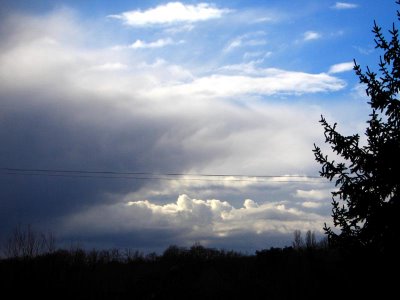
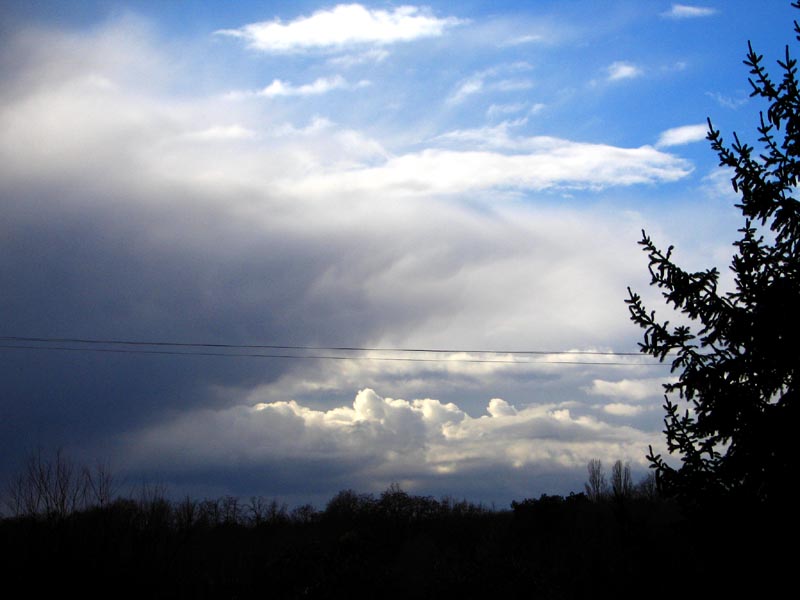
Storm clouds this afternoon

Whew. I was still waiting, and I was wondering if I would get back to the pharmacy to pick up my medecines before it closed for lunch. The woman in the red Peugeot drove away, so traffic started flowing more easily again. I was surprised at the number of cars. Many businesses are closed on Mondays, so I guess Tuesday mornings are especially busy. The navy blue Renault still sat there, blocking the entrance to the pharmacy, with its emergency flashers flashing.

The optician had the man try on three different glasses frames. He put on the first ones, and said he couldn't see very well with them. She explained that there were no lenses in the frames. Just see how they feel on your face, and look in the mirror to see if you like the way they look. Oh, he said, OK. He didn't like the first frames. He liked the second ones better; they were bigger. He asked if she had anything that would keep the wind out of his eyes. She said no, those would be goggles and we don't sell those. He said he bent his glasses at the nosepiece so that the lenses would be closer to his eyes, and that helped a little, but the wind still blew in his eyes. That was a really bad thing to do, the optician said, because you are changing the angle between the lenses and your eyes when you bend the glasses. You can't see as well if you do that. It was quite a discussion.

The navy blue Renault was suddenly gone. It had started snowing. The man was satisfied with the frames he found. I'll call you when your glasses are ready, the optician told him. Call between noon and 2:00, he said, because that's the only time I'm home. For an old codger, he gets out a lot, I guess. OK, I will for sure, the optician said. And the charge will be 646 euros. Wow, I thought, that's a lot. I thought the man had insurance. Whatever. None of my business.

The man wanted to pay immediately. It took a minute before the optician could get him to understand that he would pay later, when he picked up the glasses.

It was finally my turn. It went pretty fast. The optician repaired my glasses so that the right lens doesn't fall out any more. We chatted for a minute. There were no customers after me. She didn't charge me anything. I got the feeling that things were starting to move along again, and the slow-motion scene was over.

I went back to the pharmacy and got my prescriptions. It all went off without a hitch. Then I walked the two or three blocks back to the car, through the mix of snow and rain. The town seemed very gray and dreary, though the shops were brightly lit.

I drove the mile or mile-and-a-half over to Intermarché to exchange a couple of pairs of jeans I had bought last Thursday or Friday. I needed a larger size. Yeah, I know, I should just lose weight. These were the right size, though. It's just that French clothes are cut very tight. I'm not kidding.

First I stopped to put diesel fuel in the car at Intermarché's self-service gas pumps. I stepped out of the car and was blasted by a strong gust of wind carrying a mix of rain and snow. Forget that, I said. I'll fill up later. I got back behind the wheel and drove on over to the supermarket.

I anticipated the worst at Intermarché. The store changed management over the weekend. It was closed on Monday for inventory. It re-opened this morning under the new regime, with one big change: it no longer closes from 12:15 until 2:30 for lunch. SuperU, the big supermarket in Saint-Aignan, had gone over to a journée continue -- staying open all day, through lunch -- a few months ago. I guess Intermarché had to do the same to stay competitive. Things here are changing, and I'm not sure it's for the better. What will the employees do without a two-hour lunch break? Next thing you know they'll open a MacDonald's and everybody will be having fast food for lunch instead of a leisurely, proper meal. More's the pity. I kind of like the idea that all the employees had a home-cooked lunch every day, with their children and grandparents. I guess I'm just starry-eyed.

Exchanging the jeans turned out to be no trouble. They had been on sale last week -- two pairs for €25, which seemed like a good deal. Despite my fears, they were still on sale for that price, and they still had a good selection. I easily found what I needed. I also did some grocery shopping. When I left the store, it was snowing even harder, and the wind, as we say in North Carolina, was blowing a gale.

So it was a pretty good morning, even through the part that seemed to go in slow motion. When I drove back across the bridge into Saint-Aignan, all the electric company and gas company and fire brigade and gendarme vehicles were gone. Everything had settled back down to its normal look and pace. And the jeans fit perfectly. I had to wait to try them on at home because there are no changing rooms at Intermarché.

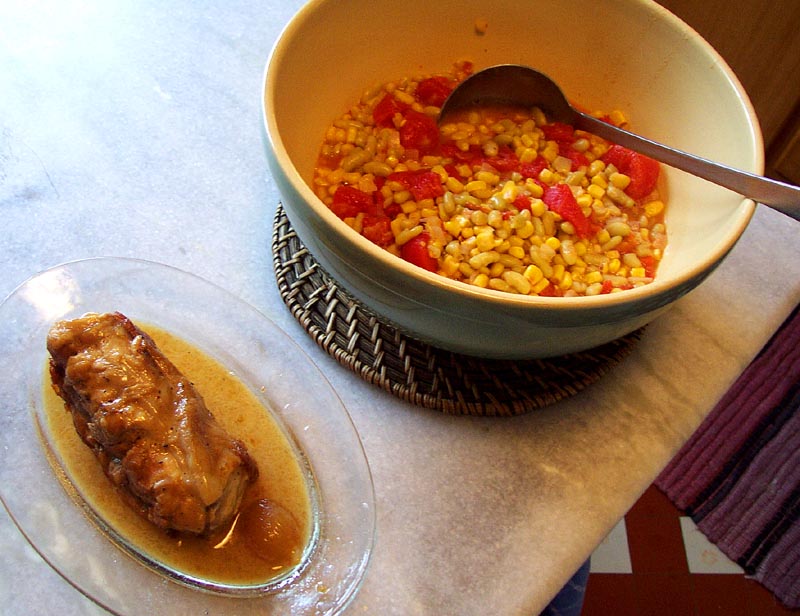
A little pork loin roast and a big bowl of French succotash

I made succotash for lunch. I don't know exactly what made me think of it. I guess I was looking at cans of vegetables in the pantry this morning, wondering what would go with the little pork roast I had in the fridge, when I noticed cans of corn, tomatoes, and flagelot beans. Flageolets are sort of like baby lima beans (or butter beans if you're from the South). The succotash turned out to be pretty good, considering it was all canned vegetables.

25 February 2006

Scaling back and facing the realities

It was a good thing we had planned to have a garage sale and get rid of some clutter. A garage sale was something we had never done before, and Walt especially wasn't enthusiastic about the idea. Two things happened, however, to confirm for us that paring down our belongings was a good idea at this point.

We "opened for business" at 8:00 on a Saturday morning. By 2:00 p.m.
we had sold or given away a lot of stuff. We took in just over $1000 that day.


First, the real estate agent that we had listed with came over and looked around. She knew the house, but she hadn’t seen it in several years. We had had a new kitchen put in, a new wooden deck built out back, and new windows put in front and back. We had also had a lot of painting done, and we had taken out old carpeting to reveal nice hardwood floors that, while more than 30 years old, looked brand new. The roof was new as well.

Jan, our real estate agent, inspected the house and declared that we had some things that would be fine for the showings she had planned. She said she didn’t need to do a radical makeover or a complete staging, as was often done then (and probably still is). However, we had about twice as much stuff in the house as she wanted to see. Take out a lot of it, even if you just store it in the garage for the time being, she said. Get rid of all these big plants. They hide the corners and make the rooms look small. (I was shocked when she said that. I thought the plants really dressed the place up.) Put in a smaller dining room table so that the dining area feels more spacious. Move the pieces of furniture in the family room sitting area closer together so that the room looks bigger. And so on.

Just a sampling of all the stuff we needed to get rid of. We gave a lot of it
away that day, selling things for a nickel here and a dime there.


The next thing that happened was that we contacted a moving company and inquired about having our belongings moved to France. We needed to know how much such a move would cost, how long it would take, and what kinds of customs regulations we would have to deal with. Friends of ours who had moved from California to New Zealand a couple of years earlier recommended a company, and we made the phone call.

The moving company sent over a man to do an inventory of our house. He walked through all the rooms with a checklist on a clipboard and talked to us about our furniture, clothes, linens, and kitchen equipment. We followed him around and pointed out all the things we would not be moving — some pieces of furniture and rugs that we no longer wanted or that we thought would not fit in the house at La Renaudière.

We had, effectively, two living rooms in the San Francisco house, and there was only one living room in the house in France. We ended up not moving any big armchairs or sofas; we gave them away. I think we sold only one armchair. We would also leave behind most of the electronics in the house — four television sets, three VCRs, three full stereo systems, etc., that we had accumulated over 20 years of living together, most of which were getting pretty old — and all the kitchen appliances, which would be sold with the house. France has 220-volt current, and all the 110V American appliances would be a headache over there.

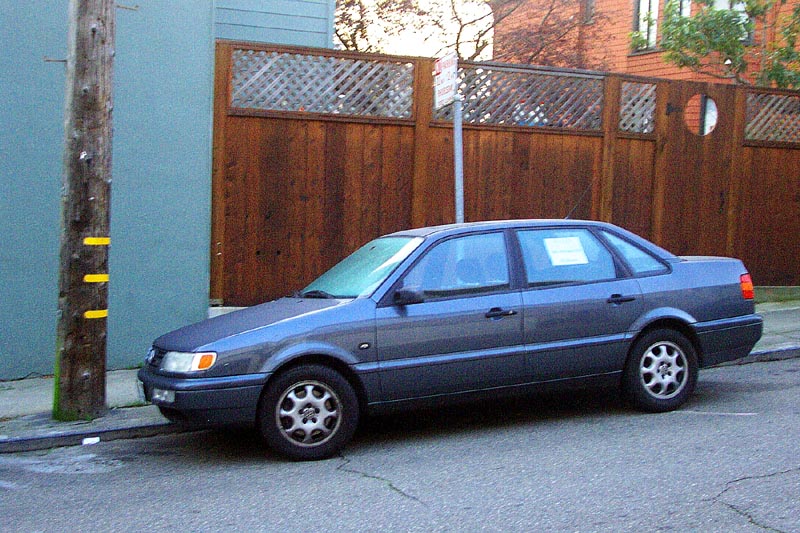
I also needed to sell my car. It didn't sell that day.

After the inventory was done, the moving man went back to his office and did all his calculations. He reported that we had about 10% too much stuff to fit into a 20-foot container, but not nearly enough to fill a 40-foot container. As a result, he said, we needed to pare down by about 10%. He also said that on moving day we would be able to prioritize and hold back certain items until the last minute, when we would see whether they would maybe fit in the container. That way, we could be sure we packed the things we really wanted to keep and left the rest behind.

We got more serious about the garage sale then. We had to be ruthless about getting rid of things. One of my rules became the do-we-use-it criterion. Even if we really like it, unless it has true sentimental value, and unless we use it frequently and couldn’t easily replace it, it had to go. We could sell it in the garage sale (or at least try), give it to good friends or family, or donate it to charity.

Back in the 1980s, a cousin in North Carolina
had given the cuttings from which this plant grew.


I decided to get rid of hundreds of books, about 400 old vinyl LP record albums, and nearly all of the hundreds of 3½” floppy disks and more than 600 audio cassettes that we had accumulated over the years.

Some of my record albums dated back to the 1960s, but they had to go. I filled the trunk of the car with boxes full of them and drove around to several old record stores in San Francisco to see if anybody would buy them or take them as a donation, but it turned out to be a mostly wasted effort. The used record dealers in Haight-Ashbury were not impressed. None of the ablums was in mint condition — they had been played too often on old record players in the dorm back in the late 1960s and early 1970s. There was no market for them, I was told repeatedly.

I gave boxes and boxes of French books from my college and graduate student days to the libraries at San Francisco City College and the Lycée Français de San Francisco. Other books went to City College, the Salvation Army, or Good Will, along a lot of stuff that didn’t get sold or given away during the garage sale. We ended up having charitable companies come with trucks and take away pieces of furniture that we couldn't sell or give away otherwise. Friends rented a truck and came to get a refrigerator we had put in the back of the garage when we had our kitchen redone.

Here are a jade plant and a schefflera that I hated to part with.
San Francisco was great for plants. They could stay outside year-round
because the weather was never really hot and never really cold.


It was amazing to realize how much stuff we had but didn't need. I guess our life had gotten out of control, to an extent. What I most regretted having to get rid of, when all was said and done, was all our big houseplants. We had had some of them since the 1980s. They had moved across the country with us when we left Washington DC for San Francisco in 1986.

That earlier move had been so different. We had rented a truck in Washington and packed it full of everything we could fit into it. We didn’t have so much furniture back then, and we didn’t have computers and all the computer paraphernalia that we had accumulated, including a couple of desks and desk chairs. We had fewer books and fewer stereos and TVs back then, not to mention fewer clothes.

For the move to California, we rented a trailer so that we could haul my car to California behind the truck. We had earlier driven to California with a car top carrier on Walt’s car and left the car and the carrier full of stuff there with friends. We flew back. This time, we put my car on the rented trailer and filled it with plants. It became a rolling greenhouse for the transcontinental journey. The plants were declared healthy by the authorities at the California border near Tahoe and we and the plants rolled on down to the SF Bay Area.

Some of our plants had survived the 1986 move from DC to SF, or their
parents had. They all had to go because we couldn't move them to France.


This time, we wondered if we really were going to sell the house quickly and for a good price. Everything depended on that. If we didn’t sell it and ended up having to forfeit the deposit we had put down on the house in France, we would still feel good about having gotten rid of a lot of stuff that we didn’t really need. But not the plants. I would miss those, especially if we ended up not moving. I ended up selling most of them for a dollar or two. I just wanted them to go to good homes.

The other big headache, in a sense, was the dog. What if we couldn’t get permission to move Collette to France? We were not willing to leave her behind. If Collette couldn’t move to France, neither could we. She was already 11 years old, so we would just have to wait a few more years until she passed on if she couldn’t move with us. Then we could relocate. I started doing research on the Internet and making phone calls to see what restrictions France placed on the importation of domestic animals.

Walt and Collette in the empty San Francisco house, March 2003.

Meanwhile, I was going to have to sacrifice myself and go back to France in early February. We had decided to incorporate ourselves in order to buy the house there. That way, we would sidestep all the strict French inheritance laws, under which you are not allowed to leave your property to anybody but immediate family when you die. We agreed that if one of us died, we each wanted the other to own the house free and clear. And one of us needed to go to France to sign papers setting up the société civile immobilière, or real estate corporation, to make that possible. That was me. Walt would stay in San Francisco and continue getting our house ready for the first public viewing, which the realtor scheduled for about February 15. He was still employed at that point, actually.

We hadn't yet agreed on an asking price.

Also, we were starting to research the requirements for getting long-stay visas for France. We didn’t want to end up as illegal immigrants if we really did move.

It all depended on selling the house for the right price and at the right time. And on getting visas for ourselves and the dog. If we found that we couldn't sell the SF house for a good price, we still might have time to arrange financing for the house at La Renaudière before April 15. Or request an extension. Time would tell.

It's still winter

I started this winter telling myself that the cold weather here in Saint-Aignan really only lasts a couple of months. It won't be long at all. And in late October we had some days when the temperature hit 26ºC -- that's about 80ºF. But November came in cold, and December very cold. We are now finishing our fourth month of cold weather. So much for my optimism.

Sunset at La Renaudière, 24 February 2006

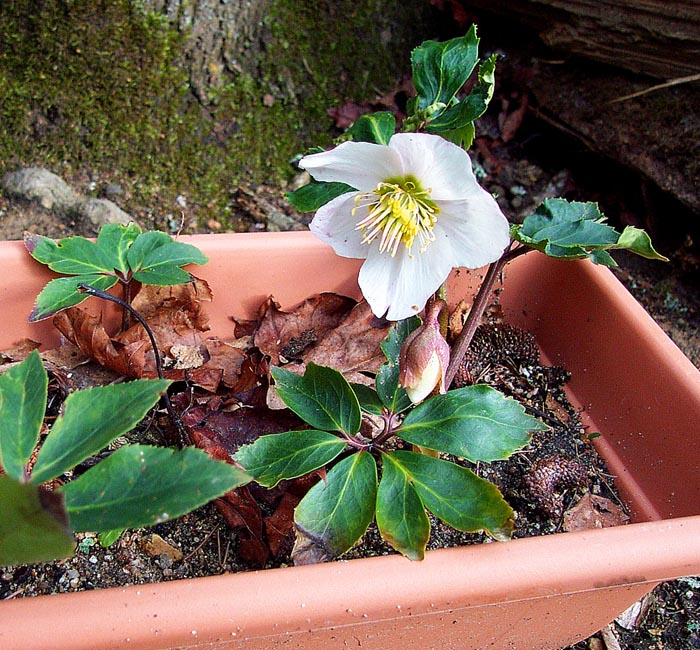
Trees and other plants are starting to bud out, though. I noticed yesterday that the roses around our house have new red growth on them. And old faithful, the helibore or winter rose has bloomed, despite the fact that I dug it up and planted it in a pot last spring. I didn't expect it to flower this winter.


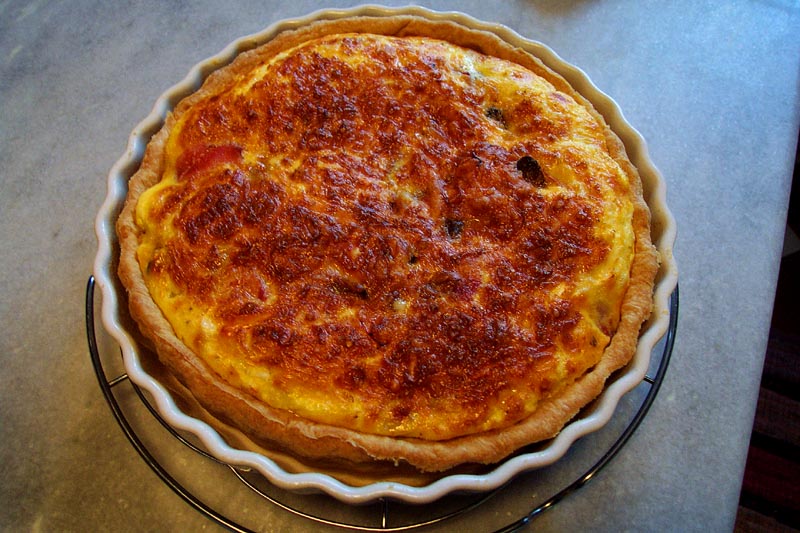
How to fight off the winter chill? Hot food, of course. Earlier this week, we made a quiche. I had a couple of slices of ham and some sauteed mushrooms left from last weekend's pizzas, and I had some comté cheese and some eggs. Walt made his good pie shell. With a big green salad, the quiche was perfect.

Ham, mushrooms, and grated cheese in a pre-baked pie crust.
Just pour on beaten eggs and bake.

Hot from the oven and ready to eat.