Showing posts sorted by relevance for query lavardin. Sort by date Show all posts

19 May 2020

L'Église Saint-Genest de Lavardin


St. Genès (or Genest, Genêt) was a Roman actor who converted to Christianity during a performance and later was martyred. The church in Lavardin is dedicated to his memory, as are churches and chapels in about 10 other towns all around France, including Metz and Flavigny-sur-Ozerain. A dozen French towns towns also carry his name.


L'Église Saint-Genest de Lavardin — I haven't read anything that explained why the church is dedicated to him — is famous for the wall paintings inside the church, which date back to the 12th century. The church itself was more than likely built in the 11th century, or at least construction was started then. Here's what it looked like when I was there in January 2004.


Back then, Walt and I drove up to Lavardin and Vendôme from Saint-Aignan just for a day out, after feeling a little confined because of miserable winter weather through December and January. We took advantage of one of the first nice days we'd had in two or three months to enjoy an excursion. I didn't really know anything about Lavardin at that point, but Walt and I had drive through the village in June 2001, when we were spending two weeks in the wine village called Vouvray, nears Tours. We didn't go inside the church, however. We didn't know about the wall paintings inside. This is another view of the interior of the St. Genest church.


Here's another photo of the church. It's bathed in the light of the afternoon sun on January 25, 2004. That's Walt on the road taking a photo. I went back to Lavardin in 2015 with my friend CHM and finally went inside the church to take some photos. It was more interesting and the murals were more extensive than I had imagined.


I took these pictures of the murals using a Canon SX700 HS camera that I don't even have any more — I gave it to a friend in 2018 because I had another camera that I liked better, a Panasonic. But I have to say the Canon camera did a very good job inside the Lavardin church. I've posted some of the photos as slide shows and others in other blog posts over the past five years.


This painting, or what is left of it, looks fairly mysterious, I think. If you have any ideas about what it represents, I'd appreciate hearing them.


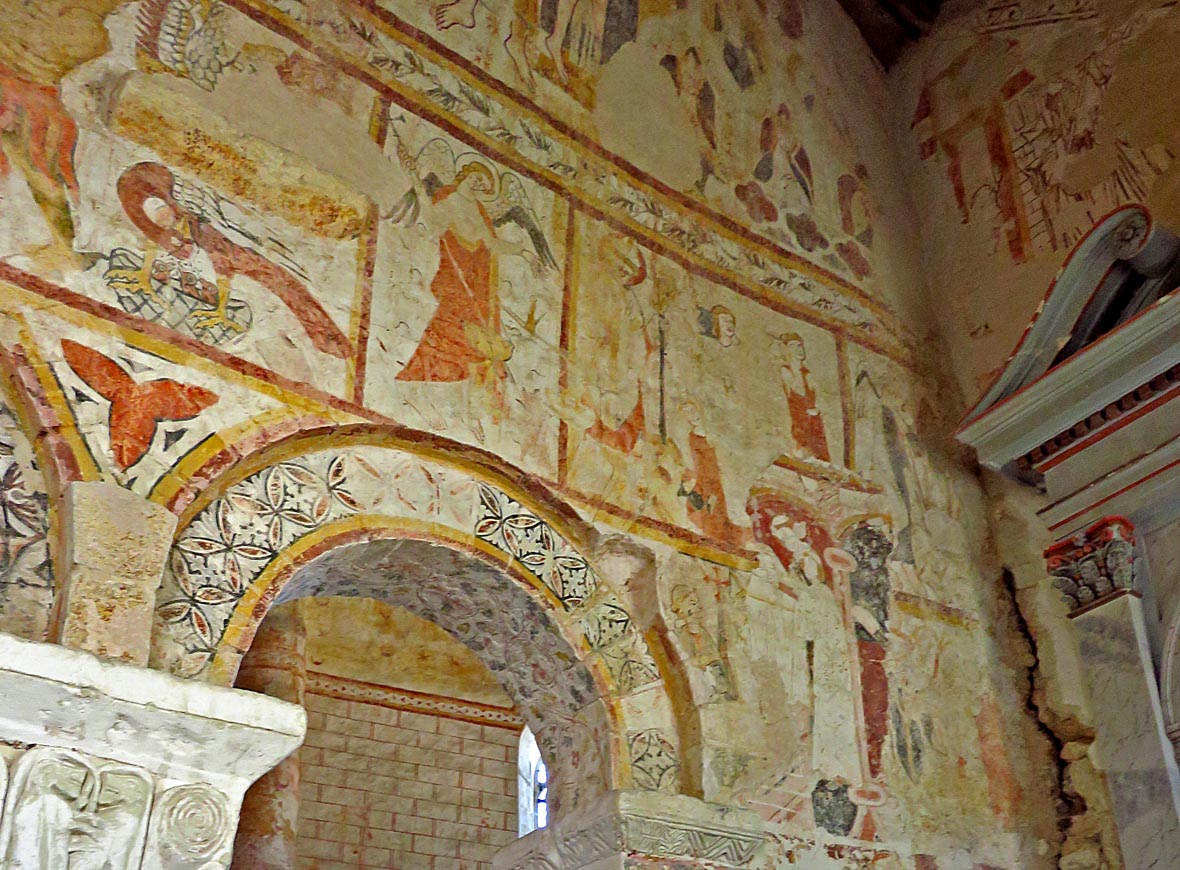
These wall paintings in the church at Lavardin were hidden by a coat of whitewash or plaster for two or three hundred years and re-discovered in the early part of the 20th century, just before World War I. They've been restored in recent years.

18 May 2020

Lavardin : le château fort


Peintres amateurs, photographes, Lavardin vous offre un sujet de choix : comme une estampe romantique les ruines de son château féodal... dominent l'un des plus beaux villages de France...

That's the Michelin Guide Vert's introduction to the village of Lavardin in the vallée du Loir, near the big town of Vendôme.


I've been there a few times, starting in 2001. Some of these pictures are from that trip. It was about then that Walt and I started seriously thinking about a move to France. Then we went back in 2004, on a nice day at the end of January, when we were spending our first winter in Saint-Aignan. We had cabin fever and just needed a nice outing, so off we went.


The old château's ruins really do loom over the town, and have been looming for nearly 1,000 years. The Loir river valley and the comté de Vendôme are a place where the old kingdom of France, based in Paris, collided with the Anjou territories of the Plantagenêts. Battles ensued, and fortresses were built. This photo and the two below (taken by Walt) are from our 2004 visit.


The donjon, or castle keep — the tall, blocky tower — actually dates back to the 11th century, according to the Michelin Guide. It's 26 meters (85 feet) tall, and over the centuries was closed in by three different sets of walls. Of it, Michelin says: Bien que très endommagé, ses ruines impressionnantes permettent encore de se faire une bonne idée... of how forbidding the whole complex must have been.


The château de Lavardin was captured by the protestant King Henri IV in the late 16th century, when he laid siege to what was a Catholic stronghold. At that time, the dismantlement of the old fortress began. The locals used the ruins as a quarry where they could mine stones to use in building their houses and barns. It's an old story, often repeated in different regions of France.


To show you where Lavardin is located, I did a screen capture of a Google Map and added some hot-pink dots showing the location of Saint-Aignan and of the famous tourist town of Amboise. Lavardin is 40 minutes by car north of Amboise, and a good hour's drive so from Saint-Aignan. Vendôme, Blois, and Tours are the big towns in the region.


19 June 2015

Mourning

Several weeks ago I wrote on this blog about a relative in North Carolina who had fallen ill. It was my mother's younger sister, an aunt that I grew up with and loved. She was my aunt, but she was more a friend or a big sister to me. She, my mother, and I had traveled together on many trips in North and South Carolina, in California, and in France over the past 25 years. We had great adventures, laughed at each other and ourselves, and just enjoyed our time together.

Well, yesterday afternoon, my aunt Ann passed away at the age of 79. Her illness lasted a month and she was in a coma in the hospital for most of that time. My thoughts are with my aunt's two children — especially with her daughter, who spent nearly 24 hours a day with Ann at the hospital for the past month. Now the mourning can begin. We will all miss Ann for a long time to come, but we will also enjoy some very vivid memories of the good times — and the not so good — that we all had together.


For now, here are a few more photos that I took on June 6 in Lavardin, when CHM and I went up there. Not all of them are technically great, but I want to post them to show you more of Lavardin and to continue my series of posts about what this whole part of France is like. The two photos below are details of the one just above.


Lavardin is also known for the ruins of an imposing château on a hilltop overlooking the village. One day I'd like to go back and go up into the old building to see the view from up there.


Some of the paintings in the Lavardin church are pretty mysterious. Judge for yourself.


The day CHM and I stopped and took photos in Lavardin, we had lunch in neighboring Montoire-sur-le-Loire. More about that tomorrow...

07 June 2025

The church at Lavardin

Lavardin is a village about 90 minutes north of Saint-Aignan, on the river called le Loir near the town of Montoire. Charles-Henry and I drove up there in June 2015 to visit a cousin of his who had bought a small château in that area. As usual, we stopped in churches, including the one in Lavardin (pop. 178), which is known for its elaborate wall paintings. The church was built toward the end of the 11th century. The site of the town has been occupied by humans since prehistoric times.

Sources say the wall paintings at Lavardin were done between the 12th and 14th centuries. I used to tease Charles-Henry about his love of churches because he was almost radically disdainful of organized religion. I miss the many car trips we took together between 2004 and 2015. This one might have been our last one together — it's hard to remember. He died in 2024 the age of 99.

18 June 2015

Wall paintings at the church in Lavardin (vallée du Loir)

One of the places I went lately and hadn't seen in a long time — 10 years, maybe — is the plus beau village called Lavardin. It's near Montoire-sur-le-Loir and about 90 minutes north of Saint-Aignan by car. The Loir is a smaller river that is not too far north of the larger Loire, to which it runs roughly parallel for a good part of its course. That Loir Valley is worth exploring for its landscapes, villages, old buildings, wines, and cheeses.


I knew that there were wall paintings in the church at Lavardin (which is dedicated to Saint-Genest) but I'd never been inside before. I was lucky to be there, with CHM, on a bright sunny afternoon. I took a lot of photos with my Canon camera. I didn't use a flash, and I didn't use a tripod or even a monopod. For all these photos, the camera was hand-held.


The Saint-Genest church certainly makes Lavardin worth a stop. Other churches or chapels within a few hours of Saint-Aignan by car also have impressive wall paintings — at Saint-Savin-sur-Gartempe, for example, or in Palluau-sur-Indre, and even in the Saint-Aignan church itself. I'm including links to some posts on these churches.


Apparently, these paintings were re-discovered by a priest about a hundred years ago. They had been painted over with whitewash sometime after the Renaissance period, at a time when medieval art was no longer appreciated or admired. France had entered its classical period, and "primitive" art was not the fashion.


These wall paintings, often called fresques in French, date back as far as the 12th century. That's when a lot of France's still-existing churches were built. Nowadays we are used to seeing churches that are very plain inside (except for their stained glass windows) but all those centuries ago most of the churches were painted inside, the way these are. But I'm no expert...

23 March 2008

Trôo, c'est trop !

That means: "Trôo is just too much!" And what or where is Trôo? It's a village on and around a big hill overlooking the Loir River and its valley.

The Loir River Valley seen from the top of the bluff at TrôoJune 2001

The Loir River? Didn't you spell that wrong? It's the Loire river, with an E. Well, no, not this time. The Loire River is the big water feature in the region, of course, of Loire Valley fame. But the Loir is a smaller river a little ways north, and a tributary of the larger Loire.

The Eglise Saint-Martin at Trôo was built in the 10th century
at the top of the hill overlooking the river valley

The Loir is a miniature Loire, in some ways. It has vineyards all along its banks, and it has some nice châteaux. The Loir flows through the northern part of our département (county), which is called the Loir-et-Cher. The Cher is the river we live near, and it's sort of the southern reflection of the Loir. Both are tributaries of the Loire, and the département is named for them. (In reality, the Loir flows into the Sarthe, which flows into the Maine, which flows into the Sèvre Nantaise, which flows into the Loire... so it finally gets there.)

Trôo, like all French villages, lost many soldiers
in World War I and has a monument to honor their memory

The big town along the Loir River, north of Blois, is Vendôme, with the ruins of a medieval château and a huge church. I have some pictures of Vendôme that I will post here soon.

The Eglise St-Jacques-des-Guérets is in the valley below Trôo25 January 2004

Then there's Montoire-sur-le-Loire, a town of 10,000 so that is famous (or infamous) as the place where Adolph Hitler and the president of France signed a treaty sealing France's surrender and occupation at the beginning of World War II. They met in the town's little train station, which is still there but has only a very small sign to indicate its historical significance.

Restaurant at the top of the hill in Trôo

The village of Lavardin is just outside Montoire. It has a ruined château too, high on a hill overlooking village and river. Lavardin is one of the famous « plus beaux villages de France » — one of France's most beautiful villages. I have some pictures from Lavardin too.

Champignons — mushrooms — are grown in the caves at Trôo

The pictures in this post show the village called Trôo, pronounced [TROH], not [TROO]. As I said, it is on a hill, and it is trogodytic. In other words, there are caves carved out of the side of the hill in places, and those caves are used as dwellings or out-buildings (wine storage and aging, mushroom growing, and so on).

The newer village at the base of the hill in Trôo25 January 2004

The church at the top of the hill in Trôo is pretty, and the view out over the valley is very nice. It's one of those places in France where you feel like you might be the first tourist of visit in years, or decades, or ever. One book I have, the Signpost Guide to the Loire Valley, calls Trôo a "strange little village." It's not even listed in the Cadogan guide.

Also at the top of the hill is this house called Le Louvre

The Signpost Guide says that Trôo not only has cave dwellings, but it also has underground passageways and stairs that serve as streets and alleys linking the troglodyte homes to each other. I didn't see those.

Another view of the St-Martin church in Trôo

I did see the church at the top of the hill and other sights, which are pictured here. I've seen the name of the village spelled Trôo, with the accent (as on the WWI monument pictured above), or Troo, without (as in the Micheline guide). Either way, c'est trop. The people there are called Troiens — all 350 of them.

Trôo and the other towns and villages along the Loir River are a good hour's drive north of Saint-Aignan and about 30 minutes north of Blois or Amboise.

16 May 2020

Peintures murales à Lavardin en 2015

It's hard for me to believe that it's been five years since I was last in the little village of Lavardin. It's a very picturesque place in the valley of the Loir river (no E, it's le Loir, a smaller river, not the much grander Loire) between the towns of Vendôme and Montoire, about 40 miles (65 km) north of Saint-Aignan and a 45-minute drive from Amboise. Lavardin is one of the 150 or so Plus Beaux Villages de France and is the site of the ruins of a medieval château-fort. CHM and I drove through there in June 2015 and stopped to take photos of the wall paintings inside the village church.


I posted these photos back then, but not in the form of a slideshow. Here they are, or at least half of them. The show runs for 2½ minutes. I'll make a slideshow of the other half of the photos for another day. The paintings date back to the 12th century and on into the 16th. In the 17th century, they were covered over with a coating of limestone render and remained hidden until the beginning of the 20th century. They are very colorful and well preserved.

17 May 2020

Lavardin (part 2)

This is the second installment of my photos of the painted interior walls of the Saint-Genest church in the village of Lavardin. Here's a link to the first set of photos. The village is on the Loir river, which flows parallel to the wider and longer Loire river at this point, about 35 miles north.


The paintings date back to the 12th century and on to the 16th. They were covered over with whitewash or limestone render in the 17th century and remained hidden until the early 20th. Lavardin, a village over which looms the ruins of a medieval fortress castle, is one of the Plus Beaux Villages de France.

09 June 2025

More Lavardin wall art


For centuries these paintings were themselves painted over and hidden from view. They were only rediscovered and uncovered about a hundred years ago, when a layer of plain gray paint was stripped off. Some have been restored.

Lavardin is also the site of a ruined medieval château-fort.

24 May 2020

Virtual sightseeing: Angles-sur-l'Anglin

Earlier, I wrote a series of posts about taking a virtual vacation, since our April getaway had to be canceled. Confinement, you know. But for that, our quasi-annual visitor Peter H. would be here from San Francisco right now. We'd be shopping in markets and supermarkets and cooking the good things we'd bring home. Walt would be enjoying the Roland Garros/French Open tennis tournament on TV, and looking forward to a good lunch or dinner. None of that is happening.


In the picture above, the woman wearing a bright blue scarf and carefully framing a photograph is our friend Sue. She lives in California, where we used to go on cool camping trips every year — Yosemite National Park, Salt Point park on the northern California coast, Zion National Park in Utah, etc. etc. Well, she's decided to cancel her trip to France and Morocco, which was scheduled for early September. The last time she came to France was in 2018. I spent a week showing her Carteret County in North Carolina — where I was born and grew up — last October.


Another good friend who's had to cancel her 2020 trip to France is Evelyn — a lot of you reading this know her, if not personally, at least virtually, through her comments on this blog. I met her and her husband thanks to an Internet forum at about the time Walt and I relocated from California to France in 2003. Evelyn was going to visit in August. She too has had to cancel. For me, and for E. and Sue too, the idea of sitting in the middle of a crowd in the claustrophobic space available on an airplane is just not imaginable at the current time.


I wasn't planning to write about such sad turns of events. What I was going to write about was how I am looking forward to days when I can return to see places like Lavardin and Angles-sur-l'Anglin one more time. Both villages are about an hour from Saint-Aignan. Or Paris, for example, and the Baie de Somme. Another old friend who has had to cancel his annual Atlantic crossing in an airplane is CHM. He has an apartment in Paris and he has family connections in the Somme. Even before he had his accident about two months ago, he had decided he mostly likely wouldn't be willing to take the risk involved in flying to France in 2020.


It's going to be kind of a quiet, lonely summer. My sister and our best cousin had been planning a trip to France in late September. I had started making plans for and lists of all the places we would go to see. They've had to cancel too, of course. I'm so glad I went to North Carolina last October and got to spend a couple of weeks with them. I'm not sure when I'll be able to go back there, or when they'll be able to come over here.


Sorry to be so downbeat today. On the positive side, the weather here is beautiful, and the garden is in. I had my doubts about that job getting done in 2020, but it has all turned out great. The ground got tilled, the seedlings grew strong in their little pots, the weather cooperated, and the plants are now in the ground. We even had just enough rain and clouds yesterday so that the tender little plants got a nice welcome rather than a fatal sunburn. Oh, and Walt went to the market and got strawberries and asparagus yesterday morning. Lunch today... By the way, the neighbors from Blois went back to Blois yesterday morning.