04 January 2016

Gratin d'endives au jambon

I really ought to throw up my hands and just take a day off. With the steady rain we had all day yesterday, there was no way to go outside and take any photos.I walked the dog in the rain in the morning, and Walt walked the dog in the rain toward evening. We just took turns getting wet. I don't have much to blog about besides food. Then again, yesterday's lunch was a classic.


I had three Belgian endives in the fridge. I bought them to eat as salad, but I also bought a head of romaine that looked appetizing and we ate that instead. And we've had so much other food lately — I don't know about you, but the holidays just flew by, even though we weren't busy, and we enjoyed all the food we made and ate — that the endives almost got lost in the shuffle. (You'll notice I also had a few cooked Brussels sprouts left over, so I tossed them in too.)


Endives wrapped in ham and then baked in a cheese sauce (sauce mornay) are a standard in Belgium and France, and there's nothing much better for a hot lunch on a cold, rainy day. First you cook the endives in butter and lemon juice, with garlic. That takes about an hour on low heat. Brown them in the butter before adding the lemon juice. Do them ahead of time if you want.


Then you wrap each endive in a slice of nice ham, or even sliced chicken or turkey breast sold as cold cuts. I used ham. And you make a sauce béchamel and add a lot of cheese in it. Add in the lemon-garlic cooking liquid from the endives too, for more flavor. Pour the cheese sauce over the wrapped endives in a baking dish and set the dish in a hot oven. If the endives and cheese sauce are hot when they go into the oven, it won't take long. Just long enough to brown the casserole, or gratin, on top a little. Don't burn your tongue when you eat it. There's a full recipe here, in two blog posts.

03 January 2016

“Rain is coming”

We're going into a rainy period now, and temperatures are supposed to drop. That'll be good weather for eating more of those white lingot beans. I might have to take another couple of duck legs out of the dish of congealed fat to have again as an accompaniment. Yesterday, for a change, we made a chicken Caesar salad for lunch, and boy was it good. I didn't take photos...

As a change from all the "food porn" here are a few vineyard sunrise photos that I took at the very end of 2015.


I took the first and third shots as I began the walk one morning at about 8:30 — in other words, before actual sunrise, in low light conditions.


The shot above is one I took as I was getting back home, so the sun was up. I like the rows of tall poplar trees on our neighbor's property.


A groggy Walt (he says he didn't sleep well) just called out to tell me that "rain is coming." A front is moving in off the Atlantic, bringing significant rain to the British Isles and to northern parts of France. I hope it doesn't start falling before I can take Callie out into the vineyard for this morning's walk, but I don't want to go out much before sun-up, which is still a good hour away.

02 January 2016

Cassoulet — white beans with duck and sausage

One of the best memories Walt and I have of eating cassoulet takes us back to the town of Castelnaudary in southwestern France in 1989. We were doing a 10-day driving trip around that region and decided to stay the night in the main hotel in the center of the town. It had a nice restaurant and, Castelnaudary being the birthplace of cassoulet according to local tradition, that's what we ordered. (Pronounce those [kah-stehl-noh-dah-ree] and [kah-soo-lay]).

Our waiter recommended the cassoulet, accompanied by a salad and a nice bottle of the local Fitou red wine. He was very attentive, and I think he enjoyed talking to two young (imagine!) Americans who spoke French and enjoyed good French food and cooking. After the fine dinner, he offered us — on the house — a couple of glasses of Armagnac brandy (also a local product) as a digestif (that's a strong after-dinner drink that supposedly helps you digest the rich food you just ate). We were staying upstairs in the hotel, so we didn't have to drive anywhere until the next morning. The whole thing is a very vivid and positive memory of those long-ago days when we started exploring France together.

Today I want to post the last of the 2016 cassoulet photos. I cooked the beans (big white beans called haricots lingots in France, or cannellini in Italy and the U.S.) in the slow-cooker for nearly 8 hours. They were maybe a little overcooked, but then the cassoulet needed only a short time in the oven so it was good that the beans were already done. I put a layer of beans in a baking dish and laid two slow-cooked duck leg pieces on top, browning the duck in a skillet first.

Then I added more cooked beans to cover the duck pieces (those are duck gizzards — gésier confits — along with the duck leg pieces in the photo above). On top of the beans, I placed a few pre-cooked, fairly plain pork sausages (saucisses de Toulouse are good) and spooned on a few more beans so that the sausages were nearly covered but still visible. Actually, I used some little chipolatas aux herbes that I had on hand. Cassoulet doesn't normally include smoked meats...

Next, I covered the beans with breadcrumbs. My breadcrumbs were home-made from stale baguettes, and I sautéed them lightly in some duck fat before I spread them over the beans. There is a little bit of duck fat in the beans too — beans need some fat for richness, and duck fat is a delicious ingredient. There's also a little bit of cooking liquid in the dish with the beans, and you can add more as it cooks. If the beans go into the oven already heated through, all you have to do is brown the top of the cassoulet quickly. Liquid will bubble up to the top in places.

It's hard to take a "pretty" picture of cassoulet, but it certainly does taste good. It's filling, obviously. The duck is tender and succulent, and the sausages add a little spice and contrast. The beans melt in your mouth, and the bread crumbs lend a nice crunch. Actually, we had a stray saucisse de Monbéliard (smoked pork sausage) in the fridge, already cooked, so we heated it up with the cassoulet and enjoyed it alongside.

01 January 2016

Bonne année 2016

In France, people always wait until January 1, at the earliest, to say « bonne année », and around Saint-Aignan they often add « et surtout, bonne santé ». Officially, we have until the end of January to express our good wishes — « meilleurs vœux » — for 2016. I've now expressed mine to you.


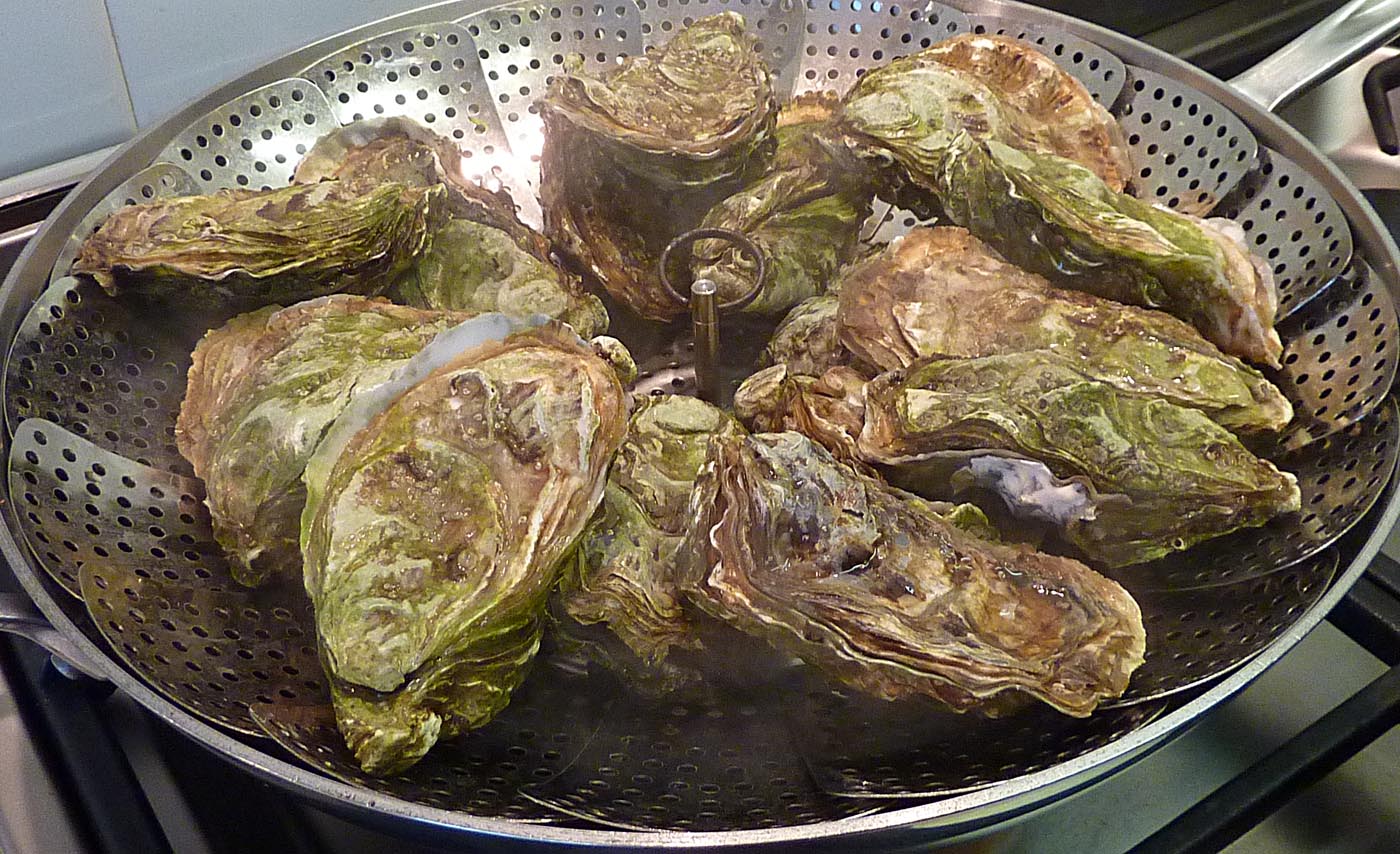
New Year's Eve for us means oysters, so here are five photos of ours. Walt bought two dozen oysters of medium size (numéro 3 on a scale that goes from 5, the smallest, down to 1, the largest) for about 12 €. We steamed the open — most of them — this year, except for half a dozen that I shucked so we could try them raw on the half-shell. In the photo above, you can see that the one in the foreground on the right has started to open up. It's ready to be removed from the steamer. See this Wiki-How web page  for information about cooking oysters.


These are the farmed oysters called « fines de claires » — they are fattened in saltwater ponds on the coast down near the Ile d'Oléron for weeks or months before they are brought to market.


We are lucky to have a fish and seafood vendor who drives up from the Oléron area to Saint-Aignan every week, bringing us the freshest seafood you can imagine. I blogged about the seafood at the market a few weeks ago here.


The last two photos are before and after shots. Steaming them open doesn't fundamentally alter the taste or texture of the oysters — they are not cooked but more or less mi-cuites, like a good foie gras. And it's a lot safer than risking stabbing yourself in the hand with the oyster knife when you shuck them raw.