The south bank of the Loir at Vendôme is a high bluff or escarpment that is known locally as La Montagne. And on top are the ruins of a medieval château. From the promenade at the top of the escarpment you get nice views out over the city.
The most striking feature of the Vendôme skyline is the tall steeple of the Abbaye de la Trinité, which was founded in the year 1040 by a community of Benedictines. There had been Celtic and then Gallo-Roman settlements on the site for centuries, but the town really grew up around this abbey over the past 1000 years.
In the 11th century, Geoffroy Martel, Count of Anjou, returning from a crusade to the Holy Land, brought back a drop of liquid from Constantinople that was claimed was a tear Jesus had shed on the tomb of Lazarus. For centuries, pilgrims made the trek to Vendôme to see the « Sainte Larme » — the Holy Tear — especially those who need a cure for diseases of the eye.
In the Renaissance, a great church was built on the central Place Saint-Martin, not far from the Abbey. The church was demolished in the 19th century, but the bell tower remains as one of the town's main landmarks.
For centuries, Vendôme was a county, presided over by a count. In the Renaissance François Ier elevated the county to a dukedom, and later Henri de Navarre became the Duc de Vendôme before he converted to Catholicism at the end of the 1500s and became the French king called Henri IV.
The Place Vendôme in Paris, where the Ritz Hotel, several expensive jewelry stores, and the French Ministry of Justice are located, was named that because Henri IV's son, the Duke of Vendôme, built a mansion there in the 1600s.
30 March 2008
29 March 2008
Vendôme's Porte St-Georges
Vendôme, a town 30 minutes north of Blois by car, was ringed by fortifications in the Middle Ages. Of the old ramparts, the south gate into the city, called the Porte St-Georges, is one of the few pieces that remain.
The Porte St-Georges stonework dates back to the 14th century. The Michelin Guide says that the gateway itself was widened in the 19th century so that Napoleon's armies could pass through it.
Vendôme's town council has used a room in the
Porte St-Georges for its meetings since the 16th century.
The name Vendôme has Celtic origins, and the town was called Vindocinum by the Romans. These days, the population is about 20,000.
Walt and I first went there in January 2004, on one of the first sunny days we had seen in weeks. It's more than an hour's drive from Saint-Aignan, but it was a place we hadn't visited yet. We put the dog in the car and spent the afternoon enjoying the scenery and good weather.
The Porte St-Georges stonework dates back to the 14th century. The Michelin Guide says that the gateway itself was widened in the 19th century so that Napoleon's armies could pass through it.
Vendôme's town council has used a room in thePorte St-Georges for its meetings since the 16th century.
The name Vendôme has Celtic origins, and the town was called Vindocinum by the Romans. These days, the population is about 20,000.
Walt and I first went there in January 2004, on one of the first sunny days we had seen in weeks. It's more than an hour's drive from Saint-Aignan, but it was a place we hadn't visited yet. We put the dog in the car and spent the afternoon enjoying the scenery and good weather.
27 March 2008
A talk with some local wine-makers
Day before yesterday, I met some neighbors I hadn’t gotten to know before. I think I had seen them working out in the vineyards, but we had never spoken. I went to see them on the recommendation of some other people I have met working out in the vineyards and who own a lot of parcels of land and grapes out there.
The Guerriers said they don't have a business card, but
they gave me an old label with their contact info on it.
Monsieur and Madame Guerrier — his name is Jean-Noël but I don't know hers — are grape-growers and wine-makers on a pretty small scale. They are both locals. He was born and grew up in the house where he has his wine cellar — his parents still live there. She was born and grew up about three miles up the road, on the other side of the village.
They live in the house next door to his parents’ place, which is about a mile from our house as the crow flies. I went to see them in their cave (cellar) and we sampled some of their 2006 and even 2007 wines.
Mr Guerrier told me that the grape varieties he grows are Côt (aka Malbec), Gamay, Sauvignon Blanc, and Pineau d’Aunis (a local specialty used to make rosé wines). He and his wife do all the work of trimming and treating the vines themselves. They harvest the grapes too, many of them by hand. He said a lot of his vines are too old to be harvested by machine. The couple themselves must be in their mid-40s, and I assume they took over the business from his father (I didn't ask).
They do all the work themselves because, economically, it’s the only way they can stay in the business. Besides, Mme Guerrier said, it’s too difficult to find people who are willing to do the work, especially when the weather is cold and rainy, and who know what they are doing or are willing to learn.
The Guerriers make their own wine, and they sell some of it in bulk. Some they bottle for sale. They don’t export. And they sell a lot of their wine in bulk to négociants — wholesalers who bottle the wine and put their own label on it for sale. Two of the négociants he mentioned are Paul Buisse and the Caves Monmousseau over in Montrichard. I’ve driven past their signs and facilities over there hundreds of times.
Mr Guerrier joked that his name is a little strange and can put people off, but that he no meaner than most people. Guerrier means "warrior" in French.
This is a small plot of vines the Guerriers own and work on
the gravel road out back. They said they haven't gotten around
to pruning these vines yet this spring. I noticed that the canes
are covered in buds, so I hope it's not too late.
I thought the rosé wine I tasted was excellent. It’s an assemblage, or blend, of wine from two grapes, Pineau d’Aunis (75%) and Gamay (25%). The 2006 Gamay was also very good — supple and fruity, and very drinkable. The 2006 Côt was much more tannic, but also delicious. He sells the rosé to retail customers like me for €1.65; the Gamay for €1.15; and the Côt for €1.30. If you do the math, you figure out that the wines sell for between U.S. $1.25 and $1.90 per bottle.
The Guerriers said that I should taste the 2007 Gamay red after tasting the 2006, but that I should be prepare my taste buds for a shock. And they were right — the 2007 was a sharp and thin as the 2006 was supple and rich. They said 2007 was a very difficult vintage to work with. We had a very cool, wet summer, with about a month of warm sunny weather from the 20th of August to the 20th of September. The same plant and even the same bunch had some grapes that were rotting, some that were not yet ripe, and some that were just right. That was a challenge. With a few months of age, the 2007 will probably mellow out at least a little.
Our wines are very different from year to year, the Guerriers said. They don't use any additives in the wine-making process, though the wines are not organic — they use an herbicide to keep the grass and weeds down in the rows between the vines.
A lot of their wine is sold as vin de pays, not A.O.C., Mr Guerrier said. That makes it less expensive and therefore more competitive. A.O.C. (Appellation d’Origine Contrôlée) means that the wines are inspected and analyzed by an industry group for quality, the wine-making methods are strictly defined, and the grapes are certified to have been grown on certain plots of land where conditions are ideal. Vin de pays is not necessarily inferior in quality, and it can actually be better wine than some A.O.C. wines from grapes grown nearby, but it is not as strictly regulated.
Even selling non-A.O.C. wines, Mr Guerrier said he has to take samples of his wines to a local lab at several points during the wine-making process to be analyzed for sugar and alcohol content and general quality and clarity. It gets expensive, he says.
Locally, the Guerriers told me, grape-growers and wine-makers are starting to give up the business. Whether this is really a trend, I don’t know. Maybe it’s just that they know a few people who have decided to quit. They named three, two in our village that I do know and from whom I have bought wine over the past few years, and one whose vineyards and cellars are over on the south side of Saint-Aignan.
I think it is true that many thousands of acres of vines are being ripped out of the ground all around France these days. There is a glut of wine, and the strong euro can’t be helping sales in countries that are part of what is called the “dollar zone.” Competition from wine areas in the southern hemisphere — Malbec wines made in Argentina, Sauvignon Blancs in New Zealand... not to mention Chile, South Africa, and Australia — is fierce.
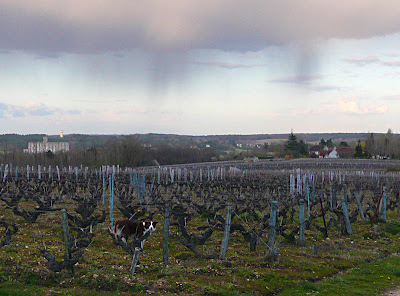
The Guerriers say that thousands of acres of vines are now being planted in China. I’ll have to take their word for that. They didn’t seem to have much of an opinion about California wines or the wine business in the U.S. I’ll have to ask them about that the next time I go see them.
And I’ll have to take some pictures of their cellar too. It’s a dark, vaulted room maybe 75 feet long and 30 feet wide. There are big fiber-glass and stainless steel vats of wine at one end, and the whole room is lined with racks of bottles, some of them full and some of them empties.
They said the best way to do business with them is to call them and make an appointment when I want to come by. They don’t have any employees, and they both work out in the vineyard most days.
They also don’t have an answering machine (or a fax machine, so I assume they don’t have a computer) so they aren’t that easy to get in touch with. They didn’t mention a cell phone. They are almost always at home at noon and after about 8:00 in the evening, however. That's when people make phone calls here — at meal times.
The Guerriers said they don't have a business card, butthey gave me an old label with their contact info on it.
Monsieur and Madame Guerrier — his name is Jean-Noël but I don't know hers — are grape-growers and wine-makers on a pretty small scale. They are both locals. He was born and grew up in the house where he has his wine cellar — his parents still live there. She was born and grew up about three miles up the road, on the other side of the village.
They live in the house next door to his parents’ place, which is about a mile from our house as the crow flies. I went to see them in their cave (cellar) and we sampled some of their 2006 and even 2007 wines.
Mr Guerrier told me that the grape varieties he grows are Côt (aka Malbec), Gamay, Sauvignon Blanc, and Pineau d’Aunis (a local specialty used to make rosé wines). He and his wife do all the work of trimming and treating the vines themselves. They harvest the grapes too, many of them by hand. He said a lot of his vines are too old to be harvested by machine. The couple themselves must be in their mid-40s, and I assume they took over the business from his father (I didn't ask).
They do all the work themselves because, economically, it’s the only way they can stay in the business. Besides, Mme Guerrier said, it’s too difficult to find people who are willing to do the work, especially when the weather is cold and rainy, and who know what they are doing or are willing to learn.
The Guerriers make their own wine, and they sell some of it in bulk. Some they bottle for sale. They don’t export. And they sell a lot of their wine in bulk to négociants — wholesalers who bottle the wine and put their own label on it for sale. Two of the négociants he mentioned are Paul Buisse and the Caves Monmousseau over in Montrichard. I’ve driven past their signs and facilities over there hundreds of times.
Mr Guerrier joked that his name is a little strange and can put people off, but that he no meaner than most people. Guerrier means "warrior" in French.
This is a small plot of vines the Guerriers own and work onthe gravel road out back. They said they haven't gotten around
to pruning these vines yet this spring. I noticed that the canes
are covered in buds, so I hope it's not too late.
I thought the rosé wine I tasted was excellent. It’s an assemblage, or blend, of wine from two grapes, Pineau d’Aunis (75%) and Gamay (25%). The 2006 Gamay was also very good — supple and fruity, and very drinkable. The 2006 Côt was much more tannic, but also delicious. He sells the rosé to retail customers like me for €1.65; the Gamay for €1.15; and the Côt for €1.30. If you do the math, you figure out that the wines sell for between U.S. $1.25 and $1.90 per bottle.
The Guerriers said that I should taste the 2007 Gamay red after tasting the 2006, but that I should be prepare my taste buds for a shock. And they were right — the 2007 was a sharp and thin as the 2006 was supple and rich. They said 2007 was a very difficult vintage to work with. We had a very cool, wet summer, with about a month of warm sunny weather from the 20th of August to the 20th of September. The same plant and even the same bunch had some grapes that were rotting, some that were not yet ripe, and some that were just right. That was a challenge. With a few months of age, the 2007 will probably mellow out at least a little.
Our wines are very different from year to year, the Guerriers said. They don't use any additives in the wine-making process, though the wines are not organic — they use an herbicide to keep the grass and weeds down in the rows between the vines.
A lot of their wine is sold as vin de pays, not A.O.C., Mr Guerrier said. That makes it less expensive and therefore more competitive. A.O.C. (Appellation d’Origine Contrôlée) means that the wines are inspected and analyzed by an industry group for quality, the wine-making methods are strictly defined, and the grapes are certified to have been grown on certain plots of land where conditions are ideal. Vin de pays is not necessarily inferior in quality, and it can actually be better wine than some A.O.C. wines from grapes grown nearby, but it is not as strictly regulated.
Even selling non-A.O.C. wines, Mr Guerrier said he has to take samples of his wines to a local lab at several points during the wine-making process to be analyzed for sugar and alcohol content and general quality and clarity. It gets expensive, he says.
Locally, the Guerriers told me, grape-growers and wine-makers are starting to give up the business. Whether this is really a trend, I don’t know. Maybe it’s just that they know a few people who have decided to quit. They named three, two in our village that I do know and from whom I have bought wine over the past few years, and one whose vineyards and cellars are over on the south side of Saint-Aignan.
I think it is true that many thousands of acres of vines are being ripped out of the ground all around France these days. There is a glut of wine, and the strong euro can’t be helping sales in countries that are part of what is called the “dollar zone.” Competition from wine areas in the southern hemisphere — Malbec wines made in Argentina, Sauvignon Blancs in New Zealand... not to mention Chile, South Africa, and Australia — is fierce.
The Guerriers say that thousands of acres of vines are now being planted in China. I’ll have to take their word for that. They didn’t seem to have much of an opinion about California wines or the wine business in the U.S. I’ll have to ask them about that the next time I go see them.
And I’ll have to take some pictures of their cellar too. It’s a dark, vaulted room maybe 75 feet long and 30 feet wide. There are big fiber-glass and stainless steel vats of wine at one end, and the whole room is lined with racks of bottles, some of them full and some of them empties.
They said the best way to do business with them is to call them and make an appointment when I want to come by. They don’t have any employees, and they both work out in the vineyard most days.
They also don’t have an answering machine (or a fax machine, so I assume they don’t have a computer) so they aren’t that easy to get in touch with. They didn’t mention a cell phone. They are almost always at home at noon and after about 8:00 in the evening, however. That's when people make phone calls here — at meal times.
Himalayan Cedar — Cedrus deodarus
Thanks to Susan of Days on the Claise, the big tree in our yard is now no longer a mystery. Every sign points to it being a Cedrus deodarus — a Himalayan Cedar or Deodar Cedar — and not a Lebanon Cedar or a Turkish Cedar. (See the original topic with pictures of the tree by clicking this link.)
Here is one more piece of evidence. Earlier, I posted this scan of an image that I found in Taylor's Guide to Trees. It shows the cones of the Deodar Cedar.

A couple of day ago I was out during one of our (too rare) sunny periods and I took another good look at the tree in question. Lo and behold, up on a high branch, I spied some cones that I had never noticed before. I've never found one like them on the ground under the tree either, but here they are.
I think the existence of these cones pretty much seals the deal. I really had never noticed them before.
Here's what Taylor says about Cedrus deodarus:
Now that that is done, what about this tree? I think of it as a Sapin bleu, or a Blue Spruce. Is it?
The tree in Taylor's Guide that most resembles this one is the Colorado Spruce, Picea pungens. Actually, I'm pretty happy calling this one by the names I mentioned above, whereas the Deodar Cedar was truly unidentifiable to me until this week.
And if we get this second tree a name, I have still another one to ask about!
Here is one more piece of evidence. Earlier, I posted this scan of an image that I found in Taylor's Guide to Trees. It shows the cones of the Deodar Cedar.

A couple of day ago I was out during one of our (too rare) sunny periods and I took another good look at the tree in question. Lo and behold, up on a high branch, I spied some cones that I had never noticed before. I've never found one like them on the ground under the tree either, but here they are.
I think the existence of these cones pretty much seals the deal. I really had never noticed them before.
Here's what Taylor says about Cedrus deodarus:
A tree, up to 150 ft. (45 m) high in nature, reaching 80 ft. (24 m) as usually cultivated. Branch tips, including the leader, generally pendulous. Leaves dark bluish- or grayish-green, nearly 2 in. (5 cm) long, not very rigid. Cones 3-5 in. (7.5-12.5 cm) long, reddish brown. One of the most graceful of all evergreens. 'Shalimar', 'Kingsville', and 'Kashmir' are the hardier cultivars, possibly in descending order. Himalayas. Cones throughout the year...Thanks, Susan. I really hoped the tree was a Lebanon Cedar after you explained the status attached to those particular conifers. But a cedar from the Himalayas is even more exotic-sounding, don't you think?
Now that that is done, what about this tree? I think of it as a Sapin bleu, or a Blue Spruce. Is it?
The tree in Taylor's Guide that most resembles this one is the Colorado Spruce, Picea pungens. Actually, I'm pretty happy calling this one by the names I mentioned above, whereas the Deodar Cedar was truly unidentifiable to me until this week.
And if we get this second tree a name, I have still another one to ask about!
Subscribe to:
Posts (Atom)


