28 March 2006

A post you will never see (or maybe later...)

Here's a recent picture of Walt emerging from a bou-
langerie
with a baguette. I took the picture in the town of Fougères-sur-Bièvre, located 15 miles or so north of Saint-Aignan.

This morning I spent three hours writing a very complete description of our recent tour of a beautiful little château here called Villesavin, near Chambord. I published it and then noticed some font problems in the text. I went back to fix them, and suddenly the Blogger software burped and my topic just disappeared, pictures and all. Very frustrating. Blogger is free software, and I guess you get what you pay for. And then again, maybe it was my fault entirely. Ah, computers...

26 March 2006

What are these protests about?

What is all this controversy about work contracts and young people's jobs in France? As far as I understand, it is very difficult in France to fire an unproductive or uncooperative worker. That makes employers extremely cautious in their hiring practices. They want to make sure they have found the right person for the job before they hire anybody. Unemployment among the young is very high -- 10 to 20 per cent.

Add to this situation the reluctance of employers to hire people who are not ethnically French. Unfortunately, racism exists, in France as in other countries. There is a generation of 20-somethings in France who have been born here to parents that immigrated from, for example, North Africa (Algeria, Tunisia, Morocco) and black Africa (Mali, Sénégal, Côte d'Ivoire, etc.) back in the 1970s and '80s. These are the young people who rioted in the Paris suburbs last year. Many of them are unemployed, bored, and angry.

President Jacques Chirac's prime minister, Dominique de Villepin, has come up with and, despite strong opposition, succeeded in pushing through the French National Assembly (the parliament) a law decreeing that employers can hire workers younger than 26 years old under a contract imposing a two-year probationary period. At any time during those two years, the young employee can be let go without cause.

Understandably, a lot of people see this scheme as setting up a situation in which young people can be exploited for two years at low wages. Then the employers can let them go and hire other young people, at similarly low wages, instead of putting the more experienced young employees on long-term contracts at a higher pay rate. From this perspective, the government's new employment contract (the CPE, or Contrat Première Embauche) is fundamentally unfair to young workers. It institutionalizes a system in which they have little or no job security.

(All this reminds me of the tenure system in American universities, which was much abused in the same way back in the late 1970s and early 1980s. There were too many tenured professors and too many new PhDs looking for work, so a lot of young professors were denied tenure despite their excellent job performance. It's one of the reasons I got out of teaching back then.)

Why would the Chirac government want to set up such a system? The only thing that makes sense to me is that Chirac and Villepin understand that employers are reluctant to hire young workers in general, and young people who are not ethnically French specifically. If an employer has an escape clause -- the two-year probationary period -- maybe more of these French-born children of African and North African immigrants will find jobs. There will be less anger in the projects (les cités) surrounding the big cities. But even if this is true, it is unspoken and perhaps unspeakable in France, for all kinds of philosophical and political reasons.

It is clear that French employers, the government, and French people in general are opposed to American-style "affirmative action" programs. Here, what Americans call affirmative action is called discrimination positive. The point is that it is viewed as a form of discrimination. France is a country with a long history of social inequality because of the centuries-long existence of a class of aristocrats that ruled the country and were inherently "better" than their compatriots. They had distinct privileges. Officially, that social system ended in the 1790s with the French Revolution. With the institution of the republic in the 19th and 20th centuries, the ideal became égalité -- equality. All people are equal.

But while the U.S. has its long history of slavery that turned into nominally free if under-privileged class of African-American citizens, the existence in France of a significant population of ethnically different people is a relatively new reality. The situations are very different, and maybe very different solutions to the resulting tensions in the society are called for.

There is also significant opposition in France to the American model of what the French call communautarisme -- ethnic, religious, and social communities within the society. All people are equal, theoretically, and there is no need for society to divide itself into interest groups on the basis of gender, sexual orientation, ethnicity, or religious beliefs. Affirmative action programs would be a tacit acknowledgment that such communities already exist in France.

When you apply for a job in France, you are expected to attach a photo to your resumé. That's a practice that was banned in the U.S. many years ago. The picture makes it too easy for employers to eliminate people whom they want, for reasons of ethnicity, to screen out. It aids and encourages negative racial discrimination, and makes it harder for minority candidates to get a foot in the door.

After last fall's riots in the housing projects and new towns that surround Paris, there was a proposal to move to a system of "anonymous" resumés in France. Candidates would no longer have to include a photo, and they wouldn't even have to give their name (because the name might not sound French) or their address (because if you live in certain housing projects, there's a good chance that you are not ethnically French). This was to be an experiment, a pilot program. It occurs to me that measures such as these are proof that ethnic communities really do exist in France, but let's not get sidetracked. French people are entitled to a little denial, I guess.

So maybe the CPE is a kind of affirmative action plan in disguise. Sooner or later, I think, somebody in France is going to have to point out that the emperor has no clothes. Communities exist. Racism exists. The integration model is not working -- young people of foreign descent are not accepted as full-fledged members of French society. They are different (we Americans talk of the benefits of diversity) but in this case Vive la différence! doesn't apply. What's the point of denying that?

Meanwhile, many students, whether they are fully French or not, are participating in demonstrations against the Villepin youth employment plan. That's the way politics works in France, at the national level. The government, the out-of-power political parties, the students, and the labor unions are competing power blocks, and they use shows of force and numbers as necessary and as much as they can to move policy in the direction they favor.

But now something has changed. Groups of angry non-students (it is assumed) are taking advantage of the student demonstrations and unrest to wreak havoc and destruction in the cities. There's a level of violence that didn't exist before.

Tomorrow a nationwide general strike is planned. The trains won't run and there will be little if any public transit in Paris and other cities. Schools will be disrupted. There will be major marches and demonstrations, especially in university towns and large cities around the country. The question is, will there be a lot of violence? Will the demonstrations turn into riots? Stay tuned.

25 March 2006

Returning to normal

Today is the last day of l'heure d'hiver en France. That's standard time (or winter time). Tomorrow we'll be on l'heure d'été, daylight saving time (summer time). Tomorrow the sun will come up at about 8:00 a.m. and go down at about 8:00 p.m. It seems like it wasn't that long ago — December and January — that it was dark in Saint-Aignan by 5:00 or 5:30 p.m. The extra sunlight is truly rejuvenating. In San Francisco, there wasn't much difference between winter and spring. Here in northern France, spring is a real rebirth, for plants and for people.

* * *

I put up a new picture of myself in my profile. The one I was using before, I realized, had been taken in 1996. That seems recent to me, but it was after all 10 years ago. I wasn't really trying to fool anybody into thinking I was younger than I am (I just turned 57).

The picture I posted briefly of me and Collette at the University of Illinois was taken in May 2003 by our friend Tom (I think). Or by Harriett. I replaced it yesterday because I think I need to move on. Collette has disappeared, as we say in French.

Earlier, I had posted a picture taken last October by our friends John and Candy, who were visiting. But several people told me that picture didn't look like me.

Now Walt tells me that my current picture doesn't look like me. I don't know about you, but I really don't know what I look like.

* * *

Yesterday was the first "normal" day we had had since my birthday, March 5. That's when we started seriously getting the house ready to receive guests. It was a first swipe at spring cleaning — there is still much to do now that the weather really is becoming springlike.

We had Chris and Tony here from March 8 - 12, and then Susan from March 15 - 22, with her husband Ray for the last three days of that stay. On March 11, we went to Tours to see a Julien Clerc concert. And on March 22, we went to Tours again to see an Alain Souchon concert. That meant getting home at midnight or later two times, and that's way past my bedtime.

You might not know who Julien Clerc and Alain Souchon are. Both are singers who are about my age, and both have been well-known performers in France since the early 1970s.

Julien Clerc, in fact, first came into the public eye when he sang the lead role in the French version of the 1960s musical Hair. He composes his own music but works with lyricists who write the words. He has produced a stream of hit songs for 35 years. I had seen him perform before, but Walt hadn't. The concert I saw took place in San Francisco in about 1999. There were about 3,000 people in the auditorium for that one — I was surprised Julien Clerc could draw such a crowd there. This latest one in Tours was much bigger.

Just last Wednesday, we went to see Alain Souchon's concert. We had seen him in 2002 in Paris, and he is a good singer. He writes the words to his songs, and another well-known performer named Laurent Voulzy writes the music. The first time I saw them perform was at the Olympia theatre in Paris in 1978. Souchon is a poet, and his songs have a more political bent than Julien Clerc's do.

One of his best songs is on the subject of marketing and materialism and how people really want a better life and not just more things and gadgets. Just listen to how the marketers and big corporations talk to us, he says:

On nous prend, faut pas déconner, dès qu'on est né
Pour des cons alors qu'on est
Des
Foules sentimentales
Avec soif d'idéal

Translation: "They take us for idiots from the day we are born, while in fact we are people with feelings and a thirst for ideals."

Alain Souchon and his musicians on stage in Tours

Another recent Alain Souchon song is about how awful it would be, after all the wars and violence and hatred that religions and religious people of all stripes have inflicted on the world, to find out that the sky is just empty and that there really isn't anybody up there.

America misses out on a lot of good music from all around the world because we close ourselves off from it. Most of us live in an American bubble. It's too bad.

Be that as it may, we were very busy for two weeks, and the dog passed away right in the middle of it all. It's almost as if we had been sucked up into a whirlwind and then spit out on the other side, but without the dog.

Part of what was normal yesterday was watching a TV show we had recorded last Sunday afternoon. It's Michel Drucker's interview show called Vivement Dimanche on France 2. His guest was Julien Clerc. The show is a retrospective of a celebrity's life and career, with clips of past performances and the participation of the celebrity's friends, along with performers the celebrity wants to introduce to the public.

For me, the Julien Clerc show was a walk down memory lane. I lived in France from 1970 to 1982, when Juju (as he has been called) was a big star. I grew up (my second childhood, the French one I lived through when I was in my 20s) with his songs ringing in my ears.

* * *

As I said, yesterday was the first "normal" day we'd had in a while. As normal as it could be without a dog to go for a couple of walks with. What did we do? We blogged. I moved some plants outdoors because the weather warmed up. It was raining, and the plants needed water. At lunch time, we looked in the refrigerator and ate the leftovers we found there.

First, there was a container of zucchini soup. I made zucchini soup twice while Susan was here — the second time because it was so good the first time. I had zucchini pulp and whole steamed zucchinis in the freezer.

Potage de courgettes au fromage

The first batch of zucchini soup I made was different from the one pictured here. It was white, for one thing, or yellow, and not green, because I made it with zucchini pulp that didn't have any zucchini skin in it. I cooked the zucchinis last fall, when they were fresh from the garden, by splitting them in half the long way and putting the two halves cut-side down on an oiled baking sheet. Then I baked them for 30 to 45 minutes in a medium oven until they started to collapse and were obviously soft. After they were cool enough to handle, I scraped out the pulp with a spoon and threw the skins out.

The second batch of soup, pictured above, is green because I made it with whole zucchinis that I had steamed and then put in the freezer. The other day when I made the soup I thawed them and pureed them, skin and all, with a stick blender. The skin colored the soup green.

To the zucchini puree, in both cases, I added enough chicken stock to thin it down to the consistency of soup as I heated it up. Then I put in two or three portions of Vache Qui Rit cheese and a couple of tablespoons of Boursin cheese with herbs and garlic in it. You could use cream cheese, Boursin, Rondelé, or any cheese that will melt completely into the soup. You don't want a cheese that will melt into a big lump at the bottom of the pot. Instead of cheese, you could use cream. And I think you could also put in some grated parmesan, but not too much.

To finish off the soup, make croutons. Put a few tablespoons of olive or other oil into the bottom of a big bowl. Cut some dry French bread into cubes and toss them in the oil. Add some chopped garlic or some herbs if you want to. Toast the oiled cubes of bread on a baking sheet in a hot oven for 5 minutes. Keep an eye on them; they will burn up before you know it if you let your mind wander.

Put the croutons and a drizzle of olive oil on top of the hot soup and eat it.

The second course of yesterday's lunch was an improvised salad. I had some roasted peppers in a container in the fridge. I had thawed them earlier in the week. They were peppers we grew and then roasted, peeled, and put in the freezer last summer. I also had about half a small can of corn left over from making some salsa last week. And I had a wing and a drumstick left over from a guinea fowl that Walt cooked last weekend. Guinea fowl is very similar to chicken.

Salade de poivrons rôtis, maïs, et pintade

I put the peppers and their juice, the corn, and the meat from the chicken pieces (skinned, boned, and cut into dice) into a bowl with some olive oil, vinegar, salt, and pepper. I washed and dried six nice lettuce leaves. Then I put three lettuce leaves on each plate and spooned the pepper-corn-chicken "dressing" over them. There were also some croutons left, so they went on top. Very tasty.

We had the last two pieces of a kiwi tart for dessert. No pictures of that.

Today we are again eating leftovers. During Susan's visit, I worked over a period of two or three days to make a potée, which is a little like a New England boiled dinner but with pork and sausages instead of corned beef.

The preparation involved first cooking two pieces of "corned" pork — porc demi-sel, in French — in water with bay leaves, onions, carrots, allspice berries, and black peppercorns for two hours. The pork was a small shoulder-blade roast (une palette) and a slab of smoked bacon (un morceau de poitrine fumée).

When that was done, I started cooking vegetables in the same broth while the meat was stored in the refrigerator for later. I peeled and cooked some carrots, some turnips, a rutabaga, a celery root ("celeriac" is another name, and it's un céleri rave in French), and a cabbage. I cooked each vegetable separately and then took it out of the broth and put it in the refrigerator when it was done. I could have cooked potatoes too, but I decided I had enough vegetables as it was. As I said, I did all this preparation over a two- or three-day period.

La potée lorraine, still frozen

On the day we were going to have potée for dinner, I heated up the broth again and I poached some smoked sausages in it. I had bought two kinds of sausages — Morteau and Montbéliard — that come from the towns with those names in the mountains of eastern France, near the Swiss border. After 20 minutes or so of poaching, I cut up the sausages and put some pieces back into the pot with some of the vegetables and some pieces of the cooked pork. That made a big dinner for three people, with lots of meat and vegetables left over.

The rest of the meat and vegetables went into the freezer in a big Tupperware container. That's what you see in the picture above. This morning, I took it out of the plastic container, put it in a deep baking pan, and put it in a slow oven to thaw and cook for a couple of hours. Hey, it's 11:00 and almost time for lunch. Bon appétit !


24 March 2006

A Sunday in Blois

March 12, 2006. Chris and Tony were taking the train back to Paris. We drove them up to Blois and took a walk around the town. It was Sunday lunchtime, so there weren't many people or cars on the streets.

Click on the pictures to see the full-size image.

This is the kind of thing that Chris called a "ghost sign."
This must have been a department store at one time.
Does it look modern to you?

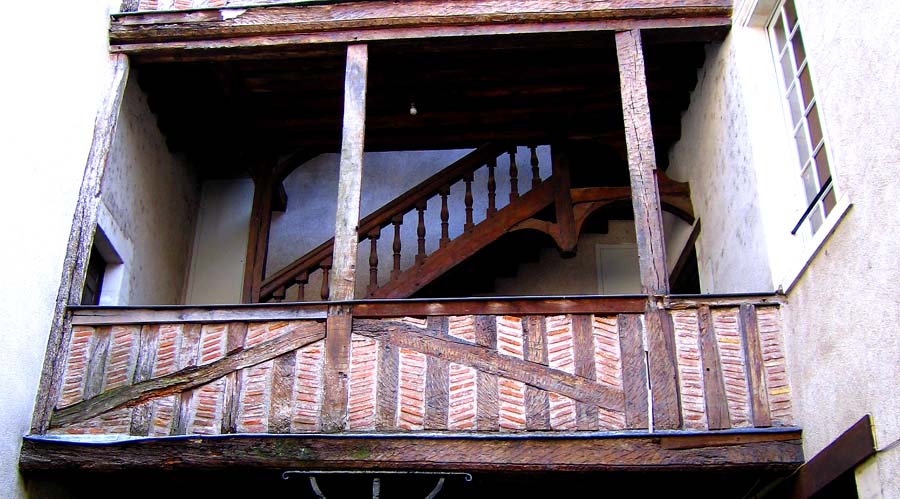
In the streets of old Blois, there are courtyards you can look into along the way. This one had a nice old staircase in it.

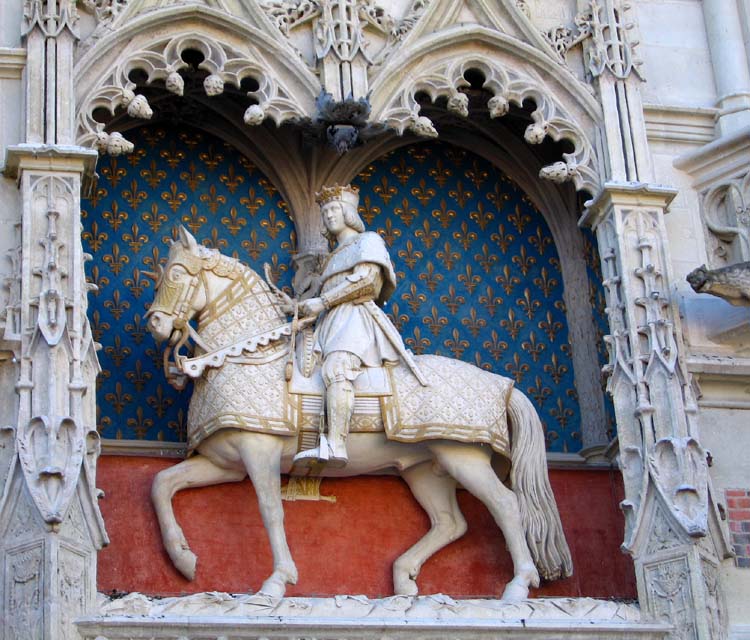
At the famous château in Blois, there's this statue of an equestrian Louis XII (1452-1516). His reign ushered in the Renaissance. He was a popular figure and was known as "the father of his people."

In old town Blois, the Pigier secretarial school occupies a fine old building and has a nice old sign.

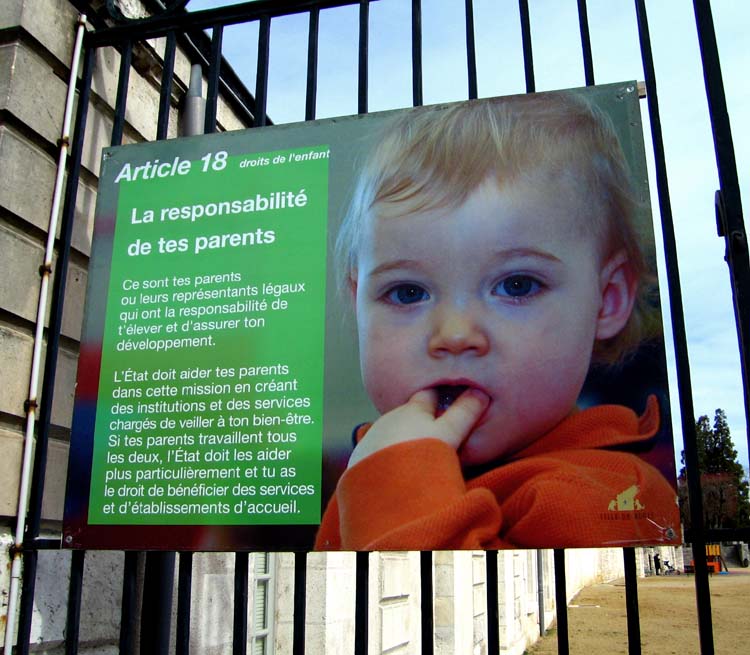
At the Hôtel de Ville — city hall — there's a display of posters explaining the rights of children in France. This one lists the responsibilities of parents and the State.

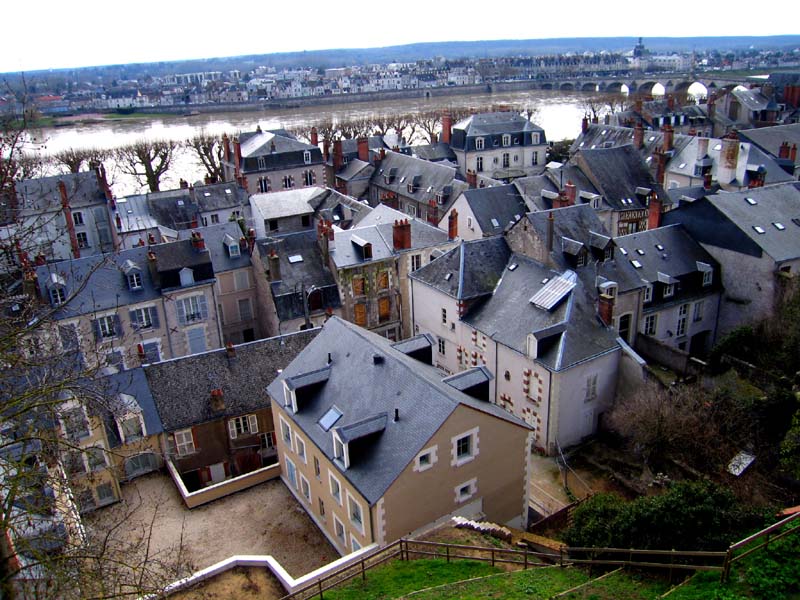
Looking down on the rooftops of Blois and the Loire river from the rose garden at the Hôtel de Ville.

You still see quite a few of these old Citroën 2CV (Deux Chevaux) cars here in the Loire Valley. I think they stopped manufacturing them more than 20 years ago.

This is a picture of the rooftops of Blois, the rose garden, and the Hôtel de Ville. You can see the steeple of the cathedral on the right, the steeples of the Eglise St-Nicolas in the distance, and the Loire river on the left.

At the Hôtel de Ville there's this statue of Joan of Arc on horseback. It was donated by an American philanthropist and francophile.