Showing posts sorted by date for query Moulin. Sort by relevance Show all posts

15 August 2025

La Ferté-Imbault

The Château de la Ferté-Imbault is just about half and hour's drive east of The Château du Moulin. Between the two is the town of Romorantin-Lanthenay (known locally as "Romo"). It doesn't appear in any of my guidebooks, though it is worth a visit. The population of the village is about one thousand.

A château-fort was built on this site starting in the year 980. During the 100 Years' War between the English and the French in the 14th and 15th centuries, that building was destroyed, as was the neighboring village. A new château was built during the Renaissance in the 16th century. That château was destroyed by fire in 1562, during the French Wars of Religion between Catholics and Protestants. La Ferté-Imbault was re-built in the early 17th century.

The Château de la Ferté-Imbault is the largest brick château in the Sologne region of France.


I remember having dinner at the restaurant pictured above. In French the word lard means bacon or pork belly. What we call lard (rendered pork fat) is known as saindoux in France. The expression tête de lard is an insult used to describe a person who is ignorant and obstinate.

14 August 2025

Le Château du Moulin

According to another guidebook I have, Les Guides Illustrés (Hachette, 1924) the Château du Moulin was built between the years 1489 and 1502 by Philippe du Moulin, a loyal servant of the French king Charles VIII. The Château du Moulin is less than 15 miles southeast of Cheverny and was built of red and black brick with stone accents. The author of the Cadogan guide to the Loire calls it "the romantic star of the brick châteaux of the Sologne" and says it is "a dreamy place hidden in the countryside." It is surrounded by a wide moat and accessible via drawbridge.

02 March 2024

RIP Peter H.

Recently, I've spent a lot of time thinking and writing about my friend Charles-Henry and his passing. Now I need to share some more sad news. Another friend of mine, the food writer and excellent cook named Peter Hertzmann, passed away back in December. Peter's wife Jill sent out an e-mail in late December letting Peter's friends know that he had died. He was in his mid-70s. Sincere condolences and best wishes to Jill.

Peter at work in our little kitchen here in Saint-Aignan on a 2007 visit.

Peter was a major figure on this blog. I first met him back in 2002, soon after we had put down the money on our house here in Saint-Aignan and while we were getting our San Francisco house ready to sell. It was a friend in Rouen (Normandy) who put Peter and me in touch with each other. I didn't see him again before we left California and moved to France. French cooking was his specialty in those years. Earlier in life, he had spent several years exploring Chinese cuisine.

One thing Peter liked to do when he was here was to go see the kitchens in local châteaux. This is Peter at Montpoupon.
Chenonceau, Moulin, and Valençay were others we went to see over the years.


Peter was among our first visitors in Saint-Aignan. He was one of our most faithful readers and one of our most frequent visitors over the years. He and Jill last visited us in June 2022. I could tell that he was slowing down, but so am I. He and Jill were here for four or five days and Peter went out of the house just once during that time. That was to do some food shopping. He was fine with letting me and Walt do the cooking.

Peter Hertzmann and Jill C. in front of the wine co-op in Valençay. Where there's food there must be wine. Peter was a larger than life guy who just barely fit into my little Peugeot. If you'd like to see some of my old posts that he featured in, follow this link.

~~~~~~~~~~~~~~~~~~~~~~~~~~~~~~~~~~~~~~~~~~~~~~~
P.S. I got so busy yesterday doing research about cataracts and cataract surgery in English and in French that I totally forgot to do a blog post. Thanks again to all of you who posted comments on the subject or sent me private e-mails. I'm pulling together questions I want to be sure to ask the ophthalmologist when I next see him. That won't be for the surgery, but for taking measurements of my eyeballs to prepare for subsequent surgery.

28 June 2023

Le château du Moulin

Depuis janvier 2020, le château du Moulin est définitivement fermé à la visite et mis en vente par ses actuels propriétaires.

That's what I just read on French Wikipédia.

Le Moulin was built over the last 20 years of the 15th century by king Charles VIII for his childhood friend Philippe du Moulin. Philippe had saved the king's life in a battle in Italy in 1495 and was knighted by the king. The Cadogan Loire guidebook explains that Le Moulin was built at the time of the transition from Gothic to Renaissance styles.
I've been to the château du Moulin several times over the years, starting in the year 2000. We were staying in a gîte in Vouvray that year. Le Moulin was still lived in by the woman who owned it. We arrived at about 6:30 p.m. on an October evening. The people at the front gate were getting ready to close up for the night, but they did one more guided tour, just for us. Inside the château, at one point we saw the owner discreetly disappear into her private quarters, closing the door behind her. We had surprised her. Here's a link to some of my earlier posts about le Moulin, with many photos.

08 May 2021

Looking closely

We had a technician here yesterday afternoon to tinker with our boiler. It was working enough for us to get some heat since we had fuel delivered Thursday morning, but periodically it would just shut down for no apparent reason. It seems to be working fine now, but we don't know exactly what the techician did to repair it. It doesn't matter, since we have a service contract with the company that installed the thing, for emergencies like these. When the boiler needs repair, we don't have to pay labor charges. We do have to pay for any parts that need replacing. Of course, now the weather has really warmed up and we don't really need heat. We probably won't need heat again until October. Still, on ne sait jamais. There can be cold mornings in late spring and in summertime in this climate, even in July and August.

These are some close-up shots of things that caught my eye at the Château de Carrouges
on some of my visits there.


I was just reading the pamphlet that the staff at Carrouges gives to visitors. It points out that the decision
to build the château out of bricks was made because there was a lot of clay
in the local soil but not much stone for building.

The Ancient Romans used bricks as a building material. Bricks also became popular toward
the end of the middle ages and the begining of the Renaissance in France.

One wing of the Château de Blois was built using brick. The Château du Moulin over near Romorantin,
20 miles east of Saint-Aignan, was built with brick in the late 1400s.


I suppose it was more cost-effective to make bricks and build with them that it would have been
to move loads of stone over long distances — without trucks or railroads.

Lichens like stone. They grow all around us on stone walls, and on tree trunks and limbs too.
They don't seem to grow well on bricks. At least not at Carrouges.

12 October 2020

Le Château du Moulin, en Sologne

Again, I quote from the Cadogan guidebook for the Loire Valley: "The Château du Moulin, lost in the Sologne woods 12 kilometres [7 miles] west of Romorantin-Lanthenay,is the romantic star of the brick châteaux of the Sologne. It's a dreamy place, hidden in the countryside, reached by an alley of oaks you have to walk down, and surrounded by trees dipping their branches into the moat. Swans swim elegantly in its waters. The buildings that remain are fragmnts of a more solid ensemble..."

The Château du Moulin, built in the 1480s (as was the Château de Fougères-sur-Bievre) is about 15 miles east of Saint-Aignan in the Sologne, a "natural region" of sandy soil, ponds, lakes, and pine and birch forests. It's flat and the soil is clay and sand, so bricks were the main building material for houses and châteaux. The Michelin guidebook says that Le Moulin was originally protected by high walls and turrets. Those were torn down in later centuries to make the place airier and more pleasant to live in.


The woman who owned the Château du Moulin lived there until recently (maybe she still does). I remember getting a glimpse of her when we toured the inside of the château in October 2000. We were the on last guided tour of the day, and I think we caught her off guard when we entered a room that was part of her apartments. The pictures in my slideshow here are some that I took in 2004 when, if memory serves, CHM and I visited Le Moulin, which is just 15 miles northeast of Saint-Aignan.

And guess what I just learned — the Château du Moulin is now closed to the public and has been on the market since last January. You can buy it for a couple or three million euros. It's described as having 30 rooms, including 20 bedrooms, and 100 acres (39 hectares) of land. Here's a link.
And here's a video I found on YouTube:

12 April 2018

On the way to Juliénas

Our last stop on the Beaujolais tour was the northernmost wine village in the appellation. It's called Juliénas (pop. 895), and to get there from Moulin-à-Vent you drive around a mountain, go fairly high up, and then drop down into a deep valley. The views along the way are nice.


In the World Atlas of Wine, I read that the wine of the Juliénas cru is more like the wine of Fleurie than that of Moulin-à-Vent. It's "Fleurie-like in youth, but at best fatter, fleshier, and spicier with the backbone to keep it going for five years." In other words, you can keep a bottle for five years with confidence that the wine will continue to improve.


"Juliénas is steep, ideally sheltered, and drained. No cru has a higher overall standard." That's from the same paragraph as the sentence above. In his earlier wine "encyclopedia" the same author says that Juliénas is considered to be "mealtime Beaujolais" rather than simply a thirst-quenching wine like many other Beaujolais vintages. And, I'll add, there's a big wine co-op in Juliénas that was open for business by the time we got there that afternoon.

11 April 2018

The next leg

Wrapping up this set of posts about Moulin-à-Vent and the Beaujolais wines made there and near there...


The photo above shows our next destination. We were headed to the north, and it was still the middle of the day, so everything was closed and we didn't want to linger or just wait around for wine co-op tasting rooms and shops to open for the afternoon.


The Moulin-à-Vent AOC area straddles two French départements and régions. Half of of it is offcially in Burgundy, and the other half is officially part of the Lyon administrative area. The tower above has a typically Burgundian mult-colored roof.


We were headed toward the southern tip of Burgundy and the big town of Mâcon, which is its own wine area. Above is a view of the town of Romanèche-Thorins, which is also in Burgundy (département de Saône-et-Loire). This is looking basically south from the windmill, and toward the mountains.


Above and below are shots of a famous wine village taken from the Moulin à Vent. It's the village called Fleurie, which is another cru du Beaujolais. I mentioned it yesterday and quoted a wine expert saying that Fleurie wine, light and drinkable, is completely different from Moulin-à-Vent wine, which is "severe" when it's young and benefits from years of aging in the bottle. The two wine areas are adjacent to each other and the church in Fleurie is only a mile and a half from the windmill.


Here's an impressionistic view of the village of Fleurie that I made from one of my photos. Speaking of wine, as I was, we had bought only six bottles of cru Régnié so far, because we were driving around between noon and 2:30 p.m., hours when so many shops in France are not open for business. All the shopkeepers and employees are at home or in a restaurant eating lunch. Walt and I needed to move on because we had a long drive back to the Bourbonnais ahead of us, and we wanted to be there by dinnertime. Were we going to find some wine to take home with us, or not?

10 April 2018

Terroir — stone, soil, topography, weather, climate

In his book The World Atlas of Wine (1994 edition), author Hugh Johnson says of the village of Fleurie — just to the west and south of Moulin-à-Vent — produces wines that epitomize the spirit of Beaujolais. "The scent is strong, the wine fruity and silky, limpid; a joy to swallow." Remember the photo of that little isolated hilltop chapel I posted a few days ago? It stands on the territory of Fleurie.


The wines of neighboring Moulin-à-Vent are very different. Johnson uses the term "severity" to describe them and says the differences are "a tale of terroir writ large."


« Terroir » is that complex combination of soil, topography, weather, and climate conditions that makes one place ideal for growing grapes that produce wines of superior quality, while the same variety of grapes, grown in another place — even nearby — will give you a completely different, even mediocre wine.

Pruning the vines and burning the clippings in Beaujolais

The soil of the Moulin-à-Vent area, Hugh Johnson writes, "is rich in iron and manganese, probably but unprovably implicated in the concentration, dumbness even, of its young wines and their ability to age ten years."  Most Beaujolais wines are meant to be drunk young and don't really improve with age beyond two or three years in the bottle. Moulin-à-Vent is the exception, not the rule.


Meanwhile, let me show a couple of photos of the back, north-facing house I showed yesterday and described as a typical old Beaujolais building. Iron and manganese... Pink granite... Soil is basically crushed or eroded rock, isn't it?


The back side of the house, and I'm sure the front too, were once and still are partly are covered in what is called an enduit or crépi in French — a kind of rough-textured coating like stucco, I'd call it. It's supposed to help prevent moisture from seeping into the stone and mortar underneath. It's too bad that it completely hides the colorful stone that houses like this one are built of.

09 April 2018

Cru Moulin-à-Vent

Moulin-à-Vent was the first Beaujolais cru to be delimited and recognized officially. At the beginning, in the 1860s, it was named after the nearby village of Romanèche-Thorins. Wine expert Hugh Johnson, in his 1983 Modern Encyclopedia of Wine, calls it "the most 'serious' and expensive Beaujolais appellation." And he says Moulin-à-Vent Beaujolais is normally the last wine served during an elaborate Beaujolais dinner — with the cheese course, because it has enough body to stand up to strong cheeses that would overwhelm the other, lighter, Beaujolais crus.


It's too bad the tasting room/boutique was closed when we were there. But this was one our three longer stops as we drove from Beaujeu up toward the big town of Mâcon, north of Beaujolais, over the course of the afternoon. We climbed up the steps to the windmill with the dog and took a lot of photos.


The windmill itself dates back to the 15th century. In 1983, when Johnson published his book, the blades of the windmill had fallen off the old building, attacked by a fungus that weakened the wooden structure. The blades were restored 10 or 12 years ago.


Above is a map of the Moulin-à-Vent wine production area. It covers something like 1500 acres (less than 2½ mi²) and includes the village of Chénas, which is a Beaujolais cru in its own right. I'm posting the map at a fairly large size so that you can read it if you want to, by clicking on it to enlarge it. All the names of the different vineyard parcels (les terroirs) are interesting, and there's a blurb in English as well as French about the place.


Sitting just at the foot of the windmill is the house pictured above. I think it's a pretty typical old-style Beaujolais house, built with the stone of the region. According to the map, the windmill and the house stand on land that is at about 800 feet (250 meters) of elevation.

08 April 2018

The three parts of Beaujolais

When we left Régnié-Durette after our picnic lunch, our plan was to drive north through the prime Beaujolais « cru » vineyards before driving back to the Bourbonnais late in the afternoon. « Cru » is one of those French terms like « terroir » — it's pretty hard to translate. Let's just say "local vintages." Anyway, Beaujolais is actually divided into three distinct wine areas, or « terroirs ». In the south, closer to Lyon, the soil is clay and limestone (as it is around Saint-Aignan), and the wines produced are just labeled as Beaujolais. Paradoxically, the south in south Beaujolais is "colder" — slower to warm up in the sun — than the soil in north Beaujolais.


The middle part of Beaujolais is where the soil transitions from being clay and limestone into a layer of sand and schist over a granite base. The wine towns there label their production as Beaujolais-Villages. Most are made with a mix of grapes from different vineyard parcels and villages, but still they are considered a step up in quality from the plain Beaujolais wines made to their south. They don't carry a more specific appellation than just Beaujolais-Villages, however.


Finally, the northern part of Beaujolais is an area where topography, soil type, and weather conditions produce the wines that are considered to be the best that Beaujolais has to offer. It's a much hillier area, so not only are the granitic soils lighter than the clay of the south, but the vineyard parcels are better exposed to warm sunshine because they are often on east- or south-facing slopes. The soil warms up more quickly and the grapes ripen more completely, making for richer, tastier wines.


We had done just a little bit of research to see where we might find good places to buy some bottles of Beaujolais to bring back to Saint-Aignan. We tend to favor wine cooperatives rather than individual producers in situations like these, when we don't have a lot of time. Individual producers are often very busy people, and many require you to make an appointment rather than just show up unannounced to taste and perhaps buy bottles of their wines.


Co-ops are places of business with regular hours. You can just drop in, with the assurance that somebody will be there to advise you and sell you the wines you want. You can taste too, but we weren't tasting because we were driving. We drove north through the vineyards and through villages we've long heard of — Villié-Morgon, Chiroubles, Fleurie, Chénas, Moulin-à-Vent, and Juliénas, for example. Those are the Beaujolais villages that are authorized to put their name on their wine labels, because each village produces a vintage that is distinctive compared to all the other varieties of Beaujolais, and has its own special characteristics and reputation.

21 December 2017

From Montrésor to Chemillé to Chinon

Chinon is a very different kind of place compared to Montrésor. It's a big town, pop. 8,000 or so. The château at Chinon is basically a ruin, and it's enormous. And it has much greater historical significance than does the château at Montrésor. The Plantagenets and Joan of Arc feature in its past.

A section of the Château de Chinon in an October 2005 photo

That said, I need to do some reading to refresh my memory of the history of Chinon. And I need to process some photos. Most of the ones I've found so far date back to 2005, and digital cameras didn't consistently produce images of the same quality back then. We'll see.

Meanwhile, I want to post a couple of photos of the village that lies just to the west of Montrésor. It's called Chemillé-sur-Indrois, and it's the spot where a small earthen dam creates a plan d'eau, a small artificial lake, just three kilometers (a couple of miles) from the Montrésor château.

Le plan d'eau de Chemillé-sur-Indrois, near Montrésor

There's a good restaurant there called Le Moulin de Chaudé. Nearly two years ago I posted photos I took during a meal there, and here again is a link. I am providing this information for an American who participates in a travel forum that I like to read and who has said he plans to visit Montrésor on an upcoming trip to France.

In warmer weather (we were here in December) this terrasse is set up with tables and chairs for outdoor dining.

Also, here's another panel of that Renaissance-era stained-glass window in the church at Montrésor. I don't know why I didn't post it earlier.


I can't seem to finish with Montrésor.

19 December 2017

Montrésor (nº 27)


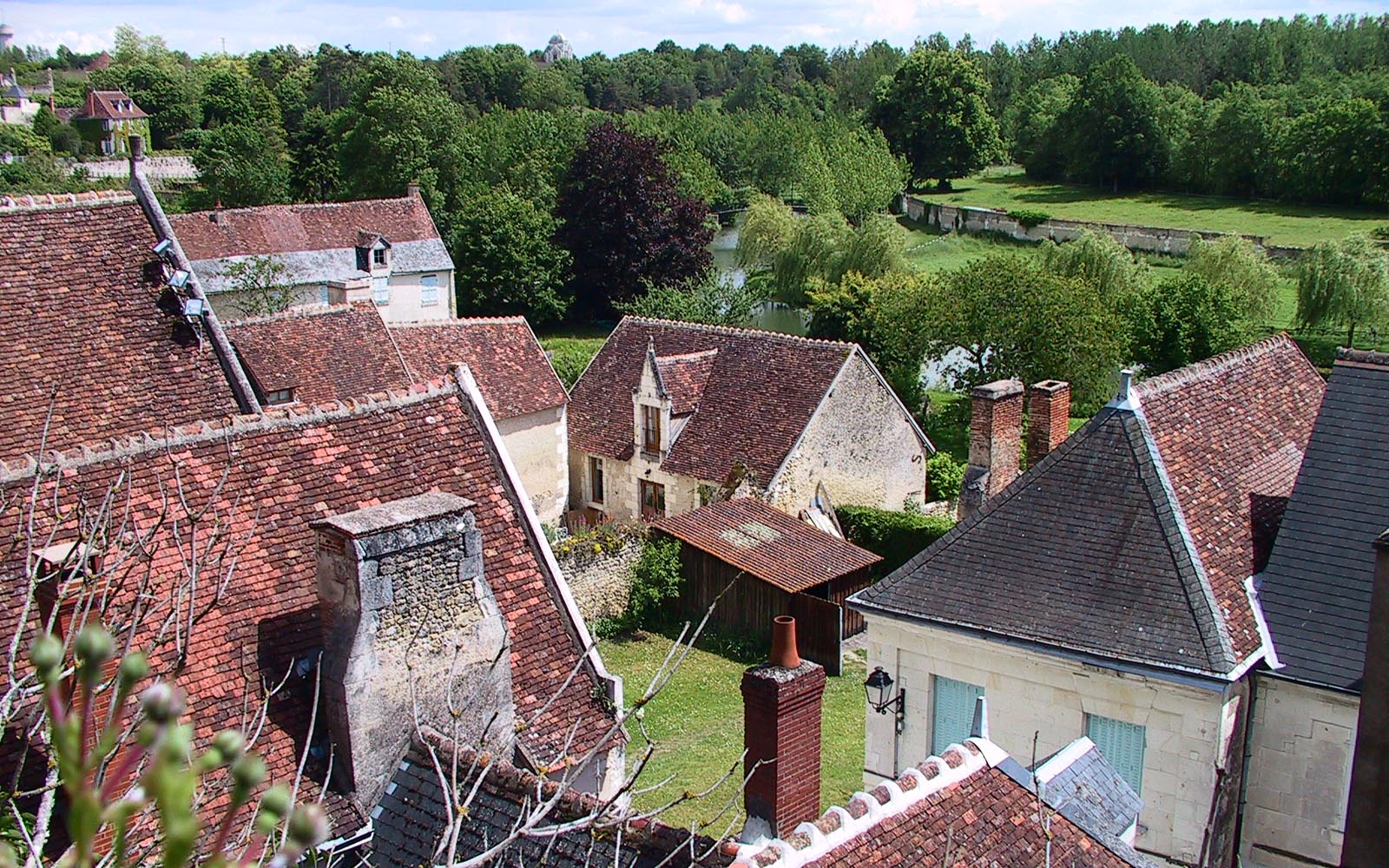
The village of Montrésor in the Loire Valley's old Touraine province is a string of houses below a 500-year-old château and church along the little Indrois River. It's about 45 minutes by car south of better-known Amboise and an hour east of Chinon. Three closer towns of note are Loches, Montrichard, and Saint-Aignan.


The Indrois is a small river that flows into the Indre River north of Loches after winding for 25 or 30 miles through the southeast corner of Touraine. The Indre in turn flows into the much larger Loire River, making the Indrois a sub-tributary of France's largest and longest river.


The Wikipedia article about the Indrois describes the rivière as only « moyennement abondante » (the flow is not especially impressive). In other words, it's not much more than a stream. Above and on the right are views of the Indrois from up in the château.


Though small and lazy, the Indrois does flood every 20 years or so, and the floods are sometimes more significant than you might expect for a stream with a fairly small drainage basin. The Indre River into which the Indrois flows has a drainage basin ten times as extensive and is five times longer, and it's still basically a small, slow-flowing river.


At Montrésor, the château stands on a sort of promontory above the Indrois valley, which is lined with vegetable gardens on its north bank and maintained as a park and river walk on the south bank. There are pretty views from the château and its grounds. At nearby Chemillé, downstream, the Indrois is dammed and forms a small artificial lake. There's a very nice restaurant there called Le Moulin de Chaudé where we've had several delicious meals over the past two or three years.