04 January 2019

Île de Noirmoutier : le Bois de la Chaise

Le Bois de la Chaise is described as a forêt (forest) on the Île de Noirmoutier, on the Atlantic coast of France. It covers only 110 hectares. That's 1.1 square kilometers, or less than half a square mile. The place we found where we could eat our picnic lunch last October 24, when we were spending a week on the coast, was in the Bois de la Chaise. I've been looking again at some of the photos I took there — so here are a couple. Also, chaise means "chair." I don't know why the "forest" is called the "woods of the chair."


Obviously, the French word forêt doesn't have the same meaning as the English word "forest" — at least not in the way we use the term in North America. Anyway, this looks a lot like a scene on the North Carolina coast, thanks to the live oak trees. I don't know if they are the same species, but they must be very closely related. In French they're called chênes verts — "green oaks." They stay green year-round.


I'm not sure what Natasha the Sheltie was doing when I took this photo. That's Walt with the sun on his face. Sorry for the poor image quality. I am sure that the picnic table also looks just like a picnic table you'd see in North Carolina. We were lucky to find one that wasn't already being used. We hadn't yet got our lunch out of the insulated Whole Foods bag we had packed it in early in the morning, before leaving the gîte.


We weren't far at all from the beach. Again, this is the bay side of the island. The body of water is called an anse in French. I knew the term, but I hadn't thought about how it would be translated. I understood it as "an arm of the sea." I just looked it up and found the term "cove" — that's exactly what it would be called in N.C. as well.


Above are the cabines de plage on the nearby Plage des Sableaux. I think we might call them "beach cabanas" but I see the term "beach huts" on English language versions of Noirmoutier tourist sites. They are little cabins where you can change into your bathing costume, with your modesty uncompromised.


Can you tell I felt at home on Noirmoutier island? I keep thinking I might like to live there. It probably won't ever happen — we are too settled here in Saint-Aignan, and we don't have much to complain about. Since Noirmoutier is not more than four hours (170 miles) away by car, maybe the thing to do would be to go back in different seasons and see what it is like at other times of the year.

03 January 2019

Noirmoutier: summery scenes

We had walked along the Plage de la Madeleine and the Plage du Vieil. We got back to the car and headed off again to find a place to have our picnic lunch. We drove through the town of Noirmoutier and again headed out toward the beaches.


One beach we wanted to see was called La Plage des Dames. The gîte owner had told us it was famous as one of the most beautiful beaches see on the island. It seemed like a place where we might be able to have our picnic. We drove down a straight, narrow road that was bordered on one side by woods — a park, it turned out to be — and by houses on the other side. We came to the end of the road and there was the beach. But there was nowhere to park the car. A lot of people were out enjoying the fine weather, and all the parking spaces were taken.


We were really hungry. We drove back along the edge of the wooded park and turned left (south) at the first opportunity. We drove a few hundred yards, with woods on our left and houses on our right. And then suddenly there it was: a picnic area with two tables, in the wooded park. One was occupied by a family with three or four children. The other table was free. The tables weren't very close together. The photos I took there aren't very interesting, but here's how the place looks on Google Maps street view image.

We had lunch. Then we continued on our way and came to another beach, the Plage des Sableaux. These beaches were sandy and there were no seaweed-covered rocks, just blue water. Again, it felt like a summer day, even though it was October 24. Signs said no dogs were allowed on the beach, so we left Tasha in the car. We couldn't go far or stay very long. We were still on the bay side of the island. I wanted to see the ocean side.

02 January 2019

Wintertime foods


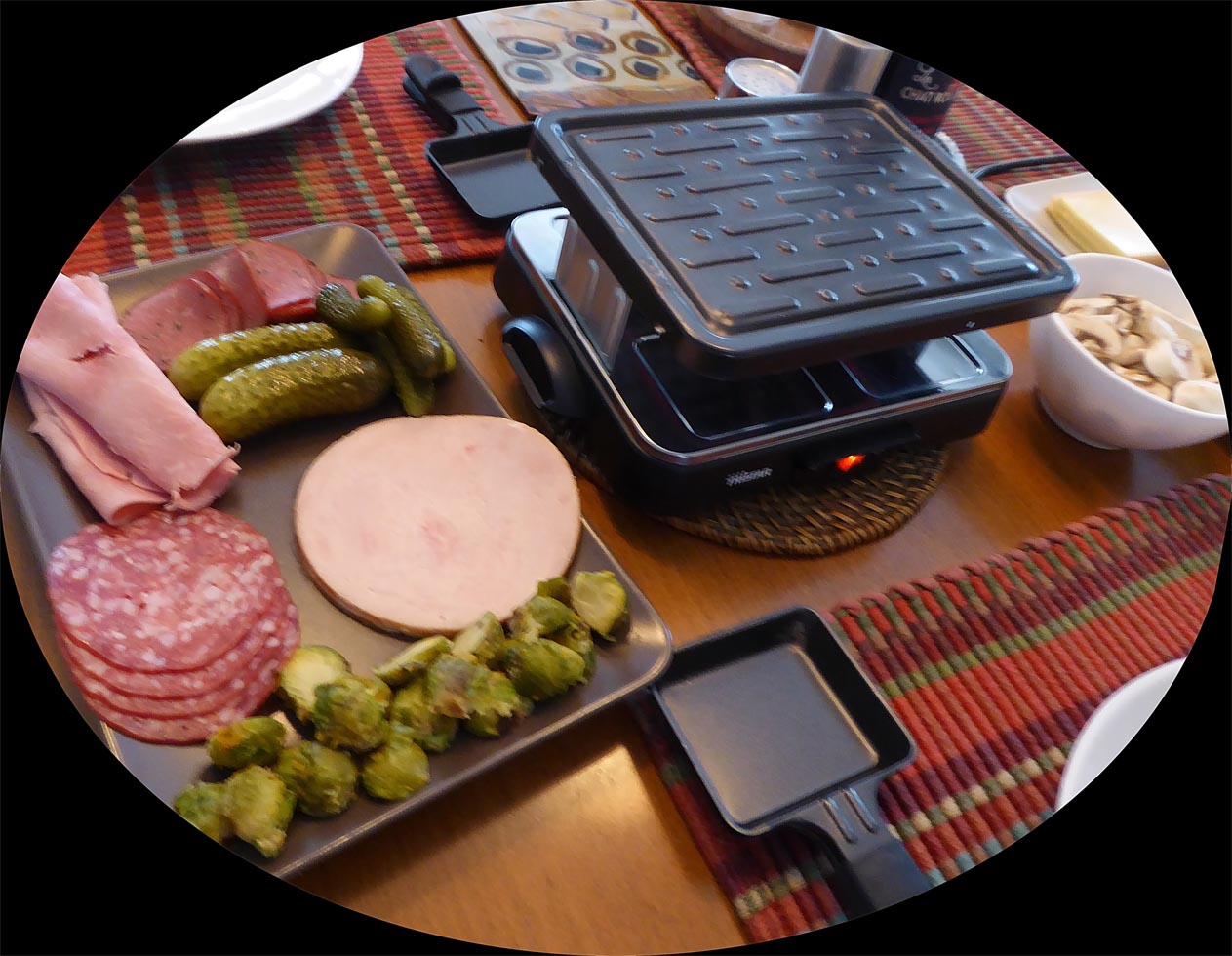
Do you recognize this contraption? It's a modern appliance used for making a traditional Swiss wintertime meal that in olden days was made in front of the fireplace. It was the meal we had on New Year's Eve, the day before cooking and dining upon our New Year's Day black-eyed peas.


Here's what you cook in it: cheese. Well, you don't so much cook it as just melt it. It's a kind of fondue. The little non-stick tray slides in under a heating element and there's a griddle on top. There are four trays. You can cook your own meal at the table.


You can cook things on the griddle to eat with the melted cheese. Both the meal and the cheese are called raclette. We cooked, or at least heated up, some blanched Brussels sprouts and some raw, sliced mushrooms to have with ours.


So what's the big picture? The main part of a raclette meal is charcuterie — salt-cured or smoked pork. We had some jambon de Paris (slices of boiled ham), slices of rosette (a salami from Lyon), some filet mignon de porc (pepper-cured pork tenderloin), some filet de dinde (roasted, sliced turkey breast), and two kinds of cornichons (pickles).


This is not exactly diet food. It's holiday food, or cold-winter-evening food. In France, the supermarkets sell sliced raclette cheese cut to just the right size for the little metal trays that you slide under the heating element. Then you scrape the melted cheese out onto your plate and enjoy eating it with meats and vegetables. Actually, the verb racler means "to scrape."


Oh, and don't forget the steamed potatoes, served hot. You can also heat up the sliced meats on the griddle on top of the appareil à raclette if you want. That way, everything's hot.


Good bread goes well with melted cheese too. That's the basis for what we call a Swiss fondue, and which is France is called a fondue savoyarde (la Savoie is an old province up in the Alps). Why not toast a slice of bread on the griddle while the raclette cheese is melting?


Here's one more shot of the platter of meats, sprouts, and pickles. We'll be having this meal again today because, as usual, we had about twice as much food as we could eat in one sitting. With food like this, we really do need to take a long walk with the dog every day.

01 January 2019

Bonne année 2019


It's almost midnight on the U.S. East Coast — approaching six a.m. in France. So it's 2019 here. 2018 went by in a flash, but it couldn't go fast enough for me. Let's hope for a better year this time around.


And I can't believe my black-eyed peas have been in the slow cooker for nearly nine hours and they aren't done yet! I guess I should have started them in boiling broth. It must have taken hours — I was sleeping — for the cooker to come up to temperature.

I've taken the black-eyes (called haricots cornille here in France) out of the slow cooker and put them in a big pot on higher heat to finish. Of course we won't eat them for another seven or eight hours, so it shouldn't be a problem. The ones we get here come from Portugal, but the package doesn't say where they were grown. Maybe in the U.S. Black-eyed peas are a variety of what are called "cowpeas" and they came originally from Africa.

Yesterday I spread a kilogram of haricots cornille out on a baking sheet in one layer so I could pick through them and eliminate the broken or shriveled ones, not to mention any extraneous matter I might have found (none this time). Then you just cook them in water or broth (a combination of pintade broth and potée broth for me this year).

U.S. Southerners (I'm from North Carolina) eat black-eyed peas on New Year's Day out of superstition. Eating them on January 1 is supposed to bring you good luck for the new year. We'll have ours with Toulouse sausage, smoked pork belly (poitrine de porc fumée), and confit de canard (slow-cooked duck, in this case leg-thigh pieces and gizzards). I guess I'll make another salade de scarole, plain this time, to round out the meal. Or maybe I'll take some garden-grown collard greens out of the freezer.

All the best to you all in 2019.