17 December 2012

The two towers

Two towers behind the tree
The two towers are done. I said "done," not "down." I'm talking about the two towers of CDs, that I have now finished transferring to computer hard disk. Each tower holds 200+ discs.

That comes to about 6500 songs — but with a good number of duplicates because the same track sometimes appears on several albums, including store-bought "Best of" discs and personal "mixed" discs that I used to make for the music I listened to while commuting to work and back in California.

I just went to look around in Walt's office. There are at least 30, maybe 35 more music CDs in a rack in there. So the job is not entirely done, but at least the discs in the two towers are transferred.

Now we can pack the CDs in boxes and put them away.

As I said, it's at least 6500 songs, which iTunes reports as 35 GB on the hard disk and 17.2 days of listening time. We've been listening, too. Putting iTunes in random mode and being surprised to again hear music we'd long forgotten about is a lot of fun. And the neighbors are far enough away that we can turn up the volume a little without the fear of bothering anybody.

Sun shining through an umbrella tree makes light patterns on a scarred wall.

I'll soon need some new projects. With the end-of-the-year holidays (including Walt's birthday) coming up, I'll be doing a lot of cooking. And then I have to make time to go out and drive my car hard and fast.

16 December 2012

Undergrounding

There's a project in the planning stages to underground the electrical wires in our hamlet. Not all of them — just the medium-tension lines that come up the hill from down in the river valley and bring electric current to the nine houses up here at the top of the hill.

View from the kitchen window: those are low-tension wires.

We'd be happy if all the wires were put underground. The reasons would be purely esthetic. The wires you see in the picture above are low-tension lines that bring current to the individual houses from a transformer on a pole out back. If you've been reading this blog for a while, you know we've had problems with electricity because of both the wires and the transformer over the past few years.

Pictures are nicer without wires in them.

The medium-tension wires that bring electric current to the transformer are the ones that need to be undergrounded, and not for esthetic reasons. They run up through some woods where there are very tall trees that really sway in high winds. One of those trees fell on the wires in 2010, pulling them down, and we were without electricity for nearly five full days.

At least a couple of utility poles will be taken out if the medium-tension wires
are put underground.

A man from the electric company ERDF (Electricité Réseau Distribution France) was out on the road surveying the situation this past week. Walt talked to him. He said they will need to put a big transformer box somewhere along the road at ground level. The man mentioned putting it in our yard, but I don't think it will end up on our property. We'll see.

15 December 2012

« Comme des petits vieux »

Comment devient-on un petit vieux ?

Réponse facile : il suffit d'attendre...

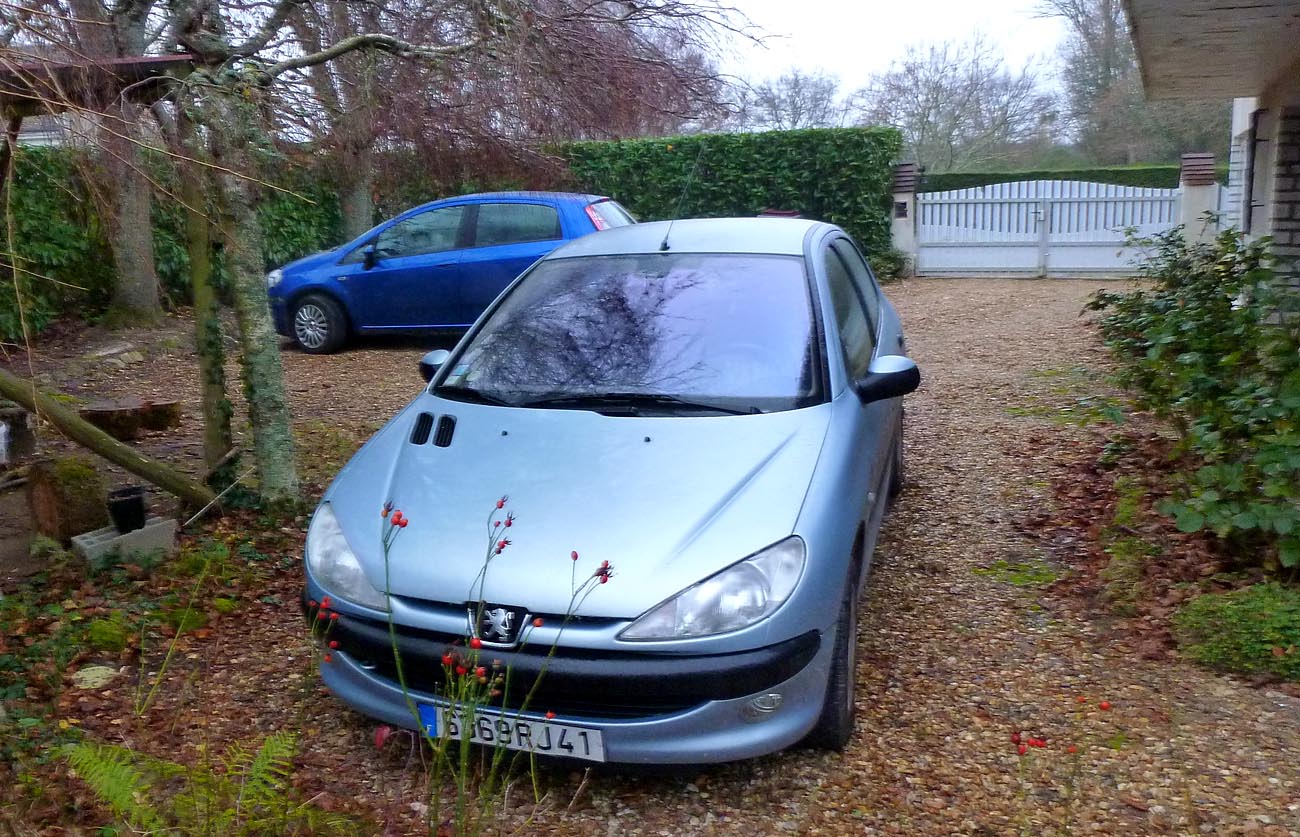
I got my car back from the mechanic yesterday. It failed inspection because it has too much carbon build-up in the cylinders. I don't drive it hard enough to keep the engine hot and carbon-free — to blow out the carbon, as we used to say.

A summertime shot of the Peugeot lazing around on the driveway

A couple of days ago, I was talking on the phone with our summer neighbors who live most of the year in Blois, 25 miles north. I asked how they were doing. « Nous, on va bien. Comme des petits vieux ! » is what they said. She's 77. He's 82.

Now I'm a petit vieux too. You know what petit means — and vieux means "old" as an adjective, or an "old person" as a noun. Des petits vieux are "little old people," in other words, on the model of  "little old lady." LOP, not LOL.

Here's my Peugeot and the Fiat Punto that we rented to stand in for it this past week.

The mechanic insisted on explaining what I need to do even after I told him that I understood the problem: Je conduis comme un petit vieux. (I drive like an old codger.) To get the car engine into better working order, I have to pour some fuel additive (which he supplied) into the tank and then drive the car really hard for a week or two. Then it will be ready to pass inspection in January.

"Your car has a high-performance two-liter engine in it," the mechanic said. "You should take it out and put it through its paces." He said to drive up hills, and we tried to think of some steep hills in the surrounding area. It turns out that there aren't that many.

 I need to drive my little Peugeot until it's red hot, like this one.
Too bad we don't have little Peugeots in the U.S.

Walt and I are trying to decide where to go. We can stay local and drive really fast in third gear up any hills we can find to get the engine hot and blow out the carbon. Or we can go on a trip on the autoroute and drive really fast and far in fourth gear — the speed limit is 81 mph (130 kph) — until all the carbon is burned off. Any ideas where we should go? Remember, we have to take the cat and the dog with us.

Reminds me of the old joke about the grandmother who started walking five miles a day for her health. Her children and grandchildren had no idea where she had got to.

14 December 2012

Asian foods and king-size beds

There's no talk of snow on the news or weather this morning, so I wonder if the whole storm didn't fizzle out. When I got up yesterday and took Callie outdoors just a sunrise (8:30 a.m.), the grass, the gravel paths, the cars, and the paved road were completely glazed over. By 9:30, when we left for Tours, everything had started to melt.

Tours, a city of 300,000, is about 35 miles (60 km) west of Saint-Aignan. We drove over on two-lane highways. There was almost no traffic, and the road surfaces were wet but not slippery. We don't go into the center of Tours, but to the shopping areas around the east side of the city. Yesterday, we needed to go to the Asian supermarket and to Ikea.

Paris Store is a chain of supermarkets in France specializing in imported foods

For most things, we have everything we need here in the Saint-Aignan area ("metro" pop. 10,000), with our two largish supermarkets, two smaller ones, the open-air markets in Saint-Aignan itself (Saturday), across the river in Noyers-sur-Cher (Sunday), Montrichard (10 miles west), and Selles-sur-Cher (10 miles east). But for some things, we will drive the 35 miles to Tours or the 25 miles north to Blois several times a year.

Sauces, condiments, and canned goods for making Asian-style dishes

Our main shopping in Tours has to do with exotic and imported foods. I've blogged about the Paris Store Asian supermarket many times. There used to be one in Blois, which is closer to us, but it shut down a year or two ago. The closest one is in the shopping area in the northern section of Tours, and we are lucky to have it.

Need any noodles? Nous en avons...

Pâte d'arachide
We go over there and stock up on noodles, rice, tofu (in cans), sauces of all kinds, and frozen shrimp (for example) two or three times a year. We could almost open our own Asian market with all the supplies we have down in our cold-storage pantry. Yesterday, we were happy to find a one-kilogram bag of black peppercorns for €12.95. That quantity of peppercorns would cost €100 €50 at SuperU (I checked the price again). We also picked up a few jars of chunky peanut butter, which is not that easy to find around here.

If you live in Paris or other big cities, finding imported products is not a problem, of course. Eight or nine years ago, we would frequently drive up to Paris to re-supply the Asian shelves in our pantry, but that's an eight-hour drive round-trip. Now we just drive the hour or so over to Tours and the hour back.

The far wall of the cellier (pantry): Are we becoming survivalists?

Féculents (starches): beans, pasta, rice, flour

Recently, we discovered that Ikea in Tours now sells fitted and flat sheets for American-standard king-size beds. Until this year, we've had to make do with the sheets we brought over from the U.S. nearly 10 years ago, and with a few king-size sheet sets that we've brought back from the U.S. on our annual trips back to see family and friends. But king-size sheets are heavy and bulky, taking up a good portion of the space in your suitcase when you travel.

We'd never been able to find king-size sheets here in France. They just don't have such large beds — the largest French beds are 160 cm wide, and our American one is 180 cm wide. We moved it here in 2003 without thinking about the problem of getting sheets for it 10 years down the line.

If and when we replace the mattress on our big bed, we'll need to buy two twin mattresses, each 90 cm wide. Then we'll be able to get fitted sheets (singles) easily, and flat sheets aren't a problem. The mattress we have is fine, and we don't want to replace it any time soon — especially since we can now get fitted sheets for it more or less locally.

Big problems, eh? Well, that's everyday life when you're an American expatriate in rural France.