16 May 2010

What is the point of brioche?

Recently I've taken up baking yeast breads. I've made three recently: the American pain au lait called Parker House rolls; a fougasse (a.k.a. foccacia), which is a Southern French flat bread that has a lot of olive oil in it; and now brioche.

I think my expanded baking horizons have something to do with having to stay inside because the weather out is so mediocre. I'm not sure where I got the idea that it was time to make brioche. I think it just came out of the blue. But two funny coincidences happened as soon as I had made up my mind and found a brioche recipe I wanted to try.

No, this is not brioche. It's a batch of Parker House rolls
that I made two weeks ago as a first baking experiment.

First, we watched a cooking show on Cuisine TV that featured a young chef who made a honey-glazed pork roast (using a suckling pig), garnished with a rhubarb compote and a Swiss chard side dish. Since we have rhubarb and Swiss chard in the garden, I focused on the show instead of vaguely following along as I did kitchen tasks or read a newspaper article (which is often how I watch TV).

All of a sudden, the young chef was making brioche to serve with his suckling pig. I ran the show back and watched again, more closely, to see how he did it.

And then Friday evening I was reading a couple of articles published by British expatriate Michael Wright in the on-line Telegraph newspaper. Michael lives a couple of hours south of Saint-Aignan with his wife and two young daughters. He keeps livestock and has a vegetable garden, and he has a good eye for observation and a quirky sense of humor.

One of his articles was about all the British expats that, he says, are returning to the United Kingdom because, with the decline in the value of the pound sterling, life in France has gotten just too expensive for them. And about how those who have stayed have taken to ordering groceries and other goods from the U.K. for delivery to France, because their pounds sterling go farther across the channel.

Here's what my brioche, a first attempt, looked like.
I didn't glaze it with beaten egg to make it shiny on top.

Almost as an aside, Michael confesses that he's curious about what kinds of food items his British compatriots might be ordering from Tesco or Safeway that they couldn't buy in France. He says his curiosity fits a pattern: “Even at the supermarket checkout,” he writes, talking about his life in rural France, “watching people unload their trolleys, I can barely resist comparing the relative lardiness of the products and their purchaser; puzzling over what on earth is the point of brioche; or playing Ready, Steady, Cook with the items they place on the conveyor belt.”

So there it was again. Brioche. As Michael Wright asks, what actually is the point? Queen Marie-Antoinette knew, or thought she did, until the revolutionaries cut her head off: Si les pauvres n'ont pas de pain à manger, she supposedly said, what's the problem? ...qu'ils mangent de la brioche ! — Let them eat cake...

By the way, Michael Wright's essay about raising bilingual children is pretty funny.


To my mind, brioche is not bread. And it's not cake either, even though it has eggs (several), butter (quite a bit), and sugar (just a couple of tablespoons for a big loaf) in it. So what is it then? I hate to re-state the obvious, but here goes. It's brioche.

In America, it would be considered a bread. That's because all our U.S. breads have sugar in them. The American Heritage Dictionary says brioche is “a soft, light-textured bread.” There is no purely English word for brioche; we just use the French word.

Thinking back, I remembered that I made this yeast-leavened Savarin
cake more than six years ago, when we first moved to Saint-Aignan.
It's a dessert cake that is soaked in a sugar syrup (or rum).

In France, brioche is not bread, because bread is made with just flour, salt, water, and yeast. According to the Robert dictionary of the French language, brioche is a pâtisserie légère — a light pastry. The Larousse Gastronomique food encyclopedia goes so far as to call it a gâteau en pâte levée — a leavened cake.

The Larousse also says that the name brioche might derive from the name of the region near Paris called Brie, where the cheese is made. Brioche would have first been made in Brie, as well has in Normandy where the butter is so good. Larousse also gives a recipe for a cheese brioche, but it's made with Gruyère cheese, not Brie cheese. (Note to self: try that.)
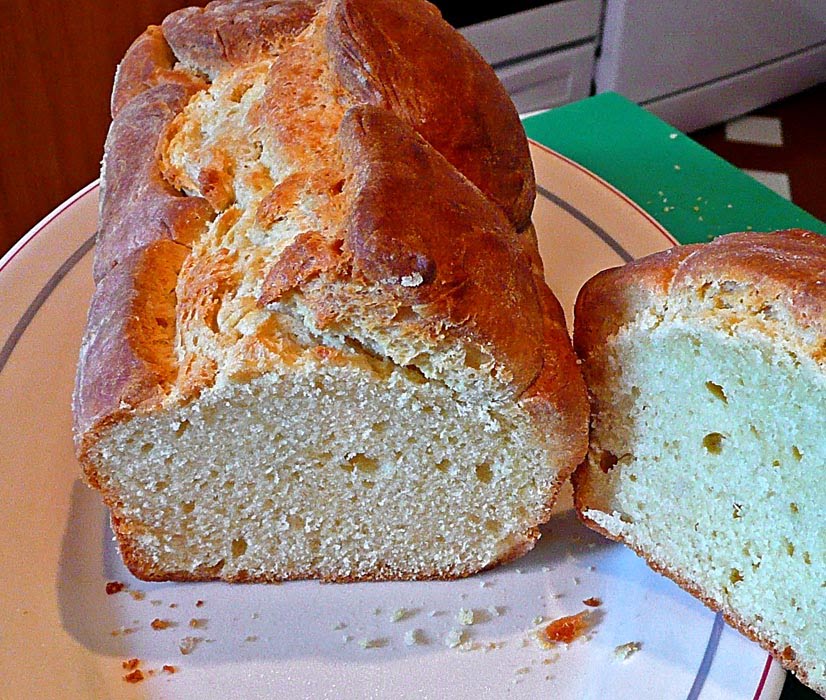
My brioche took only four or five hours to make, including a good three hours for the dough to rise.

In French, a brioche is also what you get from eating too much of this rich cake or bread. Your brioche is your “spare tire” — that roll of fat around your waist, or your pot belly. I speak of myself, of course, and not of your physique...

I think the only point of brioche is that it's delicious. I just ate two pieces with my morning cup of black coffee. You don't have to put butter on it, because there's so much butter in it. A little quince jelly or cherry jam on a slice is pretty good, though.

15 May 2010

Remontant strawberries

I learned a new word. First, I learned it in French. I was looking up strawberries to see if I could find information about a new variety we bought the other day at the market in Selles-sur-Cher from the man we often by asparagus and strawberries from in the spring.

No, remontant is not a place name. That would be Romorantin.

Up to now, the world of strawberries has been divided into four categories in my mind. There are Spanish strawberries; the ones called Gariguettes; others called Mara des Bois; and of course there are fraises des bois — wild strawberries. « Bois » means "woods" and wild strawberries are the ones you find growing in the woods and on roadsides.

These are Charlotte strawberries, a variety we just discovered.

First, Spanish strawberries. Main positive points: cheap, big, with a long shelf-life. Negative points: not much taste, grown not only industrially with lots of pesticides and chemical fertilizers, but also harvested by underpaid, exploited migrant workers and shipped long distances (high carbon footprint). I'll pass.

Second, Gariguettes. A variety developed in Provence and now grown elsewhere in France, including the Sologne region in the Loire Valley. Positive points: juicy, tasty, and delicate. Negative points: fragile — eat them right after you buy them — and available only briefly in the spring. More expensive than Spanish strawberries, but worth the price. The Gariguette strawberry is not a remontant variety.

Third, Mara des Bois. Positives: see Gariguettes — the Mara des Bois is also juicy, tasty, and delicate. And additional positive: Mara des Bois strawberry plants are a remontant variety. Negatives: fragile, and a little pricey.

Fourth, Fraises des Bois. Positives: can be unbelievably sweet. Free when you can find them. Negatives: hard to find, ans with tiny berries — it would take hundreds or even thousands of them to make a pie.

Walt made a pie with a layer of rhubarb compote
on the bottom and a layer of fresh Charlotte
'berries on top, glazed with quince jelly.


Okay, my strawberry world has been pretty limited, considering that I just read on the Internet that there are more than 600 varieties of strawberries in existence. By the way, California strawberries are the same as Spanish strawberries. They'll do in a pinch but don't expect your taste buds to do a tango when you eat them.

So what is this remontant term all about? Well, it's a French word that meant "coming back up, re-mounting." For example, in talking about drinks, « un petit remontant » is a little "pick-me-up" or a tonic.

When applied to strawberry and raspberry plants, remontant means a variety that flowers and produces fruit from spring all the way through to autumn and the first frosts. Remontant strawberries are also called "ever-bearing"or "perpetual."

Rhubarb from the back yard patch

A non-remontant variety, like the Gariguette, will flower just once in the spring and that's it. So Gariguettes, which are maybe the best strawberries I've ever tasted, are available only for a few weeks in the spring. And they don't travel well.

At the Selles-sur-Cher market the other day, the new variety of strawberries we discovered is called the Charlotte. Here's what I read about it on a web site:
Fraise remontante et vigoureuse, peu exigeante en éléments fertilisants, faible sensibilité à l'odium et aux différentes maladies, fort potentiel de rendement, excellente qualité gustative, sucré, peu acide, disposant d'un arôme fort en fraise des bois. La Charlotte est une fraise de forme regulière,de coloration rouge vive, brillante et ferme.

In English:

An ever-bearing and vigorous strawberry plant with low fertilizer requirements, a high tolerance for mildew and other maladies, high yields, excellent sweet, not-too-tart taste, and a strong fragrance of wild strawberry. Charlotte-variety strawberries are uniformly shaped, bright red, shiny, and firm.
And that describes what we bought from the vendor at Selles. I hope he will be selling them all summer — he said they are grown locally by his son. We paid four euros for 500 grams of them — that would be about U.S. $4.50/lb. Walt made them into a strawberry-rhubarb tart, using rhubarb from our patch out in the garden and a home-made butter crust.

By the way, have you seen how far the euro has plunged in value against the U.S. dollar? Right now, one euro is worth $1.25. That's 80 eurocents for your dollar, compared to about 65 eurocents a few months ago. If you're coming to France this year, you will enjoy that extra buying power.

14 May 2010

Local goat cheeses from the farm-inn

I've blogged about the local goat cheeses in the past, but I can never say enough about how good they are. The Loire Valley and the areas just south of it are goat-cheese country. The land here is too valuable to be given over the cow pasture and cattle-raising, because this is the Jardin de la France — the Garden of France — where so many vegetables, fruits, and grains are grown.

Among the fruits are, of course, grapes. That means wines. And what goes with wines? Cheeses. Raising and grazing goats doesn't take nearly as much land as raising and grazing cows. So we get goat cheeses in different styles, made in different geographical zones: Valençay or Pouligny-St-Pierre pyramids, little Selles-sur-Cher rounds, Ste-Maure-de-Touraine logs, and even Betz-le-Château squares.

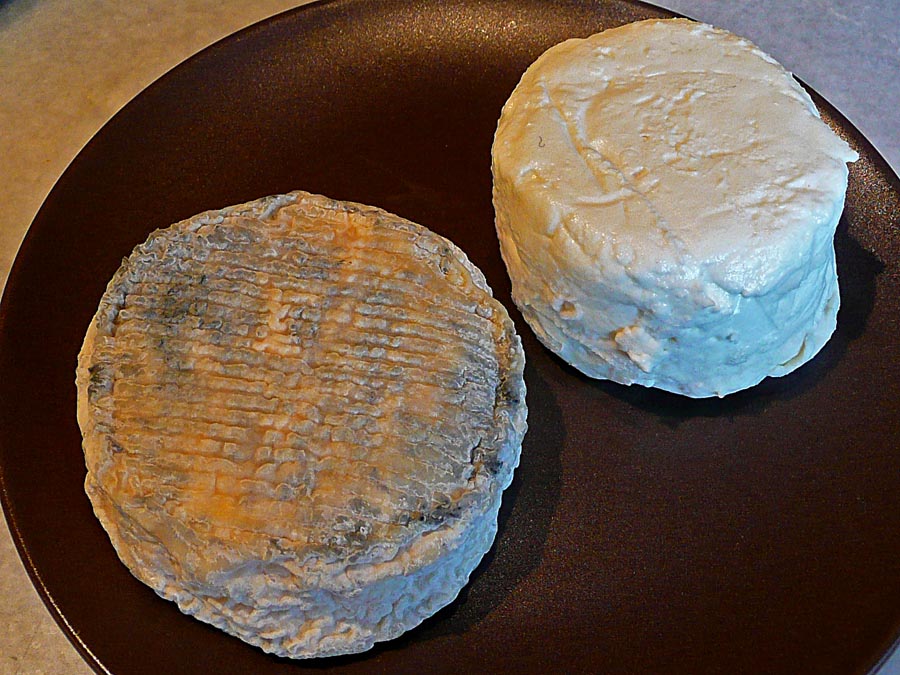
An ash-covered demi-sec goat cheese and a plain, fresh crottin
from the Ferme-Auberge « La Lionnière » in Mareuil-sur-Cher


The cheeses I buy most of the time come from a farm about a mile southwest of our house. It's run as a ferme-auberge by a couple named Françoise et Frédéric Bouland — a ferme-auberge is a “farm-inn” where tourists can rent a room or even a little cottage and, during their stay, take their meals in the farmhouse dining room. The owner's commit themselves to preparing meals using only the vegetables, fruits, cheeses, and meats they produce on the farm.

The Boulands' farm is a couple of kilometers from our house.
You can go there, pet the goats, and buy the cheeses.

Well, at least 80% of the ingredients must come from the farm. The Boulands' dining room is not exactly a restaurant, though we who live nearby, or even people just passing through, can reserve a table even if they are not staying in one of the rooms at the inn. The food will always include goat cheeses in several forms, and the meat dishes are often goat or kid too — I'm not kidding, ha ha ha.

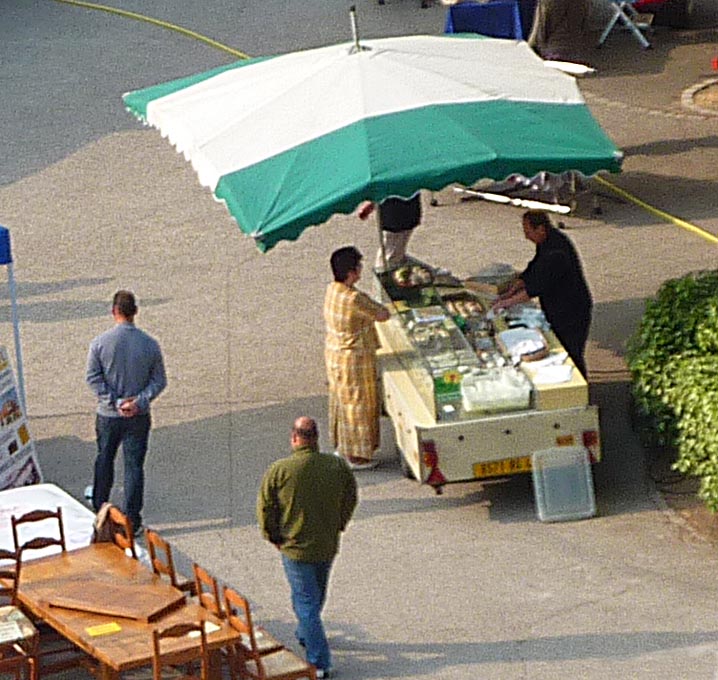
Here's Frédéric Bouland selling cheese from his little stand
at the Saint-Aignan market last Saturday.


Usually there will be only one main course at dinner, sometimes there are two to choose from, and if it's not goat in a stew or braise, it might be lamb, chicken, or guinea fowl. The Boulands also grow vegetables that end up on their table, and they have a lot of fruit trees. They serve wines produced in the village where they operate. The last time we went there for dinner, as our main course we had goat in a mustard sauce that was memorable. We also enjoyed a very good apricot charlotte for dessert.

The Boulands also sell goat cheeses at the farm, and they set up a stand at two nearby markets — the ones in Montrichard on Fridays and in Saint-Aignan on Saturdays. Saint-Aignan is where I bought the cheeses in these pictures. The ferme-auberge cheeses are not A.O.C. like the Selles-sur-Cher goat cheeses produced just east of Saint-Aignan but they are every bit as good. The Boulands run a very small, high-quality operation.

The same Bouland cheeses — the riper one is starting to run.

Yesterday, by the way, we went to the market in Selles-sur-Cher, which is 15 km upriver from our house. We wanted asparagus and strawberries, as well as some flowers to put in our window boxes. The market in Selles is one of the biggest markets around, rivaling the markets in bigger towns like Amboise, Loches, and Romorantin.

Well, yesterday, the Selles market was far too crowded. And that was true despite the mediocre weather we are having these days. Yesterday was the Ascension holiday, so a lot of people had the day off from work. Hundreds and hundreds of them drove, maybe miles the way we did, to shop at the market in Selles. There were old people, children, and young people pushing baby carriages and strollers through the crowds. For us, it was a little much. We found what we were looking for and then cut the excursion short and drove back home to cook lunch.

13 May 2010

Four days off

Today is May 13 and it's Ascension Day, which always falls on a Thursday. There's no mail, and many businesses will be closed. The exceptions are food shops and outdoor markets, which will be open until about noon.

Many people take Friday off as well, doing what they call "making the bridge" — ils font le pont — to extend the Thursday holiday and make this into a four-day weekend. More and more often in France, you hear people talking about having un long weekend. That's what the guys working on our attic conversion are doing, so we too have four days off.

The top edges of the stairwell are finished now, and
the chimneys are boxed in with plasterboard.


The weather is still chilly and gray, so we'll have to stay inside most of the time. We won't miss all the noise of hammering and sawing upstairs. Yesterday we had Coco here continuing to do plasterboard (a.k.a. sheetrock) work, and a couple of guys doing electrical and heating work as well.

The good news is that the electricity is now on upstairs. All that really means is that we have a light bulb that works, hanging from a wire sticking out of the ceiling over the new staircase. And the 16 electrical outlets we had put in around the room are live now, not to mention the switches for the overhead light.

The chimneys on either end of the attic as they were before

Coco has now boxed in the two chimneys that run diagonally up the outer walls of the attic space. Boxed them in with placoplâtre (wallboard), that is. Placoplâtre, like Sheetrock, is a brand name that has come to be used as a generic term, like kleenex in both English and French, or frigidaire (which is less used now than it used to be).

Anyway, the stairwell is mostly finished now and it is soon going to seem as if it has always looked the way it looks now. I guess that means Coco is doing a good job.

Radiators! We could use them right now if they were
hooked up, considering the cold weather we're having.


Oh, the radiators are up too, but they aren't yet connected to the boiler. As Coco and the crew worked yesterday afternoon, Bertie the cat joined them in a supervisory role. He and they seemed to enjoy the collaboration.

Problem was, when the crew left, Bertie was nowhere to be found. After a minute or two of looking, we realized all the downstairs doors were closed, so he couldn't be outside. He was hiding somewhere in the attic.

Rain on a Velux window (top), and the window
open as seen from outdoors (bottom)


At 6:00 a friend stopped by for a glass of wine and a few pieces of that cake au lard, olives, et fromage I made day before yesterday. She didn't stay very long. When she left, we went downstairs with her and Callie the collie followed us. Before we realized what was happening, Callie was off like a shot and headed back up the stairs.

From down below, we heard her scrambling up the new wooden stairs, squealing and yapping. That could mean only one thing: Bertie had made an appearance, and Callie was chasing him. I ran up the two flights of stairs to the attic, and Callie was inside one of the storage closets up against the eaves of the house, barking and growling.

The back of the house from the road,
with the roof windows open


I got the dog out of the closet, and Walt came up with a flashlight — it's dark in those little spaces
— to see if the cat was crouching in a corner. No sign of her. Then we realized the closet isn't sealed off, and Bertie was inside the walls, between the insulation and the roof tiles somewhere. It took a little while to coax him out, but finally he came.

We have to talk to Coco about sealing the ends and backs of those closets so the cat won't get trapped inside the walls.

View of the driveway/courtyard from the front attic window

We are off to the big market in Selles-sur-Cher this morning to buy petunias and maybe geraniums for our front window boxes. We'll have to bundle up, but at least it's not raining... for the moment.